

The most expensive EPM solution isn't the one with the highest licensing fee; it's the one that fails to gain internal trust. In a global market estimated to reach £7.6 billion by the end of 2026, you've likely witnessed the frustration of a significant investment that leaves your team still tethered to manual spreadsheets and reactive reporting. It's a common struggle for UK finance leaders who find that a lack of strategic change management for epm implementation leads to wasted budget and high team turnover. This disconnect often stems from a failure to align human experience with intentional architectural design.
This article explores why these high-stakes projects falter and how to safeguard your finance transformation for enduring value. You'll discover the structural reasons behind project failure and the framework needed to achieve a unified source of truth. We'll outline a path toward predictive intelligence that allows your team to forecast with quiet confidence. To discuss how to refine your own finance transformation, book a call with our advisory team.
Key Takeaways
- Identify the "Complexity Gap" between your strategic ambitions and operational realities to prevent structural project failure.
- Learn why refining fragmented processes before automation is essential for building a system that delivers precision and long-term security.
- Discover how effective change management for epm implementation addresses team friction and ensures your leadership remains aligned with the project's vision.
- Recognise EPM as a living environment that requires ongoing craftsmanship and advisory to maintain a unified source of truth.
- Transition from reactive reporting to predictive intelligence, creating a financial framework that supports confident, data-driven decisions.
The Architecture of Failure: Why Strategic Misalignment Stalls EPM Projects
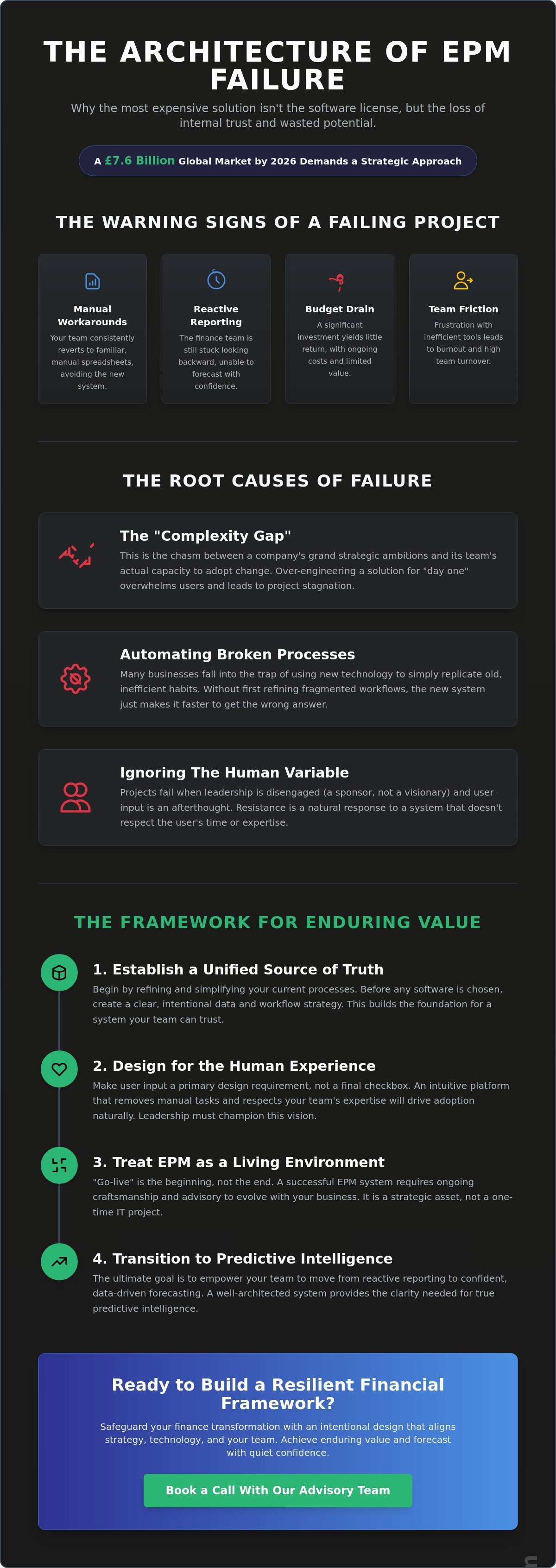
High-stakes finance transformations often stumble because they treat software as a destination rather than a vehicle. This creates an "Architecture of Failure" where the tool is expected to fix underlying structural flaws. True Enterprise Performance Management (EPM) requires a foundation of intentionality and craftsmanship. Projects fail when leadership attempts to automate broken, fragmented processes instead of refining them first. Strategic misalignment is the disconnect between a board-level vision and the practical reality of daily data execution.
To better understand the nuances of this transition, watch this helpful video:
The Complexity Gap: Measuring Ambition Against Capability
The "Complexity Gap" represents the distance between your organisation's strategic ambition and its current operational reality. Before selecting a platform, it's vital to assess your team's readiness for change. Over-engineering a solution for "day one" often leads to total project stagnation as users feel overwhelmed by the system's demands. Professional EPM Advisory ensures that your strategic planning accounts for these human factors, aligning your technical roadmap with your team's actual capacity to evolve. This approach ensures that change management for epm implementation isn't just a checkbox, but a core part of the design.
Fragmented Visions: When Process and Technology Diverge
Many UK businesses fall into the trap of reactive planning. They implement software that simply replicates old, inefficient habits rather than serving new, ambitious goals. Without a thorough analysis of your existing environment, the new system will lack the permanence required for long-term value. Effective change management for epm implementation requires looking past the initial installation to ensure the technology actually mirrors the precision your financial reporting demands. When process and technology diverge, the result is a system that feels like a burden rather than a source of predictive intelligence.
The Human Variable: Navigating the Friction of Finance Transformation
Success in finance transformation isn't just about the software you choose; it's about the people who live within the system every day. Even the most sophisticated technical architecture will fail if the team views it as a burden rather than a benefit. Resistance is rarely about a lack of technical skill. It's usually a response to a loss of control or a system that doesn't respect the user's time. Without thoughtful change management for epm implementation, even a high-value investment can end up as an underutilised tool that the team actively avoids.
Leadership Inertia and the Absence of Senior Support
Leadership inertia is a silent killer of long-term software investment returns. When a CFO acts merely as a project sponsor rather than the Visionary-in-Chief, the initiative lacks the gravitational pull needed to move the entire organisation. True transformation requires the board to see the EPM system as a standard of excellence, not just an IT project. This level of intentionality ensures that every stakeholder understands the "why" behind the change, creating a sense of trust and long-term security across the department.
User Resistance: The Cost of Overlooking the Human Experience
User input is frequently treated as a final checkbox rather than a primary design requirement. If a platform isn't intuitive, your team will inevitably drift back to fragmented spreadsheets. Integrating Work Force Planning helps bridge this gap by ensuring your team has the capacity and support to adopt new workflows. Modern Financial AI Solutions also play a vital role here by removing the manual, repetitive tasks that lead to burnout. By focusing on the human experience, you turn a complex change management for epm implementation into a shared journey toward predictive intelligence. If you're noticing friction in your current transformation, discuss your team's needs with our experts to find a better path forward.
Beyond the Go-Live: Ensuring Permanence and Precision in EPM
The celebration following a successful "Go-Live" often masks a dangerous misconception: the idea that the project is finished. EPM systems are not static installations. They are living environments that require constant craftsmanship to remain relevant. Without a dedicated strategy for change management for epm implementation that extends beyond the initial launch, organisations often see a slow drift back into fragmented, spreadsheet-based reporting. This erosion of value occurs when the system fails to adapt to new market shifts or evolving business structures. Implementation is merely the beginning of the journey, not the final finish line.
To ensure the system drives real-world outcomes, we utilise the Management Actions Library (MAL). This framework transforms data into specific, actionable steps, ensuring your investment delivers more than just reports. It provides a structured way to link financial insights directly to operational decisions, maintaining the system's relevance as a tool for strategic growth.
The Fallacy of the One-Off Implementation
Static systems are inherently fragile. As your business grows, the original configuration may no longer capture the nuance of your operations. This is why ongoing PG CARE support is essential. It provides the technical health checks and refinements needed to maintain system precision over time, preventing the obsolescence that plagues so many UK finance departments. Continuous attention ensures your data remains a reliable source of truth through every economic cycle.
Strategic Advisory as a Safeguard for Long-Term ROI
Regular stress testing and environment analysis act as a safeguard, keeping your digital architecture aligned with the CFO's vision. When you consult our EPM Platform guide, you'll see how the right partnership helps your system evolve. Ongoing change management for epm implementation ensures that as your strategy shifts, your data execution follows with absolute correctness. This long-term perspective protects your initial investment and fosters a culture of predictive intelligence.
True finance transformation is a journey of continuous improvement and intentional design. If you're ready to move beyond basic reporting and build a system that offers lasting value, book a call with our team to discuss your long-term roadmap.
Cultivating Enduring Value in Finance Transformation
Success in Enterprise Performance Management is not found in the initial purchase, but in the intentional alignment of technology with the people who use it. By bridging the complexity gap and addressing leadership inertia, you transform a technical tool into a strategic asset. A robust approach to change management for epm implementation ensures that your system evolves alongside your organisation, preventing the drift back into manual, fragmented processes. It's about moving from reactive data to predictive intelligence.
Our specialist focus on CFO-led finance transformation combines high-level strategy with granular execution. Through our subscription-based PG Care model and expertise in financial AI, we provide the long-term security your department requires. We're committed to helping you build a system that offers both precision and permanence. To ensure your next finance transformation is built with this level of craftsmanship, book a call with our advisory team today. Your journey toward a unified source of truth starts with a single, principled step.
Frequently Asked Questions
What is the most common reason EPM projects fail in 2026?
The primary cause of failure in 2026 is strategic misalignment, where software is treated as a solution for broken processes rather than a tool for refined ones. Without robust change management for epm implementation, teams often reject systems that don't respect their daily workflows. This disconnect creates a "Complexity Gap" that stalls progress and wastes budget. True success requires a focus on human experience and intentional architectural design from the start.
How can a CFO identify a complexity gap before the project starts?
Identifying this gap involves assessing the distance between your strategic goals and your team's current operational capacity. CFOs should look for signs of "data fatigue," such as high turnover or a heavy reliance on manual spreadsheets for reporting. If your team is struggling with fragmented data, jumping into a high-end system without preliminary advisory can lead to stagnation. Understanding this gap ensures your technology roadmap is both aspirational and achievable.
Is the software or the implementation partner more responsible for project success?
Success is largely determined by the strategic design and craftsmanship provided by the implementation partner rather than the software itself. Even the most advanced platform will fail if it's poorly configured or doesn't align with your business goals. The partner's role is to act as a visionary, ensuring the technology supports your team's needs while maintaining standards of correctness. Effective change management for epm implementation is the framework that makes software valuable.
How does ongoing support like PG Care prevent EPM system failure?
PG CARE prevents system failure by treating your EPM environment as a living space that needs continuous care. Finance systems often suffer from "drift," where they slowly lose relevance as the business evolves. Regular environment analysis and stress testing ensure that your reporting remains precise and your data stays unified. This proactive approach safeguards your long-term ROI and allows your finance team to operate with quiet confidence and predictive intelligence.
To ensure your finance transformation is built for permanence and precision, book a call with our team today to discuss your strategic roadmap.