

While research from Forrester indicates that organizations can realize a 393% return on investment over three years with the right tools, why do so many CFOs find themselves managing unexpected budget overruns long after the initial go-live? The reality is that a software subscription is often just the visible peak of a much larger financial structure, masking the complex hidden costs of epm software that emerge during data integration and bespoke customization. You recognize that a digital transformation is an investment in your firm's future precision, yet the frustration of low user adoption and escalating maintenance fees can quickly erode that visionary goal.
This guide offers a transparent view of the total cost of ownership, helping you see past the initial vendor quote to secure the enduring value your organization deserves. We'll provide a framework for evaluating proposals and a strategy for sustainable system maintenance that aligns human experience with technical excellence. To ensure your investment remains a pillar of strategic strength and to explore our specialized implementation advisory, book a call with our team today.
Key Takeaways
- Learn to look beyond initial license fees to calculate the true Total Cost of Ownership for a transparent and predictable financial transformation.
- Identify the hidden costs of epm software associated with complex data integration and the long-term risks of rigid system logic that fails to scale.
- Discover why user adoption is the primary factor in project success and how to prevent your finance team from being consumed by ongoing system maintenance.
- Establish a strategic framework for evaluating vendor quotes and secure the expert guidance your organization needs by booking a call with our team.
The Iceberg of EPM Investment: Beyond the Licence Fee
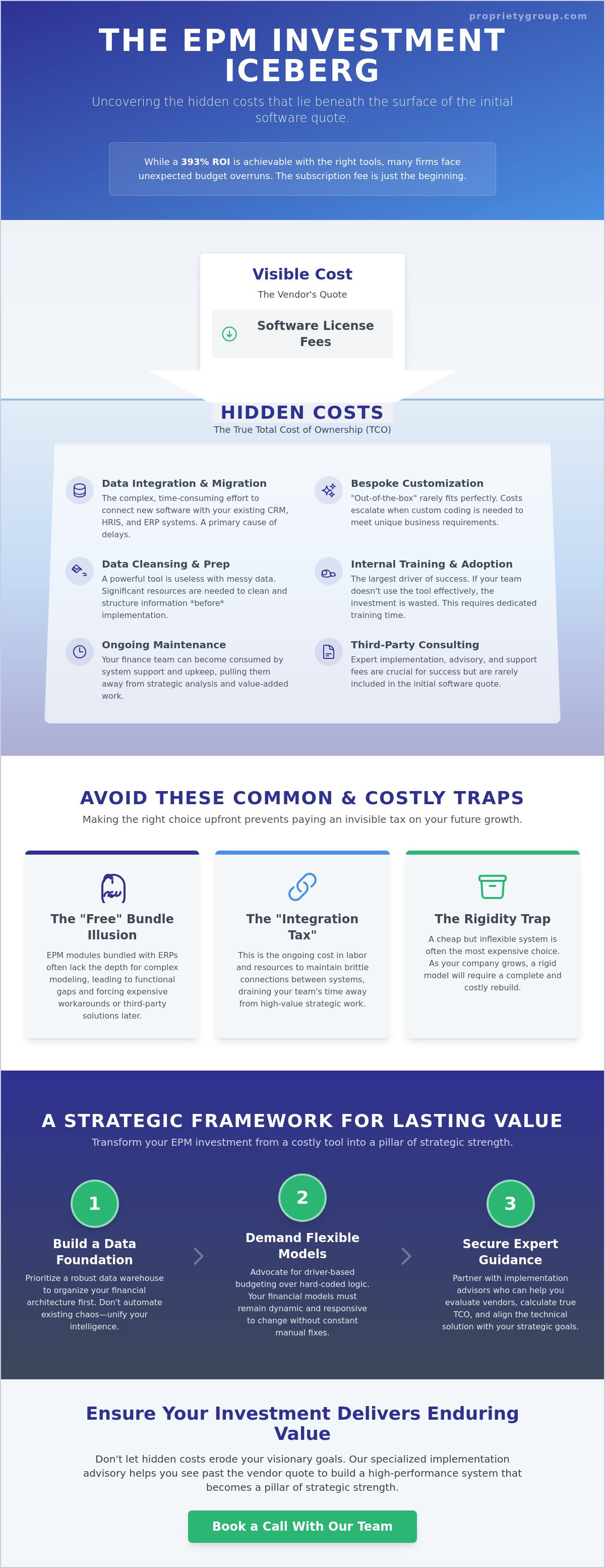
The sticker price of a platform is rarely the final cost of a transformation. In the context of financial evolution, Total Cost of Ownership (TCO) represents the sum of every resource, hour, and dollar required to maintain the system's integrity over time. While the license fee is the visible tip of the iceberg, the hidden costs of epm software often lie beneath the surface in the form of rigorous data cleansing and extensive internal training. True value isn't found in the initial purchase; it's found in the system's ability to remain accurate and relevant as your business scales.
Choosing the least expensive or least flexible option often leads to what we call strategic debt. This is an invisible tax on your future growth. You might save capital today, but you'll pay interest tomorrow through manual workarounds and technical friction. A single source of truth is not a software feature you buy; it's a standard of excellence you build through intentional data management and disciplined implementation.
To better understand how software estimates can often mask these underlying realities, watch this helpful video:
The Illusion of "Free" ERP Bundles
ERP vendors frequently offer EPM modules as a complimentary add-on to close a sale. This is a common trap that leads to significant functional gaps. These bundled tools often lack the depth required for complex scenario modeling or the predictive power found in advanced financial AI solutions. You may find yourself paying an "integration tax" later, spending more on third-party customization than you would have on a dedicated, high-performance solution from the start.
Data Integrity and the Cost of Cleanliness
Data migration is the primary cause of implementation delays across the industry. A sophisticated software interface cannot fix fragmented reporting if the underlying information is chaotic. Achieving unified intelligence requires a robust data warehouse to organize your financial architecture before the first dashboard is even built. Without this foundation, you're simply automating your existing inefficiencies.
To ensure your investment delivers long-term value and avoids these common traps, book a call with our team today.
Architectural Friction: Integration and Customisation Costs
Software implementation isn't a one-time event; it's the beginning of a long-term relationship with your data architecture. One of the most significant hidden costs of epm software is the "Integration Tax." This represents the ongoing labor and technical resources required to ensure your planning tool communicates effectively with your CRM, HRIS, and ERP. When these connections are brittle, your finance team spends more time managing data pipelines than driving business strategy.
While many vendors promise "out-of-the-box" solutions, the reality of bespoke business requirements often leads to expensive customisation. Relying on hard-coded logic is a common trap. It might solve an immediate reporting need, but it often becomes obsolete as your organization evolves. To reduce manual data entry and maintenance costs, we advocate for driver-based budgeting. This approach ensures your financial models remain dynamic and responsive to real-world changes without constant manual intervention.
The Hidden Tax of Fragmented Systems
Fragmented systems create a reliance on manual workarounds that drain your team's energy. These "shadow processes" are difficult to track and even harder to audit. By implementing automated intercompany reconciliation, you can remove these operational bottlenecks and improve the speed of your financial close. If you're seeing signs of friction in your current workflow, you might request a consultation to explore a more unified approach.
Scalability and the Price of Rigid Models
A low-cost system that lacks flexibility is often the most expensive choice in the long run. As your company grows, a rigid model usually requires a complete rebuild, which is a major source of hidden costs of epm software. Investing in professional EPM advisory during the initial design phase allows you to build for permanence. This foresight ensures your system remains a source of value rather than a technical burden as your enterprise expands.
The Human Element: Adoption, Support, and Strategic Evolution
User adoption is the primary determinant of whether a digital transformation succeeds or remains a costly artifact. Even the most sophisticated platform fails if the team finds it cumbersome or disconnected from their daily reality. This resistance creates significant hidden costs of epm software; organizations often pay for licenses that gather dust while employees revert to manual spreadsheets. The system must serve the person. When it doesn't, the investment falters. Expert-led implementation services focus on aligning the software with human intent, ensuring the system becomes an extension of the team's expertise rather than a hurdle.
A secondary risk involves the use of static models. If your system cannot adapt to sudden market shifts like rising inflation or supply chain disruptions, it loses its strategic value. This misalignment forces finance leaders to perform manual adjustments outside the system, defeating the purpose of a unified platform. Strategic debt grows when the tool stays the same while the world changes.
The Cost of Internal Resource Strain
Relying exclusively on an internal IT team to maintain a complex financial system often creates severe operational bottlenecks. IT departments lack financial context. This leads to an "Internal Resource Drain" where senior finance professionals are pulled from strategic analysis to troubleshoot software issues. Additionally, "Key Person Risk" becomes a financial liability. If the only individual who understands the system’s architecture leaves the organization, the cost of recovery and retraining can be astronomical.
PG CARE: Mitigating Long-Term Operational Risks
We believe that maintaining a high-performance system shouldn't be a source of constant financial surprise. Our PG CARE support model transforms unpredictable maintenance expenses into a manageable OPEX structure. Through ongoing advisory and training, we ensure your system evolves alongside your business objectives. This approach provides the permanence and precision required for long-term security. It ensures your software remains a visionary asset rather than a legacy burden.
To audit your current strategy and uncover hidden efficiencies within your financial architecture, book a call with our advisory team today.
Securing Your Financial Future Through Strategic Precision
Mastering the Total Cost of Ownership requires a shift from viewing software as a product to treating it as a strategic discipline. You've seen how the hidden costs of epm software often stem from fragmented data, rigid architectural models, and neglected user adoption. By prioritizing data integrity and choosing flexible, driver-based models, you ensure your financial systems remain an asset rather than a liability. True value is found when your technology aligns perfectly with your human expertise and long-term vision.
Our boutique consultancy, founded in 2019, specializes in navigating these complexities through expert-led advisory and implementation. With deep expertise in SAP Analytics Cloud and Board EPM, we help organizations build for permanence. Our specialized PG Care managed support model is designed to mitigate operational risks, turning unpredictable maintenance into a reliable foundation for growth. We're committed to creating enduring value that stands the test of market shifts and organizational expansion.
To secure the long-term value of your investment and uncover new efficiencies, book a call with our expert advisory team to evaluate your EPM strategy. We look forward to helping you build a more transparent and resilient financial future.
Frequently Asked Questions
Is free EPM software ever truly free for a growing business?
Free EPM software is rarely free when you consider the manual effort required to manage its inherent limitations. While an ERP vendor might bundle a module at no cost, the functional gaps often necessitate expensive third-party tools or extensive manual data entry to achieve basic reporting. For a growing enterprise, the lack of scalability and advanced predictive capabilities creates a technical debt that eventually requires a costly system replacement or extensive customisation.
How much should we budget for EPM implementation versus the annual licence?
Implementation costs typically exceed the annual license fee, often by a factor of two or three depending on the complexity of your financial architecture. This budget covers essential work such as data architecture design, system configuration, and comprehensive user training. Underestimating this ratio is a primary driver for the hidden costs of epm software, as it leads to rushed deployments that fail to capture the organization's unique operational nuances or strategic goals.
What are the most common hidden costs in an EPM RFP response?
The most frequent omissions in a standard RFP response include fees for data integration, storage limits, and post-deployment support. Vendors often quote a base price that excludes the cost of connecting the platform to your specific CRM or HRIS. Additionally, the labor required for internal team members to manage the rollout is rarely factored into the vendor's proposal, creating a significant strain on your existing finance resources that can impact daily operations.
Can we avoid customisation costs by changing our business processes?
Adapting your internal processes to fit the software's standard functionality can significantly reduce initial customisation expenses. This approach, often called standardization, minimizes the need for bespoke code that is difficult and expensive to maintain over time. It requires strong leadership to ensure the team embraces new workflows. Strategic advisory can help you determine which processes are unique competitive advantages and which should be standardized to lower the hidden costs of epm software.
To ensure your financial transformation is built on a foundation of transparency and precision, book a call with our team today.