

What if the true cost of your current financial reporting isn't just the hours lost to manual spreadsheets, but the strategic opportunities missed because your data lacks a clear narrative? Many finance leaders recognise that fragmented forecasting cycles hinder decisive action, yet they often struggle when building a business case for epm software because the benefits of precision can feel frustratingly abstract. It's difficult to quantify the value of trust when your existing processes rely on fragile, disconnected systems that fail to reflect the true health of the business within the complex UK regulatory environment.
You understand that true financial agility requires more than just faster calculations; it demands a foundation of absolute correctness and strategic intentionality. This article will teach you how to articulate the visionary value of Enterprise Performance Management to secure board-level buy-in and ensure long-term stability. We'll explore a sophisticated roadmap for connected planning and define clear ROI metrics that move beyond basic time-saving to demonstrate genuine, enduring corporate value. You'll learn to transform data from a static record into a dynamic asset that guides your organisation's future with quiet confidence.
Key Takeaways
- Shift your focus from reactive error correction to proactive performance management by aligning your financial systems with long-term strategic intentionality.
- Master the art of building a business case for epm software by quantifying the value of predictive intelligence and accelerated cycles of insight.
- Identify clear ROI metrics across efficiency, accuracy, and agility to demonstrate how connected planning creates a more resilient and responsive organisation.
- De-risk your investment by adopting a phased, advisory-led implementation approach that prioritises minimal disruption and ensures high standards of correctness.
- Understand why a strategic partnership is essential for transforming a software deployment into a permanent foundation for enduring corporate value.
Beyond the Spreadsheet: Aligning EPM with Strategic Intentionality
Building a business case for epm software is more than an exercise in justifying a software purchase; it's the creation of a strategic manifesto. It marks the transition from reactive reporting, where teams struggle to explain the past, to proactive performance management, where leadership shapes the future. While many organisations focus on reducing spreadsheet errors, this is merely a baseline expectation. The true narrative of financial transformation lies in the "why": the pursuit of a unified vision that allows a business to move with grace and certainty.
To better understand the practical steps of this process, watch this helpful video:
In this new environment, the CFO acts as a visionary architect. They move beyond the role of a financial gatekeeper to design a digital space where "Connected Planning" becomes the standard. This approach ensures that every department, from sales to operations, informs the central corporate strategy in real time. It's about creating a permanent structure where data flows seamlessly, ensuring that the board has a single, reliable version of the truth to guide their decisions.
The Risk of Fragmented Reporting and Reactive Planning
Data silos don't just slow down cycles; they create a pervasive sense of uncertainty. When leadership groups can't trust the numbers, decision-making becomes hesitant. This fragmented approach often leads to a hidden burden of outdated manual processes that are no longer fit for purpose. In the UK market, where regulatory scrutiny is high, maintaining rigorous standards of correctness isn't optional. It's the foundation of institutional trust and long-term security.
Establishing the Strategic North Star for Your Implementation
Success begins by defining KPIs that reflect long-term value rather than just short-term efficiency gains. When building a business case for epm software, the focus must remain on the enduring value of precision. Instead of only measuring how many hours were saved, look at the quality and speed of the management actions taken. A well-defined roadmap ensures that your implementation remains aligned with the organisation's broader goals. You can explore our EPM Advisory services to help define your specific roadmap and ensure your strategy is built on a foundation of expertise.
Quantifying ROI: The Precision of Predictive Intelligence
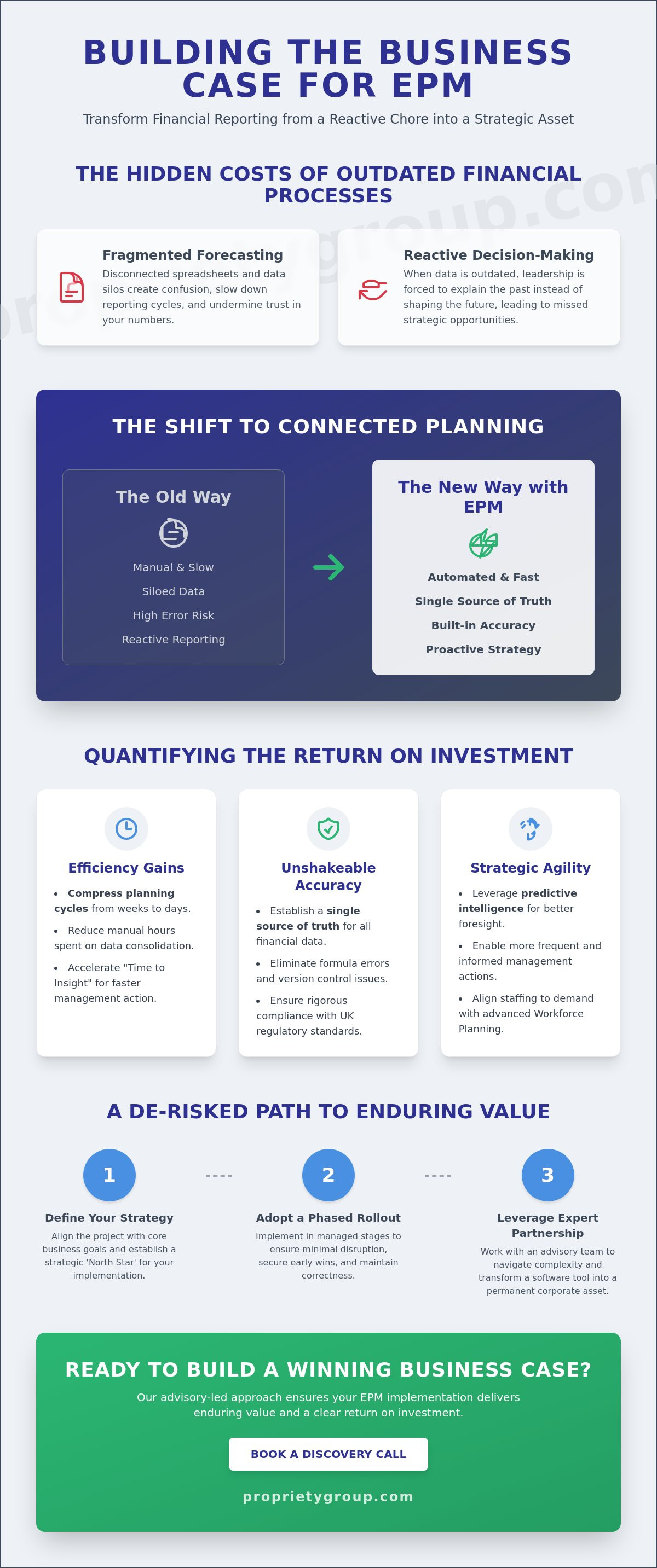
Translating a strategic vision into a financial reality requires a disciplined approach to measurement. When building a business case for epm software, you must move beyond simple cost-cutting to quantify how predictive intelligence secures the company's future. ROI in this context is best viewed through three distinct lenses: efficiency in operations, accuracy in reporting, and agility in decision-making. These pillars ensure that the investment creates enduring value rather than a temporary fix.
One of the most significant metrics is "Time to Insight." In a traditional environment, by the time a forecast is finalised, the market has already moved. Modern EPM solutions compress these cycles, allowing leadership to execute more frequent management actions based on current data. This speed directly impacts the bottom line by reducing unnecessary expenditure. For instance, organisations can achieve a measurable reduction in OPEX by implementing sophisticated Work Force Planning. This ensures that staffing levels are always aligned with actual demand rather than historical guesses.
The integration of financial AI solutions adds a layer of permanence to your forecasts. These tools don't just calculate; they learn from patterns to provide a level of foresight that manual processes can't replicate. If you're looking to refine these metrics for your own organisation, you might consider how expert guidance can clarify your specific ROI path.
Building a Single Source of Truth for Financial Data
Precision is impossible without a unified foundation. A central data architecture ensures that AI-driven insights are based on a complete picture rather than isolated fragments. This connectivity is the bedrock of modern finance. To understand how this fits into your broader infrastructure, read our guide on what a data warehouse means for unified intelligence. When data flows freely between systems, the risk of human error disappears, replaced by a standard of correctness that the board can trust.
The ROI of Scenario Modelling and Stress Testing
When building a business case for epm software, the ability to model market volatility in real-time serves as a powerful risk mitigation tool. EPM platforms like SAP SAC and Board allow you to perform rigorous stress testing, ensuring the business remains resilient under various economic pressures. This capability transforms the finance team into a strategic partner that can project certainty during times of change. Choosing the right technology is vital for this, so explore our strategic guide for selecting an EPM platform to find the best fit.
De-Risking the Business Case: The Role of Expert Advisory
The most common objection encountered when building a business case for epm software is the fear of operational disruption. Leadership groups often worry that a transition of this scale will distract teams from their core duties or lead to a period of instability. However, a phased, advisory-led approach mitigates these risks by ensuring the transition feels like a natural evolution rather than an upheaval. By focusing on intentionality from the outset, you can demonstrate that the path to precision is both steady and secure.
It's vital to distinguish between a software vendor and a strategic partner. While a vendor focuses on the transaction, a partner understands that the implementation is merely the first 90 days of a multi-year journey. True value is found in how your Financial AI Solutions integrate into the daily rhythm of your business, providing a permanent foundation for growth. To ensure this environment remains a high-performance asset, we provide PG CARE. This managed support model offers the long-term security and expertise needed to maintain your system's standards of correctness as your business evolves.
Avoiding Common Implementation Pitfalls
Many organisations fall into the trap of "feature-chasing," where they prioritise complex tools that eventually become shelfware. A thorough environment analysis prevents this by aligning technology with your actual operational needs. Success also hinges on change management and user adoption. When building a business case for epm software, you must account for the human experience. Moving from a project-based mindset to a lifecycle-based mindset ensures the software remains relevant and valuable for years to come.
Securing Board Approval with a Refined Narrative
Presenting your case to the board requires a narrative built on quiet confidence and professional prestige. Rather than focusing solely on technical specifications, emphasise the ethics of transparency and the enduring value of reliable data. Your proposal should reflect a commitment to excellence that aligns with the organisation's highest standards. By framing EPM as a tool for principled leadership, you move the conversation from cost to corporate legacy.
Secure the future of your financial planning and book a call with our advisory team today to begin crafting a business case that commands respect and delivers results.
Designing a Future of Financial Agility
The transition to a unified planning environment is a commitment to precision and permanent value. You've seen that success lies in moving beyond the limitations of legacy spreadsheets to embrace predictive intelligence. When building a business case for epm software, the narrative must focus on the strategic agility that allows your organisation to thrive in a volatile UK market. This approach ensures that every financial decision is rooted in a standard of correctness that the board can trust implicitly.
Our team provides expert EPM advisory for CFOs and finance leaders, specialising in the implementation of premier platforms like SAP Analytics Cloud (SAC) and Board. We ensure your investment is protected through PG Care, our subscription-based managed support model designed for long-term excellence. This journey is about more than technology; it's about creating a foundation of trust and intentionality that serves your business for years to come.
Book a call with our specialist advisory team to refine your EPM business case and begin the process of transforming your financial architecture today. Your path to a more resilient and visionary future starts with a single, principled step.
Frequently Asked Questions
What is the most common reason an EPM business case is rejected?
The most common reason for rejection is a failure to align the investment with the board's strategic vision. When building a business case for epm software, many leaders focus too heavily on technical fixes for manual errors rather than articulating how the system enables faster, more accurate management actions. Without a clear narrative of how EPM supports long-term growth and risk mitigation, the board may view it as an unnecessary cost.
How do we calculate the ROI of EPM software for a mid-market organisation?
ROI for mid-market organisations is calculated by measuring improvements in efficiency, reporting accuracy, and decision-making agility. You should quantify the reduction in manual reporting hours and the financial impact of more precise Work Force Planning. By identifying how faster forecasting cycles prevent wasted OPEX, you can demonstrate a clear path to value that resonates with stakeholders who prioritise fiscal responsibility and strategic growth.
Do we need to replace our current ERP system to implement EPM?
You don't need to replace your current ERP system to implement EPM software. EPM is designed to sit on top of your existing infrastructure, acting as a sophisticated layer that unifies data from various sources into a single source of truth. This connectivity allows you to extract higher value from your current systems without the disruption of a full ERP overhaul; this ensures your financial architecture remains both stable and progressive.
How long does it take to see tangible value from an EPM implementation?
Tangible value is often visible within the first three to six months following a phased implementation. While the full transformation of your financial culture takes longer, early wins such as reduced month-end closing times and improved forecast accuracy provide immediate justification for the investment. Success when building a business case for epm software involves setting realistic milestones that demonstrate incremental progress toward a state of enduring financial excellence.