

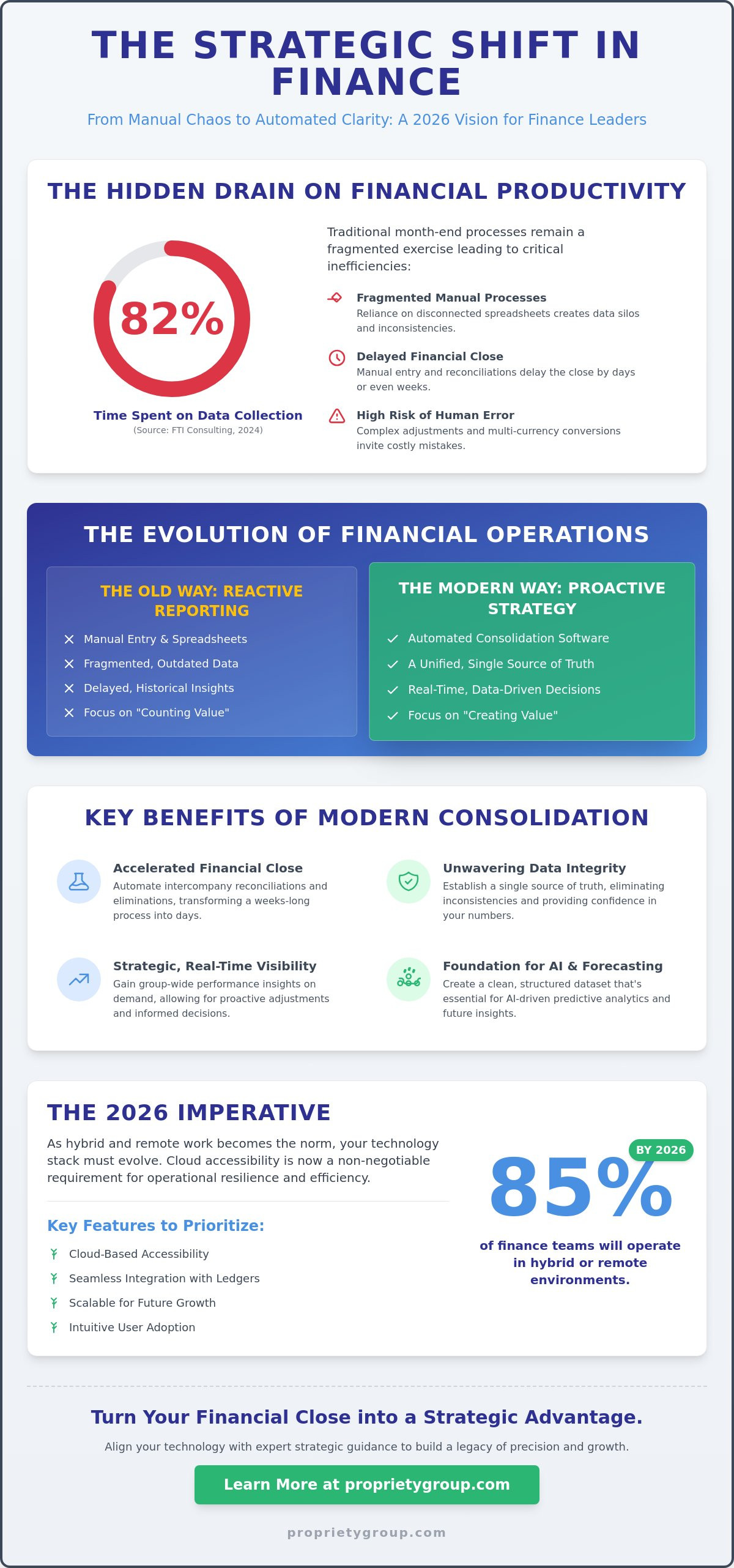
Did you know that 82% of finance professionals still spend more time collecting data than actually analysing it, according to a 2024 study by FTI Consulting? For many UK finance leaders, the month-end process remains a fragmented exercise in manual entry and complex multi-currency adjustments that often lead to inconsistencies. Implementing modern consolidation software is no longer just a technical upgrade; it's a commitment to precision and integrity within your corporate structure. It allows you to move beyond the limitations of spreadsheets and embrace a more sophisticated way of working.
We understand that maintaining a single source of truth across diverse entities is a significant challenge that demands a meticulous approach. This guide will show you how to select and implement the ideal consolidation software to transform your financial close into a strategic advantage for 2026. You'll learn how to automate intercompany reconciliations and achieve a faster, more confident close that empowers data-driven decisions at the highest level. We'll explore the essential features for the coming year and provide a clear roadmap for a seamless implementation that creates lasting value for your firm.
Key Takeaways
- Transition from fragmented manual processes to a unified digital platform that secures your data and accelerates the financial close.
- Identify the most effective consolidation software for your specific needs by evaluating solutions ranging from cloud-native tools to enterprise-grade systems.
- Adopt a meticulous framework for selection that focuses on seamless integration and the long-term scalability of your financial infrastructure.
- Understand why the success of your digital transformation relies on aligning your technology with expert strategic guidance and clear business goals.
- Learn how to turn complex financial data into a strategic asset that provides clarity and confidence for your organisation’s future growth.
What is Consolidation Software and Why Does Modern Finance Need It?
Consolidation software serves as a sophisticated digital platform designed to harmonise financial data from diverse departments and global entities into a single, cohesive view. It replaces the fragmented, error-prone world of manual spreadsheets, which often delay the financial close by days or weeks. By centralising information, firms can produce accurate consolidated financial statements that reflect the true health of the entire organisation without the risk of human error.
To better understand how this technology transforms group reporting, watch this helpful overview:
As we look toward 2026, the role of the CFO is shifting from reactive reporting to proactive strategic leadership. This evolution requires a single source of truth finance to ensure data integrity across every touchpoint. In a landscape where market conditions can shift in hours, relying on outdated figures isn't a viable option for those seeking to build a lasting legacy. Modern systems provide the clarity needed to make bold, informed decisions.
The Core Benefits for Visionary Finance Leaders
Automation is the hallmark of a refined finance function. Modern platforms handle intercompany eliminations and reconciliations automatically; this is a process that used to consume hundreds of hours during year-end. Leaders gain real-time visibility into group-wide performance, allowing for meticulous adjustments well before the month-end deadline. Consolidation software acts as the vital connective tissue that bridges the gap between disparate ERP systems to create a unified data ecosystem.
Moving Beyond Basic Accounting
Standard accounting tools often struggle with the complexities of global trade. Modern software simplifies multi-currency consolidation by applying live exchange rates and managing local tax compliance with precision. This creates a clean, structured dataset that's essential for AI-driven predictive forecasting. By 2026, the ability to turn historical data into future insights will distinguish industry leaders from the rest of the market. It's about moving from simply counting value to actively creating it.
Evaluating the Best Consolidation Software for Your Organisation
Selecting the right consolidation software requires a meticulous assessment of your firm's current architecture and future aspirations. For large-scale organisations with intricate global footprints, enterprise solutions like OneStream or SAP provide the robust infrastructure needed for high-volume data. Mid-market entities often find a balance of power and agility in tools like Board, while smaller, agile teams might opt for cloud-native solutions such as Joiin or Fathom. The choice depends entirely on the complexity of your financial close process, which serves as the foundation for your reporting integrity.
A study by the Federal Reserve Bank of New York highlights how consolidation in the financial services industry impacts operational efficiency, a principle that applies directly to your technology stack. You should evaluate potential tools based on three pillars: seamless integration with existing ledgers, ease of user adoption, and the ability to scale as your business matures. This ensures your consolidation software isn't just a utility, but a vehicle for long-term legacy.
Key Features to Prioritise in 2026
By 2026, 85% of finance teams will likely operate in hybrid or remote environments, making cloud-based accessibility a non-negotiable requirement. Look for intercompany reconciliation modules that automate the matching of internal balances, reducing manual errors by up to 40%. Meticulous audit trails are equally vital, providing the transparency required for UK regulatory compliance and external stakeholder trust.
Software vs. Platform: Which Path to Take?
Standalone tools offer a bespoke, best-of-breed approach for specific tasks. Conversely, unified Enterprise Performance Management (EPM) platforms integrate consolidation with planning and analysis. If your goal is a single source of truth across all departments, an all-in-one ecosystem is often the superior choice. You can consult with our strategic advisors to determine which path aligns with your bespoke business purpose.
Implementing Your Consolidation Strategy for Long-Term Success
Selecting the right consolidation software represents a significant milestone, yet the platform's true value is realised through the precision of its implementation. Technology serves as an architect's tool; its effectiveness depends entirely on the skill of the hands that guide it and the clarity of the vision behind it. To ensure your system meets specific business objectives, engaging in epm advisory is essential. This strategic partnership aligns your digital infrastructure with long-term growth targets, ensuring every configuration serves a bespoke purpose for your organisation.
Disruption remains the primary concern for finance leaders during any transition. We mitigate this risk through a meticulous, phased deployment approach. By introducing changes in manageable stages, we maintain operational continuity and build confidence across your team. Sustaining this excellence requires more than just a successful launch. Ongoing support models, such as PG Care, ensure your system remains healthy and adapts as your UK enterprise evolves within the shifting regulatory landscape of 2026.
Common Implementation Pitfalls to Avoid
Success in digital transformation requires a principled approach to process design. Many organisations fail because they attempt to automate "messy" manual processes without first refining the underlying strategy. This merely accelerates inefficiency rather than eliminating it. Additionally, underestimating the importance of team training and change management can lead to poor adoption rates. A comprehensive environment analysis must always precede any software configuration to ensure the digital architecture reflects your actual business requirements and data integrity.
The Future of Connected Finance
A successful implementation creates a robust foundation that paves the way for ai in finance. This transition allows your team to move beyond the role of a traditional "numbers reporter." By embracing these tools, finance leaders function as strategic business partners. They use predictive intelligence to drive value and secure a lasting legacy for their organisations, moving from historical reporting to visionary leadership.
Mastering Your Financial Legacy for 2026
Selecting the right consolidation software isn't just a technical choice; it's a commitment to the enduring integrity of your financial narrative. Success hinges on two critical pillars. First, you must choose a platform that mirrors your specific organisational structure. Second, you must execute an implementation that prioritises long-term agility over temporary fixes. As finance leaders navigate the complexities of the 2026 reporting cycle, the focus remains on transforming raw data into a clear, purposeful legacy for the entire business.
Propriety Group brings a meticulous, boutique approach to this journey. We maintain a 100% focus on EPM and CRM success, ensuring every project receives the expert-led attention it deserves. Our team possesses deep expertise in leading ecosystems like SAP SAC and Board, providing the precision needed for complex UK market requirements. Beyond the initial setup, our PG Care model offers the ongoing support required to maintain a standard of excellence as your needs evolve. We believe that the intersection of people and technology creates the most significant value.
Explore our EPM Advisory services to find the perfect consolidation fit for your team.
Building a resilient finance function is a rewarding endeavour that will define the future of your leadership for years to come.
Frequently Asked Questions
How long does it typically take to implement consolidation software?
Implementation of consolidation software typically requires between three and six months for mid-market organisations when guided by expert consultants. This meticulous timeline ensures that data migration and system configuration meet the high standards required for precise financial reporting. Bespoke solutions often involve a phased approach. This allows for rigorous testing during a 90 day pilot period before the final transition occurs, ensuring the total integrity of your group accounts.
Can consolidation software integrate with my existing ERP?
Modern consolidation software connects seamlessly with existing ERP systems like SAP, Oracle, and Microsoft Dynamics to create a unified data flow. This integration eliminates the friction of manual data entry, which accounts for 80 percent of errors in financial reporting according to industry benchmarks. By establishing a direct link, finance leaders ensure that data moves with precision from local ledgers to the group level without any compromise to data integrity.
Is consolidation software worth the investment for a mid-sized company?
The investment is justified if your finance team spends more than three days on manual reconciliations and spreadsheet adjustments each month. In the UK, mid-sized firms often see an immediate return on investment through a 40 percent reduction in closing times. This efficiency allows professionals to focus on strategic growth rather than the meticulous correction of spreadsheet errors. It's a vital step for leaders aiming to secure the long-term legacy of their business.
What is the difference between accounting software and consolidation software?
Accounting software records individual transactions at the entity level, while consolidation software aggregates data from multiple sources to provide a high-level view of group performance. While a standard ledger manages the daily minutiae of a single office, a consolidation tool handles complex multi-currency conversions and intercompany eliminations. This distinction is crucial for groups operating across different jurisdictions. It ensures that the final narrative of the company's health remains accurate, authoritative, and perfectly aligned.