
Choosing the Right EPM Platform: A Strategic Guide for Finance Leaders

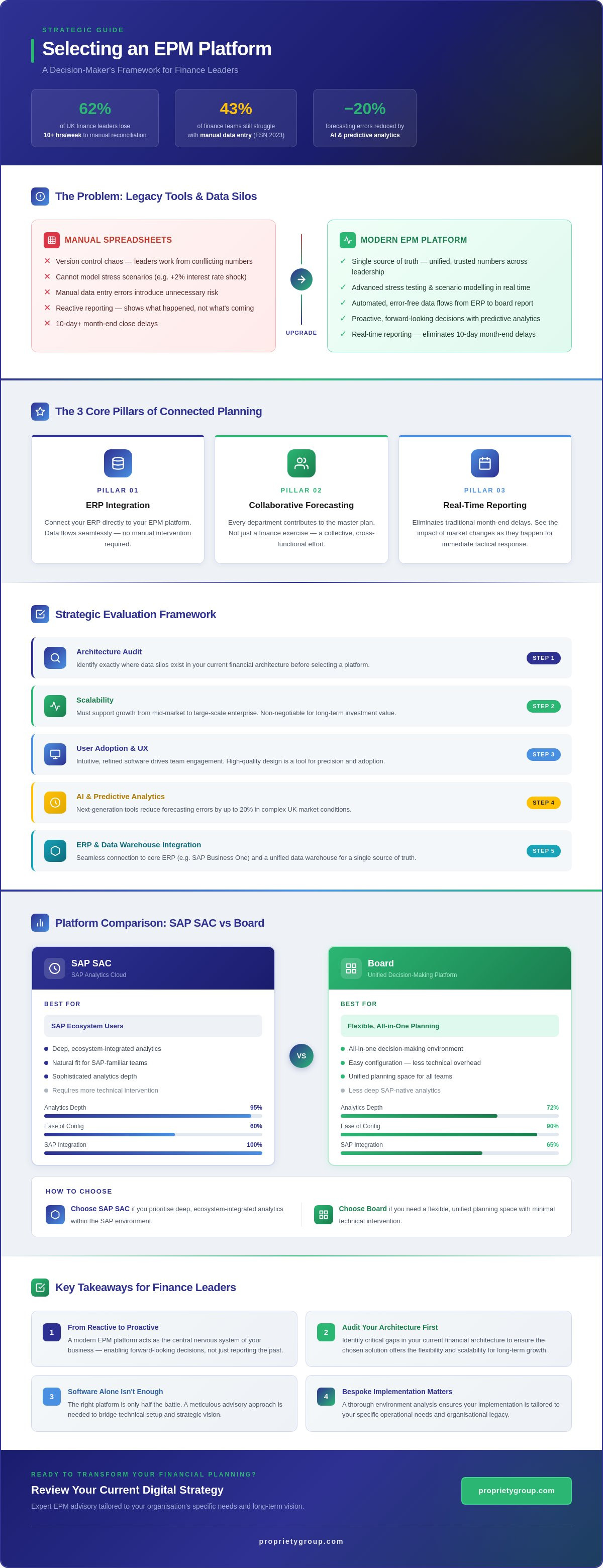
A 2023 industry report found that 62% of UK finance leaders lose more than 10 hours every week to manual data reconciliation across disconnected systems. This inefficiency often stems from a reliance on legacy tools that no longer support a visionary firm's growth. You likely recognise the frustration of reactive planning and the persistent risk of errors within complex spreadsheets. Selecting a sophisticated epm platform is a principled step toward restoring clarity and ensuring your organisation's financial narrative remains one of precision and integrity.
We agree that your leadership deserves a unified perspective that transcends departmental silos to offer true visibility. This guide outlines how to evaluate and select an epm platform that aligns with your long-term vision and operational requirements. We'll examine a deliberate approach to this transition, ensuring your final choice provides faster forecasting cycles and the quiet confidence that comes from bespoke, data-driven insights.
Key Takeaways
- Transition from reactive reporting to a proactive strategy by understanding how a modern epm platform serves as the central nervous system of your business.
- Identify critical gaps in your current financial architecture to ensure your chosen solution offers the flexibility and scalability required for long-term growth.
- Recognise why the right software is only half the battle, requiring a meticulous advisory approach to bridge the gap between technical setup and strategic vision.
- Learn the value of a thorough environment analysis, ensuring your implementation is bespoke to your specific operational needs and organisational legacy.
Understanding the Modern EPM Platform Landscape
A modern epm platform acts as the central nervous system for your organisation's financial and operational health. It integrates every moving part of the business into a single, cohesive view. Leaders no longer have to rely on reactive reports that show what happened last month. Instead, they gain the clarity needed for proactive, forward-looking decisions. This shift moves the business from fragmented data silos into a unified, cloud-based environment. It creates a single source of truth that the entire leadership group can trust implicitly.
The Core Pillars of Connected Planning
A robust strategy relies on three foundational elements. First, you must connect your ERP directly to your epm platform. This ensures data flows seamlessly without manual intervention. Second, collaborative forecasting allows every department to contribute to the master plan. This isn't just a finance exercise; it's a collective effort. Finally, real-time reporting eliminates the traditional ten-day month-end delay. You see the impact of market changes as they happen, allowing for immediate tactical adjustments.
Why Spreadsheets are No Longer Sufficient
Relying on manual spreadsheets introduces unnecessary risk into your operations. Errors in manual data entry often lead to version control chaos, where different leaders work from conflicting sets of numbers. This fragmentation makes it nearly impossible to perform effective stress testing. A spreadsheet cannot easily model how a 2% rise in interest rates or a sudden supply chain disruption will affect your long-term legacy.
Moving toward a more meticulous and integrated approach is essential for maintaining integrity in your reporting. Static grids lack the depth required for sophisticated modern business. By adopting a unified platform, you replace fragile links with a permanent, secure architecture. This transition ensures your financial planning is as enduring and precise as the assets you manage.
Evaluating EPM Platforms: A Strategic Framework for Decision-Makers
Selecting an epm platform isn't merely a technical purchase. It's a commitment to the long-term integrity of your organisation's financial narrative. A meticulous evaluation begins with an audit of your current architecture to identify exactly where data silos exist. Research from FSN in 2023 indicates that 43% of finance teams still struggle with manual data entry, which introduces unnecessary risk. Your new system should bridge these gaps, offering a bespoke fit for your specific operational needs while removing the friction of legacy processes.
Scalability remains a non-negotiable factor. A platform must support your organisation as it grows from a mid-market entity into a large-scale enterprise. This flexibility ensures that your investment creates enduring value. Additionally, user adoption hinges on both aesthetics and functionality. If the software feels intuitive and refined, your team will embrace it. High-quality design is a tool for driving engagement and precision across the department. Next-generation tools now incorporate AI and predictive analytics, which can reduce forecasting errors by up to 20% in complex UK market conditions.
Comparing Leading Solutions: SAP SAC vs Board
For organisations already embedded in the SAP ecosystem, SAP SAC represents a sophisticated choice. It offers deep analytics that feel natural to those familiar with SAP structures. However, Board software provides a different advantage. It serves as an all-in-one decision-making environment that prioritises ease of configuration. Choosing between them depends on whether you value deep, ecosystem-integrated analytics or a more flexible, unified planning space that requires less technical intervention.
Integration with Existing Systems
A robust epm platform must integrate seamlessly with your core ERP, such as SAP Business One. This connection ensures that data flows without friction from daily operations to the final board report. Utilising a data warehouse is often the most effective way to unify this intelligence. It protects the accuracy of your figures and provides a clear, single source of truth. If you're looking to build a more resilient financial future, reviewing your current digital strategy can provide the clarity needed for your next move.
Beyond the Software: Implementation and Long-Term Success
Selecting an epm platform represents a significant capital investment, but the software alone cannot drive transformation. Success depends on how well the technology mirrors your unique operational reality. At Propriety Group, we begin with a meticulous analysis of your financial environment before a single line of code is configured. This approach prevents the common 70 percent failure rate seen in digital transformations, a figure highlighted in a 2023 McKinsey report. Our methodology ensures that the software adapts to your organisation, not the other way around. This preparation is what distinguishes a successful rollout from a costly mistake. We focus on creating a legacy of precision rather than just a digital replica of old, inefficient processes.
The Role of EPM Advisory and Implementation
Implementation isn't a technical task; it's a strategic alignment. We build bespoke systems that respect your specific business logic. This involves more than migrating data. It requires training your team to move away from static spreadsheets toward a visionary, data-driven culture. A principled partner understands that technology must serve the people using it. Our goal is to ensure your finance team feels empowered, not overwhelmed, by their new tools. We focus on:
- Bespoke Configuration: Tailoring workflows to your specific reporting cycles.
- Cultural Adoption: Training staff to trust and use real-time data.
- Strategic Partnership: Providing expert guidance that bridges the gap between finance and IT.
Ensuring Continuous Value with PG Care
The "go-live" date is a beginning, not an end. Markets shift, and your epm platform must evolve to remain effective. Through PG Care, we provide ongoing technical assistance and system optimisation to maintain peak performance. This includes exploring how AI in finance can be integrated for predictive intelligence. By 2025, it's estimated that 80 percent of finance leaders will leverage some form of AI for strategic growth. We ensure your system is ready for that future, keeping your business agile and informed.
Securing Your Financial Future Through Strategic Selection
Selecting the right epm platform isn't just a software purchase; it's a commitment to your organisation's long-term clarity and precision. A successful transition requires a framework that balances immediate functionality with future scalability. You've explored how to evaluate the market landscape and the necessity of looking beyond the initial rollout toward a model of continuous improvement. This strategic alignment ensures your finance team operates with certainty and integrity in an increasingly complex 2024 market.
Propriety Group provides the meticulous guidance needed to navigate these high-stakes choices. As specialists in SAP SAC and Board implementations, we bring expert-led advisory directly to CFOs and finance teams across the United Kingdom. Our bespoke PG Care support model ensures your systems remain as robust and reliable as the day they were launched. This approach transforms financial planning from a routine task into a strategic advantage that protects your professional legacy. We invite you to Explore our EPM Advisory services to find your ideal platform and begin your journey toward operational excellence. Your path to a more transparent and efficient financial future starts with a single, well-informed decision.
Frequently Asked Questions
What is the difference between an EPM platform and an ERP system?
An ERP system focuses on the daily operational transactions of a business, such as processing invoices or managing payroll. In contrast, an epm platform sits above these systems to provide strategic oversight, focusing on planning, budgeting, and long-term forecasting. While the ERP records what has happened, the EPM helps finance leaders decide what should happen next through meticulous analysis.
How long does a typical EPM platform implementation take?
A standard implementation usually requires between 12 and 36 weeks to complete with full integrity. Smaller, bespoke projects for specific departments might be operational within 90 days. Larger organisations with complex international structures often find that a nine-month timeline allows for the necessary precision and staff training required to secure a lasting legacy of efficiency.
Is an EPM platform only for large enterprises, or can mid-market firms benefit?
Mid-market firms with annual revenues starting from £50 million often see the greatest proportional benefit from these systems. While large enterprises in the FTSE 100 have used these tools for decades, modern software is now accessible to growing UK businesses. It provides the structured framework needed to scale operations without the chaos of disconnected data.
What are the main benefits of moving EPM to the cloud?
Cloud-based systems eliminate the need for expensive on-site servers, often reducing maintenance costs by 20% to 30% according to recent UK market surveys. It allows your finance team to collaborate securely from any location, ensuring data remains consistent across the entire organisation. This shift provides a reliable foundation for remote working while guaranteeing that software updates happen automatically.
How does an EPM platform help with the month-end financial close?
An epm platform accelerates the month-end process by automating the collection and consolidation of data from various sources. This automation can reduce the time spent on closing the books by 3 to 5 days each month. By removing manual data entry, the system ensures that the final reports are accurate and reflect the true financial position of the company.
Do we need to replace our existing spreadsheets to use an EPM platform?
You don't need to discard your existing spreadsheets to adopt a more sophisticated system. Many platforms are designed to integrate directly with Excel, allowing your team to use a familiar interface while benefiting from a centralised database. This approach maintains the flexibility of spreadsheets while adding the security and control that a professional financial environment demands.