

Relying on the comfort of legacy spreadsheets is often the most expensive risk a modern finance team can take. You likely feel the weight of fragmented reporting and the constant pressure to move from reactive numbers to proactive strategy. It's a common struggle for UK-based leaders who value precision but find themselves hindered by tools that don't talk to each other. According to a 2023 report by FSN, 77% of finance functions are still struggling to integrate their data across disparate systems. This meticulous evaluation of sap sac vs board offers a sophisticated roadmap to help you choose a platform that secures your financial legacy and maintains data integrity. We'll explore how these solutions transform raw figures into a clear vision for growth, ensuring your implementation delivers the immediate value your organisation demands.
Key Takeaways
- Discern the fundamental architectural philosophies of both platforms to ensure your choice supports a seamless integration of business intelligence and enterprise planning.
- Navigate the sap sac vs board landscape to identify which solution offers the precision and flexibility required for your organisation’s rolling forecasts and scenario modelling.
- Evaluate how a platform’s user environment—whether web-based or visual-first—influences the daily productivity and strategic clarity of your finance team.
- Understand that long-term value is rooted in a meticulous implementation process, ensuring your technology evolves into a permanent asset rather than a temporary fix.
- Gain insights into the role of bespoke advisory in aligning sophisticated software with your company’s unique purpose and specific UK market requirements.
Understanding the Fundamental Philosophies of SAP SAC and Board
Choosing between enterprise platforms requires a meticulous look at their core design principles. SAP Analytics Cloud (SAC) operates as a singular, cloud-native environment. It brings together business intelligence and financial planning into one interface. This approach ensures that data flows without friction between reporting and forecasting. It provides a sense of integrity for finance teams who require a direct link between their strategy and their execution.
To better understand how these systems compare in a broader context, watch this helpful video:
The primary debate of sap sac vs board often centres on architectural preference. While SAC is built to enhance the SAP universe, Board offers a different path. It functions as a comprehensive toolkit for corporate performance management. It allows teams to build specific applications for their unique needs. Both systems aim to provide a single source of truth, though they reach this goal through different methods. One relies on ecosystem depth, while the other thrives on standalone versatility.
SAP SAC: The Power of Ecosystem Integration
For organisations already utilising SAP S/4HANA, sap sac acts as a natural extension of their existing digital architecture. It offers a live connection to data, meaning finance teams don't have to wait for lengthy uploads. It uses AI-driven insights to highlight trends that might otherwise stay hidden. This integration is vital for UK businesses managing complex supply chains or regulatory shifts in 2024, as it ensures decision-makers work with the most current figures available.
Board: The Versatility of the Toolkit Approach
Board takes a more modular stance. The platform combines BI and CPM into one space without needing separate pieces of software. According to the Board International company profile, the firm has focused on this unified model since 1994. Users can create bespoke board software applications that reflect their specific business logic without writing complex code. This flexibility is ideal for departments with multi-dimensional planning needs that fall outside standard templates. When evaluating sap sac vs board, the decision often rests on whether a firm prefers a ready-made ecosystem or a highly customisable canvas.
Evaluating Functional Excellence: Planning, Analytics, and Integration
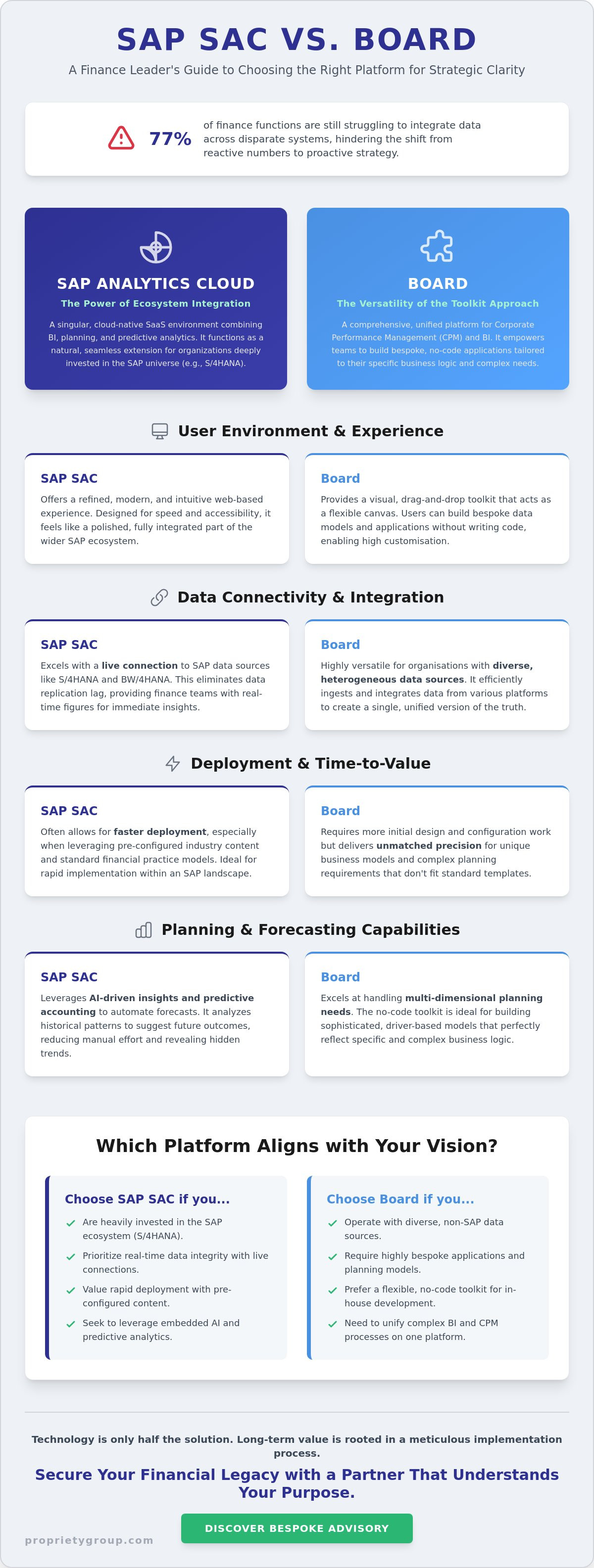
Choosing between sap sac vs board requires a meticulous look at how your team interacts with data. SAP Analytics Cloud (SAC) offers a refined, web-based experience that feels modern and intuitive. It's designed for speed and accessibility. Board takes a different path, providing a visual, drag-and-drop toolkit. This allows teams to build bespoke applications without writing a single line of code. While SAC feels like a polished extension of the SAP ecosystem, Board acts as a flexible canvas for complex logic.
When we look at data connectivity, SAC excels with its live connection to SAP environments like S/4HANA. This means your finance team sees real-time figures without the lag of data replication. Board is a versatile choice for organisations with diverse, heterogeneous data sources. It ingests information from various platforms to create a single version of the truth. Industry analysis in the Forrester Wave BI Platforms report highlights how these tools empower users to manage complex environments with greater autonomy.
Time to value is a critical metric for any UK finance director. SAC often allows for faster deployment, particularly when using pre-configured industry content that aligns with standard financial practices. Board requires more initial design work, yet it offers a level of precision that suits unique business models. Both platforms support rolling forecasts and driver-based budgeting, ensuring that your financial strategy remains agile in a fluctuating economy.
Budgeting and Forecasting Accuracy
SAC uses predictive accounting to automate your forecasts. It looks at historical patterns to suggest future outcomes, which reduces manual effort by up to 40% in some implementations. Board handles complex global requirements with ease. It manages multi-currency consolidations and intricate cost allocations for organisations operating across different UK and international jurisdictions. This ensures financial integrity across every ledger and reinforces a legacy of precision.
Reporting and Visualisation Depth
SAC uses "Stories" to present data through interactive dashboards. These are easy for non-technical managers to navigate. Board uses "Capsules", which are self-contained reporting environments that combine data discovery with performance management. Both platforms ensure that insights aren't trapped within the IT department. Instead, they provide clarity for every stakeholder. If you're looking to refine your financial strategy, a bespoke consultation can help clarify your path.
Beyond the Software: Ensuring Implementation Integrity and Long-Term Value
The decision between sap sac vs board is a significant milestone, yet the software itself is merely the canvas. The true success of an Enterprise Performance Management (EPM) platform is determined by the meticulousness of its implementation. At Propriety Group, we believe that technology must be shaped by a visionary, design-led philosophy that prioritises the unique purpose of your organisation over generic templates.
Strategic epm advisory is essential to ensure your chosen tool serves your specific business processes. Many finance teams fall into the "lift and shift" trap, where they move existing, often flawed, financial models into a new system. This approach limits the potential of the software. Instead, we re-evaluate your models during the transition to ensure they provide a lasting legacy of precision. By aligning the platform with your strategic goals, we transform it into a source of quiet confidence for the entire finance department.
The Importance of Environment Analysis
A thorough analysis of your current financial environment must precede any software configuration. Propriety Group conducts a deep dive into your data structures to identify integrity gaps before they become implementation roadblocks. Research indicates that approximately 70% of digital transformations fail to meet their original objectives due to inadequate planning. Our meticulous analysis ensures your data is clean and your processes are ready, creating a foundation of reliability from day one.
Ongoing Support and System Optimisation
An EPM solution should never be static; it must evolve alongside your business. We provide PG Care as a bespoke model for continuous technical assistance and user training. This ensures your team remains proficient and the system remains optimised. Our approach aligns with the excellence highlighted in the Gartner Magic Quadrant for FP&A, which emphasises the need for systems that adapt to changing market conditions. Regular reviews allow us to refine your sap sac vs board environment, ensuring it continues to deliver clarity and professional prestige as your business grows.
Defining Your Strategic Financial Path
The decision between sap sac vs board ultimately rests on your current infrastructure and your vision for the next decade. SAP SAC offers a powerful, cloud-native experience for those deeply embedded in the SAP ecosystem, while Board provides a unified toolkit that excels in versatility across diverse data sources. Data from the 2023 Gartner Magic Quadrant for Financial Planning Software confirms that both platforms are top-tier contenders, yet their effectiveness depends on how they're woven into your specific business fabric. It's not just about the software's features; it's about how the platform supports your people and your purpose.
A successful transition requires more than just a license. It demands a partnership built on precision and expert oversight. Propriety Group provides a bespoke environment analysis to ensure your chosen solution fits your operational needs perfectly. We maintain meticulous implementation standards to protect your data integrity, followed by our PG Care support model for long-term stability. Secure your organisation’s financial future with expert EPM advisory from Propriety Group. You have the opportunity to build a lasting legacy of clarity and confidence within your finance department.
Frequently Asked Questions
Is SAP Analytics Cloud only suitable for companies already using SAP ERP?
SAP Analytics Cloud isn't restricted to organizations operating within the SAP ecosystem. It connects to over 200 external data sources, including Microsoft Excel and various cloud databases. This versatility ensures that finance teams can achieve a holistic view of their performance even if their historical data resides in separate, non-SAP environments.
How does Board’s pricing model differ from the subscription-based approach of SAP SAC?
Board utilizes a bespoke pricing structure that adapts to the specific modules and user roles required by a business. In contrast, SAP SAC follows a transparent subscription model where professional user licenses typically start at approximately £30 per month. This difference means that Board requires a more meticulous initial consultation to determine the total investment needed for a firm's unique requirements.
Can both platforms handle complex financial consolidation and multi-currency reporting?
Both platforms possess the necessary precision to manage complex financial consolidation and multi-currency reporting for global entities. In the debate of sap sac vs board, both systems excel at automating the elimination of intercompany transactions and converting diverse currencies into a single reporting format. This capability allows finance leaders to maintain absolute accuracy when presenting consolidated results to stakeholders.
What are the typical implementation timelines for SAP SAC versus Board?
Most organizations should expect an implementation period ranging from 12 to 24 weeks for a full deployment. SAP SAC often allows for a faster initial setup because it provides pre-configured templates for common financial tasks. Board’s timeline is typically influenced by its highly flexible nature, as the system is often tailored to reflect the specific, enduring values and processes of the client.