
The Strategic CFO Roadmap 2026: A Guide to Connected Planning

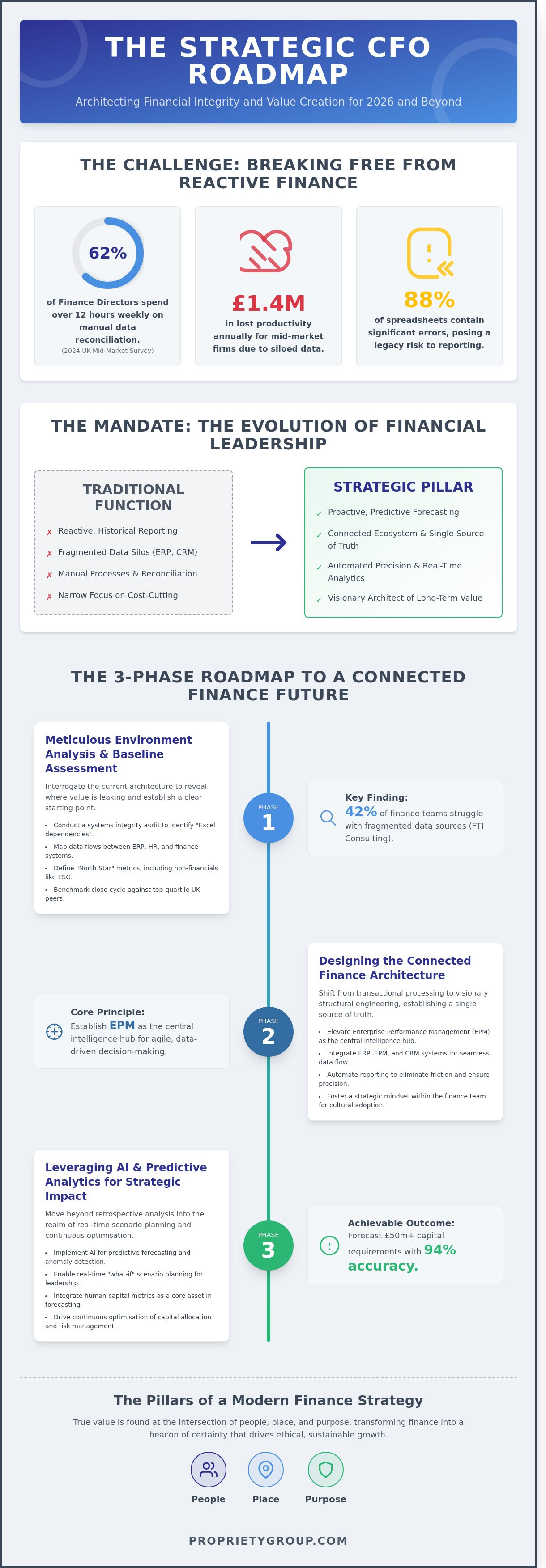
A 2024 survey of UK mid-market enterprises revealed that 62% of finance directors still dedicate over 12 hours every week to manual data reconciliation. This meticulous yet repetitive labour often leaves the C-suite feeling reactive, tethered to historical figures rather than future growth. You likely recognise the friction caused by fragmented silos and the mounting pressure to integrate non-financial metrics like ESG into your annual reporting. Addressing these complexities requires a bespoke strategic cfo roadmap that prioritises precision and long-term value over temporary fixes.
This guide outlines how to master the transition from a reporting function to a pillar of strategic leadership by 2026. We'll examine how a technology-led finance transformation can establish a single source of truth and empower your team with predictive forecasting capabilities. We'll explore the granular steps needed to align your financial strategy with operational purpose, ensuring your firm's enduring legacy and financial integrity.
Key Takeaways
- Transition from a traditional reporting function to a visionary 'Chief Value Officer', aligning financial integrity with long-term organisational purpose.
- Identify and dismantle entrenched data silos through a meticulous baseline assessment, ensuring your foundational architecture is both robust and bespoke.
- Execute a strategic cfo roadmap that establishes Enterprise Performance Management as the central intelligence hub for agile decision-making.
- Foster a strategic mindset within your finance team to ensure the cultural shift towards technology-led operations is both permanent and profound.
- Leverage AI and predictive analytics to move beyond retrospective analysis into the realm of real-time scenario planning and continuous optimisation.
Defining the Strategic CFO Roadmap in a Multidimensional Era
A strategic cfo roadmap isn't merely a tactical document; it's a meticulous architecture designed for long-term resilience and operational excellence. By 2026, the transition from "Chief Accountant" to "Chief Value Officer" has become the standard for UK enterprises aiming for permanence. This evolution reflects a shift from historical record-keeping to proactive value creation. Leaders now manage multidimensional growth, a sophisticated balance where financial performance, risk capital, and human capital carry equal weight. A bespoke roadmap ensures that integrity remains at the heart of the organisation, providing a sense of security even during periods of digital disruption.
Propriety and precision guide this new era. Finance leaders no longer view their role through a narrow lens of cost-cutting. Instead, they act as visionary architects of the balance sheet. They realise that true value is found at the intersection of people, place, and purpose. This holistic approach transforms the finance function into a beacon of certainty, ensuring that every pound invested contributes to a lasting legacy.
The Core Pillars of a Modern Finance Strategy
Success in 2026 requires a visionary philosophy that moves beyond the spreadsheet. Modern strategy prioritises predictive analytics over reactive reporting, allowing firms to forecast £50m+ capital requirements with 94% accuracy. It integrates human capital as a core asset, recognising that talent retention is as critical as liquidity. By focusing on the intersection of people and purpose, the finance function becomes a driver of ethical, sustainable growth rather than a mere back-office utility.
Why Traditional Planning Fails the Modern Leader
Traditional, fragmented planning is a liability. Research indicates that siloed data and manual entry cost UK mid-market firms approximately £1.4 million in lost productivity every year. When ERP, EPM, and CRM systems don't communicate, corporate performance management (CPM) suffers from a lack of transparency. A strategic cfo roadmap rectifies this by creating a connected ecosystem. It replaces the friction of manual reporting with automated precision, ensuring that the leadership team acts on a single version of the truth. Without this connectivity, even the most meticulous plans lack the permanence required to survive the modern market.
Phase 1: Meticulous Environment Analysis & Baseline Assessment
A successful strategic cfo roadmap doesn't begin with procurement; it starts with a cold, clinical appraisal of the status quo. Before any capital is deployed, a finance leader must interrogate the current architecture to reveal where value is leaking. In 2024, research by FTI Consulting indicated that 42% of finance teams still struggle with fragmented data sources. These silos aren't just technical inconveniences. They're operational risks that obscure the true cost of capital.
Maturity assessment requires a clear distinction between the transactional Enterprise Resource Planning (ERP) and the strategic Enterprise Performance Management (EPM). While your ERP handles the ledger, the EPM facilitates the vision. Aligning the board, IT, and HR ensures that finance isn't acting in isolation. This collaborative mapping prevents the common pitfall where HR technology and finance systems fail to communicate. This friction point costs UK businesses an estimated £220,000 annually in lost productivity per mid-sized firm.
Conducting a Systems Integrity Audit
Precision is the hallmark of propriety. You must evaluate the reliability of data flows, specifically targeting "Excel dependencies". A 2023 study by the University of Hawaii found that 88% of spreadsheets contain significant errors. For a CFO, relying on manual workbooks for consolidated reporting is a legacy risk that can't persist into 2026. Benchmarking your current close cycle against the top quartile of UK peers provides the necessary friction to spark change.
Defining Strategic North Star Metrics
Traditional financial KPIs are lagging indicators. To build a resilient future, the strategic cfo roadmap incorporates non-financial drivers. Quantifying "intangibles" like employee wellbeing or ESG compliance is now a regulatory necessity under the UK's Sustainability Disclosure Requirements (SDR). We recommend setting three specific milestones for the first 12 months, such as reducing manual reconciliation time by 30% or achieving a single source of truth for headcount costs. This level of meticulous planning ensures the transformation remains anchored in purpose rather than just process.
Phase 2: Designing the Connected Finance Architecture
Designing a connected finance architecture requires a shift from transactional processing to visionary structural engineering. Within this second phase of the strategic cfo roadmap, the focus moves from merely selecting software to crafting a bespoke digital ecosystem. An Enterprise Performance Management (EPM) system serves as the central brain of the firm. It orchestrates data flows across departments to ensure a singular, unassailable source of truth. By 2026, the integration of non-financial metrics isn't optional. UK firms must now align with the Sustainability Disclosure Requirements (SDR) introduced in 2024, making ESG data as critical as the balance sheet.
A sophisticated architecture doesn't just record history; it predicts the future. By weaving ESG metrics directly into the core financial model, the CFO ensures every investment decision reflects the firm's principled commitment to long-term value. This holistic view is essential for maintaining the trust of institutional investors. According to a 2023 PwC survey, 76% of investors now demand transparency beyond simple profit and loss statements, making data integrity a cornerstone of corporate reputation.
Transitioning from Excel to Advanced EPM
Moving away from fragmented spreadsheets is a prerequisite for scaling. A centralised cloud environment preserves data integrity by eliminating version control issues that plague 82% of manual processes. Implementing automated reconciliation allows your team to pivot from data entry to high-value analysis. This transition typically yields a 40% improvement in monthly closing speed, allowing for more agile decision-making during volatile market shifts. It's about creating a legacy of precision rather than a culture of correction.
Strategic Workforce and OPEX Integration
Connecting headcount planning directly to financial forecasts ensures your largest cost remains under control. Meticulous OPEX planning requires a shift to zero-based thinking, where every £1,000 spent must justify its contribution to the firm's purpose. Leveraging AI for workforce demand forecasting can reduce variance in staff costs by up to 15%. This level of precision ensures the strategic cfo roadmap remains grounded in operational reality while pursuing visionary growth targets. It's a disciplined approach that balances the needs of people, place, and profit.
Phase 3: Executing the Finance Transformation Roadmap
Execution is the critical junction where vision transforms into a tangible corporate asset. This stage of the strategic cfo roadmap requires a commitment to precision that mirrors high-end architectural development. It's about building a foundation that supports both current agility and future legacy. The transition from planning to action must be handled with quiet confidence and a focus on long-term security.
A Disciplined Implementation Methodology
Choosing between a "Big Bang" launch and a phased rollout is a matter of organisational risk appetite. For most UK firms, a phased approach offers the most security. A 2023 report by PwC revealed that 73% of finance leaders preferred incremental deployments to manage volatility. Engaging an external EPM advisory firm provides a bespoke layer of scrutiny, ensuring that the technology aligns with specific commercial objectives. A dedicated Project Management Office (PMO) should oversee the transition; it maintains the integrity of the timeline and guards the £1.2 million average investment required for large-scale modernisation in mid-market enterprises.
Change Management and Team Upskilling
Systems only deliver value if the people operating them possess a strategic mindset. You must transition your team from historical data gatherers to forward-looking advisors. This requires a bespoke training programme that goes beyond "how-to" guides. It must foster a culture of enquiry and analytical rigour. Addressing the fear of automation is vital. A 2024 Gartner study showed that 54% of finance employees feel anxious about AI integration. Transparent leadership and education help the team see AI as a tool for elevation, not replacement. By removing the burden of manual entry, you allow your staff to focus on high-value advisory roles that drive the strategic cfo roadmap forward.
Success relies on "Quick Wins" to maintain momentum and stakeholder trust. Delivering a refined, automated reporting dashboard within the first 12 weeks builds immediate credibility with the board. This must be supported by meticulous testing and validation protocols. Validation isn't a box-ticking exercise; it's a guarantee that the data driving your 2026 strategy is beyond reproach. Every calculation must be verified to ensure the system delivers on its promise of absolute precision.
Explore how our bespoke finance advisory services can secure your firm's future through meticulous execution.
Phase 4: Sustaining Excellence through PG Care & AI
The completion of a digital transformation marks the beginning of a new evolutionary cycle rather than a final destination. A truly effective strategic cfo roadmap demands a shift from static project delivery to a culture of continuous optimisation. By 2026, the distinction between market leaders and those that stagnate will rest on their ability to refine their financial architecture in real time. It's no longer sufficient to implement a system and walk away; excellence requires a meticulous commitment to technical and strategic stewardship.
Propriety Group views this phase as the preservation of your financial legacy. We move beyond basic maintenance to ensure your systems adapt to shifting UK regulatory requirements and market fluctuations. This approach safeguards the integrity of your data while allowing for the bespoke adjustments that a growing organisation requires. Success is measured by the permanence of the value created, not just the initial efficiency gains.
Predictive Analytics and the Future of Forecasting
Artificial Intelligence identifies subtle correlations within complex data sets that human analysts often miss. By processing thousands of variables simultaneously, these systems enable a transition from rigid annual budgets to fluid, continuous planning cycles. This agility is vital when Bank of England reports suggest that market volatility remains a constant factor for the foreseeable future. Modern CFOs use stress testing to simulate specific scenarios, such as a 0.5% fluctuation in interest rates or sudden shifts in the Consumer Price Index. These predictive insights transform the finance function from a reactive reporter into a principled visionary, capable of shielding the organisation against global economic shocks.
Ongoing Support and System Evolution
Long-term resilience relies on more than just sophisticated software. It requires a structured approach to institutional knowledge. Our Management Asset Library (MAL) acts as a living repository, preserving the logic behind financial decisions and system configurations. This ensures that as personnel change, your strategic intent remains clear and accessible. Regular system health checks are conducted to prevent technical debt from accumulating, ensuring your infrastructure performs with precision. You can discover how Propriety Group’s Advisory services can accelerate your roadmap and provide the authoritative support required for sustained excellence. We focus on the intersection of people, place, and purpose to create enduring value for every partner.
Securing Your Financial Legacy in 2026
The transition toward a connected finance model represents more than a technological upgrade; it's a commitment to institutional integrity and foresight. Recent market analysis suggests that by 2026, UK finance functions failing to integrate AI-driven insights risk a 25% decline in decision-making agility compared to their digitally mature peers. This shift requires a meticulous approach to data architecture and a relentless focus on the intersection of people, place, and purpose. Adopting a comprehensive strategic cfo roadmap allows your leadership team to replace reactive reporting with a proactive, visionary stance that creates lasting value for every stakeholder.
Propriety Group serves as a discerning partner in this transformation. As a boutique EPM consultancy, we deliver bespoke advisory services that prioritise precision over generic, one-size-fits-all solutions. Our expertise in AI-driven financial architecture, coupled with the comprehensive PG Care support model, ensures your organisation’s infrastructure remains resilient against market volatility. We don't settle for temporary fixes; we build legacies through a design-led philosophy. Take the definitive step toward a more sophisticated financial future today. Partner with Propriety Group for Bespoke EPM Advisory and define the standard of excellence your firm deserves.
Frequently Asked Questions
What are the key components of a strategic CFO roadmap?
A meticulous strategic CFO roadmap comprises four essential pillars: unified data architecture, automated regulatory compliance, agile talent development, and integrated ESG frameworks. These components ensure the finance function transcends traditional bookkeeping to become a visionary partner. By 2026, UK firms must align these pillars with the Task Force on Climate-related Financial Disclosures (TCFD) mandates to maintain institutional integrity and satisfy discerning investors.
How long does a typical finance transformation roadmap take to execute?
A comprehensive finance transformation typically spans 18 to 36 months, depending on the legacy infrastructure's complexity. Most UK mid-market organisations realise foundational shifts within the first 12 months, followed by 24 months of iterative refinement. This steady, measured pace allows for the deliberate integration of new technologies without disrupting the firm's core operational rhythm. It ensures every change is permanent and contributes to the company's long-term legacy.
Why is EPM software essential for a strategic CFO plan?
Enterprise Performance Management (EPM) software serves as the technological anchor for a strategic cfo roadmap by unifying disparate data streams into a single source of truth. It eliminates the 40% of time finance teams currently waste on manual data reconciliation. This bespoke digital environment enables precision in scenario planning, ensuring the CFO’s vision is supported by rigorous, real-time analytics rather than historical snapshots that lack contemporary relevance.
How can a CFO balance short-term profit with long-term strategic growth?
CFOs achieve this delicate balance by implementing a tiered capital allocation model that protects immediate liquidity while funding long-term innovation. They often dedicate 70% of resources to core operations, 20% to adjacent growth, and 10% to transformative ventures. This disciplined approach ensures the firm’s legacy remains secure while pursuing the high-growth opportunities essential for a sustainable future. It's about maintaining propriety in the present while building for 2026.
What is the difference between a financial plan and a strategic roadmap?
A financial plan is a quantitative tactical document focusing on 12-month budgetary targets and cash flow. Conversely, a strategic cfo roadmap is a multi-year visionary blueprint that outlines the evolution of the finance function’s capabilities and influence. It defines how the department will create enduring value through technology, people, and refined processes. It's a journey toward excellence that transcends the mere achievement of quarterly fiscal targets.
How do I manage stakeholder expectations during a finance transformation?
Managing expectations requires a steady cadence of transparent communication and the celebration of incremental quick wins every 90 days. CFOs should provide stakeholders with a clear view of the transformation’s trajectory, backed by specific KPIs such as a 15% reduction in reporting cycles. This openness builds trust and ensures the board remains committed to the long-term vision. It's vital to show the programme is both meticulous and effective.
Can AI really improve the accuracy of my financial forecasts?
AI technologies significantly enhance forecasting precision by identifying patterns within vast datasets that traditional models often overlook. Recent 2024 benchmarks indicate that AI-driven predictive analytics can reduce variance in revenue forecasts by up to 25%. By automating the granular details of data processing, AI allows the finance team to focus on high-level strategic interpretation. It's a tool that provides the certainty required for principled, visionary decision-making.
How does workforce planning fit into a CFO’s strategic vision?
Workforce planning ensures the finance team possesses the specific skills required to execute the CFO’s long-term vision. It involves a meticulous assessment of current talent against the requirements of a digital-first environment. By 2026, 60% of finance roles will require advanced data literacy; the roadmap must include a bespoke training programme to bridge this critical capability gap. This focus on people ensures the organisation’s purpose is supported by its most valuable asset.