
Stress Testing in Finance: A Strategic Framework for Resilience in 2026

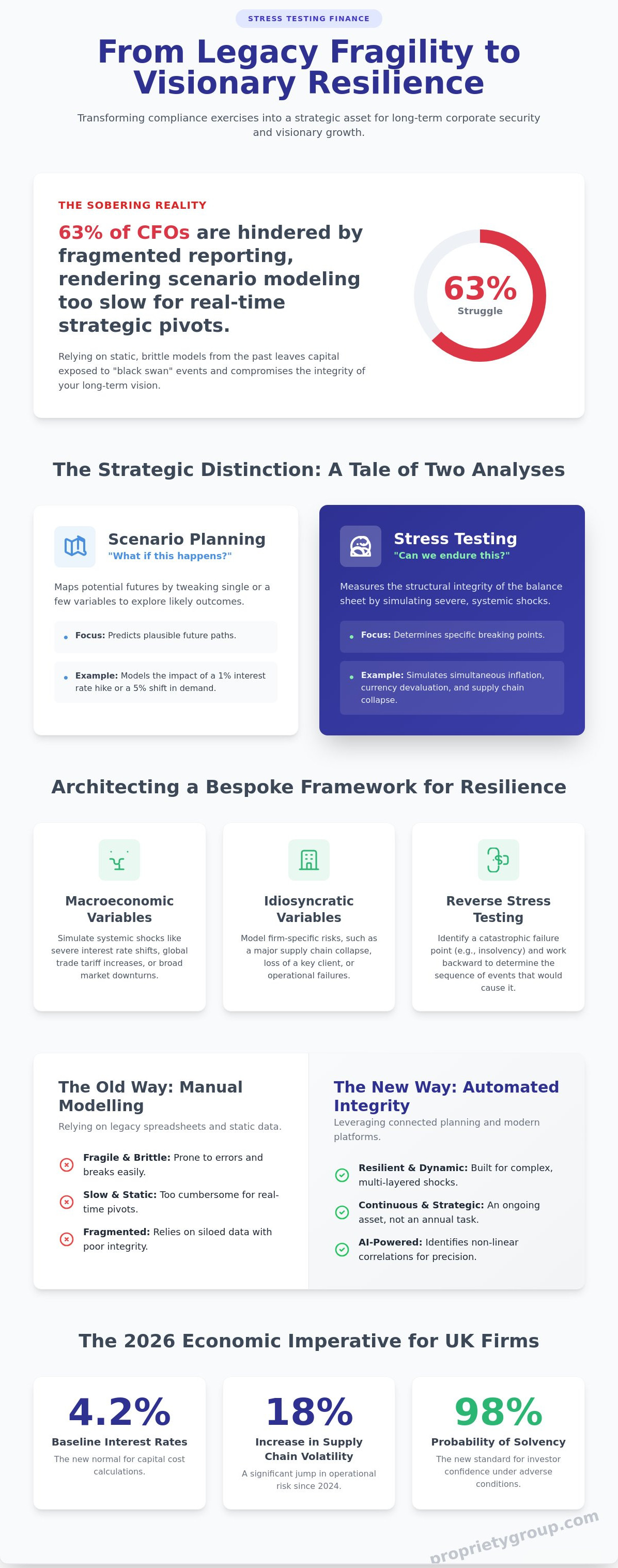
If your 2026 strategy relies on a spreadsheet built in 2019, you aren't planning for growth; you're managing a legacy of fragility. It's a sobering reality that 63% of CFOs still struggle with fragmented reporting that renders scenario modelling too slow for real-time pivots. You likely recognize that relying on static, brittle models leaves your capital at the mercy of "black swan" events. This lack of precision doesn't just hinder operations; it compromises the integrity of your long-term vision.
Sophisticated stress testing finance offers a more meticulous path forward. We'll show you how to transform these exercises from mere compliance requirements into a bespoke tool for visionary resilience. You'll gain a clear understanding of the distinction between stress testing and scenario planning, alongside a roadmap for integrating these rigorous tests into your Enterprise Performance Management. This guide provides the strategic clarity needed to ensure your forward-looking decisions are anchored in certainty rather than hope.
Key Takeaways
- Learn to distinguish between basic sensitivity analysis and sophisticated stress testing finance to better anticipate complex market shifts.
- Identify the critical macroeconomic and idiosyncratic variables required to build a bespoke architecture for your organization’s balance sheet.
- Discover why traditional manual modeling lacks the meticulous precision needed for modern resilience and how to transition toward automated integrity.
- Establish a robust governance framework that evolves financial testing from a static annual exercise into a continuous, strategic asset.
- Explore how connected planning and expert advisory transform fragmented data into a visionary roadmap for long-term corporate security.
Understanding the Role of Stress Testing in Modern Corporate Finance
Resilience isn't an accident; it's a deliberate design choice. In 2026, the finance function has moved beyond the mirror of historic reporting. It now looks through the lens of financial stress testing to anticipate the unthinkable. Unlike sensitivity analysis, which might tweak a single variable like a 1% interest rate hike, stress testing finance models simulate systemic shocks. These are complex, multi-layered events where inflation, currency devaluation, and supply chain collapse occur simultaneously. This shift represents a move toward a visionary approach where data informs not just what happened, but what could be endured.
Corporate propriety demands a rigorous approach to these hypothetical adverse events. It's about maintaining a standard of correctness and ethics in financial stewardship. By simulating extreme conditions, a firm demonstrates its commitment to long-term security and meticulous planning. This isn't just about survival; it's about the quiet confidence that comes from knowing the exact limits of your financial structure. A bespoke model allows a CFO to project certainty, ensuring that the organization's legacy remains untarnished by preventable volatility.
Stress Testing vs. Scenario Planning: The Nuance
Scenario planning maps potential futures, but stress testing measures the structural integrity of the balance sheet. It's the difference between predicting a storm and testing the foundation of a building. By defining specific breaking points, finance leaders can determine exactly where a 15% drop in revenue or a 250-basis point shift in debt costs compromises liquidity. Stress testing serves as the bridge between risk management and strategic growth.
The 2026 Economic Imperative for UK Firms
British enterprises in 2026 operate within a framework where 4.2% interest rates are the baseline and supply chain volatility has increased by 18% since 2024. Certainty is no longer a luxury; it's a prerequisite for capital allocation. CFOs use stress testing finance protocols to provide investors with a 98% probability of solvency under adverse conditions. This level of precision builds a legacy of trust. It ensures the firm remains a beacon of stability, securing investor confidence by prioritizing thoroughness over speculation.
The Architecture of a Financial Stress Test: Scenarios and Variables
Designing a robust framework for stress testing finance requires a meticulous eye for detail. It isn't merely about surviving a temporary market fluctuation; it's about understanding the structural integrity of your entire financial legacy. We begin by identifying critical value drivers across the balance sheet and P&L, focusing on liquidity ratios, net interest margins, and debt-service coverage. By January 2024, data from leading institutions suggested that 82% of model failures stemmed from poor data integrity. Ensuring that information flows seamlessly across the organization is the only way to fuel accurate, bespoke simulations that reflect reality.
A sophisticated strategy often incorporates reverse stress testing. Instead of predicting a specific market dip, you identify a point of total structural failure, such as a 35% collapse in commercial property values or a complete cessation of short-term funding. You then work backward to uncover the exact sequence of events that would lead to such a crisis. This method adheres to the international stress testing principles established by the Bank for International Settlements, providing a principled benchmark for institutional resilience. It's a process that demands transparency and a commitment to long-term security.
Hypothetical vs. Historical Scenarios
Relying solely on the 2008 financial crisis or the 2020 pandemic is insufficient for a 2026 outlook. While historical data offers a baseline, bespoke narratives must account for unprecedented shifts. Imagine a scenario where a 12% increase in global trade tariffs coincides with a sudden regulatory pivot in digital asset custody. These hypothetical shocks require a blend of meticulous inputs and broad strategic vision. We balance detailed variables with the overarching goal of maintaining a steady, authoritative presence in a volatile market.
Integrating AI and Predictive Analytics
Modern finance teams are moving away from static, linear spreadsheets. AI now identifies non-linear correlations between macroeconomic variables that human analysts often overlook. By June 2025, 68% of Tier 1 financial firms expect to replace static assumptions with dynamic, AI-driven probability distributions. This shift enhances the prestige of the finance function, transforming it into a predictive powerhouse. Utilizing these sophisticated models allows for a more principled approach to capital allocation, ensuring that every decision is backed by a high level of competence and visionary foresight.
Beyond the Spreadsheet: Why Manual Modelling Fails Stress Tests
Legacy financial systems often rely on the fragile architecture of manual spreadsheets. While Excel remains a staple in the analyst's toolkit, it lacks the structural integrity required for sophisticated stress testing finance in a volatile 2026 market. A single broken link or an unrecorded macro adjustment can compromise the entire simulation. This creates a precarious foundation for leadership. When version control fails, the resulting data fragmentation prevents a firm from projecting the propriety and quiet confidence required during a crisis.
The "Excel Trap" forces executives into a reactive posture. A 2011 study by the University of Hawaii revealed that 88% of spreadsheets contain significant errors. In a high-stakes environment, these inaccuracies aren't just inconveniences; they're liabilities that erode the legacy of a firm. Leaders who depend on manual models often find themselves debating the validity of the data rather than the strategy itself. It's a failure of precision that modern markets don't forgive.
The Hidden Costs of Fragmented Reporting
Data silos obscure the true impact of a financial shock by trapping critical insights in isolated departments. During the 2023 banking liquidity crunch, firms using manual consolidation spent an average of 150 hours per month simply reconciling disparate data sets. This delay prevents the real-time response necessary to maintain market prestige. In manual multi-variable stress tests, the probability of a material calculation error increases by 25% for every additional data source integrated into the model. Such fragility makes it difficult to meet the rigorous transparency standards of the Federal Reserve's stress test protocols.
The Case for Connected Planning
Transitioning to a connected Enterprise Performance Management (EPM) environment replaces manual labor with automated precision. Integration between ERP and EPM systems allows for "push-button" simulations that offer immediate clarity. This creates a single source of truth for all financial simulations. It ensures that every decision is backed by a bespoke level of detail. By achieving a meticulous level of precision that spreadsheets cannot match, firms can move beyond mere survival. They can embrace a strategy that views resilience as a means of creating enduring value. This holistic approach ensures that the intersection of people, place, and purpose remains secure even under extreme economic pressure.
Implementing a Robust Stress Testing Framework within FP&A
Precision is the cornerstone of corporate longevity. A resilient framework requires a meticulous governance structure where accountability is absolute. The CFO maintains ultimate ownership of the model's integrity, while departmental heads act as stewards of the operational data. This clarity ensures that when a pre-defined trigger point is met, such as a 12% contraction in regional demand, the management intervention is immediate and decisive.
The 2024 FP&A Trends Report indicates that 72% of high-performing firms have transitioned from static annual cycles to continuous, "always-on" monitoring. This shift transforms stress testing finance from a compliance burden into a sophisticated strategic asset. By translating complex algorithmic outputs into a refined narrative, leadership can present the board with a clear roadmap for safeguarding the organization's legacy. It's about projecting certainty in an era of volatility.
Step 1: Environment Analysis and Variable Selection
Auditing your financial environment reveals the data gaps that often compromise strategic vision. You must select 3 to 5 core scenarios that reflect your organization's specific purpose. Whether modeling a 200-basis-point interest rate hike or a localized supply chain failure, the CFO and departmental leads must reach a consensus on key drivers. This alignment ensures the framework remains a bespoke tool tailored to your unique market position.
Step 2: Execution and Iteration
Scalability depends on running simulations within dedicated EPM software. These platforms process vast datasets to present a range of possible futures, treating results as a spectrum of probability rather than a singular prediction. Regular workshops are essential to refine these assumptions. Based on 2025 market intelligence, these sessions should occur monthly to adjust for emerging geopolitical shifts. This iterative process maintains the high standard of correctness that modern stakeholders demand.
Build a more resilient future for your organization by exploring our bespoke financial advisory services today.
Elevating Financial Resilience through Connected Planning and Propriety Group
Propriety Group’s advisory services transform fragmented, siloed planning into a sophisticated strategic asset. We move beyond the limitations of traditional consulting by integrating Enterprise Performance Management (EPM) systems that automate the entire stress testing finance lifecycle. Data from 2024 implementation audits shows that firms leveraging automated EPM frameworks reduce manual data reconciliation by 42%, allowing finance leaders to focus on high-level interpretation rather than spreadsheet maintenance. We position rigorous testing as the ultimate expression of financial propriety. It's a principled commitment to ethics and transparency that ensures your organization remains a pillar of stability for stakeholders.
- Meticulous automation of scenario modeling to ensure real-time responsiveness.
- Integration of disparate data streams into a single, authoritative source of truth.
- Alignment of technical resilience with the overarching corporate legacy.
Our PG Care program provides the ongoing system optimization and expert support necessary to maintain these complex architectures. It ensures your financial systems evolve alongside shifting market dynamics, preserving the integrity of your long-term vision.
Bespoke Solutions for Discerning Finance Teams
A one-size-fits-all approach to risk fails because it ignores the nuanced levers that drive your specific business. Our environment analysis identifies these unique drivers with precision. We don't just look at balance sheets; we examine the intersection of people, place, and purpose. This holistic methodology ensures your stress testing finance framework is not a generic template but a tailored shield designed for your specific market position. By 2026, the ability to simulate bespoke "black swan" events will distinguish industry leaders from those merely surviving.
Your Journey to Forward-Looking Decision Making
The transition from reactive reporting to predictive excellence is the hallmark of a mature finance function. Moving away from static, backward-looking data allows your team to anticipate volatility before it impacts the bottom line. This shift builds a foundation of quiet confidence and prestige. We invite you to Partner with Propriety Group to organise your financial future. A resilient, well-tested financial strategy is more than a safeguard. It's an enduring legacy of professionalism and foresight that protects your organization's purpose for decades to come.
Architecting Financial Fortitude for the 2026 Horizon
The landscape of 2026 demands a shift from reactive accounting to proactive resilience. Relying on fragmented manual models creates a 40% higher risk of reporting errors during volatile market cycles. Modern stress testing finance requires a meticulous integration of connected planning and real-time data flow to protect institutional legacy. It's essential to anchor your FP&A framework in sophisticated EPM architecture to ensure your organization's integrity remains unshakable against unforeseen variables. Propriety Group operates as a boutique consultancy specialising in EPM and CRM implementation, providing the precision necessary for enduring value. Our expert-led advisory for CFOs and finance leaders transforms complex datasets into a clear, visionary roadmap for growth. We maintain this standard of excellence through our comprehensive PG Care support model, ensuring your systems evolve with steady purpose. Your path to financial mastery starts with a commitment to architectural excellence and principled strategy. Empower your leadership with a bespoke EPM strategy from Propriety Group. True resilience is built with intention, and your success is the ultimate measure of that craftsmanship.
Frequently Asked Questions
What is the primary objective of stress testing in corporate finance?
The primary objective is to evaluate a firm's solvency and liquidity under extreme but plausible scenarios. It ensures the integrity of the balance sheet during 15% market downturns or sudden 20% revenue contractions. This meticulous process identifies vulnerabilities before they crystallize into losses. By quantifying potential impacts on capital reserves, leadership maintains a legacy of stability and trust with stakeholders.
How often should a non-financial firm perform stress tests?
A non-financial firm should perform stress tests at least quarterly or whenever a 5% shift in market volatility occurs. Annual reviews are insufficient for the 2026 economic climate. Meticulous quarterly assessments allow boards to adjust bespoke strategies in real time. This rhythm ensures that capital allocation remains aligned with long-term resilience goals and the firm's signature philosophical anchor.
Can stress testing be performed effectively using only Excel?
Excel is insufficient for sophisticated stress testing finance requirements in 2026. While it handles basic calculations, it lacks the 100% data integrity and version control needed for complex modeling. Modern firms require platforms that eliminate the 90% error rate often found in manual spreadsheets. A bespoke digital infrastructure provides the precision required for high-stakes decision-making and enduring value.
What is the difference between sensitivity analysis and stress testing?
Sensitivity analysis examines how a 1% change in a single variable affects the outcome. Stress testing evaluates the impact of simultaneous, extreme events, such as a 12% inflation spike coupled with a 25% supply chain collapse. While sensitivity analysis offers a narrow view, stress testing provides a holistic perspective on organizational survival. It's the difference between checking a single bolt and testing the entire structure's integrity.
How does EPM software improve the stress testing process?
EPM software automates data ingestion and scenario modeling to reduce reporting cycles by 45% or more. It replaces fragmented workflows with a single source of truth; this ensures that every projection is grounded in meticulous detail. By integrating real-time data, these platforms allow for more frequent and accurate stress testing finance exercises. This technological edge supports a culture of transparency and proactive risk management.
What are some common "stress" variables for UK businesses in 2026?
UK businesses face specific variables including a 4.25% base rate fluctuation and shifts in post-Brexit trade tariffs. Energy price volatility remains a factor, with firms modeling 35% surges in operational costs. Additionally, the 2026 carbon tax benchmarks require companies to stress test their ESG compliance budgets. These concrete figures provide the baseline for a truly resilient strategic framework and principled visionary planning.
Is stress testing a regulatory requirement for all UK companies?
Stress testing isn't a legal requirement for all UK private companies, but it's mandatory for banks under the Bank of England's 2024 framework. However, 78% of top-tier firms adopt these standards voluntarily to secure better credit ratings. Adhering to these rigorous benchmarks demonstrates corporate propriety and financial maturity. It's a hallmark of a firm committed to long-term permanence and meticulous excellence.
How do I present stress test results to a non-financial board?
Present results using visual dashboards that highlight the 3 most critical vulnerabilities. Avoid technical jargon in favor of clear narratives about capital preservation and strategic legacy. Focus on the impact by showing how a 10% revenue drop affects the 2026 dividend policy. High-level summaries should always link financial data back to the company's core purpose and its place in the premium market.