
Financial Consolidation Challenges: Navigating Complexity in 2026

By 2026, the traditional 12-day month-end close will be regarded as a structural failure rather than an acceptable operational delay. Most finance leaders recognise the frustration of reconciling inconsistent data from international subsidiaries, where a single discrepancy can compromise the integrity of the entire group report. You've likely felt the weight of these financial consolidation challenges as you attempt to bridge the gap between disparate systems and manual spreadsheets. It's a meticulous process that often leaves little room for the high-level strategic oversight your board expects.
We'll show you how to transform this reporting burden into a bespoke strategic asset. By adopting a more refined approach to data architecture, you'll achieve a faster, automated close that provides a single version of the truth. This guide examines the path from historic record-keeping to forward-looking analysis, ensuring your finance function delivers the precision and permanence required for long-term security. We'll explore the transition to automated excellence and the creation of a reporting framework that empowers genuine strategic decision-making.
Key Takeaways
- Recognise why the traditional spreadsheet-first approach has reached a breaking point and how to architect a more resilient framework for complex, multi-entity groups.
- Master the intricacies of intercompany eliminations and multi-currency translations to overcome the most pervasive financial consolidation challenges facing modern finance leaders.
- Evaluate the strategic opportunity cost of fragmented reporting and how data silos divert your team from high-value analysis to manual remediation.
- Implement a connected planning environment that replaces disconnected workflows with a meticulous, single version of the truth.
- Discover how a bespoke advisory philosophy can align your EPM architecture with a vision of long-term integrity and strategic purpose.
The Evolution of Financial Consolidation in 2026
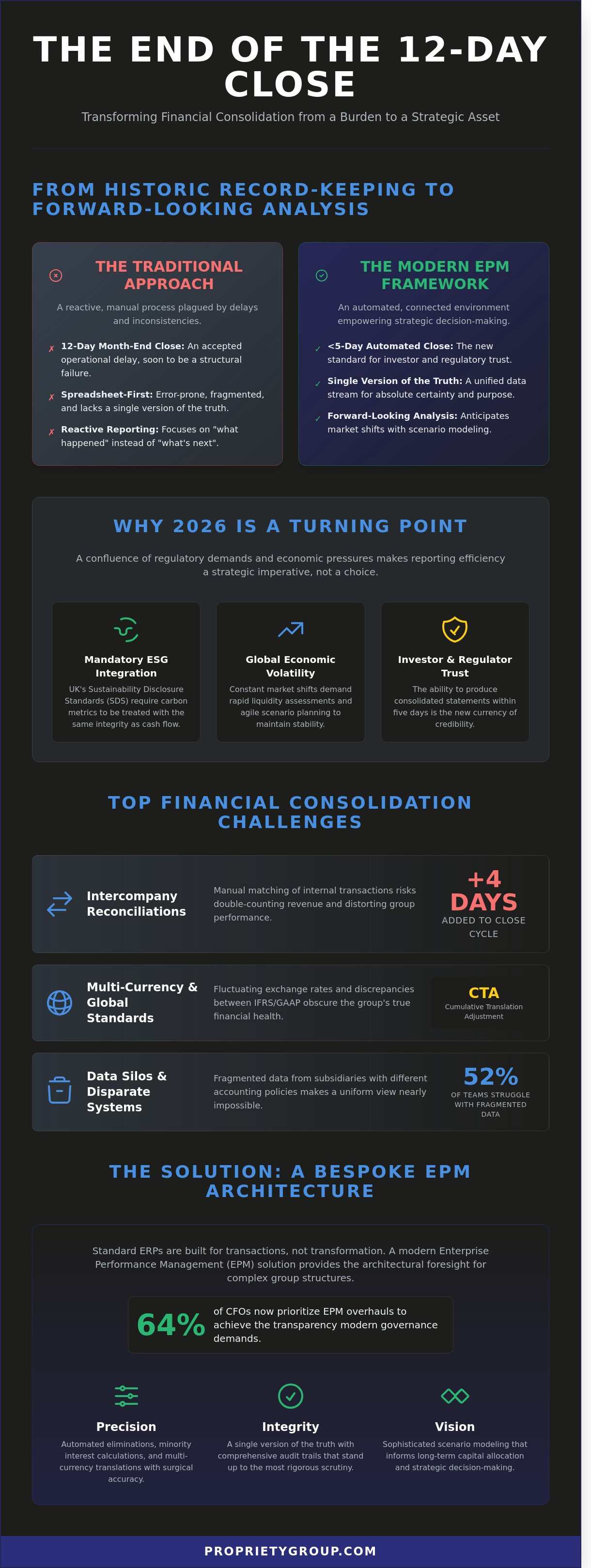
Financial consolidation represents the meticulous synthesis of diverse entity data into a single, authoritative truth. For modern UK groups, it's no longer a mere accounting exercise. It's a strategic imperative. The traditional reliance on manual spreadsheets has reached a definitive break point. A 2024 study by FSN found that 52% of finance teams still struggle with fragmented data silos. This lack of cohesion creates significant financial consolidation challenges that hinder agile decision-making in a high-stakes market.
Propriety demands a shift from reactive, historic reporting to a visionary style of financial management. We're moving away from looking in the rear-view mirror. Leaders now require a forward-looking perspective that anticipates market shifts before they manifest on a balance sheet. Connected planning serves as the architectural foundation for this transition. It integrates operational and financial data into a unified, real-time stream. This ensures every stakeholder operates from a position of absolute certainty and shared purpose.
Why 2026 is a Turning Point for UK Finance Teams
The UK government's adoption of Sustainability Disclosure Standards (SDS), which became mandatory for large entities in 2025, makes 2026 the first year of comprehensive, granular ESG integration. Finance teams must now treat carbon metrics with the same integrity as cash flow. Global economic volatility remains a constant, with the Bank of England's 2025 projections suggesting a continued need for rapid liquidity assessments. Reliability is the new currency. Organisations that can't produce consolidated statements within five business days risk losing the trust of institutional investors and regulatory bodies alike.
Moving from ERP to EPM: A Strategic Necessity
Standard ERP systems often lack the sophistication required for complex, multi-currency consolidations. They're built for transactions, not transformation. A bespoke Enterprise Performance Management (EPM) solution offers the precision needed for intricate group structures. Success isn't found in a one-size-fits-all software package. It requires a meticulous environment analysis before any implementation begins. This process ensures the digital infrastructure reflects the unique legacy and aspirations of the organisation. Effectively addressing financial consolidation challenges requires this level of architectural foresight. A 2025 Gartner report highlighted that 64% of CFOs now prioritise EPM overhauls to achieve the transparency that modern governance demands.
- Precision: Automated eliminations and minority interest calculations.
- Integrity: Audit trails that stand up to the most rigorous scrutiny.
- Vision: Scenario modelling that informs long-term capital allocation.
Top 5 Financial Consolidation Challenges Facing CFOs Today
CFOs in 2026 operate in a landscape where precision defines their professional legacy. The friction between disparate data sources and the requirement for a singular, untarnished truth creates significant financial consolidation challenges. Achieving a refined consolidated view requires more than just technical skill; it demands a meticulous approach to data integrity and a commitment to transparency across the entire corporate structure.
The Complexity of Intercompany Reconciliations
Matching internal buy and sell transactions requires a meticulous effort that often tests the integrity of the finance function. When these transactions aren't aligned, the risk of double-counting revenue or expenses increases, distorting the group's true performance. Manual reconciliations cause significant month-end delays. Recent 2024 benchmarks indicate that manual matching can extend the close cycle by up to four days. Modern software utilizes automated matching engines to resolve these discrepancies, ensuring that internal balances net to zero with surgical precision.
Multi-Currency and Global Reporting Standards
Consolidating entities across international borders introduces the volatility of fluctuating exchange rates. Discrepancies between IFRS and local GAAP standards can further obscure the group's financial health. The Cumulative Translation Adjustment (CTA) serves as the dedicated line item within the equity section of a consolidated balance sheet to account for these currency fluctuations over time. Maintaining a principled approach to financial reporting ensures that these movements don't undermine long-term value.
Beyond currency, three additional hurdles frequently disrupt the consolidation process:
- Data Silos: When subsidiaries operate with disparate accounting policies, achieving a uniform view becomes nearly impossible. In 2025, approximately 38% of UK-based finance leaders cited a lack of policy standardisation as their primary barrier to reporting speed.
- Manual Entry Risks: Without a robust, automated audit trail, identifying the origin of an error becomes a forensic exercise rather than a simple review. A 2023 study by Ventana Research highlighted that spreadsheet-heavy processes are 3.2 times more prone to material inaccuracies.
- Non-Financial KPIs: Modern stakeholders demand visibility into ESG metrics and operational performance alongside traditional figures. Weaving these threads into a single narrative is one of the most pressing financial consolidation challenges for the modern visionary leader.
The absence of a robust audit trail doesn't just invite error; it compromises the sense of security that partners and stakeholders expect. Accuracy is the cornerstone of propriety. Leaders must look past the granular details of execution to see the holistic impact of their financial architecture on the wider organisation.
The Strategic Cost of Fragmented Financial Reporting
Fragmented data isn't just an administrative hurdle; it's a silent erosion of corporate integrity. When leadership groups wait 15 days or longer for a month-end close, they're navigating by the stars of the previous month. This latency creates a vacuum where confidence should reside. In the UK’s volatile property market, a delay in identifying a £2.4 million liquidity gap can be the difference between a successful acquisition and a missed opportunity. Decisions made on stale data lack the precision required for modern governance.
Finance professionals should be the architects of strategy. However, a 2024 study of UK finance functions revealed that 62% of teams spend over half their time on manual reconciliation and data cleaning. This misallocation of talent represents a profound opportunity cost. Every hour spent fixing a broken spreadsheet link is an hour stolen from high-level portfolio analysis. When the finance team is trapped in the "engine room" of data entry, they can't provide the visionary insights that define a firm's market position.
Lack of transparency doesn't just slow things down; it actively damages investor confidence. Boards require a narrative built on absolute certainty. If reporting feels opaque, trust evaporates. This risk extends to the very legacy of the organisation. A brand built on the pillars of propriety and excellence cannot afford the reputational stain of restated accounts or unforeseen fiscal shocks. Precision in reporting is the ultimate safeguard for a firm's long-term heritage.
Masking Performance: When the Group View Hides the Detail
High-level consolidated statements often act as a veil. They can easily disguise a struggling subsidiary behind the robust performance of a primary asset. True financial integrity requires meticulous drill-down capabilities. Management Asset Libraries provide this essential depth, allowing boards to verify the health of individual investments instantly. Without this granularity, the group's legacy is built on a foundation of hidden risks that financial consolidation challenges often leave unaddressed until it's too late.
The Impact on Forecasting and Predictive Agility
Flawed historic data inevitably produces distorted projections. If the input is compromised, the output is fiction. Successfully navigating financial consolidation challenges requires a shift toward AI-driven pattern recognition. Modern systems identify anomalies that manual consolidation misses. This precision is vital for stress-testing exercises, where a 1.5% shift in Bank of England base rates must be modelled against accurate debt structures to ensure the organisation’s future remains secure and predictable.
Overcoming Challenges Through Modern EPM Architecture
Overcoming complex financial consolidation challenges requires a departure from the fragility of disconnected spreadsheets. A modern, connected planning environment integrates disparate data streams into a single, authoritative version of the truth. This architectural shift ensures that data governance is not a reactive measure but a foundational principle of the finance function. Relying on fragmented Excel files introduces a 15% margin for error in reporting, according to 2024 industry benchmarks. By centralising information within a refined Enterprise Performance Management (EPM) framework, organisations build a legacy of precision and trust.
Meticulous Process Design: The Foundation of Success
Technology serves as a tool; the underlying process remains the craft. Software is only as effective as the logic it automates. A bespoke advisory approach aligns financial models with the specific business purpose, ensuring the system reflects the organisation's unique character and strategic goals. To protect the well-being of the finance team, we advocate for a phased rollout. Implementing changes in three distinct stages over a 16-week period allows for steady adaptation. This measured pace ensures that the integrity of the monthly close remains uncompromised during the transition.
Leveraging AI for Automated Reconciliations
AI-augmented systems provide the surgical precision required to resolve modern financial consolidation challenges. Predictive analytics now identify intercompany discrepancies 72 hours before the month-end close, allowing for immediate rectification before they impact the final statement. Automated data mapping facilitates the seamless flow of information from disparate ERP systems into the central repository. By 2026, AI-driven validation protocols will reduce human error in consolidation by 85% compared to manual entry methods.
A system's value diminishes without ongoing optimisation. The cost of manual reconciliation errors for UK mid-market firms often exceeds £45,000 per reporting cycle. A managed support model provides the continuous refinement necessary to keep the architecture aligned with evolving market conditions. This commitment to excellence ensures the platform remains a high-performing asset rather than a legacy burden.
The Propriety Approach: Bespoke Solutions for Complex Groups
Propriety Group operates at the intersection of People, Place, and Purpose. We recognise that the most persistent financial consolidation challenges aren't merely technical; they're structural and human. Our Advisory for EPM service addresses the root cause of these complexities by harmonising your digital environment with your strategic objectives. We view the financial system as a digital "place" where your team must perform with precision. By aligning this environment with a clear sense of purpose, we transform consolidation from a monthly burden into a source of enduring value.
Our PG CARE model underpins every engagement, ensuring technical excellence and ethical integrity. This framework prioritises a meticulous attention to detail that larger, volume-driven firms often overlook. We work with UK-based groups with turnovers exceeding £250 million to ensure their reporting frameworks are resilient enough to withstand the regulatory shifts expected in 2026. This principled approach ensures your data remains a reliable asset for long-term legacy building.
Implementation with Integrity: Our Methodology
Our delivery process moves from a rigorous environment analysis to a bespoke configuration phase. We don't believe in "out-of-the-box" solutions for complex organisations. Instead, we tailor every aspect of the EPM system to mirror your specific group structure and IFRS requirements. We empower finance teams through intensive, bespoke workshops. These sessions ensure your staff aren't just users, but masters of the platform. This transfer of knowledge is vital for maintaining a system that supports your professional excellence for years to come.
Securing Your Financial Future
Choosing a boutique consultancy offers a more refined, partner-led experience. We bring quiet confidence to the table, focusing on quality over quantity. Our clients value a partnership built on transparency and a shared commitment to correctness. In an era where 78% of CFOs are seeking more integrated reporting, we provide the steady hand needed to navigate these transitions. We invite you to enquire about our EPM Advisory services to discuss how we can secure your group’s financial narrative. Let's build a reporting legacy that reflects the true value of your enterprise.
Securing Financial Integrity for the 2026 Fiscal Year
Navigating financial consolidation challenges in 2026 requires a shift from reactive reporting to a visionary EPM architecture. Fragmented data costs UK firms an average of £250,000 annually in lost productivity. It's time to replace these inefficiencies with a meticulous, design-led approach to financial data. Propriety Group delivers bespoke EPM advisory led by specialists with 15 plus years of industry expertise. We focus on the intersection of people and technology to ensure your reporting framework is both functional and enduring. Our team excels in implementing CCH Tagetik, SAP BPC, and IBM Planning Analytics, ensuring your technical foundation is beyond reproach. With PG CARE managed support, we provide the ongoing oversight needed to protect your system's integrity well into the future. You'll gain a partner dedicated to creating a legacy of precision and ethical transparency.
Discover how Propriety Group transforms complex financial reporting to elevate your organisation's strategic output. Your path to a more certain financial future starts with a refined perspective.
Frequently Asked Questions
What are the most common financial consolidation challenges in 2026?
The most common financial consolidation challenges in 2026 include managing fragmented data silos and adhering to the UK’s Sustainability Disclosure Requirements (SDR). Finance teams now navigate an average of 15 distinct data sources per group entity. This complexity often leads to a 20% increase in reporting lag if systems aren't unified. Maintaining a single version of truth requires a meticulous approach to integration that many legacy infrastructures lack.
How does multi-currency translation affect consolidated financial statements?
Multi-currency translation introduces volatility into consolidated statements by requiring all foreign operations to be converted under IAS 21 standards. A 3% shift in the GBP to EUR exchange rate can alter reported group profits by over £500,000 for a mid-market enterprise. To maintain integrity, firms must apply closing rates for balance sheets and average rates for profit and loss accounts with surgical precision. It's a task that demands absolute accuracy to avoid misleading stakeholders.
Can we use Excel for group consolidation, or is it too risky?
Using Excel for group consolidation is considered excessively risky for any organisation with more than three subsidiaries. Research from the University of Hawaii indicates that 88% of complex spreadsheets contain material errors. These manual processes often add five days to the month-end close. Relying on bespoke software ensures a legacy of accuracy that manual workbooks simply cannot guarantee in a high-stakes regulatory environment.
What is the difference between ERP and EPM for consolidation?
ERP systems focus on the granular recording of daily transactions, while EPM platforms provide the sophisticated layer needed for complex group reporting. While an ERP might manage £1.2 million in local accounts payable, an EPM automates the elimination of £400,000 in intercompany sales. This distinction is vital for groups requiring a holistic view of performance across diverse jurisdictions. EPM tools are designed specifically to handle the intricate requirements of the final output.
How long should a typical financial consolidation process take?
A typical, high-performing financial consolidation process should take between five and seven business days. Data from APQC shows that top-quartile organisations achieve a close in 4.8 days, whereas laggards often exceed 10 days. Reducing this window by 48 hours allows the finance function to transition from data processing to strategic advisory roles. Efficiency here is a hallmark of a well-governed corporate structure that values time as a premium asset.
What are intercompany eliminations and why are they difficult?
Intercompany eliminations involve removing the effects of transactions between subsidiaries to ensure the group's financial health isn't artificially inflated. They're difficult because mismatched data in £50,000 internal trades can lead to reconciliation discrepancies that halt the entire close. Resolving these mismatches manually consumes roughly 30% of a finance team's time during the final reporting week. Precision in these eliminations is essential for reflecting the true economic reality of the business.
How can AI and predictive analytics improve the consolidation process?
AI and predictive analytics improve the process by automating anomaly detection and identifying variance patterns that human eyes might miss. Implementing these tools can reduce manual reconciliation efforts by 40% according to 2025 Gartner projections. By leveraging machine learning, firms can predict future cash requirements with 95% accuracy. This technological edge addresses several financial consolidation challenges by ensuring data flows are both rapid and reliable.
What role does data governance play in financial reporting integrity?
Data governance acts as the foundational framework that ensures the integrity and auditability of all financial reports. Without a meticulous governance policy, the risk of a £250,000 misstatement increases by nearly 60% in decentralised groups. It establishes a clear lineage for every pound recorded. This commitment to propriety ensures that stakeholders can trust the long-term security and value of the organisation’s financial disclosures.