

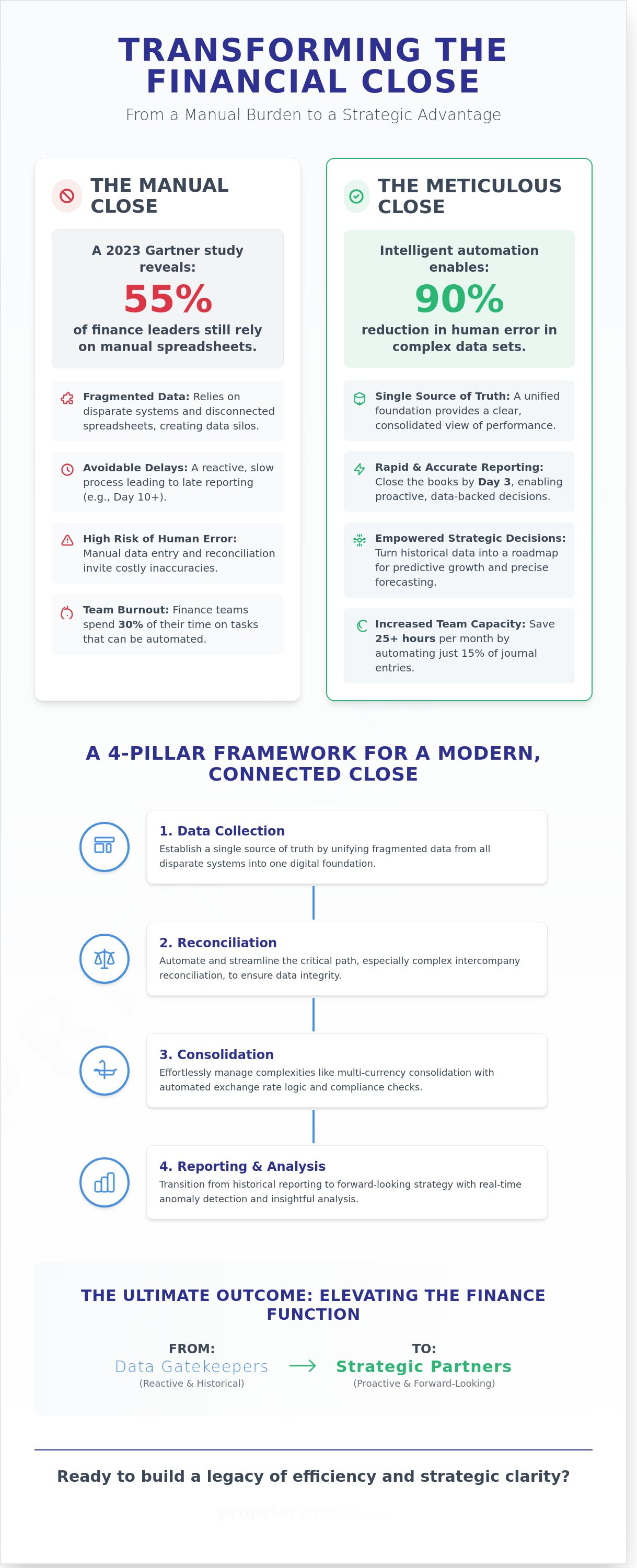
A 2023 study by Gartner reveals that 55% of finance leaders still rely on manual spreadsheets to manage their month-end workflows, often leading to avoidable delays. For many UK organisations, the financial close process remains a source of recurring friction rather than a moment of clarity. It's a period defined by fragmented data across disparate systems and the relentless pressure to deliver figures that are both rapid and precise.
You likely recognise the frustration of a team spent on meticulous data entry when they should be focused on the visionary analysis that secures your firm's legacy. We'll show you how to transform this administrative burden into a powerful platform for strategic decision-making. This guide provides a bespoke framework to achieve a faster cycle, absolute confidence in your statements, and a unified view of performance that informs your future strategy.
Key Takeaways
- Discover how to evolve your financial close process from a manual compliance task into a sophisticated rhythm that drives long-term business growth.
- Learn a modern framework designed to ensure meticulous data accuracy and reporting integrity across every level of your organisation.
- Understand the necessity of establishing a single source of truth to eliminate fragmented information and provide a clear, unified view of performance.
- Explore how intelligent automation can transform the close into a continuous activity, providing the real-time insights required for a fast-paced market.
- Transition your finance function from traditional data gatekeepers to influential partners who provide the clarity needed for confident, strategic decision-making.
Reimagining the Financial Close Process: From Compliance to Strategy
The financial close process isn't just a monthly chore. It's a structured rhythm that validates a company's performance while setting the stage for future growth. In a 2026 business environment, waiting weeks for results is a liability. Modern financial close management requires a transition from reactive reporting to proactive strategy. This shift ensures that data serves as a compass for the future rather than a mirror of the past.
To better understand this concept, watch this helpful video:
We distinguish between the "Manual Close" and the "Meticulous Close." A manual approach is fragmented and slow. It relies on disconnected spreadsheets that invite human error and delay. Conversely, a meticulous close is visionary and automated. It looks forward rather than backward. This refined approach builds a legacy of financial integrity that protects a brand's reputation and long-term security. By treating the close as a bespoke operation, firms can transform their financial close process into a pillar of corporate excellence.
The Strategic Value of a Polished Month-End
A faster close empowers leadership. It allows for confident, data-backed decisions earlier in the month. When the books are settled by day three instead of day ten, the board can pivot quickly to address market shifts. This reliability is essential for executing precise rolling forecasts. These forecasts turn historical data into a roadmap for predictive growth, ensuring that every pound is allocated with purpose.
The Risks of Fragmented Financial Reporting
Manual data reconciliation has hidden costs. It leads to team burnout and missed strategic opportunities. A 2024 industry report found that finance teams often spend 30 percent of their time on manual tasks that could be automated. This lack of visibility creates a fog. It hinders long-term planning and leaves the business vulnerable. Without a unified view, the path to expansion remains blocked by administrative friction.
A Framework for a Modern and Connected Financial Close
A modern financial close process requires a rhythmic progression through four distinct pillars: data collection, reconciliation, consolidation, and reporting. To move beyond the limitations of legacy systems, leaders must establish a single source of truth for finance. This unified digital foundation eliminates the friction of data silos, ensuring that every figure remains beyond reproach. Connected Finance is the intersection of people, place, and purpose within the ledger.
Finance directors often cite limited capacity as a barrier to change. However, incremental refinements yield immediate dividends. A streamlined financial close process transforms the finance function from a cost centre into a value creator. Automating just 15% of manual journal entries can save a typical UK finance team over 25 hours during a month-end cycle. These reclaimed hours allow teams to transition from historical record-keeping to forward-looking strategy. It's about creating a legacy of efficiency rather than just meeting a deadline.
Streamlining Consolidation and Reconciliation
Efficient intercompany reconciliation serves as the critical path to a faster close. When entities operate across borders, multi-currency consolidation introduces complexities that manual spreadsheets cannot resolve without risk. Modern systems apply bespoke exchange rate logic automatically, protecting the integrity of the consolidated balance sheet and ensuring compliance with UK GAAP or IFRS standards.
The Role of Precision in Financial Statements
Precision is the hallmark of professional excellence. Meticulous data validation acts as the final safeguard before reporting. The integration of intelligent automation in finance allows for real-time anomaly detection, reducing human error by up to 90% in complex data sets. Deploying financial consolidation software ensures that your final output isn't just accurate, it's a reflection of your firm's commitment to quality. To see how these principles apply to your specific portfolio, consider how a tailored financial architecture can support your long-term growth.
Elevating Finance through EPM and Intelligent Automation
Enterprise Performance Management (EPM) software changes the fundamental rhythm of a business. It turns the financial close process into a steady, daily activity instead of a stressful monthly hurdle. This shift moves finance teams away from being mere data gatekeepers. They become strategic partners who provide foresight. Modern systems use predictive intelligence to flag anomalies. If a transaction looks unusual, the system identifies it before the period ends. This proactive approach ensures accuracy and builds a legacy of financial integrity.
Moving Toward Continuous Accounting
Continuous accounting involves performing small tasks every day. It removes the traditional month-end pressure. When data flows in real time, CFOs gain immediate clarity. They can speak with departmental budget holders using current figures rather than month-old reports. A 2023 report by Ventana Research suggests that companies using continuous close methods complete their reporting 25% faster than those relying on manual legacy systems. This efficiency creates room for deeper analysis and more informed decision-making.
Partnering for a Seamless Transformation
Technology alone isn't a solution. Success requires a meticulous analysis of the existing environment before any software is installed. Propriety Group bridges the gap between fragmented systems and visionary execution. We provide bespoke training to ensure your team masters these new tools. A structured implementation plan prevents disruption. It ensures that the transition to an automated financial close process delivers long-term security and professional excellence for your organisation. We focus on the intersection of people and purpose to create enduring value.
Securing the Future of Financial Leadership
Modernising the financial close process is no longer just an operational goal; it's a strategic necessity for UK finance leaders aiming for long-term resilience. By moving away from manual compliance and embracing a connected framework, your team can refocus on high-value analysis that drives the business forward. This transition ensures that data isn't just recorded but is used to create a lasting legacy of precision and integrity. According to 2023 industry benchmarks, teams utilising intelligent automation can reduce reporting cycles by 30%, allowing more time for visionary planning.
Propriety Group delivers bespoke implementation of industry-leading EPM solutions, specifically designed to meet the rigorous standards of the United Kingdom's regulatory environment. We focus on the intersection of AI and financial precision to ensure your records remain beyond reproach. Through our dedicated PG Care model, we provide ongoing support that evolves alongside your organisation's needs. Explore how Propriety Group elevates your financial close through expert EPM advisory. It's time to transform your finance function into a visionary partner for growth.
Frequently Asked Questions
How long should a typical financial close process take in 2026?
By 2026, a high-performing financial close process should be completed within three business days. Meticulous planning and digital integration allow UK firms to move away from the traditional 10-day cycle. This speed provides stakeholders with immediate insights, ensuring that strategic decisions are based on the most current data rather than historical records. It creates a competitive advantage through agility and precision.
What are the biggest bottlenecks in the month-end close for mid-sized companies?
The primary obstacles for mid-sized companies during the financial close process are fragmented data sources and manual entry errors. In a typical UK mid-market firm, 60% of the finance team's time is often consumed by cleaning data across disparate systems. These delays prevent a swift transition to strategic analysis. This often stalls the final reporting phase by several days and impacts the firm's overall efficiency.
Can automation truly replace manual reconciliation without losing accuracy?
Automation improves accuracy by eliminating the risk of human error in repetitive tasks. Modern systems can achieve a 95% reduction in reconciliation discrepancies compared to manual methods. By implementing bespoke software solutions, businesses ensure that every transaction is verified with integrity. It's a method that allows the finance team to focus on interpreting results rather than fixing mistakes, ensuring the legacy of the data remains untarnished.
What is the difference between a hard close and a soft close?
A hard close is a final verification of all accounts, typically performed at year-end to satisfy HMRC and audit requirements. In contrast, a soft close is a simplified month-end procedure that provides a reliable snapshot of performance without the exhaustive detail of a full audit. This approach maintains a steady rhythm while preserving the precision required for long-term financial health and corporate propriety.