

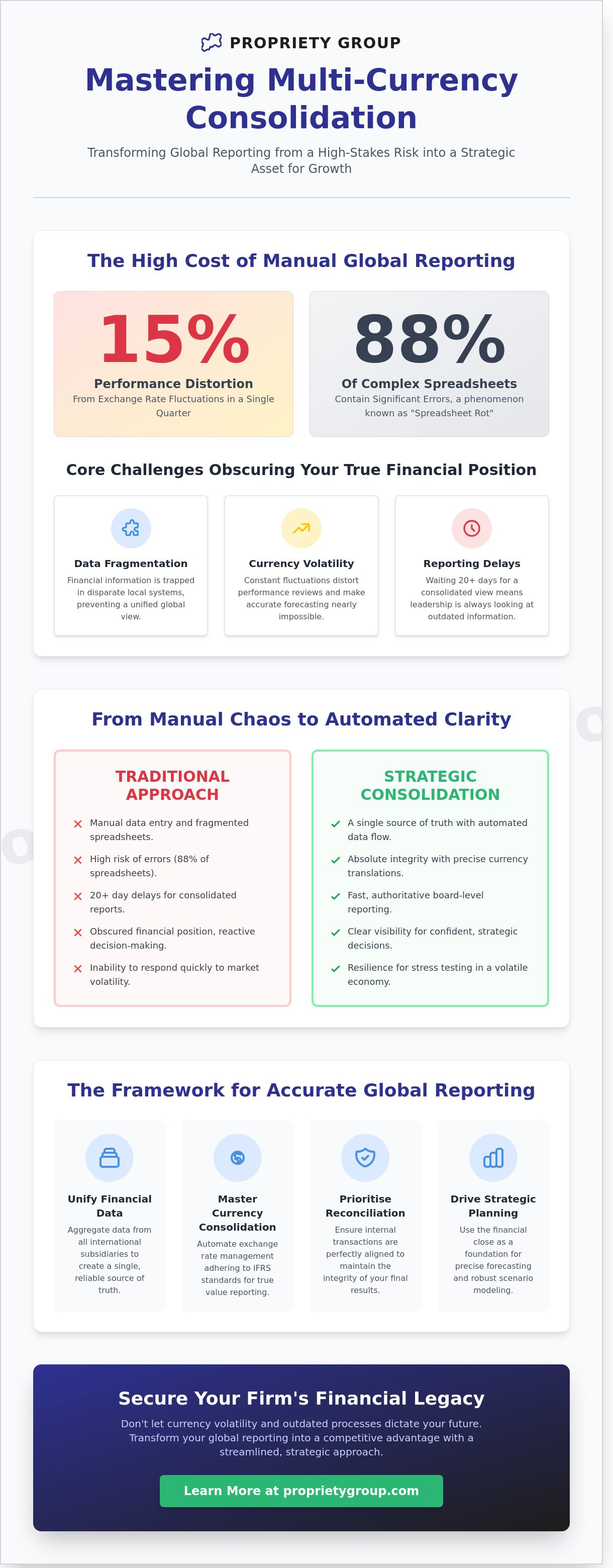
What if the volatility of the British Pound didn't just represent a risk to your balance sheet, but served as the very catalyst for your next phase of global growth? For many UK finance leaders, the reality of 2024 involves managing a complex web of international entities where exchange rate fluctuations can distort performance by as much as 15% in a single quarter. You likely recognise that the traditional reliance on manual data entry and fragmented spreadsheets creates a reconciliation nightmare that obscures your true financial position. We agree that this lack of real-time visibility isn't just an administrative burden; it's a barrier to confident, strategic decision-making.
This guide will show you how to master multi-currency consolidation, transforming your global reporting from a source of friction into a streamlined, strategic asset. You'll learn how to establish a single source of truth that automates currency translations with absolute integrity and precision. We'll examine the specific steps to move beyond manual errors toward faster, more authoritative board-level reporting that secures your organisation's financial legacy.
Key Takeaways
- Learn how to unify financial data from international subsidiaries to gain a clear, aggregated view of your organisation’s global performance.
- Master the art of multi-currency consolidation by establishing a meticulous framework for exchange rate management that ensures every report reflects true value.
- Discover why prioritising intercompany reconciliation is essential for maintaining the integrity of your results and ensuring internal transactions are perfectly aligned.
- Shift your perspective to view the financial close as a foundation for strategic planning, allowing for more precise forecasting and scenario modelling.
- Explore how unified data provides the resilience needed to conduct stress testing in a volatile global economy, securing your firm's long-term legacy.
What is Multi-Currency Consolidation and Why Does It Matter?
Multi-currency consolidation is the meticulous process of unifying financial data from various international subsidiaries into a single, cohesive presentation currency. For a UK-based group, this typically involves translating local accounts into British Pound (GBP) to ensure a clear view of global performance. Precision is paramount. Without this alignment, leadership teams can't accurately assess the health of their legacy or the value of their collective assets.
To better understand this concept, watch this helpful video:
Growth is a testament to a brand's vision, yet it introduces a friction that can erode operational excellence. When a firm expands into its fifth or tenth international market, traditional reporting often falters. This complexity requires a sophisticated approach to multi-currency consolidation and the identification of the functional currency for each entity. The ultimate goal is to establish a single source of truth finance for the entire organisation, ensuring every decision is backed by integrity.
The Core Challenges of Manual Global Reporting
Manual reporting often suffers from spreadsheet rot. This occurs when hidden formulas or outdated exchange rates lead to material errors in the final accounts. Research suggests that 88% of complex spreadsheets contain significant errors. For a group managing £50 million in turnover across multiple jurisdictions, a small error in a conversion formula can result in a £500,000 discrepancy. This risk compromises the reliability of the entire financial statement.
Managing multiple bank accounts and local tax requirements adds another layer of difficulty. Each jurisdiction, from the UK's HMRC regulations to local European VAT rules, demands bespoke attention. Common issues include:
- Data Fragmentation: Information trapped in separate local systems.
- Currency Volatility: Fluctuations that distort monthly performance reviews.
- Reporting Delays: Waiting 20 days for a consolidated view means looking at the past, not the present.
When reporting is delayed, leadership loses the ability to be agile. In a volatile market, precision and speed are the hallmarks of a secure and visionary business.
Best Practices for Accurate Currency Translation and Reporting
Establishing a meticulous framework for exchange rate management forms the bedrock of a reliable multi-currency consolidation. Finance leaders must decide between using average rates for income statements and period-end rates for balance sheets. This choice ensures that the financial narrative remains coherent across different jurisdictions. Adhering to the International Financial Reporting Standards (IFRS) for currency translation provides a clear, principled path for these decisions, ensuring that your reports meet global expectations for transparency.
Precision requires more than just picking a rate; it demands total data integrity. You must prioritise intercompany reconciliation to prevent internal transfers from distorting your final figures. When data flows from diverse global entities, standardising the input format is essential. Shifting from reactive manual gathering to a proactive, automated flow ensures that your legacy of financial accuracy remains untarnished. This transition allows teams to focus on strategy rather than simple data entry.
Understanding Translation Methods: Current vs. Temporal
The Current Rate Method involves translating most financial items using the exchange rate active on the balance sheet date. This approach is common when a subsidiary operates with a high degree of independence. In contrast, the Temporal Method is used when a subsidiary’s functional currency matches the parent company’s, requiring specific historical rates for certain assets. Your choice of method depends entirely on how closely integrated your global offices are with the central head office.
The Role of Automation in Reducing Financial Risk
Manual spreadsheets often introduce subtle errors that compound over time, creating significant risk during multi-currency consolidation. Modern financial consolidation software removes this human element, replacing it with a bespoke, automated workflow. Real-time revaluation allows your team to see the impact of currency shifts immediately, rather than waiting for month-end reports. This level of visibility transforms financial management from a retrospective task into a strategic advantage. Refined organisations often find that adopting professional financial systems provides the long-term security needed for global growth.
Transforming Consolidation into a Competitive Advantage
The month-end close is often viewed as a finish line. This perspective is limiting. For a global enterprise, the completion of multi-currency consolidation represents the starting point for high-level strategic planning. When numbers are final, they become the foundation for stress testing and scenario modelling. In a climate where the British Pound can fluctuate by 5% or 10% against major currencies in a single quarter, having unified data is vital. Leaders use this clarity to simulate how future market shifts might impact the group's £-denominated bottom line.
We call this connected planning. It ensures that the performance of global subsidiaries directly informs the board's strategic decisions. This approach relies on the concept of propriety, ensuring multi-currency consolidation remains a source of truth rather than a source of confusion. In finance, propriety means maintaining the highest standards of reporting ethics and accuracy. It's about building a legacy of trust through numbers that are beyond reproach.
Beyond Software: The Importance of Strategic EPM Advisory
Software isn't a silver bullet. A tool is only as effective as the logic behind its configuration. Professional epm advisory bridges the gap between technical capability and a CFO's long-term vision. It involves a meticulous analysis of the business environment to ensure the system reflects actual operational needs. Our PG Care model provides this ongoing support. It ensures that as your business scales from £50 million to £500 million in turnover, your systems remain optimised for growth and continue to deliver the precision your stakeholders expect.
Securing Your Global Financial Future
Mastering the complexities of international finance requires more than just balancing books. It demands a meticulous approach to how data flows across borders. By implementing best practices for currency translation, your finance team moves beyond simple reporting and enters the realm of strategic foresight. Efficient multi-currency consolidation ensures your global figures remain accurate and ready for scrutiny under UK standards like FRS 102. A 2023 report by Gartner indicates that automated finance processes can reduce manual errors by up to 40%.
Propriety Group brings a principled perspective to this challenge. We specialise in bespoke EPM and CRM implementations that turn fragmented data into a clear narrative of growth. Our expert-led PG Care support model provides long-term security; our focus on AI and predictive analytics helps CFOs use past data to forecast future trends with confidence. We view financial architecture as a means of creating enduring value for your organisation.
Discover how Propriety Group’s advisory services can refine your global financial close
The path to a seamless close is built on precision and purpose. We're ready to help you establish a legacy of financial excellence.
Frequently Asked Questions
What is the difference between functional currency and presentation currency?
Functional currency is the primary currency of the economic environment where a subsidiary operates, whereas presentation currency is the currency used for the group's final reports. It's a vital distinction for accurate multi-currency consolidation and determines how translation gains are recorded. Under UK accounting standard FRS 102, firms must meticulously identify these currencies to ensure financial integrity. This clarity allows stakeholders to understand the true performance of each bespoke operation within the wider group.
How often should exchange rates be updated for multi-currency consolidation?
Visionary finance teams now update exchange rates daily to ensure their financial position remains an accurate reflection of global market conditions. While a 2023 industry survey found that 40 percent of firms still use monthly updates, this approach often leads to surprises during the close. Real-time data provides the precision required for high-level decision-making. It ensures that your reporting maintains a standard of propriety and avoids the distortions caused by sudden currency shifts.
What are the biggest risks in manual multi-currency reporting?
The most significant risks in manual reporting include version control issues, formula errors, and the failure to properly eliminate intercompany transactions. Research indicates that 88 percent of spreadsheets used in large organisations contain at least one major error. These inaccuracies don't just delay the month-end process; they can lead to incorrect tax filings in the UK. Maintaining the legacy of your firm requires a move away from fragile, manual processes toward more secure, automated systems.
Can EPM software automate the entire consolidation process?
Modern Enterprise Performance Management software can automate the majority of the technical consolidation process, including data ingestion and currency translation. These tools provide a sophisticated framework for multi-currency consolidation, yet they don't replace the need for expert human review. Professional oversight is vital to interpret strategic insights and ensure the system's logic adheres to current UK regulations. This combination of technology and human expertise creates a foundation of trust and long-term security for the group.