
The Financial Planning and Analysis Maturity Model: A Strategic Roadmap for 2026

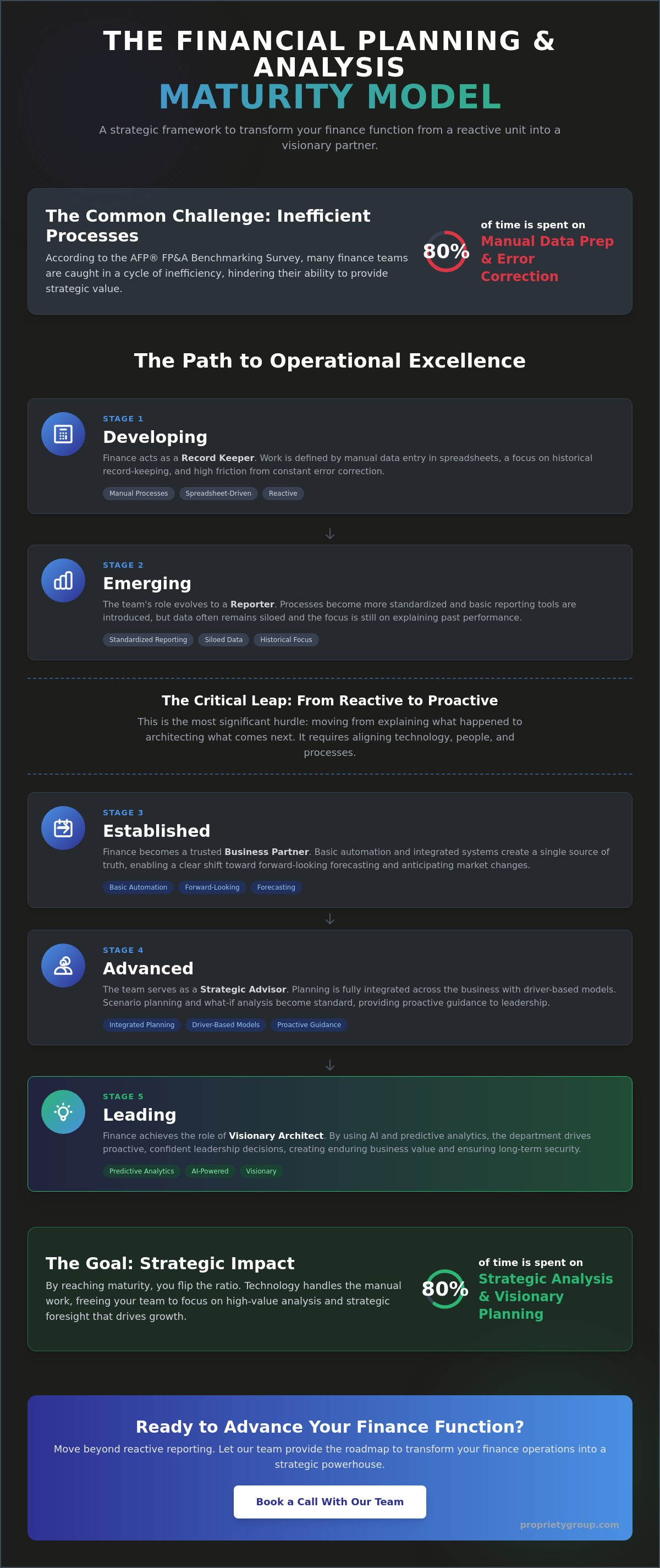
The 2026 AFP® FP&A Benchmarking Survey reveals that finance leaders across 54 countries are struggling to translate strategy into execution, even with substantial technological investments. You likely recognize this friction within your own operations. It's a common burden to see your team spend 80% of their energy on manual data preparation rather than high-level analysis. This article provides a sophisticated framework to help you move past these operational hurdles. By understanding the financial planning and analysis maturity model, you can transform your finance function from a reactive unit into a visionary strategic partner.
We'll examine the five stages of operational maturity and outline a practical roadmap toward predictive planning. This journey ensures your technology choices reflect a commitment to excellence and long-term security. You'll gain the clarity needed to lead with quiet confidence and precision, ensuring every decision is backed by a single source of truth. By aligning human experience with intentional design, you can move beyond simple reporting to create enduring value for your organization.
Key Takeaways
- Identify your current standing within the five stages of the financial planning and analysis maturity model to create a clear path toward operational excellence.
- Learn how to bridge the difficult gap between explaining past performance and providing the strategic foresight needed for future growth.
- Discover how modern software serves as a platform for execution, linking operational actions directly to financial outcomes through driver-based planning.
- Understand the shift toward becoming a visionary partner by utilizing advanced tools that prioritize precision and long-term business security.
The Architecture of Excellence: Defining the FP&A Maturity Model Stages
A financial planning and analysis maturity model is far more than a simple assessment tool; it's a strategic framework used to evaluate the effectiveness, sophistication, and strategic value of a finance department. This structure provides a clear path for organizational growth, much like the foundational Capability Maturity Model used to standardize complex processes. By defining clear benchmarks, leaders can move away from fragmented reporting and toward a single source of truth that informs every major business decision.
To better understand how these functions operate within a modern business, watch this helpful video:
The model typically progresses through five distinct stages, moving from manual, reactive spreadsheet work to automated, predictive intelligence. Understanding your current stage is the essential first step toward replacing inefficient habits with a holistic approach to data. This evolution requires a commitment to excellence and a focus on long-term security, ensuring that finance moves from a supporting role to a position of prestige and influence. It's about aligning human experience with intentionality to create enduring value.
The Five Stages of Financial Evolution
Progressing through the stages requires a blend of precision and craftsmanship in how data is handled. Each step represents a higher level of competence and a more refined narrative for the business.
- Stage 1: Developing. This phase is characterized by manual data entry and a heavy focus on historical record-keeping. It's often a period of high friction where teams spend most of their time correcting errors rather than analyzing trends.
- Stage 3: Established. Here, we see the introduction of basic automation and a clear shift toward forward-looking forecasting. Finance begins to anticipate market changes, moving beyond simply explaining what happened in the past.
- Stage 5: Leading. This final stage is the point where finance becomes a visionary architect of business value. By utilizing Financial AI Solutions and predictive analytics, the department drives proactive, confident leadership decisions.
Reaching the highest level of maturity ensures that your organization remains resilient in volatile environments. It requires a blend of high-level expertise and the right technological foundation to maintain standards of correctness. To discuss how your organization can advance through these stages, book a call with the team today.
Bridging the Gap: Moving from Reactive Reporting to Strategic Insight
The most significant hurdle within the financial planning and analysis maturity model occurs during the transition from Stage 2 to Stage 3. It's the moment when a finance team stops merely explaining the past and begins to architect the future. This evolution isn't just about technical upgrades. It requires a deliberate alignment of human experience, intentionality, and a unified digital space where collaboration can flourish. When these elements meet, finance moves from a support function to a position of prestige.
To navigate this complex shift, organizations need a reliable roadmap. Professional epm advisory provides the strategic framework necessary to move from opinion-based decisions to data-driven strategies. This transition is essential for maintaining resilience in 2026. It ensures that every management action is backed by precision and a commitment to excellence, moving the needle from reactive reporting to visionary partnership.
Identifying the Barriers to Maturity
Progress often stalls because of a common objection: teams feel they don't have time to change. However, the true cost lies in the hours lost to manual errors and repetitive data cleaning. If your staff spends 80% of their energy on preparation rather than analysis, the business remains in a reactive state. This friction is a clear signal that the current process lacks the craftsmanship required for high-level performance. It's a cycle that traps talent in low-value tasks.
Fragmented data sources also act as a heavy anchor on financial growth. When information is siloed across different systems, a single source of truth becomes impossible to maintain. Overcoming this requires shifting the team culture. Finance professionals must evolve from being gatekeepers of data to becoming essential business partners. This transformation allows them to provide the strategic insight that drives long-term security. If you are ready to refine your approach, you might consider how to discuss your unique strategic goals with an expert.
The Catalyst for Growth: Leveraging EPM and AI to Achieve Advanced Maturity
In the 2026 landscape, software is no longer a simple utility. It is the execution platform for corporate strategy. To advance through the financial planning and analysis maturity model, leaders must view their digital infrastructure as a means of creating enduring value. Implementing modern EPM software enables driver-based planning. This approach links business results directly to operational actions, providing a level of precision that manual spreadsheets can't replicate. It's about building a foundation of permanence and reliability.
With the integration of AI and predictive analytics, finance teams can perform rigorous Stress Testing and scenario modeling with unprecedented accuracy. These tools allow for a high level of competence when navigating volatile markets, ensuring that every strategic move is backed by certainty. However, achieving maturity isn't a one-time event. The PG Care model serves as the essential support system to maintain these standards of correctness and ethics long after the initial implementation is complete.
Building Your Maturity Roadmap
A successful transition requires a steady, measured rhythm. It begins with a deep understanding of your current environment before moving toward granular execution.
- Step 1: Environment Analysis. Conduct a thorough review to identify where your data is currently fragmented. This transparency is vital for creating a single source of truth.
- Step 2: Platform Selection. Focus on selecting an EPM platform that aligns with your specific industry requirements. The choice should reflect a commitment to excellence and functional aesthetics.
- Step 3: AI Integration. Incorporate financial AI solutions to automate the most time-consuming elements of forecasting. This allows your team to focus on the alignment of human experience and intentionality.
The journey toward becoming a visionary strategic partner requires both the right tools and expert-led guidance. If you're ready to transform your finance function into an engine for sustainable value, book a call with our team today.
Architecting Your Financial Future
Moving through the financial planning and analysis maturity model is a deliberate process that replaces operational friction with precision. We've explored how identifying your current stage allows you to bridge the gap between historical reporting and forward-looking insight. By leveraging advanced software as an execution platform for strategy, your finance team evolves into a visionary partner. This transformation ensures long-term security and creates a single source of truth that empowers the entire organization.
Since 2019, our team has specialized in the implementation of EPM software with a focus on CFO empowerment and strategic growth. We provide an expert-led narrative that balances corporate professionalism with a commitment to craftsmanship. Through the subscription-based PG Care model, we offer the ongoing support necessary to maintain your progress and uphold standards of correctness. To begin your journey toward advanced maturity, book a discovery call with our advisory team to assess your FP&A maturity. The path to predictive leadership starts with a single, intentional step.
Frequently Asked Questions
How long does it take to move from one stage of the FP&A maturity model to the next?
The transition between stages typically requires twelve to twenty-four months of focused effort. This timeline reflects the need to align human experience with new technological standards. It's a journey of refinement rather than a quick fix. Success depends on the steady adoption of new processes and the elimination of fragmented data habits that hinder progress.
Is a high level of FP&A maturity only achievable for large enterprises?
Advanced maturity is accessible to any organization that prioritizes precision and strategic alignment. While large enterprises often have more resources, smaller firms benefit from greater agility and fewer organizational silos. The financial planning and analysis maturity model serves as a principled guide for any leadership team aiming to create enduring value through data.
Can software alone solve our maturity challenges, or do we need advisory support?
Software acts as the essential execution platform, but advisory support provides the strategic vision required for true transformation. Technology alone cannot resolve underlying process inefficiencies or cultural resistance. Expert guidance ensures that your digital space is designed with intentionality, matching your specific operational needs with the right technical capabilities and standards of correctness.
What is the role of AI in the 2026 FP&A maturity model?
AI functions as a core capability that moves finance teams from reactive reporting to predictive intelligence. By 2026, it's the primary engine for automating manual tasks and conducting sophisticated scenario modeling. This technology allows professionals to focus on their role as strategic architects, ensuring the financial planning and analysis maturity model is fully realized through high-level expertise.
Achieving a visionary finance function requires a balance of sophisticated technology and expert-led strategy. To define your specific path toward excellence, book a call with our team today.