
How to Structure a Finance Team for Growth: A Strategic Framework for 2026

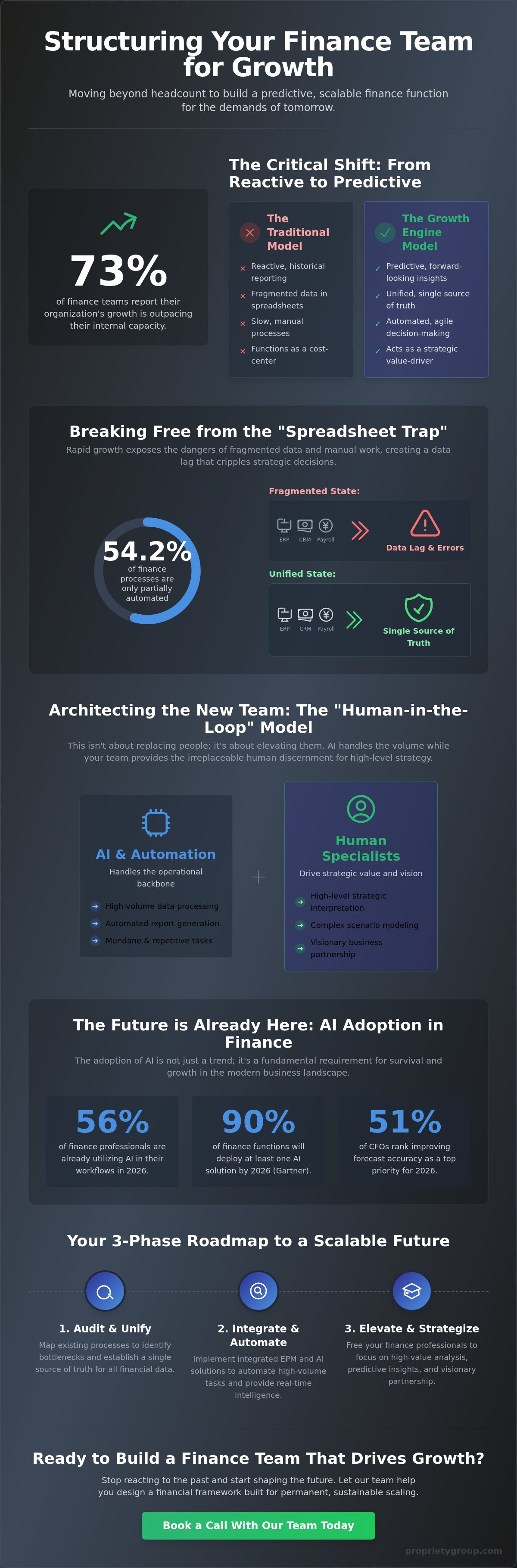
Seventy-three percent of finance professionals now report that their organizations are growing at a pace that outstrips their internal capacity to keep up. This reality suggests that the traditional approach to departmental scaling is no longer sufficient for the demands of 2026. If you are evaluating how to structure a finance team for growth, you likely realize that adding more headcount is not the solution to fragmented reporting or slow decision-making.
We recognize the frustration of relying on manual spreadsheets while attempting to provide the strategic vision your leadership expects. It's a difficult balance to maintain; reactive planning often consumes the hours needed for deep, impactful analysis. This article provides a strategic framework to evolve your finance function into a predictive engine built for scalable expansion. We'll explore how to unify your data, align your hiring roadmap with modern technology, and transition your team into a visionary partner that drives long-term value. To discuss how these strategies apply to your specific organizational goals, book a call with our team today.
Key Takeaways
- Shift your finance function from a traditional reporting role into a visionary department that actively identifies opportunities for organizational expansion.
- Discover how to structure a finance team for growth by balancing specialized human expertise with integrated software that provides a single source of truth.
- Implement a model where automated solutions handle high-volume tasks, freeing your professionals to focus on high-level strategy and predictive insights.
- Follow a clear, phased roadmap to audit your existing processes and implement a technology path that supports permanent, sustainable scaling.
- Ensure long-term reliability for your financial systems by booking a call with our team to explore a tailored support and implementation plan.
Beyond Headcount: The Evolution of the Growth-Oriented Finance Function
The traditional model of a finance department often resembles a fortress; it is secure but frequently isolated. In this legacy view, the team exists primarily to record history and ensure compliance. However, as we look toward the 2026 business environment, the definition of success has shifted. A growth-oriented finance structure is no longer a cost-center. It's a value-driver. When you consider how to structure a finance team for growth, you must look beyond simply adding more people to manage increasing transaction volumes. True scalability requires a team that functions as a predictive engine.
In 2026, 56% of finance professionals are already utilizing AI in their workflows. This shift isn't just about efficiency. It's about survival. Traditional, siloed departments often fail during rapid scaling because they suffer from a significant data lag. By the time a report reaches a decision-maker, the information is already cold. Understanding how to structure a finance team for growth requires moving toward a model where current data influences future outcomes.
To better understand this concept, watch this helpful video:
From Historical Reporting to Predictive Insight
Many finance leaders still operate using a "rearview mirror" approach. They spend their energy reconciling the past month's activities rather than shaping the next quarter's results. A growth-ready structure prioritizes forecasting and scenario modeling over basic bookkeeping. With 51% of CFOs ranking the improvement of forecast accuracy as a top priority for 2026, the mandate is clear. You can explore how a strategic framework supports this transition through our EPM Advisory services. This shift allows your team to provide forward-looking leadership that anticipates market changes before they impact the bottom line.
The Cost of Fragmentation in a Scaling Business
Rapid growth often exposes the "spreadsheet trap." When teams rely on manual data entry across disconnected files, strategic analysis becomes impossible. This fragmentation creates a dangerous lack of clarity. While standard corporate structures often separate departments into functional silos, a scaling business requires a single source of truth. Currently, 54.2% of finance leaders report that their processes are only partially automated. This reliance on manual intervention prevents the agile decision-making necessary for expansion. Establishing a unified data environment ensures that every hire and every investment is backed by reliable, real-time intelligence. To begin refining your team's architecture, book a call with our team today.
Architecting the Team: Balancing Specialist Expertise with Connected Technology
Building a team capable of supporting 10x expansion requires a blueprint that balances human discernment with digital precision. When you determine how to structure a finance team for growth, the focus shifts from transactional efficiency to strategic depth. This evolution demands new archetypes. You need FP&A specialists who interpret complex patterns and Data Architects who ensure information flows seamlessly across the enterprise. These professionals don't just manage books; they design the systems that allow for permanent, scalable expansion.
We advocate for a "Human-in-the-Loop" model. In this framework, AI handles the immense volume of data processing while your team focuses on high-level strategy. This isn't about replacing people; it's about elevating them. By integrating EPM software into daily workflows, you automate the mundane tasks that typically lead to burnout and data lag. This allows your team to act as "Translators," bridging the gap between financial data and operational reality to ensure every department moves in unison.
The Role of AI and Automation as a Team Member
Modern workforce planning relies on Financial AI Solutions to provide a backbone for decision-making. Utilizing AI for FP&A significantly reduces the need for large, transactional departments. Since Gartner predicts that 90% of finance functions will deploy at least one AI-enabled solution by 2026, these tools are no longer optional. They create a lean environment where predictive intelligence is the standard. If you want to see how these tools fit your vision, book a call with our team to discuss a tailored implementation.
Designing for Connected Planning
A growth-oriented team must break down the traditional silos between HR, Sales, and Finance. This is the essence of connected planning. Before hiring new staff, perform a thorough environment analysis to identify where data gaps exist. This ensures that every new hire serves a specific purpose in your broader strategic roadmap as you refine how to structure a finance team for growth. By prioritizing roles that connect different business functions, you create a resilient structure that scales without the need for constant, reactive hiring.
Implementing the Growth Framework: A Strategic Roadmap
Transitioning to a modern structure is an exercise in precision and craftsmanship. It requires a deliberate roadmap rather than a reactive response to headcount pressures. When you commit to learning how to structure a finance team for growth, the implementation phase becomes your most critical milestone. This isn't merely a software installation; it's a design process that aligns your human talent with your technological infrastructure. We approach this through a phased framework: Audit, Automate, and then Augment.
Many organizations falter because they lack expert guidance during this high-stakes shift. Professional implementation advisory ensures that your team doesn't just adopt new tools, but masters them. This external perspective is vital for identifying blind spots in your current workflow and ensuring your new structure is built for permanence. It bridges the gap between high-level strategy and the granular details of execution.
Auditing the Current Environment
Before you can scale, you must understand where your current reporting cycle stutters. Identify the specific bottlenecks that cause data lag, such as manual reconciliation or fragmented data sources. You should also evaluate your current staff's alignment with your future goals. Are they "strategic-ready" professionals who can interpret predictive insights, or are they "transaction-focused" workers trapped by manual tasks? Understanding this distinction is the first step toward a leaner, more agile team.
Securing Long-Term Scalability with Managed Support
Growth is rarely linear, and your systems must evolve alongside your business. A "set and forget" mindset often leads to technical debt and the return of operational silos. We provide the PG CARE - EPM Solution Support model to ensure your team remains agile long after the initial implementation. This ongoing technical optimization allows your finance function to adapt to shifting market conditions with quiet confidence. Intentionality in team design creates enduring value that manual processes simply cannot replicate. To begin architecting your team's future, book a call with our team today.
The Path to Scalable Financial Excellence
Scaling an organization requires more than just increased operational capacity; it demands a finance function that acts as a visionary partner. By moving away from historical reporting and embracing predictive intelligence, you ensure your team remains a driver of value rather than a bottleneck. Understanding how to structure a finance team for growth is a process of intentional design, where every role and every piece of technology aligns to support permanent expansion.
As a boutique consultancy, we provide a refined approach to team architecture. We are specialists in EPM and CRM software implementation, offering deep expertise in AI-driven predictive analytics to help you build a lean, agile team. Our expert-led narrative prioritizes craftsmanship and precision, ensuring your financial systems provide long-term security and aspiration. To ensure your finance team is architected for the complexities of growth, book a call with our advisory team today. Your journey toward a predictive, growth-ready finance function starts with a single, deliberate step. We look forward to helping you navigate that path with confidence.
Frequently Asked Questions
Is it better to hire a new Controller or implement EPM software first?
Implementing EPM software first is generally the more principled choice for long-term scalability. It ensures that when you eventually hire a Controller, they step into a role defined by visionary strategy rather than one consumed by manual data cleanup. Establishing a single source of truth early creates a standard of correctness that allows your senior talent to focus on high-level advisory work from their first day.
How many people should be in a finance team for a company with £50m turnover?
A company at this scale typically maintains a lean team of four to six specialists when supported by modern technology. The focus on how to structure a finance team for growth has shifted from total headcount to the quality of the digital infrastructure. Using automated tools allows this smaller group to manage complex operations with precision, avoiding the bloat and communication lag common in traditional structures.
What is the difference between a traditional FP&A role and a modern Data Architect in finance?
Traditional FP&A roles center on budget management and historical reporting. A modern Data Architect, however, designs the underlying data environment to ensure seamless integration between different business functions. While the FP&A specialist interprets the financial narrative, the Data Architect creates the permanence and precision required for that data to be reliable. This distinction is vital for maintaining a sophisticated, expert-led finance function.
How can AI help a small finance team compete with larger organisations?
AI empowers smaller teams to execute sophisticated analysis that once required significant manual labor and large back-office departments. By utilizing Financial AI Solutions, a lean department can perform real-time stress testing and predictive modeling with the same authority as a global corporation. This technology removes the burden of repetitive tasks, allowing your professionals to dedicate their intentionality to strategic leadership and long-term value creation.
To refine your team's architecture for the challenges of 2026, book a call with our team today.