
Automating Management Reporting Packs: A Strategic Guide for Finance Leaders

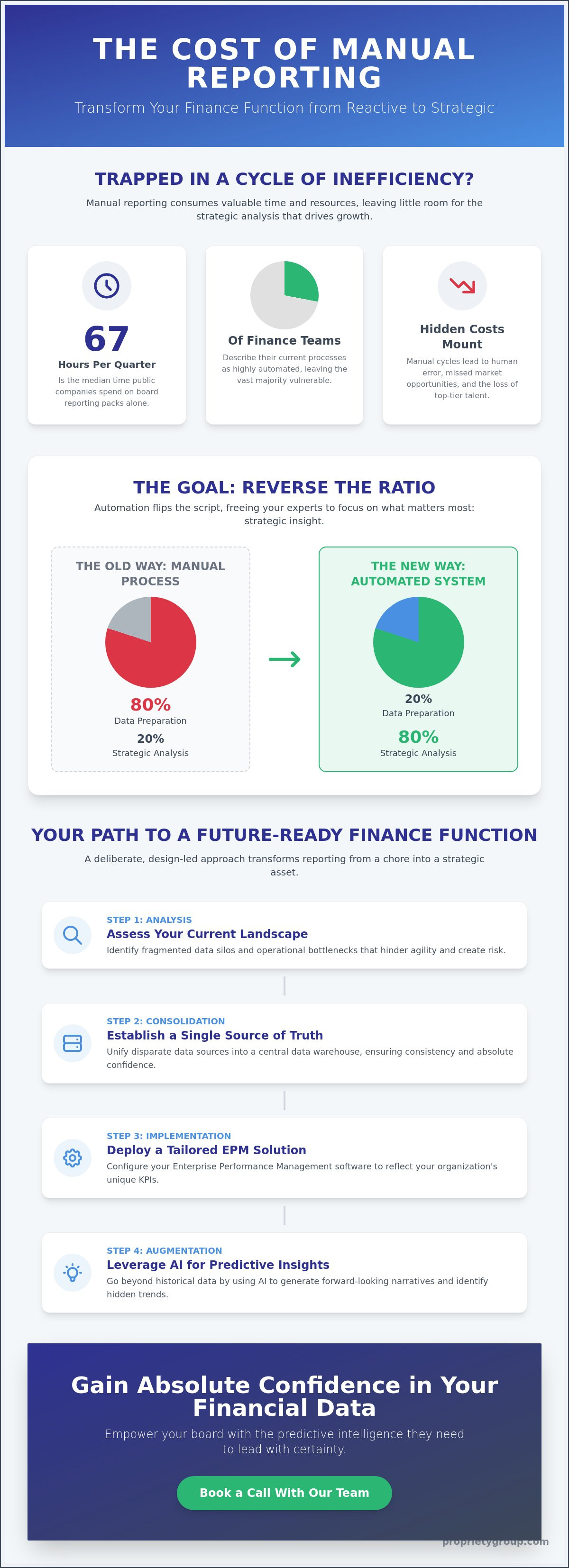
The median public company spends 67 hours every quarter producing the board reporting package alone. It's a significant drain on resources that often results in data that's already outdated by the time it reaches the executive suite. If you find your team trapped in a cycle of manual data extraction and fragmented spreadsheets, you're not alone. Only 28% of corporate finance teams currently describe their processes as highly automated. The risk of human error and the lack of forward-looking insights can make automating management reporting packs feel like a distant luxury rather than the strategic necessity it has become.
You deserve a reporting architecture that reflects the prestige and precision of your organization. This guide outlines how to move beyond manual labor toward a streamlined system that empowers you to provide predictive intelligence to your board. We'll show you how to gain absolute confidence in your financial data while freeing your team to focus on high-level analysis. By aligning your reporting with a visionary, design-led approach, you can transform the finance function into a true engine of strategic growth. To explore how our advisory for EPM can help you achieve this transition, book a call with our team today.
Key Takeaways
- Transition from a reactive reporting cycle to a proactive culture that prioritizes long-term growth and business agility.
- Discover how automating management reporting packs creates a connected ecosystem that eliminates manual errors and fragmented spreadsheets.
- Learn how to establish a central hub for your financial information to provide the board with the high-level precision they require.
- Identify how a thorough analysis of your current landscape ensures your new reporting architecture aligns with your organization's specific goals.
- Understand that achieving a future-ready finance function is a continuous journey of refinement; book a call with our team to discuss your strategic needs.
The Strategic Necessity of Automating Management Reporting Packs
True transformation begins when you stop viewing reports as static documents and start seeing them as a living, connected ecosystem. By automating management reporting packs, you remove the friction of manual data handling and replace it with a fluid stream of information. This shift is essential because a manual cycle forces a reactive stance. You're constantly looking back at what happened, rather than looking forward at what’s possible. Most finance leaders find themselves trapped in a cycle where 80% of their time is consumed by data preparation, leaving only 20% for actual strategic analysis. Reversing this ratio is the hallmark of a sophisticated, future-ready finance function.
To better understand how this shift impacts your daily operations, watch this helpful video:
Beyond Accuracy: The Agility Advantage for Finance Leaders
Precision is more than just a standard of correctness; it's the foundation of trust. When you establish a single source of truth through Business intelligence, you create an environment where every number tells a consistent, ethical story. This level of clarity is vital for real-time course correction. Instead of driving by looking in the rear-view mirror, automation allows you to navigate the future with certainty. This is where EPM advisory becomes a powerful ally. It helps you align your reporting architecture with your broader performance goals, ensuring that your leadership is both visionary and grounded in reality.
Addressing the Hidden Costs of Manual Spreadsheet Cycles
The costs of sticking to manual processes are often invisible until they manifest as missed market opportunities or delayed executive decisions. When reporting cycles take weeks instead of days, your organization loses its competitive edge. There's also a significant human cost. Top-tier finance talent is drawn to organizations that value their intellectual contribution. They don't want to spend their careers fixing broken formulas in spreadsheets. If your reporting cycle remains slow and error-prone, you risk losing the very people who could help you innovate. Transitioning to a sophisticated system isn't just about software. It's about valuing human experience and intentionality. To start your journey toward a more refined reporting structure, book a call with our team today.
Designing an Integrated Architecture for Automated Financial Insights
Creating a sophisticated reporting system requires more than just new tools; it demands a deliberate architectural design. The first step involves a thorough environment analysis to identify fragmented data silos that currently hinder your agility. Once these gaps are understood, the foundation of your system is built upon a data warehouse. This central hub consolidates disparate sources into a single, reliable stream, ensuring that automating management reporting packs is based on a foundation of absolute truth.
With a unified data layer in place, the focus shifts to implementation. This involves configuring your Enterprise Performance Management (EPM) software to mirror your specific business drivers and key performance indicators. It's about ensuring the system speaks the unique language of your organization. This structured approach is central to building a Future-Ready Finance Function, where technology serves human intentionality rather than just processing numbers.
Leveraging AI for Predictive Narrative and Commentary
Modern financial AI solutions go beyond simple calculation. They provide the "why" behind the numbers by identifying trends and variances that might otherwise remain hidden. This human-AI collaboration allows finance leaders to produce board packs that are forward-looking and deeply insightful. By maintaining high standards of correctness and ethics, you can use these predictive tools to enhance your strategic narrative without sacrificing the prestige of your reporting.
Connecting ERP and EPM for Seamless Data Flow
For reporting packs to remain relevant, they must stay connected to live data. A comprehensive EPM platform ensures a seamless flow from your Enterprise Resource Planning (ERP) system, allowing for immediate management action. Unlike simple visualization tools, this integrated approach provides a holistic view of your financial health. If you're ready to refine your data architecture, you might consider how our implementation of EPM software can transform your monthly cycle.
Transitioning to a Future-Ready Finance Function
True transformation is never a destination. It's a continuous process of refinement that begins the moment your implementation concludes. By automating management reporting packs, you're establishing a new standard of excellence that requires ongoing stewardship. This isn't just about technical maintenance. It's about ensuring that your digital architecture continues to reflect the unique intentionality of your leadership. We focus on the alignment of human experience and digital space to ensure your team operates at the peak of their professional capacity.
Our PG CARE - EPM Solution Support model serves as the guardian of this excellence. It provides a structured path for system evolution, ensuring that your reporting remains a source of long-term security and value. This commitment to permanence means your architecture won't become a relic of the past. Instead, it grows as a living extension of your strategic vision, adapting as your organization reaches new milestones.
The First 90 Days: From Implementation to Insight
The initial months following a shift in architecture are critical. Your team will transition toward modern financial close processes that prioritize speed and accuracy. This phase is about more than just learning new software. It's about empowering your leadership to interpret real-time data with confidence. We provide the guidance necessary to ensure your team feels secure and capable in this new landscape.
Sustaining Excellence with Continuous System Optimisation
A sophisticated system requires periodic reviews to maintain its precision. As your business evolves, your reporting must adapt to capture new drivers and market shifts. This proactive approach to automating management reporting packs ensures that your strategic narrative remains sharp and ethical. It's a principled way to manage a business, where every detail is intentional and every report adds enduring value. To explore how our advisory for EPM can support your long-term transformation, book a call with our team today.
Elevating the Standard of Financial Stewardship
Transitioning toward a sophisticated reporting architecture is more than a technical upgrade. It's an act of intentionality that repositions the finance leader as a strategic architect. By automating management reporting packs, you reclaim the time necessary for high-level analysis and visionary decision-making. You've seen how a unified data layer and the integration of predictive intelligence create a foundation for ethical, accurate storytelling that resonates in the boardroom.
As a boutique consultancy specializing in EPM and CRM, we understand that permanence requires more than just software implementation. Our PG Care managed support model provides the long-term security your system needs to evolve alongside your business. With our expertise in AI-driven predictive analytics, we help you navigate the complexities of modern finance with quiet confidence. We invite you to book a call with our specialist advisory team to discuss your reporting transformation. Your journey toward a more refined and purposeful finance function starts here.
Frequently Asked Questions
What are the primary benefits of automating management reporting packs?
The primary benefits of automating management reporting packs include the elimination of manual errors and a significant reduction in the time required for the month-end close. By removing the friction of manual data collection, your team can pivot from record-keeping to strategic analysis. This shift ensures that the board receives precise, timely information that drives proactive decision-making. It's about creating a reporting environment that reflects the excellence and prestige of your leadership.
How long does it typically take to implement an automated reporting solution?
Implementation timelines depend on the complexity of your current data silos and the depth of your reporting needs. A typical journey for a mid-market organization spans three to six months. This timeframe allows for a comprehensive environment analysis and the careful implementation of EPM software. It's a measured approach that ensures every element of the new system is built for permanence and aligns with your organization's unique business drivers.
Can automated reporting handle multi-entity and multi-currency consolidations?
Sophisticated automated platforms are built to handle multi-entity and multi-currency consolidations with ease. These systems manage complex exchange rate movements and intercompany eliminations automatically, ensuring absolute accuracy across all jurisdictions. By establishing a unified data layer, you can produce consolidated reports that are both reliable and ethically sound. This level of precision is vital for organizations operating in a global market where transparency is a prerequisite for stakeholder trust.
Is AI required for effective management reporting automation?
AI isn't a prerequisite for basic automation, but it's essential for leaders who want to move beyond historical reporting. While core automation streamlines the collection and presentation of data, automating management reporting packs with AI provides the predictive intelligence needed to forecast future trends. It helps identify the underlying causes of variances, allowing you to offer a more nuanced narrative to your board. It's a strategic choice for those aiming to achieve a truly future-ready finance function.
To explore how our advisory for EPM can help you navigate these transitions and secure your organization's financial future, book a call with our team today.