
The Evolution of What-If Analysis Tools for Strategic Finance

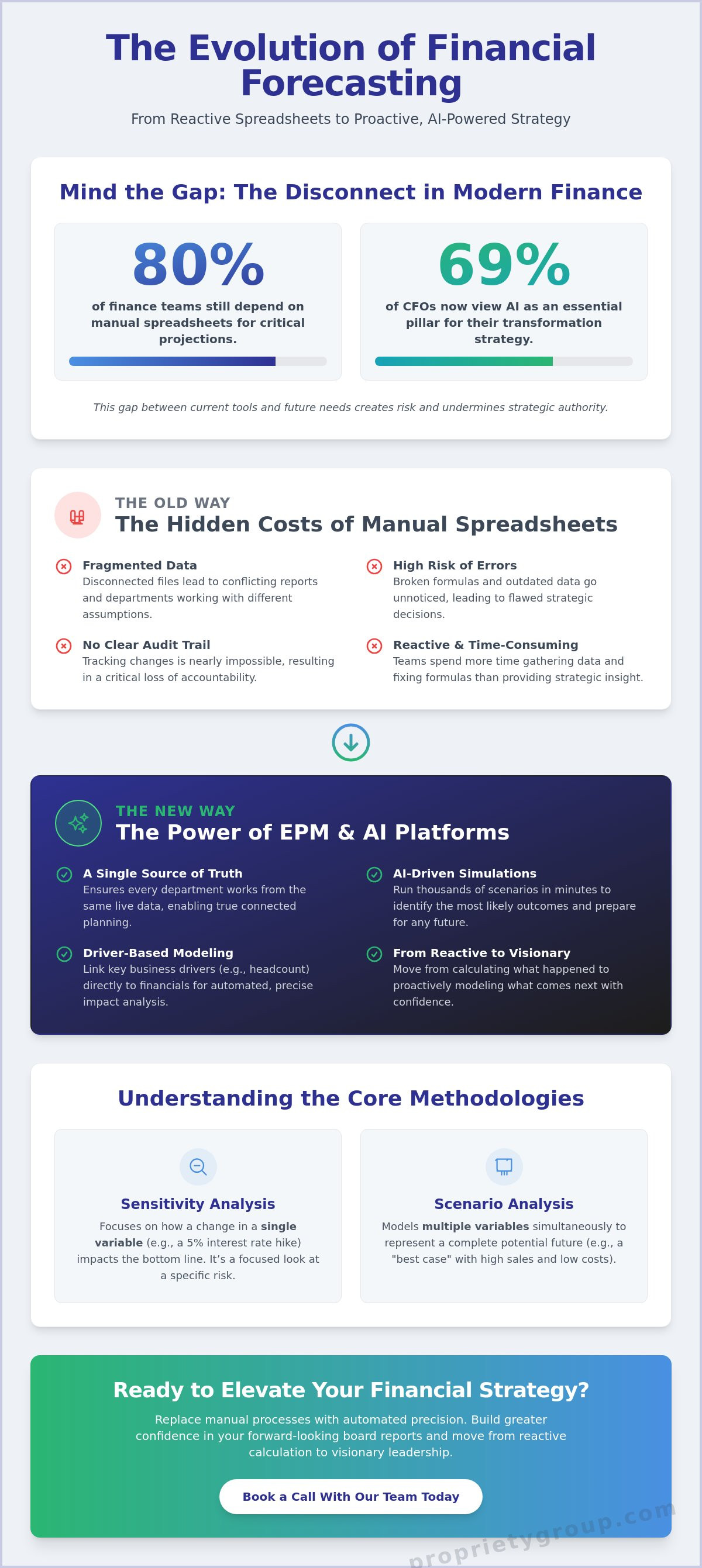
Approximately 80% of finance teams still rely on spreadsheets for their most critical projections, even as 69% of CFOs now view AI as an essential pillar of their transformation strategy. This continued reliance on manual entry often results in fragmented data and errors that undermine the authority of your board reports. You've likely experienced the frustration of trying to run complex scenarios while managing data that lacks real-time integration. Transitioning to modern what-if analysis tools for finance is the necessary step to move from reactive calculation to proactive, visionary leadership.
In this article, you'll learn how to replace manual processes with sophisticated Enterprise Performance Management (EPM) and AI solutions that provide a single source of truth. We'll examine the shift from periodic planning to continuous decision orchestration, allowing you to model financial futures with absolute precision in minutes. This evolution ensures that your strategic choices are grounded in reliability and long-term security. To discuss how these solutions can elevate your financial strategy, book a call with our team today.
Key Takeaways
- Shift from reactive reporting to visionary leadership by learning how to adjust key variables to predict future financial outcomes with precision.
- Discover the critical differences between manual spreadsheets and modern what-if analysis tools for finance that automate data flows and reduce errors.
- Understand how professional EPM platforms provide a single source of truth, allowing for connected planning across your entire organization.
- Explore the power of AI-driven simulations that can run thousands of scenarios in minutes to identify the most likely paths forward.
- Learn how to build greater confidence in your forward-looking board reports and book a call with our team to start your transformation.
Understanding What-If Analysis in a Modern Financial Context
What-if analysis is the deliberate process of adjusting independent variables to observe how they influence your financial outcomes. In a modern context, this isn't just a technical exercise. It's a fundamental shift from reactive reporting to proactive, visionary leadership. By exploring various possibilities, you can prepare for market shifts before they occur. This methodology serves as a cornerstone for epm advisory, allowing leaders to perform rigorous stress testing on their core assumptions.
To better understand the basic mechanics of these concepts, watch this helpful video:
While many teams start with basic spreadsheets, these manual systems often lack the permanence and precision required for high-stakes decisions. Modern what-if analysis tools for finance provide the architectural strength needed to model complex futures without the risk of broken formulas or outdated data.
The Distinction Between Scenario and Sensitivity Analysis
Understanding the nuance between these two methods is vital for strategic clarity. Many professionals start with Sensitivity Analysis, which focuses on how a change in a single variable, such as a 5% increase in interest rates, impacts the bottom line. It's a focused look at a specific risk. In contrast, scenario analysis takes a more holistic approach. It models multiple variables simultaneously to represent a complete potential future. For instance, a "Best Case" scenario for a national expansion would account for high sales volume, low shipping costs, and favorable currency rates all at once.
Why Finance Leaders are Moving Beyond Spreadsheets
Relying on disconnected spreadsheets creates fragmented reporting, where different departments operate under conflicting assumptions. This leads to friction and uncertainty. To achieve true agility, leaders are adopting a single source of truth. Using integrated what-if analysis tools for finance ensures that every department works from the same data set, providing a reliable foundation for every forward-looking report. To see how your organization can transition toward a more precise modeling framework, book a call with our team today.
Evaluating Tools: From Spreadsheet Limitations to EPM Excellence
The landscape of what-if analysis tools for finance is categorized into three distinct tiers. While basic spreadsheets offer familiar flexibility, they lack the structural integrity required for complex modeling. Intermediate Business Intelligence tools provide improved visualization, yet they often struggle with the intricacies of forward-looking projections. True strategic excellence is achieved through Enterprise Performance Management (EPM) platforms. These systems replace manual tinkering with automated, connected data flows, ensuring that every calculation is grounded in reality.
A significant advantage of these advanced platforms is driver-based modeling. In this framework, key business drivers, such as headcount or production volume, are linked directly to your financial statements. When you adjust a single driver, the impact ripples through your entire model automatically. This creates a level of precision that manual entry can't replicate. Before selecting a tool, it's vital to perform an environment analysis to ensure the software aligns with your existing ERP systems. Understanding What-If Analysis in Financial Modeling highlights why this structured approach is superior to ad-hoc calculations.
The Hidden Costs of Manual Modeling
Manual systems carry risks that aren't always immediately apparent. Tracking changes in a shared spreadsheet is notoriously difficult, creating a significant "audit trail" problem where accountability is lost. It's common for broken formulas or outdated data to go unnoticed, leading to flawed strategic decisions. These errors don't just affect a single report; they can compromise the long-term security of the entire organization.
The Advantages of Integrated EPM Solutions
Modern solutions like Board or SAP Analytics Cloud offer "write-back" capabilities, allowing your analysis to inform the budget directly rather than existing in isolation. Real-time data integration ensures that your scenarios are always based on the most current figures available. Propriety Group services assist organizations in configuring these complex environments to ensure they provide a single source of truth. To explore how a custom implementation can secure your financial future, book a call with our team today.
The Future of Foresight: AI and Predictive Analysis
Modern financial leadership is moving beyond the constraints of static modeling. While traditional systems allow you to test a handful of variables, financial AI solutions represent the ultimate evolution in strategic modeling. These systems use machine learning to run thousands of simulations simultaneously, often referred to as Monte Carlo analysis. This provides a probabilistic view of the future rather than just three static outcomes. Understanding What is What-If Analysis? in this advanced context reveals a shift from asking "what if" to determining "what next."
Sophisticated what-if analysis tools for finance now suggest specific management actions based on predicted trends. This transition allows the finance function to act as a visionary partner to the board. It's vital to recognize that AI isn't a replacement for human discernment. Instead, it enhances the craftsmanship and precision of your planning, providing the clarity needed to make high-stakes decisions with absolute confidence. This technology ensures that your strategic output creates enduring value.
Leveraging Predictive Intelligence for Strategic Growth
AI excels at identifying subtle patterns in historical data that might escape even the most seasoned analyst. Whether it's recognizing complex seasonal correlations or predicting the impact of broader economic shifts, predictive intelligence offers a level of depth that manual processes can't match. By utilizing financial AI solutions, your strategy remains resilient and adaptable in an ever-changing market. These what-if analysis tools for finance ensure that your team is prepared for what lies ahead.
Empowering the CFO through Expert Advisory
Technology alone isn't a strategy. Even the most advanced tools are only as effective as the logic and intentionality behind their implementation. Advisory partners play a crucial role in ensuring that your financial architecture aligns with the highest standards of corporate ethics and precision. This collaborative approach transforms raw data into a narrative of reliability and aspiration. True foresight requires a deliberate blend of advanced technology and seasoned expert implementation. To begin your transition toward a more predictive future, book a call with our team today.
Securing Your Financial Legacy through Predictive Precision
The transition from manual spreadsheets to integrated EPM architecture is more than a technical upgrade; it's a commitment to organizational excellence. By embracing advanced what-if analysis tools for finance, leaders can move beyond simple projections to a state of continuous decision orchestration. This evolution allows for the modeling of thousands of scenarios with absolute precision, ensuring that every board report is backed by a single source of truth. Relying on fragments of data is no longer necessary when you can leverage a system designed for permanence and craftsmanship.
True strategic foresight isn't found in software alone but in the alignment of advanced technology with seasoned human judgment. As specialists in EPM implementation and bespoke financial AI solutions, Propriety Group provides the expert-led advisory necessary to transform your financial function into a visionary powerhouse. We focus on creating enduring value through systems that respect both functionality and professional ethics. To ensure your finance team is equipped with the precision of modern foresight, book a call with the Propriety Group team today. Your path to a more certain and aspirational future begins with a single, intentional step.
Common Questions on Financial Foresight
What is the difference between what-if analysis and scenario planning?
What-if analysis focuses on the immediate impact of changing specific variables, while scenario planning constructs entire narratives about the future. You can think of what-if analysis as testing a single lever, such as a localized price increase, to see its direct effect on your margins. Scenario planning combines many of these individual changes to model complex, holistic outcomes like a total market entry or a global supply chain shift. Both methods are essential for maintaining a resilient and visionary leadership position.
Can I perform professional-grade what-if analysis using only Excel?
Excel remains a capable starting point for individual calculations, but it often fails to meet the high standards of enterprise-level precision. High-stakes decisions require sophisticated what-if analysis tools for finance that offer automated data flows and a clear audit trail of every change. Without these professional features, you risk fragmented reporting and hidden formula errors that can lead to costly strategic mistakes. Professional-grade analysis demands a more permanent, secure, and integrated architecture.
How does AI improve the accuracy of financial what-if models?
AI improves accuracy by processing vast amounts of historical data to uncover hidden correlations that aren't visible to the human eye. Instead of relying on a few static assumptions, AI-driven models run thousands of simulations simultaneously to determine the actual probability of various outcomes. This shift toward predictive intelligence allows your team to move from reactive guessing to a more refined, expert-led narrative. It ensures your strategic output is grounded in reliability and long-term security.
What are the most important features to look for in a what-if analysis tool?
The most effective what-if analysis tools for finance prioritize real-time data integration and driver-based modeling. It's vital to look for platforms that offer "write-back" capabilities, which allow your analysis to update your budget or operational plan directly. You should also ensure the tool aligns perfectly with your existing ERP environment to maintain a single source of truth. This alignment of technology and intentionality is what creates enduring value for the modern finance function. To explore how these features can be implemented in your organization, book a call with our team today.