
The Visionary Guide to the Driver-Based Budgeting Model in 2026

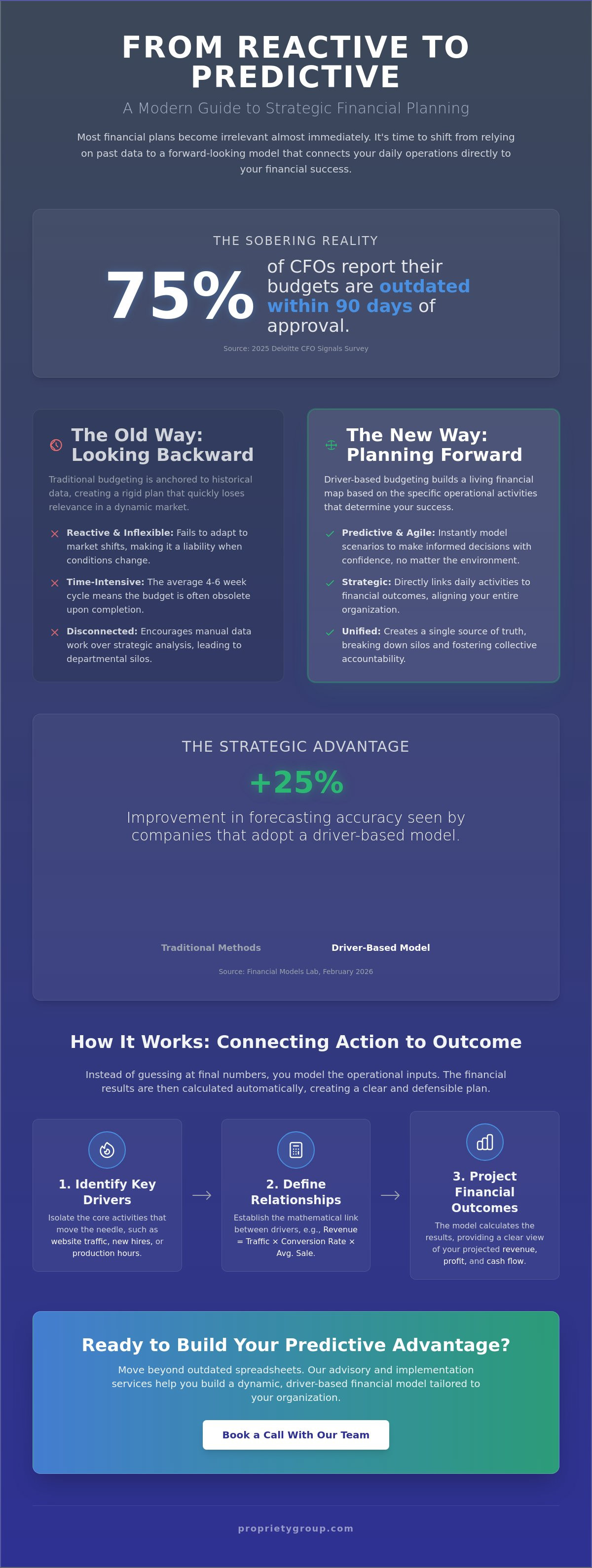
75% of CFOs report that their traditional budgets are outdated within 90 days of approval. This data from the 2025 Deloitte CFO Signals Survey highlights a structural limitation in how many organizations approach their financial future. It's understandable to feel that your finance team spends too much time on manual data entry rather than strategic analysis. Adopting a driver-based budgeting model provides a refined way to bridge this gap by connecting financial outcomes directly to the operational activities that create them. Research from the Financial Models Lab in February 2026 shows that companies making this shift often see forecasting accuracy improve by more than 25% compared to traditional methods.
This guide offers a clear roadmap for moving away from historical guesswork toward a system of predictive intelligence and strategic confidence. You will learn how to create a single source of truth that aligns your operational intentions with precise financial results. We will explore how to use accurate scenario modeling to navigate the complexities of the current year, including new requirements for sustainability reporting. To discuss how our advisory and software implementation services can elevate your planning, please book a call with our team.
Key Takeaways
- Shift your focus from looking at past data to managing the operational activities that define your future performance.
- Discover how a driver-based budgeting model creates a direct link between your daily business actions and your financial success.
- Learn to identify the essential drivers that influence the majority of your results to maintain clarity and avoid unnecessary complexity.
- Gain the ability to model different business scenarios instantly, providing your leadership with the confidence to make informed decisions.
- To see how these strategic planning tools can be tailored to your organization, book a call with our team today.
The Evolution of Financial Planning: Defining the Driver-Based Budgeting Model
Financial planning is maturing into a strategic discipline that values precision over mere calculation. At its heart, a driver-based budgeting model is a methodology that bases financial projections on the operational activities that most influence performance. This represents a fundamental shift. We're moving away from historical-only budgeting and toward a forward-looking, predictive framework. Instead of treating the budget as a static document, we view it as a living map of business intentionality.
To better understand this concept, watch this helpful video:
Traditional models often fail in a volatile market because they rely on patterns that no longer exist. When the environment changes, a budget based on last year's data becomes a liability. Designing a modern model requires a level of craftsmanship. It must be built to reflect the unique nuances of your organization. This approach ensures that your financial plan isn't just a list of numbers; it's a reflection of your strategic identity and a commitment to excellence.
The Limitations of Traditional Historical Budgeting
Looking solely at last year’s numbers creates a reactive culture. It forces leadership to look in the rearview mirror while trying to drive forward. This leads to a significant time lag problem. According to the 2025 AFP Benchmarking Report, the average budget cycle for a mid-market company takes four to six weeks, meaning many plans are obsolete by the time they reach the board. High-performing organizations now use more agile tools like rolling forecasts to maintain relevance. This transition ensures that your planning remains connected to the current reality of the market.
The Core Philosophy: Connecting Activity to Outcome
The strength of this model lies in how it connects daily activity to financial outcomes. Within the broader scope of Financial Planning and Analysis (FP&A), this approach brings a sense of intentionality to your planning. You aren't just setting targets. You're choosing the specific drivers, such as customer acquisition or production hours, that align with your long-term vision. This creates a single source of truth where every team member understands how their work impacts the bottom line. To learn how our strategic performance advisory and software implementation services can help you build this framework, please book a call with our team.
Implementing a Driver-Based Framework with Precision and Intentionality
Transitioning to a driver-based budgeting model is an exercise in intentionality that requires a deep understanding of your business's unique mechanics. Success begins with identifying the critical 20% of drivers that influence 80% of your financial results. This focus prevents the model from becoming an unmanageable collection of data points. Before you begin the implementation, a thorough strategic performance advisory audit is essential to evaluate your current environment. This process uncovers the human experience behind the numbers, ensuring the final framework reflects your specific operational reality rather than a generic template.
Precision relies on establishing a single source of truth. When every department works from the same validated data set, silos disappear and a culture of collective accountability takes root. You must maintain a steady balance between granular detail and strategic clarity. Too much detail obscures the vision; too little makes the model unreliable. If you're ready to define these parameters for your business, book a call with the team to begin your environment audit.
Identifying Internal and External Value Drivers
Internal drivers are factors within your direct control, such as headcount, marketing spend, or production efficiency. External drivers represent market forces that exist outside your immediate influence, such as inflation rates, regulatory changes, or shifting consumer demand. By mapping how internal resources respond to external pressures, you create a holistic view of your business health that remains resilient in any climate.
The 5-Step Process for a Successful Transition
- Environment Analysis: Conduct a rigorous audit to identify existing data silos and process gaps.
- Driver Selection: Collaborate across departments to select the key operational metrics that truly move the needle.
- Relationship Mapping: Build the mathematical links between these operational drivers and your financial line items.
- Stress Testing: Test the model against various scenarios to ensure it provides reliable guidance under pressure.
- Ongoing Support: Establish a structure for continuous refinement through a support model like PG Care.
From Reactive Reporting to Predictive Intelligence: The Strategic Advantage
The true measure of a driver-based budgeting model lies in its ability to transform the finance function from a department of record to a center of predictive intelligence. By grounding financial plans in operational reality, leadership teams gain the clarity needed to lead with quiet confidence. This shift isn't just about efficiency; it's about the ethical imperative of using accurate, unbiased data to guide an organization. When your data is precise, your decisions reflect a commitment to excellence and long-term security. This approach effectively removes the burden of manual data entry, allowing your finance professionals to transition into high-value advisory roles that create enduring value.
Empowering Leadership through Scenario Modelling
In a traditional environment, testing a new business direction can take weeks of spreadsheet manipulation. With sophisticated scenario modelling, leaders can now evaluate "what-if" possibilities in seconds. Whether you're considering a new market entry or adjusting for supply chain shifts, the impact on your bottom line is immediately visible. The integration of AI in finance further enhances these predictive capabilities, identifying subtle patterns that human analysis might overlook. This speed doesn't sacrifice depth; it provides the rhythmic steady flow of information required for agile, principled leadership.
The Role of Professional Advisory in Sustaining Excellence
Successful implementation is merely the beginning of the journey. Maintaining a high-performance planning environment requires a partner who understands both the granular technical execution and the overarching strategic vision. A principled visionary approach ensures your tools evolve alongside your business. Excellence is not a static state but a continuous pursuit of alignment between your human experience and your financial outcomes. We invite you to take the first step toward a more certain and prosperous future. To discuss how our enterprise performance advisory and software implementation services can support your goals, please book a call with our team today.
Securing Your Strategic Future Through Precision Planning
Transitioning to a driver-based budgeting model is more than a technical upgrade; it's a commitment to organizational clarity and intentionality. By aligning your financial results with real-world operational activities, you move beyond the limitations of static data into a space of predictive intelligence. This shift empowers your leadership with the confidence to navigate volatility with poise and precision. It ensures that every strategic decision is rooted in a single source of truth that reflects your unique business architecture.
As a boutique consultancy founded on the principles of craftsmanship, we've specialized in EPM and CRM integration since 2019. Our approach focuses on creating enduring value through meticulous implementation and long-term system optimization via our PG Care support model. We understand that excellence requires both a visionary strategy and a steady hand in execution. To discover how these sophisticated planning methods can transform your organization, book a call with our expert team today. We look forward to helping you build a more resilient and certain future for your organization.
Frequently Asked Questions
How many drivers should be included in a driver-based budgeting model?
Focus on the 10 to 15 most material and controllable variables when designing your driver-based budgeting model. Overcomplicating the framework with dozens of minor metrics often leads to diminishing returns and a lack of clarity for leadership. By isolating the most significant drivers, such as sales rep productivity or average deal size, you maintain a precise and manageable system that reflects your strategic intentionality.
Can a driver-based model work if our data is currently fragmented or messy?
Yes, a driver-based budgeting model can be implemented even if your current data is fragmented. The process begins with a rigorous environment analysis to identify silos and establish a single source of truth. By prioritizing data integrity during the implementation phase, you transform messy inputs into a reliable foundation. This structural refinement ensures your financial planning is built on a standard of correctness that provides long-term security.
What is the main difference between driver-based budgeting and traditional budgeting?
The primary difference is that traditional budgeting relies on historical precedent, while this approach focuses on the operational activities that create results. Instead of just setting a revenue target, you model the specific actions required to achieve it. This fundamental shift ensures your budget is a forward-looking map of physical reality rather than a reactive reflection of the past. It provides leaders with the context needed for truly informed decision-making.
How often should the drivers in our financial model be reviewed and updated?
You should review your drivers at least quarterly, though high-performing organizations often move to a monthly cadence. Market conditions change rapidly; what was a primary driver in January might lose its materiality by June. Regular stress testing and updates ensure your model remains agile and accurate. This steady rhythm of refinement allows you to maintain predictive intelligence and align your strategy with the evolving needs of your business environment.
To discuss how our advisory and implementation services can help you refine your planning process, please book a call with our team.