
Scenario Planning in Finance: Strategic Examples for Forward-Looking Leadership

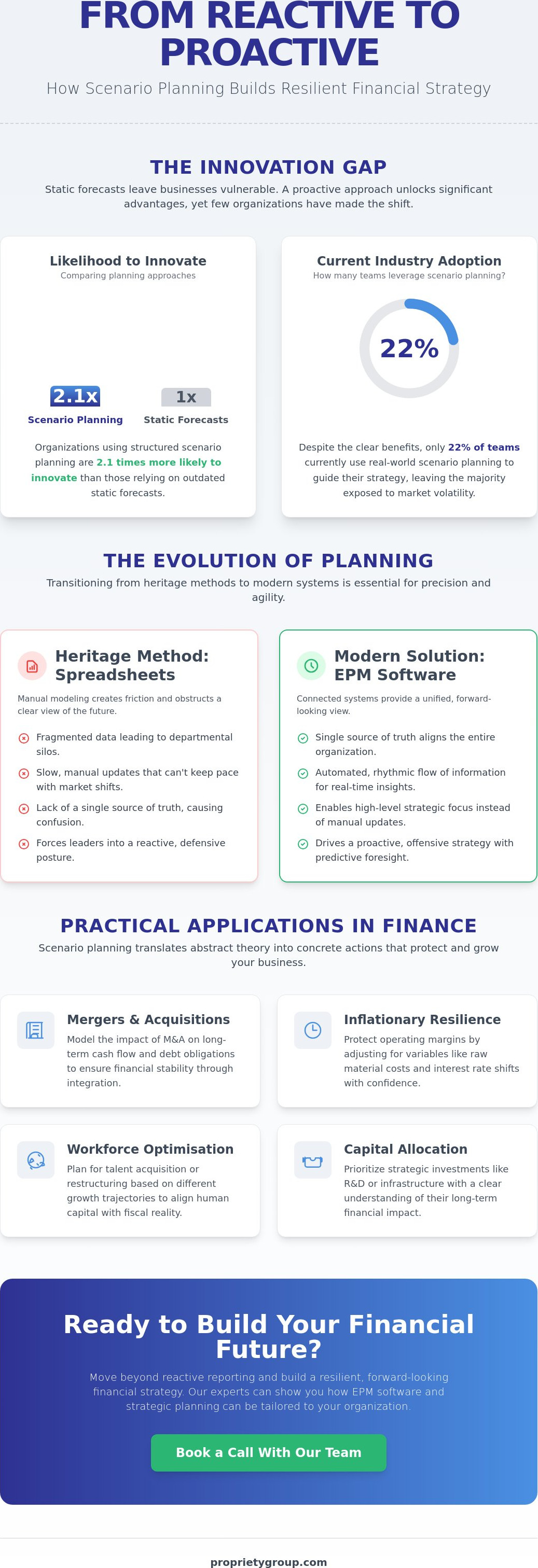
Organizations that utilize structured scenario planning are 2.1 times more likely to innovate than those that rely on static forecasts. It's a striking figure. Yet, industry data shows that only 22% of teams currently leverage real-world scenario planning in finance examples to guide their strategic intent. In an economic climate where shifting base rates and persistent inflationary pressures demand constant vigilance, the ability to pivot with precision is a requirement for excellence. You've likely experienced the frustration of fragmented reporting or the lack of confidence that stems from slow, manual modeling during market shifts. These obstacles often force leaders into a reactive posture that obscures the path to long-term security.
This article provides the clarity you need to transition from defensive forecasting to offensive strategy. You'll gain a clear framework for implementation and concrete examples to share with your board. We also explore how EPM software automates these processes for greater accuracy. By aligning human intentionality with sophisticated data tools, you can drive enduring value even in uncertain times. To discuss how these strategies can be tailored to your organization, book a call with our team today.
Key Takeaways
- Replace static budgeting with a sophisticated framework. It's the most effective way to ensure your responses to market volatility remain intentional and rhythmic.
- Examine practical scenario planning in finance examples to model the impact of acquisitions on long-term cash flow and debt obligations with precision.
- Identify the strategic drivers that allow your team to achieve true predictive foresight. It's time to move beyond the limitations of fragmented reporting.
- Protect your operating margins by learning to adjust for variables like raw material costs and interest rate shifts with confidence and clarity.
- Understand how EPM software automates complex modeling to drive strategic value; book a call with our team to explore these professional solutions.
The Strategic Imperative: Why Finance Leaders Prioritise Scenario Planning
Leadership in the current economic climate requires more than just maintaining the status quo. When market volatility increases, the margin for error narrows significantly for British enterprises. Scenario planning isn't an optional exercise for the curious; it's a sophisticated framework designed to identify potential business realities before they arrive. By examining various scenario planning in finance examples, leaders can determine intentional responses that preserve capital and capture growth opportunities. This approach transforms uncertainty into a structured path for execution.
Traditional, static budgeting often feels like looking through a rearview mirror while driving at high speed. It relies on fixed assumptions that can become obsolete within weeks of a market shift. Modern stewardship demands a single source of truth that aligns the entire leadership group around a unified vision. When teams move away from isolated data points toward a holistic view, they become significantly more agile. This shift ensures that every decision is backed by data rather than intuition alone, fostering a culture of quiet confidence and precision.
To better understand this concept, watch this helpful video:
Moving from reactive reporting to proactive financial stewardship is a journey of refinement. It's about shifting the focus from what happened last month to what could happen next year. This forward-looking approach allows finance leaders to act as strategic architects rather than just record keepers. By building resilience into the very fabric of the organization, you create a sense of trust and long-term security for all stakeholders. It's a commitment to excellence that prioritizes permanence over temporary fixes.
Beyond the Spreadsheet: The Evolution of Modern Planning
Manual modeling in Excel is a heritage method that often struggles to keep pace with modern complexity. These spreadsheets frequently become fragmented, leading to departmental silos and inconsistent data. Transitioning to modern financial planning through connected Enterprise Performance Management (EPM) software, which is a unified system for tracking and improving business performance, allows for a rhythmic flow of information. These digital tools ensure that a change in sales projections automatically updates workforce requirements and cash flow expectations. This level of precision eliminates the friction of manual updates and allows your team to focus on high-level strategic concepts. If you're ready to elevate your financial operations, book a call with our team to discuss our implementation of EPM software and advisory services.
Practical Examples of Scenario Planning in Action
To move beyond abstract theory, we must examine how these concepts manifest in high-stakes environments. By reviewing scenario planning in finance examples, visionary leaders can see how intent is translated into granular, data-driven execution. This process isn't about predicting the future with absolute certainty. It's about building a resilient structure that maintains its integrity regardless of market shifts. This quiet confidence allows an organization to act with precision when competitors are paralyzed by doubt.
- Strategic Mergers, Acquisitions, and Market Expansion: Modeling the impact of a potential merger or acquisition on long-term cash flow is vital. It ensures that loan agreements and financial rules set by lenders remain secure even if the integration timeline exceeds the original estimate.
- Supply Chain and Inflationary Resilience: With annual inflation at 3.8% as of May 2026, protecting margins requires constant vigilance. Adjusting variables for raw material costs and interest rate shifts allows for a rhythmic response to price volatility.
- Workforce and Operational Expense Optimisation: Planning for talent acquisition or restructuring based on different growth trajectories ensures that human experience remains aligned with fiscal reality.
- Capital Allocation and Investment: Prioritizing research and development or infrastructure spend becomes a deliberate choice when revenue performance scenarios are clearly defined.
If you're looking to refine your approach to these complex challenges, you might explore our advisory for EPM to see how these models are professionally constructed.
Modelling for Operational Excellence (OPEX)
Operational excellence requires a deep understanding of how staff numbers and fixed costs interact with varying revenue streams. Leaders use driver-based budgeting, which links financial forecasts to specific business activities, to ensure that every expense is tied to a strategic outcome. By utilizing scenario modelling for OPEX, you can visualize how a 2.0% economic growth rate impacts your hiring needs. This level of precision eliminates the guesswork often found in fragmented, manual reporting systems.
Navigating Market Disruption with Predictive Foresight
Sudden shifts in consumer behavior or regulatory changes, such as the new Buy-Now-Pay-Later regulations effective July 2026, demand immediate action. Having a pre-defined Management Actions Library allows your leadership group to execute with speed and certainty. Instead of debating the next move during a crisis, you simply activate the plan that fits the current reality. This proactive stance is the hallmark of forward-looking financial stewardship and enduring value creation.
Transitioning from Reactive Modelling to Predictive Foresight
Moving from a reactive posture to one of predictive foresight requires a deliberate evolution of your financial architecture. This journey begins with a thorough environment analysis; it ensures your data foundation is robust enough to support complex simulations. You must then identify the strategic drivers that truly influence your outcomes. While many organizations rely on basic scenario planning in finance examples, true leaders look deeper into variables like market volatility or regulatory shifts to find what moves the needle.
Implementing connected EPM software is the next logical progression. It replaces fragmented, departmental tools with a unified platform that encourages real-time collaboration across the enterprise. This integration is then amplified by leveraging AI and predictive intelligence. By using machine learning to identify hidden patterns, your team can anticipate risks before they manifest in your quarterly reports. It's a shift from asking what happened to deciding what will happen.
The Role of AI in Strategic Scenario Planning
AI serves as a powerful co-pilot. It reduces human bias and enhances the accuracy of your financial forecasts. By examining diverse scenario planning in finance examples, you can see how AI-driven tools identify risks that human analysis might overlook. At Propriety Group, we specialize in Financial AI Solutions that empower modern finance teams to model complex realities with ease. To ensure these systems continue to perform at their peak, our PG CARE service provides ongoing optimization. This ensures your models remain as sharp and intentional as the day they were implemented.
Empowering the CFO as a Strategic Partner
Adopting these advanced frameworks elevates the finance function. No longer just a back-office cost center, the department becomes a vital strategic partner capable of guiding the entire organization through uncertainty. This transition secures long-term value and instills a sense of trust among stakeholders. It's about aligning human experience with high-level strategic concepts to create a position of permanence. To ensure your finance team is equipped with the foresight needed for the years ahead, book a call with our advisory team.
Cultivating Resilience Through Strategic Foresight
Strategic leadership is defined by the ability to remain composed when market conditions shift. Transitioning from reactive models to predictive foresight ensures that your organization doesn't just survive volatility but thrives within it. By integrating the scenario planning in finance examples discussed, you establish a culture of precision and quiet confidence. This evolution requires a commitment to excellence, moving beyond fragmented spreadsheets toward a unified source of truth that aligns human experience with sophisticated data architecture.
As specialists in EPM and CRM software implementation, Propriety Group provides the expert-led advisory needed to guide CFOs and leadership groups through this transformation. Our approach combines high-level strategic concepts with the granular details of execution, supported by ongoing technical assistance via the PG Care model. It's time to elevate your finance function and secure long-term value for your stakeholders. Book a call with the Propriety Group team to discuss your finance transformation and take the first step toward a future of enduring security. We look forward to helping you build a more resilient and visionary organization.
Frequently Asked Questions
What is the primary difference between scenario planning and traditional forecasting?
Traditional forecasting typically assumes a single, linear path based on historical performance. In contrast, scenario planning identifies multiple potential futures and prepares intentional responses for each. This method moves away from isolated facts toward a holistic understanding of how various market shifts might impact the organization. It's a fundamental shift from trying to predict the future to building a resilient structure that can handle any business reality.
How many scenarios should a finance team typically model?
Most expert-led finance teams focus on modeling three core scenarios: a base case, an optimistic case, and a pessimistic case. This balanced approach provides enough detail to inform strategic choices without overwhelming the leadership group with excessive data points. While specific scenario planning in finance examples may include more variables, maintaining this rhythmic simplicity ensures that the board can make confident, high-level decisions with clarity and precision.
What are the most common mistakes made during the scenario planning process?
One common mistake is creating overly complex models that focus on minor details rather than the strategic drivers that move the needle. Another frequent error is allowing reporting to remain fragmented across different departments, which undermines the confidence in forecast accuracy. To create enduring value, the process must be viewed as an operational discipline rather than a quarterly exercise, ensuring that every scenario is tied to a clear management action.
Can scenario planning be automated using EPM software?
Automation is a central component of modern financial stewardship, and EPM software is designed to handle this process with thoroughness and transparency. These platforms can automatically adjust scenario planning in finance examples as external variables, like interest rates or regulatory changes, evolve in real-time. This transition from manual modeling to automated predictive foresight allows your team to focus on high-level strategy. To discuss how our implementation and advisory services can support your goals, book a call with our team today.