
Skills Gap Analysis for Finance Teams: A Strategic Guide for 2026

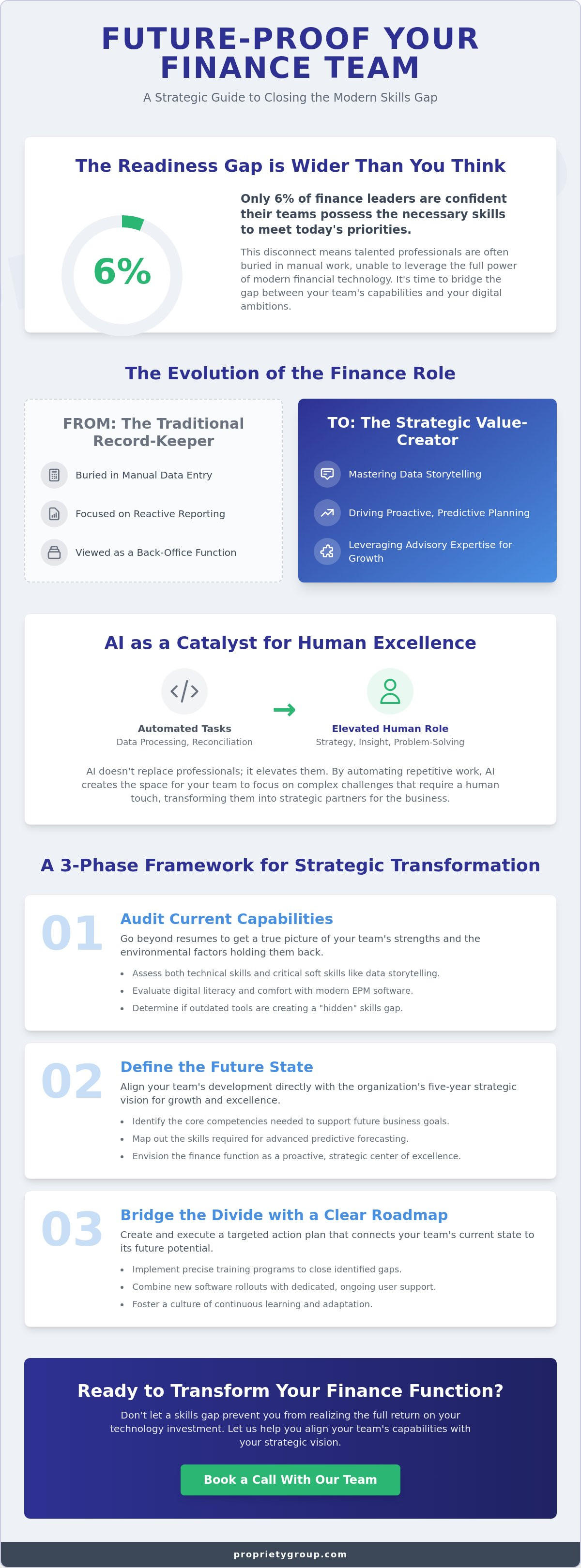
If only 6% of finance leaders feel their teams possess the necessary capabilities to meet this year's priorities, the path forward requires more than just incremental change. Many organizations find their talented professionals buried under manual data entry, struggling to keep pace with a financial technology landscape that evolves faster than their internal training programs. Conducting a comprehensive skills gap analysis for finance teams is no longer a routine administrative exercise; it's a strategic necessity to ensure your human capital matches the intentionality of your digital infrastructure.
You likely recognize the frustration of investing in high performance software only to see it underutilized because the team lacks specific expertise in data storytelling or predictive modeling. This guide provides a clear roadmap to bridge that divide. We'll show you how to align staff capabilities with modern enterprise performance management software to drive strategic growth and predictive accuracy. By the end, you'll understand how to identify the most critical new competencies and transform your finance function into a future-proof center of excellence that prioritizes analytical depth over administrative repetition.
Key Takeaways
- Understand the transition from traditional record-keeping to a value-adding function that leverages advisory expertise to drive organizational growth.
- Execute a thorough skills gap analysis for finance teams to identify exactly where current capabilities fall short of modern digital requirements.
- Master a structured three-phase framework designed to audit existing strengths and define a clear roadmap for your team's five-year strategic vision.
- Learn why combining precise software implementation with dedicated support is the only way to ensure long-term alignment between your staff and your technology.
The Evolution of Finance: Why Traditional Skills Assessments Are No Longer Sufficient
A Gap analysis serves as a critical diagnostic tool for any department aiming for excellence. In a corporate setting, it identifies the precise distance between your team's current capabilities and the requirements of a modern, technology-enabled function. Historically, finance was often viewed as a back-office role focused on record-keeping and technical accuracy. Today, the role has shifted toward Advisory for Enterprise Performance Management (EPM). This strategic discipline focuses on using data to drive better business outcomes, requiring a thorough skills gap analysis for finance teams to ensure your people are equipped to move from counting value to creating it.
To better understand this concept, watch this helpful video:
The required skill set has moved decisively away from manual data entry and toward strategic interpretation. Professionals now need the digital literacy to navigate complex systems while maintaining the high ethical standards that define the sector. A modern finance professional is a principled visionary who balances a commitment to correctness with the sharp precision of data-driven insight. They don't just report numbers; they provide the context that helps a business grow with confidence.
From Reactive Reporting to Proactive Planning
Fragmented reporting often masks a "hidden" skills gap where teams are too busy fixing data to actually analyze it. When staff spend their week reconciling disparate spreadsheets, they aren't performing the high-level work they were hired for. Moving toward connected planning and forecasting allows for a more proactive stance. It provides the situational framing needed to anticipate market changes rather than just reacting to them. A skills gap analysis for finance teams reveals whether your staff is ready for this transition to forward-looking strategy.
The Impact of AI on the Competency Framework
Advanced Financial AI Solutions are redefining what it means to be competent in finance. These tools automate the mechanical aspects of data processing, which creates space for humans to focus on the "so what" of business strategy. There's often a concern that automation replaces the professional, but it actually acts as a catalyst that elevates the human experience. By removing the burden of repetitive tasks, your team can apply their discernment to complex problems that require a human touch. Training ensures your people treat these tools as sophisticated partners rather than a replacement for their expertise.
A Three-Phase Framework for a Strategic Skills Gap Analysis
A strategic approach to transformation requires a structured methodology that respects both the human experience and the technical architecture. Conducting a skills gap analysis for finance teams isn't a one-time audit. It's a foundational element of sophisticated Work Force Planning. This process should be viewed as a continuous cycle of refinement. It ensures your team's growth mirrors the pace of technological innovation and maintains the high standards your organization demands.
Conducting the Capabilities Audit
The first phase involves a deep assessment of your current landscape. You must look beyond the technical certifications listed on a resume. True capability includes skills like data storytelling and the capacity for ethical decision-making in complex scenarios. It's also vital to analyze the working environment. Often, a professional's skills are throttled by outdated ERP systems that force them into manual workarounds. You have to determine if a perceived lack of skill is actually a lack of adequate tools. If you're unsure how to evaluate these environmental factors, a consultation with a strategic advisor can help clarify the path forward.
Defining the Future State
Phase two focuses on the strategic aspiration of the organization. What must the finance function look like to support a five-year vision of prestige and growth? This requires setting high standards of correctness for data handling and predictive intelligence. Reaching this state usually involves the adoption of modern EPM platforms. These systems provide the precision necessary for high-level analysis and strategic business partnering.
The final phase is the Alignment Roadmap. This is where you identify the specific training or advisory services needed to bridge the divide between current reality and your future vision. By treating a skills gap analysis for finance teams as a deliberate act of craftsmanship, you ensure that your department doesn't just keep up with the industry. You ensure it leads through intentional development and operational excellence.
Bridging the Divide: Integrating Technology and Human Excellence
Successfully deploying new technology is only half the battle. Without the corresponding human proficiency, even the most sophisticated software remains a dormant asset. A strategic skills gap analysis for finance teams ensures that your investment translates into tangible results. It's often tempting to look toward external hiring as a primary solution. However, there's immense value in upskilling those who already possess deep institutional knowledge. By refining the talents of your existing staff, you preserve the craftsmanship and business context that new hires would take months to acquire.
The most common objection to this process is a perceived lack of time. In reality, a skills-aligned team recovers hours every week by eliminating manual workarounds and data cleansing. This newfound efficiency allows for the high-level analysis that drives predictive accuracy. Through PG CARE - EPM Solution Support, we provide the ongoing technical assistance and system optimization that allows your people to focus on strategic growth rather than troubleshooting.
The Role of Bespoke Training and Workshops
Fixed-fee advisory services offer more than just technical instructions. They provide the situational framing your team needs to embrace a new philosophy of work. Adopting AI in Finance isn't simply about learning a new login; it's about a fundamental shift in intentionality. Training ensures your team understands the "why" behind the data. This allows them to act as true visionaries who drive the organization forward with confidence.
Sustaining Growth with Managed Support
As we look toward 2026, the pace of change will only accelerate. A subscription-based managed support model ensures that your team's skills evolve alongside the technology. This creates a steady rhythm of development. It prevents the emergence of new gaps as software updates and market regulations shift. The ultimate goal is a perfect alignment of the digital environment and human potential. By treating the skills gap analysis for finance teams as an investment in permanence and precision, you secure the long-term health of your finance function.
To begin aligning your team’s capabilities with your strategic vision, book a call with our advisory team today.
Securing a Legacy of Financial Excellence
The transition from manual reporting to predictive intelligence requires a deliberate commitment to team development. By following a structured three-phase framework, you ensure that your staff's capabilities are perfectly synchronized with the digital tools they use every day. A thorough skills gap analysis for finance teams is the first step toward transforming your department into a visionary business partner. This process doesn't just fill technical voids; it builds a foundation of permanent value and strategic precision.
As specialists in EPM and CRM implementation, we understand that the strength of your technology is only realized through the expertise of your people. Our expert-led advisory for CFOs and bespoke PG Care managed support model are designed to provide the continuous guidance your organization needs to thrive in 2026. To ensure your team is prepared for the future of finance, book a call with the Propriety Group team today. We're ready to help you bridge the divide between current potential and future growth.
Frequently Asked Questions
What is the most critical skill for finance teams in 2026?
Analytical discernment and ethical data interpretation are the most vital competencies for the coming year. As automation handles the mechanical aspects of data entry, your team must focus on explaining the deeper significance behind financial trends. This shift requires professionals to act as visionary partners who translate complex figures into clear, actionable narratives. It's about ensuring every data point serves the organization's broader mission with precision and clarity.
How long does a comprehensive skills gap analysis typically take?
A thorough skills gap analysis for finance teams generally requires a period of four to six weeks to execute properly. This duration provides the necessary space to conduct a deep audit of current capabilities and define a tailored roadmap for future growth. It's a deliberate, measured process that ensures no critical soft skills or technical requirements are overlooked. This timeframe allows for a steady transition that respects the team's existing workload.
Should we focus on hiring new talent or upskilling our current finance team?
Upskilling your existing staff is often more effective than external hiring because it preserves deep institutional knowledge and company culture. Those who already understand your organization's unique ethical standards and historical context are best positioned to leverage new technology effectively. While hiring can fill immediate technical voids, training your current team fosters a sense of trust and long-term security. It respects the craftsmanship already present within your finance function.
How does the implementation of new systems impact the skills gap?
Deploying new performance management systems often acts as a catalyst that reveals where human talent and digital tools are out of sync. It highlights the distance between manual habits and the modern potential for predictive accuracy. A skills gap analysis for finance teams ensures that your people aren't just using the software but are mastering it to drive strategy. This alignment is what transforms a technical upgrade into a lasting strategic advantage for the business.
To begin aligning your team's capabilities with your strategic vision, book a call with our advisory team today.