
Headcount Planning and Forecasting Tools: A Strategic Guide for Finance Leaders

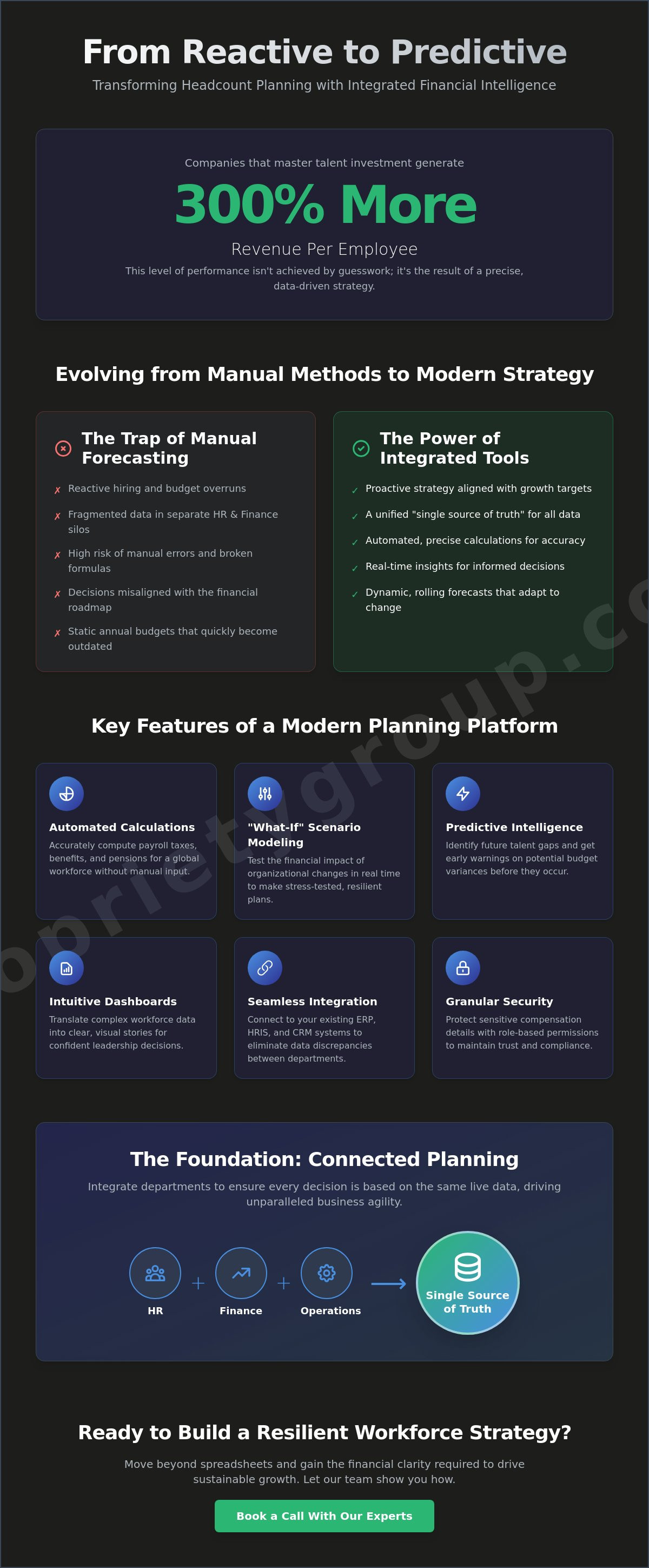
Companies that excel at maximizing their talent investments generate 300% more revenue per employee, according to McKinsey’s 2025 research. This level of performance is rarely achieved through guesswork. Many finance leaders still find themselves trapped in a cycle of reactive hiring and budget overruns because they lack integrated headcount planning and forecasting tools. It's a common struggle to manage fragmented data that lives in separate silos between HR and Finance. You likely recognize the tension of manual errors in benefit forecasting or the uncertainty that comes when hiring decisions don't align with your broader financial roadmap.
This strategic guide explores how modern software solutions transform personnel planning from a static exercise into a dynamic, predictive strategy. You'll discover how to establish a single source of truth for workforce costs and gain the ability to run real-time scenarios. We will provide the context you need to move beyond the limitations of spreadsheets. This ensures your hiring plans are a precise reflection of your company's visionary goals and long-term financial health.
Key Takeaways
- Learn how aligning personnel costs with growth targets creates a proactive strategy rather than a reactive one.
- Identify the essential features of headcount planning and forecasting tools, including automated calculations for regional taxes and benefits.
- Discover how real-time scenario modeling lets you test the financial impact of organizational changes before it's time to commit.
- Understand the role of predictive intelligence in identifying future talent gaps to ensure your workforce remains ahead of your needs.
- Transition from fragmented data silos to a unified financial model that serves as a single source of truth for all personnel expenses.
Beyond the Spreadsheet: The Strategic Evolution of Headcount Planning
Headcount planning is the intentional alignment of personnel expenses with your organization’s growth targets. It isn't just a list of roles to fill; it's a strategic roadmap. For most companies, the workforce represents the largest single expense. This scale requires an uncompromising level of precision. Traditional spreadsheets often create data silos that lead to reactive leadership. When finance and HR don't share a live view, decisions are made in a vacuum. Adopting modern headcount planning and forecasting tools is the first step toward clarity.
To better understand the mechanics of this process, watch this helpful video on forecasting and analysis:
The shift from static annual budgets to dynamic rolling forecasts is now essential. These systems allow leaders to use live data to adjust strategies on the fly. This evolution ensures that every hiring decision supports the broader vision of the firm. It moves the conversation from "what can we afford?" to "how do we grow?"
The Limitations of Manual Workforce Forecasting
Manual models are fragile. They're prone to version control errors and broken formulas. These small mistakes can lead to massive budget discrepancies over time. There's often an "intentionality gap" where the speed of hiring outpaces financial visibility. Without integrated headcount planning and forecasting tools, leaders lack the unified financial intelligence needed to connect every data point. This creates a foundation of uncertainty rather than trust.
Connected Planning: Integrating HR, Finance, and Operations
Advanced solutions enable a seamless data flow between your HR systems and the general ledger. This is known as driver-based planning. In this model, a change in headcount automatically updates the entire budget. It ensures that Strategic human resource planning remains a core part of the financial strategy. When HR, Finance, and Operations speak the same language, the business moves with greater agility and purpose.
Key Features to Evaluate in Headcount Planning and Forecasting Tools
Selecting the right software requires a focus on precision and integration. Effective headcount planning and forecasting tools must handle the complexity of global operations without stumbling. This includes the automated calculation of payroll taxes, local benefits, and pension requirements across different regions. Accuracy in these areas is non-negotiable. Because salary data is inherently sensitive, the platform must also offer granular security permissions. This ensures that only authorized personnel can access confidential compensation details, which maintains organizational trust and ethical standards.
Scenario Modelling and "What-If" Analysis
Modern finance teams need to look beyond current numbers. Reliable Workforce Planning involves testing how different decisions impact the bottom line in real time. For instance, you can model the financial outcome of a 10% increase in staff versus a 5% boost in overall productivity. This level of stress testing allows you to evaluate personnel costs against shifting market conditions. It transforms the budget from a fixed document into a resilient strategy that can withstand economic volatility.
Reporting and Visualisation for Leadership
Data is only as valuable as the insights it provides. Intuitive dashboards are essential for translating complex HR data into clear narratives for the board. Predictive analytics can flag potential budget variances before they occur, giving leaders time to course-correct. To achieve this level of clarity, your tool must integrate seamlessly with existing ERP and CRM systems. This creates a single source of truth that eliminates discrepancies between departments. If you are ready to modernize your workforce strategy, you can speak with our experts to explore a solution tailored to your needs.
Implementing Intelligence: Transitioning to Advanced Forecasting Models
Transitioning from reactive recruitment to a mature, EPM-supported workforce strategy represents a significant evolution in corporate management. It's a shift from merely filling seats to intentionally crafting a talent roadmap that mirrors your financial ambitions. While headcount planning and forecasting tools provide the necessary infrastructure, their effectiveness depends entirely on the strategy behind the setup. Specialist advisory acts as the essential bridge, transforming a software purchase into a vehicle for true performance optimization and long-term security.
The Role of AI in Personnel Forecasting
Within this sophisticated environment, AI and predictive intelligence play a pivotal role in identifying future talent gaps before they disrupt growth. These technologies analyze historical turnover patterns to anticipate attrition with remarkable accuracy. Rather than waiting for a resignation, leaders can proactively plan for succession. Additionally, predictive algorithms allow for the optimization of salary benchmarking and total reward packages. This ensures your compensation strategy is both financially sustainable and competitive enough to attract top-tier talent.
A Framework for Successful EPM Implementation
Implementing these advanced models requires a deliberate, three-step framework to ensure precision:
- Environment analysis: This initial stage identifies data bottlenecks and silos that currently obscure your financial visibility.
- Configuration of drivers: We build scenario models that are uniquely tailored to your organization’s operational nuances and strategic goals.
- Ongoing support: Success is maintained through a managed care model that offers constant refinement as your business evolves.
This steady rhythm of execution ensures your headcount planning and forecasting tools continue to provide a single source of truth as your business scales. By aligning human experience with intentional financial planning, you create enduring value for the entire organization. To begin your journey toward a more predictive and precise workforce strategy, book a call with our team today.
Mastering Your Workforce Strategy
Precision in workforce management is no longer a luxury; it's a foundational requirement for sustainable growth. By moving beyond the limitations of manual spreadsheets, your organization can establish a single source of truth that aligns personnel costs with long-term strategic goals. You've seen how integrating advanced headcount planning and forecasting tools allows for real-time scenario modeling and predictive insights into talent gaps. This transformation ensures that every hiring decision is backed by data rather than intuition.
Success in this transition requires more than just software. It demands a partnership built on expertise and reliable support. Our team specializes in EPM and CRM implementation, providing the visionary guidance needed to deploy AI-driven financial solutions effectively. Through our comprehensive PG Care managed support model, we ensure your systems remain accurate and resilient as your business scales.
The path to a more predictable financial future is within reach. Book a discovery call with our EPM specialists to transform your headcount planning and secure your organization's competitive edge. We look forward to helping you build a strategy that creates enduring value.
Frequently Asked Questions
What is the difference between headcount planning and workforce planning?
Headcount planning is a focused financial exercise that determines the specific number of roles and their associated costs within a budget cycle. It ensures that personnel expenses stay within defined limits. Workforce planning takes a broader view by analyzing the skills and talent required to meet long-term strategic goals. While headcount planning manages the dollars, workforce planning manages the human potential and intentionality behind the organization's growth.
How do headcount planning tools integrate with existing HR and Finance systems?
Modern headcount planning and forecasting tools utilize secure data connectors to link your HRIS directly with your general ledger and ERP systems. This integration enables a seamless, real-time flow of information across the organization. When changes occur in your personnel records, those updates immediately flow into your financial models. This creates a single source of truth that eliminates the need for manual data entry and reduces the risk of costly errors.
Why should a business move away from spreadsheets for personnel forecasting?
Spreadsheets are inherently static and fragile, making them ill-suited for the complexity of modern financial leadership. They often lead to version control issues and data silos that prevent a holistic view of the business. Transitioning to professional headcount planning and forecasting tools provides a dynamic environment where you can model scenarios with precision. This shift instills a sense of trust and long-term security in your financial strategy by replacing manual guesswork with automated accuracy.
Can headcount forecasting tools help with diversity and inclusion (D&I) goals?
These tools provide the data transparency needed to track and achieve diversity and inclusion benchmarks effectively. By visualizing representation across various departments and levels, leaders can identify specific areas that require attention. You can model future hiring scenarios to see how different recruitment strategies will impact your diversity goals over time. This approach ensures that your commitment to an inclusive workspace is backed by measurable progress and principled decision-making.
To explore how these solutions can be tailored to your organization's unique requirements, book a call with our team today.