
Automating Headcount Budget Approval: A Strategic Guide for Finance Leaders

Every day a critical headcount request remains trapped in a manual approval cycle, your organization's competitive edge loses its sharpness. In an era where headcount growth expectations are tightening to just 2% for 2026, the cost of hesitation is no longer just a delay; it's a strategic liability. You've likely felt the frustration of reconciling conflicting data between Finance and HR while top-tier talent accepts offers from more agile competitors. Transitioning toward automating headcount budget approval is not merely a technical upgrade; it's a commitment to precision and institutional excellence.
We understand that you value a single source of truth that reflects the long-term financial impact of every hiring decision. This guide will show you how to transform slow, fragmented workflows into a streamlined, predictive process that aligns your workforce with your most ambitious financial goals. We'll explore the architectural shift from reactive spreadsheets to a holistic system that empowers faster, more confident decision-making for the modern enterprise. By moving beyond isolated data points, you can ensure that every new hire serves as a deliberate step toward your broader vision of growth.
Key Takeaways
- Identify the hidden costs of manual approval cycles. You'll learn how these delays create a deep disconnect between your financial goals and your talent strategy.
- Discover the architectural shift required for automating headcount budget approval. This transition replaces fragmented spreadsheets with a unified and transparent digital framework.
- Learn why a single source of truth is essential for growth. It eliminates data errors and provides instant visibility into the long-term financial impact of every new hire.
- Explore the power of financial AI solutions. These tools allow you to stress test your budget and anticipate future workforce needs with absolute precision.
- Shift your perspective from filling seats to building capacity. Move toward a predictive model that ensures your workforce is always aligned with your strategic objectives.
The Cost of Delay: Why Manual Headcount Approvals Stifle Growth
Automating headcount budget approval represents a fundamental shift in how modern organizations manage their most significant investment: their people. This process isn't merely a software upgrade; it's the transition from static, isolated spreadsheets to dynamic, connected systems. By integrating your financial targets with your recruitment pipeline, you ensure that every hiring decision is grounded in current fiscal reality rather than historical assumptions. This digital evolution allows leaders to move away from fragmented data and toward a cohesive strategy that supports long-term stability.
To better understand this concept, watch this helpful video:
The disconnect between Finance and HR often results in expensive hiring mistakes that ripple through the entire fiscal year. When these departments operate on separate data sets, Finance might see a budget deficit while HR identifies a critical talent gap. This friction breeds reactive planning, where decisions are made based on outdated figures from the previous month. Without a shared lens, your organization risks overextending its resources or missing growth targets due to understaffing. Every day spent reconciling conflicting numbers is a day lost to your competitors.
Before introducing sophisticated technology, leaders must conduct a thorough environment analysis to identify existing bottlenecks. Understanding Workforce Management Fundamentals provides the necessary context to ensure that automation solves structural issues rather than just digitizing inefficient habits. By examining where requests stall, you can build a framework that prioritizes precision and intentionality. Only then can you implement a system that truly aligns human experience with financial goals.
The Hidden Risks of Spreadsheet-Based Planning
Version control is a persistent threat to institutional accuracy. When different teams look at different numbers, the resulting confusion halts momentum and erodes trust in leadership. In the fast-paced UK talent market, slow approvals mean losing high-caliber candidates to more decisive rivals. These delays aren't just administrative; they're missed opportunities for strategic expansion. Addressing these structural weaknesses often starts with professional EPM advisory to identify where manual processes have become a bottleneck and how to rectify them through better design.
Constructing a Modern Framework for Headcount Approval Automation
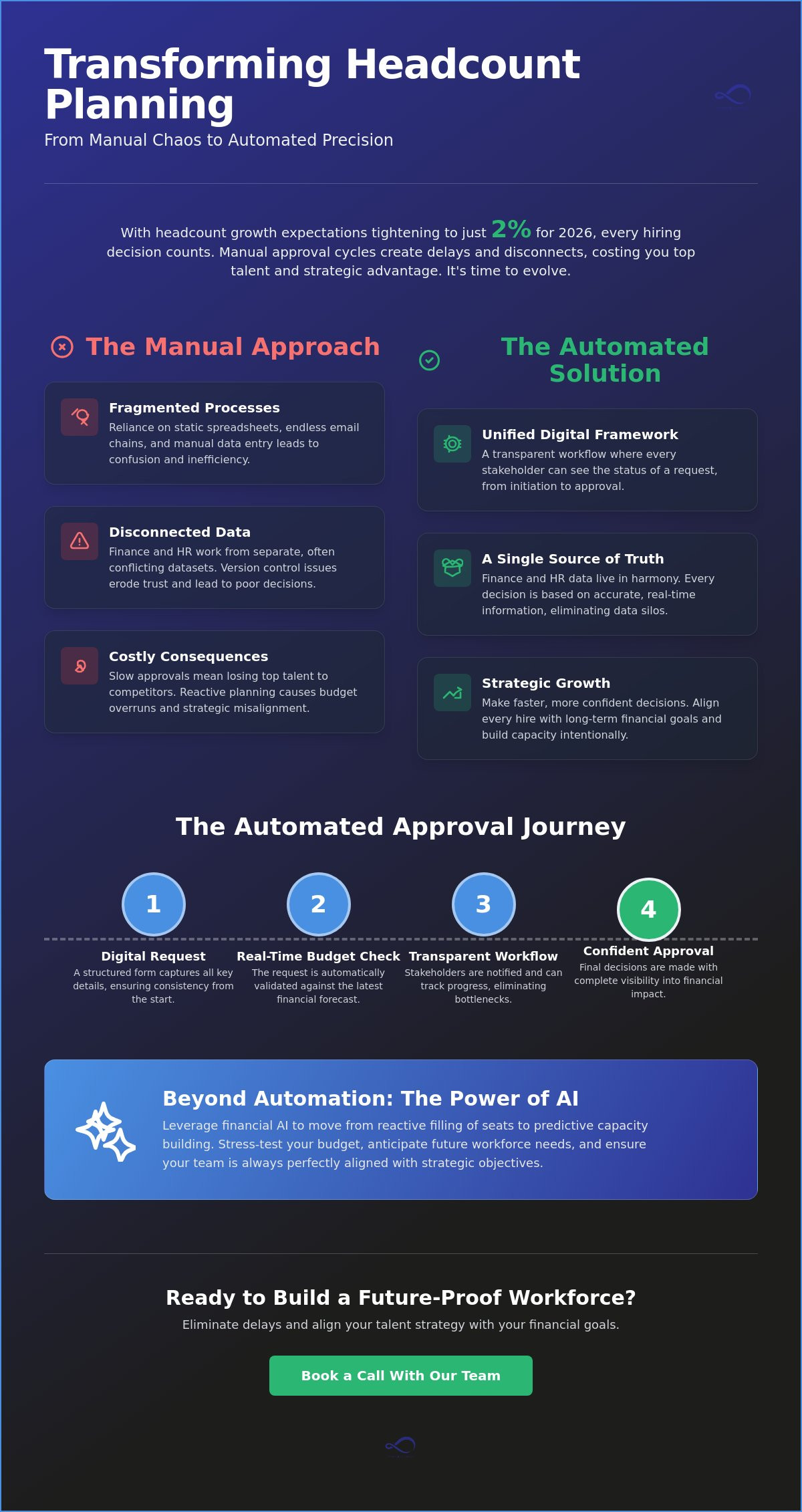
The transition from a manual request to a final approval should be a transparent digital journey. By automating headcount budget approval, you transform a historically opaque process into a visible workflow where every stakeholder understands the status of a request. This framework relies on a single source of truth. When Finance and HR data live in harmony, you eliminate the friction caused by conflicting headcounts and salary figures. This alignment ensures that every department works toward the same strategic vision without the interference of data silos.
Every hire should be pre-validated against your latest financial forecast. Automated workflows facilitate this by comparing the cost of a new role against the available budget in real time. This shift introduces driver-based planning. Instead of making hiring decisions based on emotional pleas from department heads, leaders can rely on objective data such as revenue per employee or capacity thresholds. This ensures that growth remains intentional, sustainable, and strictly aligned with your organizational capacity.
Key Stages of an Automated Approval Workflow
Digital requests replace the chaos of endless email chains. A structured digital form captures all necessary details, from role seniority to expected start dates, ensuring consistency from the outset. Real-time budget checks immediately notify leaders if a request exceeds the current plan, preventing overspending before it occurs. To achieve this level of precision, selecting the correct performance management software is essential. You can find more details on this by exploring our specialized EPM services.
Integrating Finance and HR Data
Connecting your core accounting systems and performance software is vital for accurate workforce planning. This integration ensures that actual payroll data informs future projections without manual entry. You should also establish clear approval hierarchies. For example, a standard replacement hire might only require department head approval, while a new headcount in a premium salary bracket triggers a CFO review. Implementing AI in Financial Planning can further refine these hierarchies by predicting the impact of these hires on long-term cash flow. By automating headcount budget approval, you create a system that scales with your ambition.
If you're ready to refine your internal processes, you might consider how a tailored advisory session could clarify your path forward.
Beyond the Workflow: Leveraging AI for Predictive Workforce Planning
Beyond the immediate efficiency of a digital workflow, the true value of automating headcount budget approval lies in its ability to generate foresight. Modern finance leaders are increasingly turning to financial AI solutions to bridge the gap between current operations and future growth. These tools don't just record what has happened; they anticipate what's coming. By analyzing historical trends and real-time data, AI allows your organization to move from descriptive reporting to prescriptive action. This shift ensures every hiring decision is part of a deliberate, long-term strategy rather than a reactive fix.
Propriety Group’s advisory services provide the essential bridge between technology and strategic execution. We help finance teams transition into a more sophisticated era of planning where data isn't just stored; it's activated. This approach empowers leadership to make confident, forward-looking decisions that protect the organization's financial health while fostering human potential. By removing the guesswork from workforce planning, you create an environment of quiet confidence and enduring value.
The Power of Scenario Modelling and Stress Testing
True resilience requires the ability to model "what-if" scenarios with absolute precision. You might explore the financial impact of a 10% increase in headcount or evaluate how a sudden market shift would affect your payroll obligations. AI-driven models identify subtle patterns in hiring and turnover that human analysis might overlook, significantly improving budget accuracy. This level of stress testing ensures your workforce plan remains robust under various economic conditions, allowing you to pivot without compromising your fiscal standards.
Partnering for Success with PG Care
Implementation is merely the first step toward operational excellence. Through our PG CARE - EPM Solution Support, we ensure your headcount automation evolves alongside your business needs. Continuous optimization is the key to extracting long-term value from your investment. Our team provides the steady guidance necessary to refine your processes as your organization scales. This partnership ensures your systems remain as agile and visionary as your leadership team, providing a sense of long-term security in an ever-changing landscape.
If you're ready to transform your workforce planning into a strategic asset, the next step is a conversation. Book a call with our team to discuss how we can align your headcount processes with your long-term vision.
Securing Your Strategic Advantage with Precise Planning
Transitioning from fragmented spreadsheets to a unified digital ecosystem is the hallmark of a visionary finance leader. By automating headcount budget approval, you don't just speed up a workflow; you establish a foundation for enduring organizational value. We've explored how manual delays stifle growth and how a modern framework aligns HR and Finance data into a single, reliable truth. Moving beyond simple task completion, leveraging AI-driven insights allows you to stress test your assumptions and protect your margins against economic shifts.
As specialists in EPM and CRM implementation, our team provides the expert-led advisory that CFOs and finance teams need to navigate these complex transitions. We offer more than just software setup. Through our managed support model, PG Care, we ensure your systems remain optimized and aligned with your evolving goals. To see how your organisation can transform its planning process, book a call with our expert team today. Your journey toward a more predictive and agile finance function starts with a single, intentional step.
Frequently Asked Questions
What is headcount budget approval automation?
Headcount budget approval automation is the process of replacing manual, spreadsheet-based hiring requests with a streamlined digital workflow. It ensures that every new hire is pre-validated against the organization's latest financial forecast. This transition creates a transparent journey from the initial request to final approval. By connecting your talent needs with your fiscal reality, you eliminate the risk of expensive hiring mistakes and ensure every role serves your strategic growth.
How long does it take to automate our headcount planning process?
The duration of this transition typically depends on the complexity of your current structure and the specific needs of your leadership team. Most organizations can expect a timeline of several weeks to a few months for a thorough implementation. This period includes a deep analysis of your current environment and the configuration of approval hierarchies. Taking a measured, steady approach ensures the final system is both functional and enduring.
Can we automate approvals if our HR and Finance systems are separate?
You certainly can. Modern platforms are specifically designed to act as the connective tissue between disparate HR and Finance systems. Automating headcount budget approval actually solves the problem of disconnected data by creating a single source of truth. This integration ensures that payroll figures and recruitment pipelines remain in constant harmony; it allows for more precise and confident decision-making across the entire enterprise.
Will automating approvals reduce the control the CFO has over the budget?
No, automation actually provides a higher level of oversight than manual processes ever could. CFOs gain immediate visibility into every request and can establish strict validation rules based on seniority or budget impact. This transparency allows for more intentionality in spending. By automating headcount budget approval, you move away from reactive adjustments and toward a model where every hire is a deliberate step toward your financial goals.