
Rolling Forecast Best Practices for UK Finance Leaders in 2026

By the time the first quarterly update for Making Tax Digital is due on August 7, 2026, many UK finance leaders will find their annual budgets are already relics of a different economic reality. It's a common frustration to watch a carefully crafted fiscal plan lose its relevance before the second quarter even begins, especially when faced with a 3.3% inflation rate and a 3.75% Bank of England base rate. Precision is no longer optional. You understand that relying on fragmented spreadsheets and manual data entry is no longer a sustainable path for a prestige organization that values excellence. This article outlines the rolling forecast best practices uk finance teams need to master the transition from rigid annual structures to agile, AI-enhanced models that drive intentional growth.
We'll examine how to build a clear framework for continuous planning that reduces variance and provides the board with a sense of long-term security through precise, data-backed agility. By aligning your financial stewardship with the latest employment rights changes and digital tax requirements, you can ensure your organization remains both compliant and visionary in a fluctuating market. This holistic approach moves beyond simple numbers to create a narrative of permanence and strategic clarity.
Key Takeaways
- Eliminate the limitations of the traditional fiscal year end by adopting a dynamic planning horizon that moves forward every month.
- Streamline your efforts by identifying and focusing on the core business drivers that truly impact your financial performance rather than tracking every minor line item.
- Implement a 12-to-18-month outlook using rolling forecast best practices uk to maintain a clear strategic view of your long-term growth.
- Move beyond the risks of manual spreadsheets by integrating real-time data from your entire organization into a single, reliable source of truth.
- Enhance your decision-making with financial AI solutions that provide the precision needed to respond confidently to shifting economic conditions.
The Strategic Shift: Why UK Organisations are Adopting Rolling Forecasts
A rolling forecast acts as a dynamic planning horizon, advancing independently of the fiscal year-end to maintain constant visibility. This approach ensures that leadership teams aren't blinded by the 12-month wall, a common issue where traditional budgets lose their predictive power as the year draws to a close. Integrating rolling forecast best practices uk into your financial strategy allows for a more resilient posture. By utilizing sophisticated forecasting methods, finance leaders can move away from reactive reporting and toward a position of quiet confidence.
To better understand how this transition looks in practice, watch this helpful video on mapping actuals to a dynamic model:
The current UK economic climate, marked by a 3.3% inflation rate and a 3.75% Bank of England base rate, demands such agility. Static plans cannot account for the rapid supply chain shifts or regulatory changes that define the modern market. CFOs must now act as visionary partners, providing the forward-looking insights necessary for strategic growth. Implementing rolling forecast best practices uk helps bridge the gap between stagnant reporting and visionary leadership.
Limitations of Traditional UK Annual Budgeting
Budgets finalised in October frequently fail to reflect the economic realities of the following April. This disconnect often fosters a use it or lose it culture, where departmental spending is driven by a desire to preserve future budgets rather than genuine operational need. Expert EPM Advisory can help dismantle these rigid structures, aligning your fiscal planning with actual strategic intent.
The Benefits of Continuous Planning for Leadership Teams
Leadership teams gain a significant advantage through early variance detection, which allows for more nuanced risk management. This agility enables the real-time redirection of capital toward emerging growth opportunities. A rolling forecast establishes a single source of truth by integrating live data across all departments, ensuring every leader makes decisions based on the same verified reality.
Rolling Forecast Best Practices for UK Finance Teams
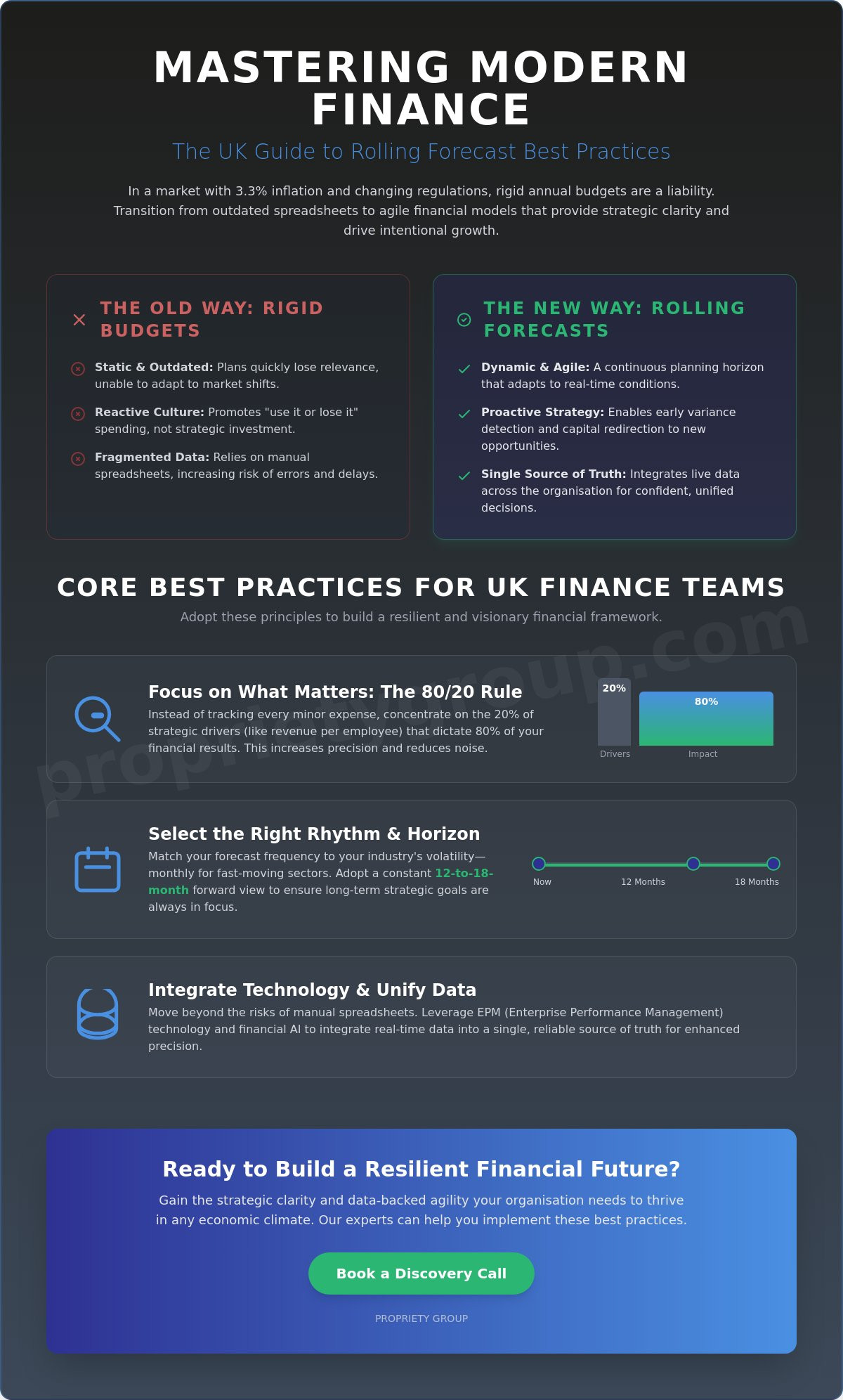
Mastering rolling forecast best practices uk requires a fundamental shift from exhaustive accounting to strategic steering. Instead of attempting to forecast every minor expense, successful leaders focus on the 20% of drivers that dictate 80% of your results. This focused approach ensures that your leadership team remains agile without being overwhelmed by data noise. It's about precision, not volume. By concentrating on the variables that truly move the needle, you create a planning environment that values aesthetics and functionality in equal measure.
Identifying and Prioritising Strategic Value Drivers
A common pitfall in financial planning is treating every line item as equally important. In a refined model, you must distinguish between a static line item, such as office supplies, and a true value driver like revenue per employee. By incorporating Workforce Planning as a central driver, you align your human capital directly with financial outcomes. Concentrating on fewer, more impactful variables significantly reduces forecast noise while increasing the speed and reliability of your decision-making.
Selecting the Right Forecast Frequency and Horizon
The rhythm of your updates should reflect your industry's specific volatility. While quarterly updates might suffice for stable sectors, most UK firms facing rapid market shifts benefit from a monthly cadence. Adopting a 12-to-18-month window provides the visibility needed for long-cycle projects or infrastructure investments common in the UK market. This extended horizon improves financial planning by ensuring that strategic goals are always within view, regardless of the calendar year.
Success also depends on deep cross-functional collaboration. When sales, marketing, and HR contribute their logic to the forecast, the resulting data reflects the ground reality of the business rather than just a financial projection. Establishing this as a disciplined routine, rather than an ad-hoc reaction, builds a culture of reliability and long-term security. If you're looking to refine your current processes, you might find it helpful to discuss your specific planning challenges with an expert who understands the nuances of the UK landscape.
Leveraging EPM Technology and AI for Forecasting Precision
Relying on manual spreadsheets remains the most significant barrier to achieving agility in the UK market. While Excel is a familiar tool, it often becomes a trap that obscures the truth through broken links and version control issues. Transitioning to a dedicated EPM platform allows for real-time integration with your existing ERP and CRM systems, ensuring that every update reflects the current state of your operations. This technological foundation is essential for implementing rolling forecast best practices uk with precision and speed.
Moving Beyond Spreadsheets with Integrated EPM Solutions
Selecting the appropriate infrastructure is a critical step in your journey toward financial excellence. By identifying the right EPM platform, you secure data integrity and move toward a model of connected planning. This approach dramatically reduces the hours your team spends on tedious data collection. Instead, they can dedicate their expertise to high-level analysis and strategic guidance, providing the board with actionable insights rather than just raw numbers.
The Future of Forecasting: AI and Predictive Intelligence
Artificial intelligence is no longer a distant prospect; it's a present-day necessity for maintaining a competitive edge in a volatile economy. Our Financial AI Solutions enable you to automate the baseline forecast, identifying subtle trends and anomalies that human analysts might overlook. These tools provide a neutral starting point by removing human bias from the planning process, allowing your finance team to focus on exceptions and high-impact strategy.
Following rolling forecast best practices uk ensures your projections remain grounded in reality even when market conditions shift. You can then use scenario modelling to conduct rigorous Stress Testing against potential UK market shocks, such as sudden interest rate changes or new regulatory requirements. This level of preparedness instils a sense of reliability and long-term security across the entire organisation. Using historical data and AI to identify these trends ensures your stewardship is both principled and visionary.
Adopting these advanced tools allows for a more rhythmic and steady communication of financial health. It moves the finance function from a back-office necessity to a strategic steering mechanism. By integrating rolling forecast best practices, you ensure that your organization values aesthetics and functionality in its financial narratives, creating enduring value for all stakeholders.
Steering Your Organization Toward Enduring Value
The transition from static budgeting to a continuous, dynamic model is more than a process change; it's a commitment to strategic agility. By focusing on essential value drivers and maintaining a 12-to-18-month horizon, you ensure your leadership team remains ahead of market shifts. Implementing rolling forecast best practices uk allows you to replace manual spreadsheet errors with the precision of integrated EPM technology and predictive AI. This shift empowers finance leaders to act as principled visionaries, providing the board with data-backed confidence and long-term security.
Our boutique consultancy offers a visionary, CFO-led approach to financial transformation. We're specialists in the implementation of EPM software and the integration of predictive analytics, ensuring your data reflects a standard of excellence. We'll help you move beyond the "12-month wall" to create a planning environment that values both functionality and foresight. Book a call with our EPM Advisory team today to discuss how we can refine your planning process and drive strategic growth. Your journey toward a more resilient and precise financial future starts with a single, intentional step.
Frequently Asked Questions
How does a rolling forecast differ from a traditional annual budget?
A traditional budget is a static document created once a year to set fixed spending limits and revenue targets. In contrast, a rolling forecast is a dynamic planning horizon that moves forward by adding a new period as the current one expires. While a budget often loses its relevance by the second quarter, a rolling forecast provides a constant, updated view of the future. This approach ensures your organization remains agile and responsive to shifting economic conditions rather than being tethered to outdated assumptions.
Should we replace our annual budget entirely with a rolling forecast?
Most organizations find success by using a hybrid approach rather than a total replacement. The annual budget serves as a foundational benchmark for setting high-level strategic goals and board-level expectations. The rolling forecast then acts as the steering mechanism that manages the path toward those goals in real-time. By combining both, you maintain a sense of long-term security while benefiting from the flexibility to reallocate capital as growth opportunities emerge.
What is the biggest challenge when implementing rolling forecasts in a UK business?
The primary obstacle is often a combination of cultural resistance and a reliance on fragmented spreadsheets. Moving away from a "once-a-year" mindset requires a shift in how departments view their responsibility toward financial data. Implementing rolling forecast best practices uk involves moving beyond the "Excel trap" to adopt integrated FP&A software solutions. This transition ensures that data collection becomes a disciplined routine rather than an ad-hoc burden for your team.
How many months ahead should a rolling forecast typically look?
A standard rolling forecast typically maintains a window of 12 to 18 months. This specific horizon is ideal for UK firms because it provides enough visibility to manage long-cycle projects and infrastructure investments without becoming overly speculative. Adopting these rolling forecast best practices uk allows leadership teams to look past the current fiscal year, ensuring that strategic decisions are always grounded in a forward-looking perspective that extends beyond immediate deadlines.