

How much time does your finance team lose to the quiet friction of a spreadsheet that refuses to balance? For many UK firms, the 2024 financial year revealed a stark reality where manual processes and fragmented reporting across multiple entities slowed decision-making to a crawl. You likely recognize the weight of this burden, where the risk of human error persists despite the meticulous efforts of your staff. Selecting the right accounting reconciliation software is no longer merely a technical upgrade. It's a strategic commitment to integrity, propriety, and precision that defines a visionary enterprise.
You've likely felt the pressure of a month-end close that demands more hours than the calendar provides. We'll show you how to evaluate and adopt a reconciliation solution that turns these manual tasks into a streamlined, strategic asset. This guide explores the transition from raw ERP data to a unified source of truth, allowing your team to focus on analysis rather than transaction matching. We'll outline the exact steps to ensure your financial operations achieve a level of clarity that supports your long-term legacy through 2026 and beyond.
Key Takeaways
- Transition from manual, spreadsheet-based methods to a sophisticated digital framework that secures the integrity and precision of your financial data.
- Evaluate the most effective accounting reconciliation software by weighing the merits of specialised tools against broader integrated platforms tailored to your specific organisational needs.
- Master the essential criteria for selection, ensuring your chosen solution offers seamless system integration and the transparent audit trails necessary for robust UK regulatory compliance.
- Realise that true software success is found in the meticulous alignment of your people and processes, moving beyond simple installation to achieve lasting operational excellence.
- Learn to evolve your financial close from a reactive manual task into a proactive strategic asset that provides clear, actionable insights for future growth.
Understanding the Landscape of Accounting Reconciliation Software
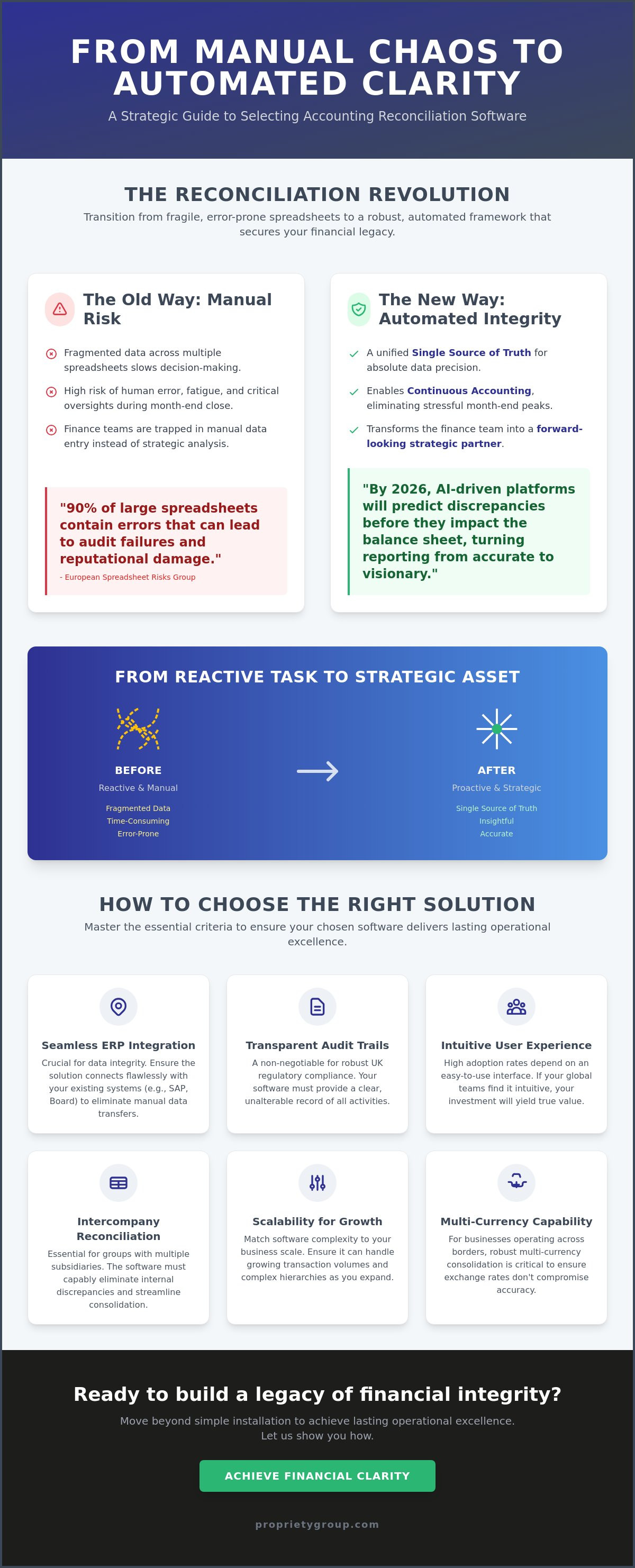
Meticulous financial oversight is the bedrock of any enduring organisation. At its core, accounting reconciliation software represents a digital foundation designed to uphold financial integrity and precision. While traditional methods relied on reactive, spreadsheet-based matching, the current era demands a transition toward proactive, automated intelligence. This shift ensures that every transaction aligns perfectly with bank records and internal ledgers, preserving the legacy of the business through absolute transparency.
To better understand this concept, watch this helpful video:
In the UK market, the reconciliation process serves as the critical first step in the modern financial close process. By 2026, the industry has moved toward AI-driven platforms that predict discrepancies before they ever impact the balance sheet. This foresight allows finance leaders to maintain a steady hand on the tiller, ensuring that reporting is not just accurate, but visionary.
The Strategic Importance of Automated Matching
Automation removes the drudgery of manual checks that often lead to fatigue and oversight. By implementing accounting reconciliation software, finance teams can transition to a model of continuous accounting. Rather than waiting for a stressful month-end peak, reconciliations happen daily. This steady rhythm allows professionals to move away from data entry and focus on forward-looking advisory roles. It turns the finance department into a strategic partner that adds value through insight rather than just record-keeping.
Why Spreadsheets Are a Risk to Your Organisation's Legacy
Relying on manual spreadsheets introduces a level of fragility that modern enterprises cannot afford. Research from the European Spreadsheet Risks Group suggests that 90% of large spreadsheets contain errors, which can lead to audit failures and reputational damage. These hidden costs often result in delayed strategic pivots and lost opportunities. Adopting bespoke software is a commitment to building a single source of truth for finance. It ensures that every decision is based on verified, real-time data, protecting the firm's standing and future growth.
Evaluating the Best Solutions for Your Organisation's Needs
Selecting the right accounting reconciliation software requires a meticulous assessment of your current financial architecture. You face a choice between best-of-breed tools, which offer bespoke functionality for specific tasks, and integrated Enterprise Performance Management (EPM) platforms that provide a unified legacy of data. While specialised tools often deliver deeper precision, integrated modules ensure a seamless flow across your entire financial suite. Integration with your existing ERP system is paramount for data integrity, as it eliminates the risks associated with manual data transfers.
A transparent audit trail is not just a requirement; it's a standard of correctness that protects the organisation. For groups with multiple subsidiaries, robust intercompany reconciliation capabilities are essential to eliminate internal discrepancies. High adoption rates depend on the user experience. If a platform feels intuitive, global finance teams will embrace it, ensuring that your investment yields long-term security and value.
Matching Software Complexity to Business Scale
Scale matters. Smaller firms might find agility in mid-market tools that offer essential automation without excessive complexity. Larger enterprises, such as those using SAP or Board, require platforms capable of handling vast datasets and complex hierarchies. For those operating across borders, multi-currency consolidation ensures that exchange rate fluctuations don't compromise your reporting accuracy. This level of precision is vital for maintaining a clear view of your global financial position.
The Role of AI and Predictive Intelligence in 2026
In 2026, intelligence means simplicity. AI now identifies subtle patterns in your data to match thousands of transactions instantly. This shift allows for exception-based reporting, where your team only investigates the few items the software cannot resolve. Predictive matching is the ability of software to suggest reconciliations based on historical data patterns. Investing in these tools is a proven method for improving the financial close process by reducing manual labour and increasing accuracy. A principled approach to financial management starts with choosing partners who value precision. Explore how a bespoke financial strategy can secure your long-term legacy.
Implementation and Beyond: Ensuring Long-Term Value
The journey to adopting accounting reconciliation software is a structured evolution rather than a simple installation. It begins with a deep analysis of the current environment, moving through meticulous data migration and finishing with a controlled go-live. It's a deliberate balance. We believe that 80% of project value comes from process design and people alignment, while the technology itself contributes the remaining 20%.
Avoiding Common Implementation Pitfalls
A frequent error is "paving over the cow path," where a firm automates a broken manual process instead of redesigning it for efficiency. In 2025, industry data suggested that 60% of finance teams struggle with system adoption because they failed to cleanse their data before migration. High-quality data is the foundation of any automated system. Without it, the software merely accelerates the production of errors. We focus on ensuring your data is pristine before it ever enters a new environment.
Building a Legacy of Financial Integrity
Propriety Group uses an advisory-first approach to ensure every system aligns with the CFO’s long-term vision. We focus on the intersection of people, place, and purpose to build a resilient finance function. Our "PG Care" model provides ongoing support to maintain system health and user competence long after the initial launch. This ensures your investment remains a source of pride and precision. It's about creating a culture where accuracy is the standard.
Once your reconciliation is seamless, the natural next step is to explore financial consolidation software. This transition allows visionary leaders to move from managing individual tasks to overseeing a unified, strategic financial narrative. By automating the foundational layers of your accounts, you free your team to focus on high-level strategy and long-term growth across the United Kingdom and beyond.
Securing Financial Integrity for 2026 and Beyond
The transition toward automated financial oversight is a critical milestone for UK businesses looking to maintain precision. Choosing the right accounting reconciliation software involves more than just a technical upgrade; it's a commitment to organisational clarity and long-term security. By 2026, firms that prioritise scalable solutions will be better positioned to navigate the complexities of UK reporting requirements and internal audits. Success relies on finding a platform that aligns with your unique operational goals while providing a clear path for future growth.
Propriety Group offers a sophisticated approach to this evolution. We specialise in bespoke EPM implementation, providing expert guidance for organisations using SAP Analytics Cloud and Board EPM. Our meticulous PG Care support model ensures that your systems remain robust and reliable long after the initial setup. We focus on the intersection of people and purpose, ensuring your financial data serves as a foundation for enduring value. It's about creating a legacy of accuracy that reflects your brand's commitment to excellence.
Partner with Propriety Group for Bespoke EPM Advisory to refine your financial strategy. We look forward to helping you build a more resilient and transparent future.
Frequently Asked Questions
What is the difference between ERP-based reconciliation and dedicated reconciliation software?
Dedicated accounting reconciliation software provides bespoke automation that standard ERP modules often lack. While an ERP manages broad business functions, specialised tools offer the meticulous precision required for high-volume matching. A 2024 study suggests that firms using dedicated solutions see a 40% reduction in month-end closing times. This investment establishes a legacy of accuracy, ensuring your financial data remains beyond reproach.
How long does it typically take to implement an automated accounting reconciliation solution?
Most organisations complete their transition to an automated system within 8 to 12 weeks. This period includes a structured phase for data integration and thorough testing to guarantee the system's integrity. UK businesses typically report that their teams become fully proficient after 15 hours of guided training. It's a measured process that replaces chaotic manual tasks with a steady, reliable digital framework.
Can reconciliation software handle complex intercompany transactions across different currencies?
These platforms are specifically designed to harmonise complex intercompany transactions across multiple currencies. By using live exchange data, the software resolves discrepancies between UK entities and global partners automatically. Industry reports from early 2025 indicate that automation reduces currency-related errors by 25%. This capability ensures that your global financial position is always clear, reflecting a principled approach to international business management.
Is AI in accounting reconciliation software secure and audit-compliant?
AI features in modern systems are entirely secure and comply with UK GDPR and ISO 27001 requirements. Every automated action generates a clear, permanent record that simplifies the work for external auditors. Data from 2025 shows that 92% of UK financial directors prefer AI-backed systems for their superior audit trails. It isn't a replacement for human oversight; it's a sophisticated way to uphold the highest standards of propriety.