
SAP SAC: A Comprehensive Guide to SAP Analytics Cloud for Finance Leaders

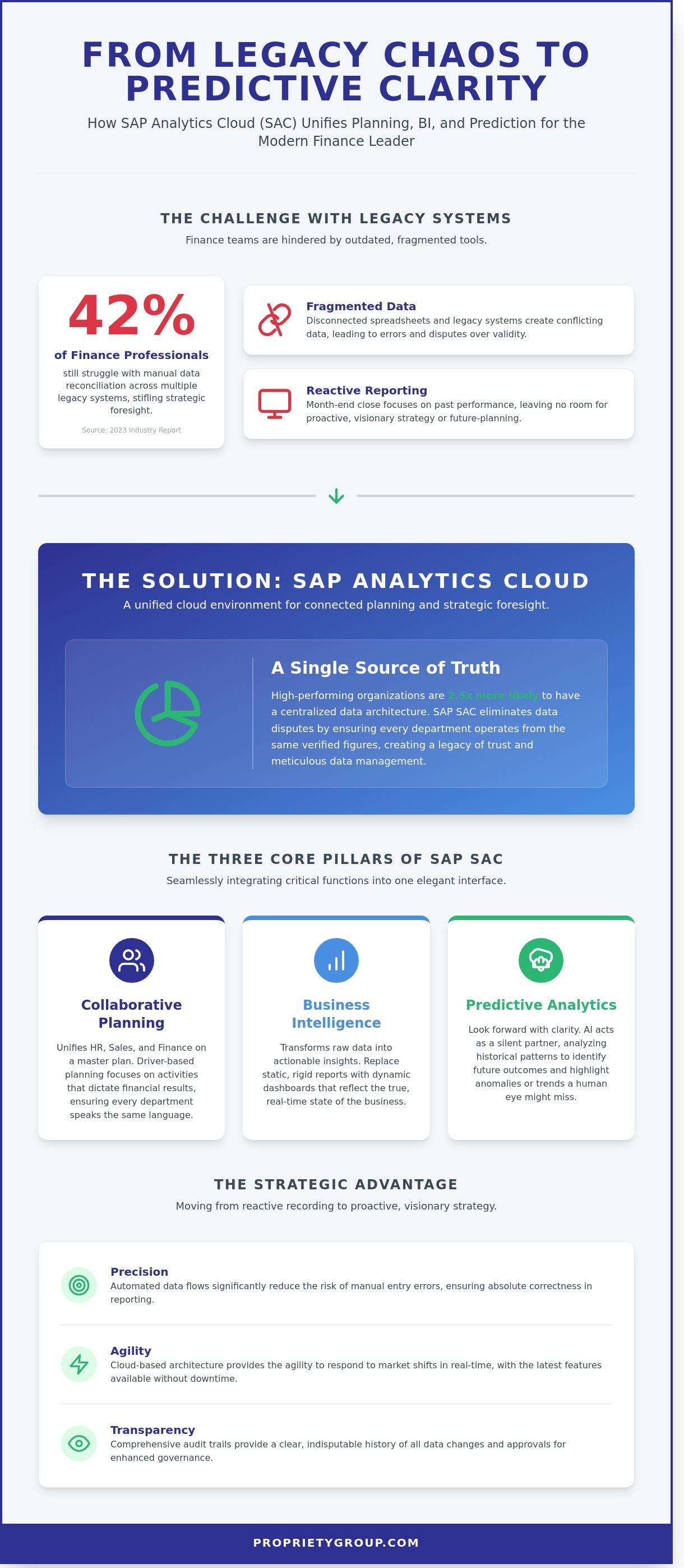
What if your month-end close didn't just report on the past, but accurately predicted the future? Recent data from a 2023 industry report indicates that 42% of finance professionals still struggle with manual data reconciliation across multiple legacy systems, leaving little room for visionary thinking. You likely recognise the frustration of managing fragmented data that prevents your team from acting with the agility your market demands. This guide demonstrates how sap sac integrates planning, business intelligence, and predictive analytics into one meticulous environment designed for the modern finance leader.
By adopting a more holistic approach to your financial architecture, you can move beyond the limitations of reactive reporting. We'll explore how this sophisticated platform creates a single source of truth, allowing your team to focus on high-level analysis rather than tedious data gathering. You'll discover how to run predictive scenarios quickly, ensuring your organisation maintains its propriety and competitive edge through principled, data-driven decisions that align people and purpose.
Key Takeaways
- Transition from fragmented legacy systems to a unified cloud environment that harmonises planning, business intelligence, and predictive analytics.
- Explore how the seamless integration of the three core pillars within sap sac creates a bespoke ecosystem for connected planning and strategic foresight.
- Master the art of meticulous environment analysis to ensure your current data landscape is perfectly prepared for a sophisticated digital evolution.
- Discover the precise steps required to migrate complex information into a clean, usable structure that drives long-term value and organisational integrity.
- Learn to replace disconnected spreadsheets with a single, authoritative source of truth designed to empower the modern financial leader.
Understanding SAP SAC: A Unified Vision for Modern Finance
SAP SAC (SAP Analytics Cloud) represents the pinnacle of modern financial management. It integrates three critical pillars: planning, business intelligence (BI), and predictive analytics into a single, cohesive cloud platform. For decades, UK finance leaders relied on disconnected spreadsheets that often led to fragmented data and manual errors. Today, the shift toward a unified environment isn't just a trend; it's a necessity for maintaining integrity in reporting.
To better understand this concept, watch this helpful video:
Central to the sap sac experience is the "Single Source of Truth." Research suggests that high-performing organisations are 2.5 times more likely to have a centralised data architecture. This ensures every department operates from the same verified figures, eliminating the disputes over data validity that once plagued monthly board meetings. At Propriety Group, we view this as a matter of propriety. It's about ensuring absolute correctness and ethical transparency, creating a legacy of trust through meticulous data management.
The Evolution of Financial Intelligence
Financial reporting has transitioned from a reactive, backward-looking exercise to a proactive, visionary strategy. Modern finance leaders no longer just record what happened; they predict what will happen next. This shift requires a robust infrastructure where sap sac acts as the intelligence layer within a broader what is a data warehouse ecosystem. Moving from on-premise hardware to the cloud provides the agility needed to respond to market shifts in real-time. It replaces static, rigid reports with dynamic, secure insights that reflect the true state of the business.
- Precision: Automated data flows reduce the risk of manual entry errors.
- Agility: Cloud-based updates ensure the latest features are always available without downtime.
- Transparency: Audit trails provide a clear history of data changes and approvals.
The Core Pillars of SAP Analytics Cloud: Planning, Intelligence, and Prediction
Finance leaders often struggle with fragmented data and disconnected departments. The sap sac platform addresses this by unifying three critical functions into a single, elegant interface. It moves beyond traditional spreadsheets. It offers a space where planning, business intelligence, and predictive analytics exist in harmony. This integration creates a connected planning environment where a change in sales forecasts automatically ripples through to the cash flow projections. Unlike legacy systems that require heavy IT intervention, the design focuses on the finance professional. The interface feels intuitive, much like the streamlined experience found in Board software, so you don't spend time troubleshooting software.
Augmented Analytics and Predictive Insights
Predictive analytics allows teams to look forward with clarity. By analysing historical patterns, SAP Analytics Cloud identifies potential future outcomes before they manifest. AI acts as a silent partner. It highlights anomalies or emerging trends that a human eye might overlook during a busy quarter. This shift from reactive reporting to proactive strategy is a cornerstone of modern AI in finance. It gives UK finance directors the confidence to make decisions based on data, not just intuition.
Collaborative Enterprise Planning
True agility requires every department to speak the same language. The sap sac ecosystem enables HR, Sales, and Finance to contribute to a unified master plan. This collaborative approach relies on driver-based planning. Instead of just looking at the final numbers, teams focus on the specific activities that dictate financial results:
- Headcount and Payroll: Aligning recruitment with revenue targets.
- Sales Volumes: Linking market demand directly to supply chain costs.
- Operational Expenses: Managing utility and rent fluctuations in the UK market.
This method reduces the friction of the traditional annual budget cycle. It allows for continuous, rolling forecasts that adapt to volatile market conditions. If you're looking to refine your approach, exploring the broader implications of AI in finance can help align your technology with your long-term goals.
Implementing SAC: From Technical Deployment to Strategic Advantage
The journey to a high-performing finance function begins with a meticulous assessment of your existing data landscape. This process ensures that the foundations of your sap sac deployment are secure and aligned with your long-term vision. The implementation follows a structured path to ensure excellence:
- Environment analysis: We conduct a thorough review of your current data architecture, meticulously assessing the landscape before making any structural changes.
- Configuration and migration: Your information is organised into a clean, usable structure that provides a single source of truth for the entire organisation.
- User empowerment: We focus on training your team to view the software as a partner in their daily work, ensuring the technology is embraced rather than feared.
- Ongoing evolution: Utilising a subscription model like PG Care ensures the system grows alongside your business, maintaining its relevance as your needs change.
It's about creating a system that delivers precision from the first day. This phased approach reduces the risk of disruption while maximising the return on your investment. Success isn't measured by the installation alone, but by the long-term integrity of the data provided.
The Role of Expert Advisory
Software alone is never a silver bullet for complex financial challenges. Achieving a genuine finance transformation requires strategic EPM advisory to align the technology with your unique legacy and goals. A partner helps bridge the gap between a simple technical install and a bespoke solution. For detailed guidance on specific features, the SAP Analytics Cloud documentation provides a comprehensive technical reference for your team. This expert-led approach ensures that 85% of implementation risks are mitigated before the first dashboard is built.
Scaling with Your Organisation
As your business expands, sap sac scales with you. It integrates seamlessly with existing systems like SAP Business One, ensuring that your data remains fluid and accessible across the enterprise. This connectivity turns the platform into a permanent asset that delivers value for years to come. By focusing on the intersection of people and technology, you create a system that delivers reliability and precision. It's about building a legacy of clarity that supports your growth through 2025 and beyond.
Elevating Your Strategic Financial Vision
The shift toward a unified financial ecosystem is no longer a luxury for UK businesses. It's a necessity for maintaining a competitive edge in an increasingly volatile market. By integrating planning, intelligence, and prediction into a single interface, sap sac transforms the finance function from a back-office requirement into a strategic powerhouse. This platform allows leaders to move beyond historical data, offering a clear view of future possibilities through meticulous predictive modelling. Success depends on more than just software; it requires a bespoke implementation strategy that aligns technical precision with your specific long-term goals.
Propriety Group operates as a boutique consultancy dedicated to CFO empowerment. We specialise in SAP and Board EPM implementations, ensuring every deployment serves a clear purpose. Our PG Care model provides comprehensive support, ensuring your systems remain resilient as the market evolves. We believe that true value is created at the intersection of people and purpose. It's about building a legacy of accuracy and integrity within your organisation.
Begin your journey toward connected planning with Propriety Group’s EPM implementation services. The path to a more certain financial future starts with a single, principled step.
Frequently Asked Questions
What is the main difference between SAP SAC and traditional Business Intelligence tools?
The fundamental distinction lies in the seamless unification of business intelligence, planning, and predictive forecasting within a single cloud-based environment. Traditional tools typically require disparate systems for these functions, leading to fragmented insights. By contrast, sap sac provides a holistic view, allowing finance leaders to move from retrospective reporting to proactive strategy with meticulous precision. It's a shift from merely observing data to actively shaping future outcomes.
Can SAP Analytics Cloud be used if our organisation does not use other SAP products?
Organisations don't need an existing SAP ecosystem to leverage the power of this platform. It's built with an open architecture that connects to diverse data sources, including Microsoft Excel, SQL databases, and third-party cloud applications. This versatility ensures that your data integrity remains intact regardless of its origin. Many firms utilise sap sac as a standalone command centre to harmonise their financial narratives across various legacy systems.
How does SAC help with financial consolidation and the month-end close?
This platform accelerates the month-end close by automating data collection and providing real-time visibility into consolidation tasks. It eliminates the manual errors often found in traditional spreadsheets, which can reduce the closing cycle by up to 25 percent according to recent financial transformation benchmarks. Leaders gain a clear, audit-ready trail that ensures every figure aligns with the highest standards of propriety and regulatory requirements.
Is SAP SAC suitable for mid-sized organisations or only large enterprises?
The software is designed to scale, making it as effective for a growing mid-sized firm as it's for a global enterprise. Its flexible subscription model allows companies with fewer than 500 employees to access the same sophisticated analytical tools used by the FTSE 100. This ensures that smaller organisations can build a legacy of data-driven decision-making without the need for the vast infrastructure typically associated with premium enterprise software.