
Driver-Based Budgeting: A Visionary Approach to Financial Agility

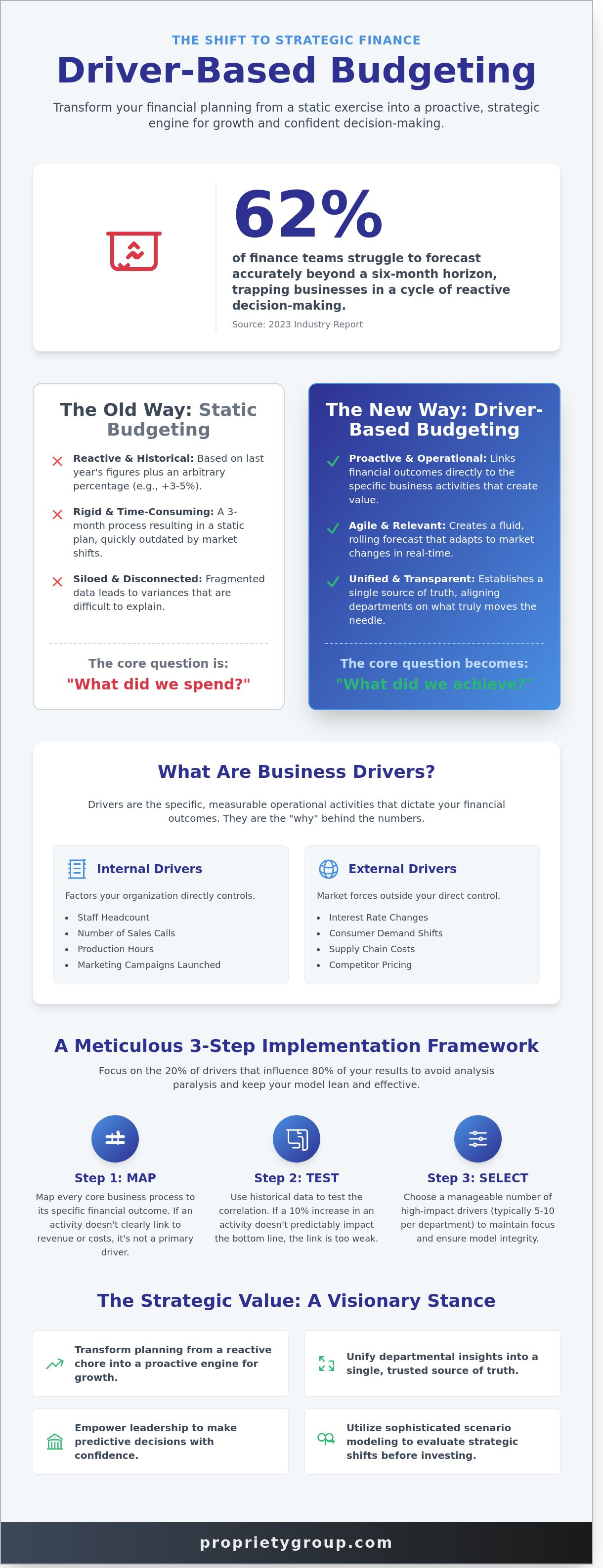
According to a 2023 industry report, 62% of finance teams struggle to forecast accurately beyond a six-month horizon, leaving many UK businesses trapped in a cycle of reactive decision-making. You likely recognise the exhaustion of a three-month budgeting process that feels disconnected from the daily pulse of your operations. It's a common frustration to see fragmented data across departments lead to variances that nobody can quite explain. This article reveals how driver-based budgeting transforms financial planning from a static exercise into a proactive, strategic engine for growth.
By focusing on the specific activities that dictate your outcomes, you can replace guesswork with a bespoke framework built on precision and integrity. We'll show you how to align your operational reality with your financial goals to create a more agile forecasting process. This approach provides the clarity needed to make predictive decisions with confidence, ensuring your business maintains its legacy of excellence in an ever-shifting market. We will explore the transition from rigid spreadsheets to a fluid, driver-led strategy that empowers your entire organisation.
Key Takeaways
- Move beyond traditional line-item constraints by learning to link financial outcomes directly to the specific operational activities that fuel your business.
- Discover how driver-based budgeting transforms your planning process from a reactive exercise into a proactive, strategic engine for growth.
- Establish a meticulous framework for success by unifying departmental insights into a single source of truth for more precise decision-making.
- Empower leadership to adopt a visionary stance, using forward-looking data to navigate market complexities with quiet confidence.
- Utilise sophisticated scenario modelling to evaluate the impact of strategic shifts before they occur, ensuring every investment is both deliberate and secure.
Beyond the Spreadsheet: The Philosophy of Driver-Based Budgeting
True financial leadership requires more than simply tracking costs. It demands a meticulous connection between every pound spent and the operational actions that generate value. This is the essence of driver-based budgeting. It's a philosophy that moves beyond static figures, linking financial outcomes to the specific activities, or drivers, that propel an organisation forward. By focusing on the "why" behind the numbers, leaders create a bespoke framework that reflects the unique pulse of their business.
To better understand how this approach transforms financial planning, watch this helpful video:
The Limitations of Traditional Financial Planning
Many organisations remain trapped in a cycle of historical bias. They often base next year's figures on last year's spending plus a standard 3% or 5% increase. This method lacks integrity in a volatile market. In 2023, many UK firms found their static budgets irrelevant within months due to rapid inflation. While zero-based budgeting offers a clean slate, driver-based budgeting provides the ongoing agility needed for modern scale. Integrating a rolling forecast methodology ensures that plans remain relevant even as the UK economy shifts.
Defining the Drivers that Shape Your Organisation
A Meticulous Framework for Implementing Driver-Based Models
Transitioning to driver-based budgeting requires more than a simple change in spreadsheet formulas. It demands a cultural shift towards transparency and collective accountability. Success begins with cross-departmental collaboration. Finance teams must step out of their silos to engage directly with operational leaders. This ensures that the chosen levers actually reflect the pulse of the business. By creating a shared understanding of what moves the needle, you replace fragmented reporting with a single source of truth that every department trusts.
Identifying and Prioritising Your Key Business Drivers
Precision is vital when defining the variables that dictate your financial health. A common mistake is attempting to track every possible metric. Instead, focus on the 20% of drivers that influence 80% of your results. This prevents analysis paralysis and keeps the model lean. To achieve this, follow a structured process:
- Step 1: Map every core business process to its specific financial outcome. If a marketing activity doesn't clearly lead to a revenue increase or a cost saving, it isn't a primary driver.
- Step 2: Use historical data to test the correlation between an activity and its impact. If a 10% increase in lead generation hasn't historically raised sales by a predictable margin, the link is too weak for a reliable model.
- Step 3: Select a manageable number of drivers, typically between five and ten per department. This ensures the team stays focused on high-impact activities.
Leveraging EPM Technology for Real-Time Intelligence
Modern organisations are moving away from rigid, static plans. They now embrace dynamic frameworks that adapt to the UK’s fluctuating economic environment. Professional EPM advisory helps leaders select tools that automatically link operational drivers to the P&L. This automation is essential for shifting from traditional annual budgets to driver-based planning. It allows for rolling forecasts that update as soon as operational data changes.
Integrating AI in finance assists in spotting non-obvious patterns within your data. These tools can identify subtle shifts in consumer behaviour or supply chain costs before they impact the bottom line. Maintaining integrity in data collection ensures that these forecasts remain both reliable and aspirational. When your data is accurate, your budget becomes a visionary roadmap rather than a historical record. For firms ready to enhance their financial precision, seeking expert strategic guidance can ensure your technology investment delivers long-term security.
The Strategic Value: Transforming the CFO into a Visionary Leader
From Reactive Reporting to Predictive Growth
Traditional finance often looks backward, but this model prioritises the future. Leaders can respond to market fluctuations in days rather than months. By stripping away irrelevant data, the focus remains on the specific metrics that dictate success. Data from the Chartered Institute of Management Accountants suggests that organisations using these agile methods can reduce their planning cycles by up to 25%. This efficiency ensures that resources are always directed toward the most profitable avenues, allowing the business to remain steady even during periods of economic volatility.
Cultivating a Culture of Accountability
When budgets are linked to tangible activities, every team member understands their personal impact on the organisation's health. It creates a bespoke roadmap for every department. Managers become stewards of their specific drivers—whether that involves tracking production efficiency or coordinating carpet maintenance with Commercial Carpet Cleaners Stockport—fostering a sense of ownership and integrity. This cultural shift ensures that financial health is a shared responsibility rather than a distant administrative concern. It transforms the balance sheet from a static document into a living reflection of the collective effort to create enduring value. This alignment ensures that every pound spent is a step toward the company's long-term vision.
- Precision: Decisions are based on operational realities, not just historical averages.
- Agility: The ability to pivot strategies within a single quarterly review.
- Transparency: Clear links between departmental actions and the final bottom line.
Secure Your Financial Legacy through Strategic Agility
This meticulous approach transforms the finance function from a department of record into a visionary partner. It allows you to anticipate market shifts with precision while maintaining the integrity of your long-term goals. Propriety Group serves as a specialist in EPM and CRM implementation, providing an expert-led narrative that guides leadership teams through this evolution. Our PG Care support model ensures your team has the comprehensive assistance needed to sustain excellence well after the initial transition.
Empower your finance team with bespoke EPM Advisory from Propriety Group
Your path to financial clarity starts with a single, deliberate step toward innovation.
Frequently Asked Questions
What is the primary difference between driver-based budgeting and traditional budgeting?
Driver-based budgeting focuses on the operational activities that dictate financial results, whereas traditional methods often rely on historical figures and incremental adjustments. By linking outputs to specific inputs like headcount or customer acquisition costs, it offers a more meticulous view of performance. This shift allows leaders to see exactly how a 5% increase in lead generation impacts the bottom line. It provides a level of precision that legacy accounting practices often lack.
How do we identify the right drivers for our specific organisation?
Can driver-based budgeting work alongside zero-based budgeting?
Driver-based budgeting integrates seamlessly with zero-based budgeting to create a rigorous financial framework. While zero-based budgeting requires every expense to be justified from a base of zero for each new period, drivers provide the mathematical logic to calculate those requirements. A 2023 industry study showed that organisations combining these methods reduced budget variances by 12%. This dual approach ensures that every pound spent aligns with the core purpose of the enterprise.
What role does EPM software play in the driver-based planning process?
Enterprise Performance Management software serves as the essential engine for the planning process by automating complex calculations and providing real-time data visualisations. It eliminates the errors found in manual spreadsheets, which affect 88% of traditional documents. By centralising information, these platforms allow teams to run various scenarios quickly. This technological foundation ensures that your financial strategy remains agile and grounded in the most current operational realities.