
How to Build a Single Source of Truth for Finance: A Visionary Guide

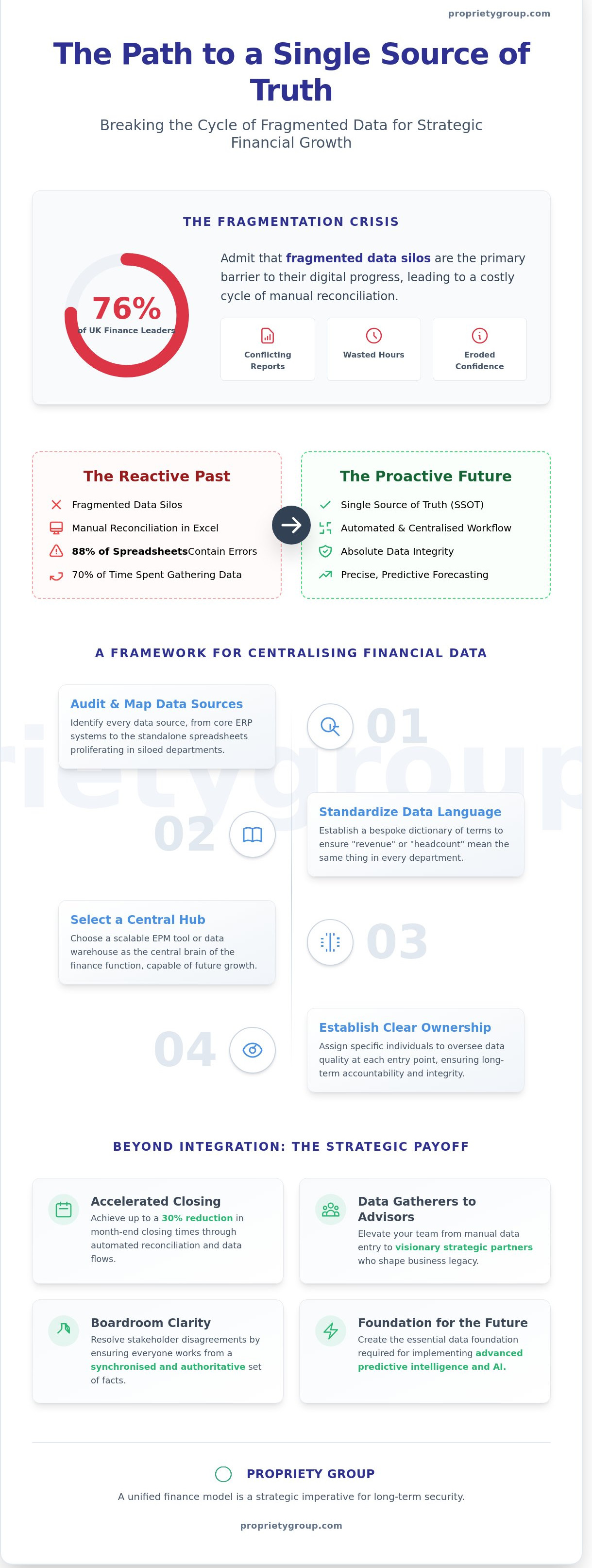
According to a 2023 report by FTI Consulting, 76% of finance leaders in the United Kingdom admit that fragmented data silos remain the primary barrier to their digital progress. You've likely felt the weight of this challenge when Sales figures clash with your ledger during a high-stakes board meeting. It's a cycle of manual reconciliation that erodes your confidence and consumes hours that should be spent on high-level growth.
We'll help you break this cycle by building a bespoke single source of truth finance framework that provides a meticulous foundation for every strategic decision. You'll discover how to unify your operational data into a single, trusted dashboard that ensures absolute integrity across your organisation. This guide explains how to accelerate your month-end close and elevate your team from data gatherers to visionary advisors who shape the long-term legacy of your business.
Key Takeaways
- Learn how to eliminate fragmented data silos by establishing a single source of truth finance that ensures all departments work from the same reliable figures.
- Discover a meticulous framework for auditing your existing data environments and standardising financial language across your entire organisation.
- Understand how a unified data foundation allows you to move beyond reactive reporting toward precise, predictive forecasting for long-term security.
- Explore how centralising your information serves as the essential first step for implementing advanced predictive intelligence and AI within your financial strategy.
- Gain the clarity needed to resolve boardroom disagreements by ensuring every stakeholder relies on a synchronised and authoritative repository of information.
Understanding the Single Source of Truth in Modern Finance
A single source of truth (SSOT) acts as a central repository where all financial and operational data is synchronised and accessible. It ensures every stakeholder works from the same set of facts. In many UK boardrooms, fragmented data leads to reactive planning. Different departments often present conflicting figures; this creates friction and delays. This "silo problem" prevents a unified vision and forces leaders to make decisions based on instinct rather than insight.
Relying on Excel creates a version control nightmare. One small error in a cell can ripple through an entire forecast. A connected Enterprise Performance Management (EPM) environment replaces this chaos with order. For a modern CFO, data accuracy is more than a technical requirement. It's a matter of propriety. Precision in reporting reflects the integrity of the leadership and the legacy of the business. Achieving a single source of truth finance model is a strategic imperative for long-term security.
The High Cost of Fragmented Reporting
Manual reconciliation is expensive. Finance teams often spend 70% of their time gathering data rather than analysing it. This leads to wasted man-hours and high risks of reporting errors that can cost a firm thousands of pounds in late filing fees or missed opportunities. Implementing financial consolidation software mitigates these risks. It automates data flows, ensuring £ millions in assets are tracked with meticulous care and transparency.
Why 2026 is the Year of Unified Data
By 2026, delayed reporting will be a significant competitive disadvantage. Businesses now require real-time insights to pivot in a volatile market. Static reports from last month are no longer enough for visionary leaders. Professional epm advisory helps leaders define a roadmap for this transition. It ensures the shift to a single source of truth finance environment is both strategic and permanent, providing a foundation for predictive growth.
As you prepare your infrastructure for the challenges of 2026, it is equally vital to ensure your personal leadership strategy reflects a similar standard of excellence; learn more about professional career coaching from Trainer Terry.
A Step-by-Step Framework for Centralising Financial Data
Building a single source of truth finance isn't merely a technical upgrade; it's a strategic commitment to clarity and institutional integrity. The journey begins with a meticulous audit of your current environment. You must identify every data source, from core ERP systems to the standalone spreadsheets that often proliferate in siloed departments. Industry data from 2023 indicates that 88% of spreadsheets contain significant errors, making this audit a critical first step in mitigating financial risk.
Once your sources are mapped, you must standardise your data language. If "revenue" or "headcount" carry different meanings in different rooms, your reporting will lack the prestige of absolute certainty. Establish a bespoke dictionary of terms that every stakeholder adopts. Following this, select a central hub. Whether you choose an Enterprise Performance Management (EPM) tool or a dedicated data warehouse, the platform must be capable of scaling as your organisation grows in complexity. Finally, establish clear ownership. Assigning a specific individual to oversee data quality at each entry point ensures accountability and maintains the single source of truth finance over the long term.
Organising Your Data Architecture
Your data warehouse acts as the central brain of the finance function. It ingests raw information from various source systems, such as payroll or sales platforms—where hospitality leaders can explore SkyTab POS for integrated transaction data—and organises it into a unified reporting layer. This structure is essential for complex processes like intercompany reconciliation, which serves as a vital safeguard for data integrity. A 2023 study by FSN found that automated reconciliation can reduce month-end closing times by 30%, creating a transparent, rhythmic path from transaction to insight.
The Human Element: Building a Data-First Culture
System failures are rarely about software; they're about people. Many implementations fail because teams revert to "shadow accounting" in private workbooks. To avoid this, you must invest in comprehensive training that builds genuine trust in the new architecture. When teams see that the system saves them hours of manual entry each week, they'll naturally abandon their old habits. For those seeking to elevate their financial operations, consulting with a strategic partner can ensure the transition is both seamless and enduring.
Beyond Integration: Leveraging Unified Data for Strategic Growth
Establishing a single source of truth finance professionals can rely on is far more than a simple technical upgrade. It represents a fundamental shift in leadership capability. Historically, finance teams have spent roughly 80% of their time on manual data reconciliation. By centralising this information, the focus shifts entirely toward high-level strategy and bespoke decision-making. This unified foundation allows a firm to move beyond merely reporting on what has already happened. It facilitates a transition to anticipating how the market will evolve.
Predictive Intelligence and AI Readiness
Modern ai in finance requires a pristine data environment to function. Algorithms fail when they pull from fragmented or conflicting spreadsheets. In 2026, the competitive advantage belongs not to those with the most data, but to those with the most trusted data. With clean, centralised records, firms can perform sophisticated scenario modelling. This includes simulating how a 0.5% increase in Bank of England base rates might impact a specific portfolio's liquidity over a five-year horizon. Proactive forecasting replaces reactive guesswork, allowing for precise stress testing against volatile economic shifts.
The Long-Term Value of Data Propriety
A single source of truth finance framework builds a legacy of business resilience. It empowers the visionary CFO to move away from reactive firefighting and toward a position of informed, confident leadership. This clarity ensures that every strategic move is backed by meticulous evidence rather than intuition alone. Propriety Group serves as the expert partner for this transformation journey. We understand that data propriety is about more than numbers; it's about the intersection of people, place, and purpose. By ensuring your data has total integrity, we help you create a permanent standard of excellence that defines your professional reputation and secures long-term value.
Just as financial integrity requires a proactive framework, personal longevity is built on a similar foundation of precision and preventative attention. To see how this standard of excellence is applied to executive health and specialized care, check out Concierge Medicine Europe.
Securing Your Financial Legacy Through Unified Data
Establishing a single source of truth finance professionals can rely on is no longer a luxury; it's a fundamental requirement for any business aiming for long-term stability in the United Kingdom market. By centralising fragmented data and moving beyond simple integration, your team gains the clarity needed to drive strategic growth rather than just managing spreadsheets. This transition requires a meticulous approach to environment analysis to ensure every piece of data aligns with your broader corporate goals; for professional support in business analysis and digital strategy, click here.
Since 2019, Propriety Group has operated as a specialist in EPM and CRM implementation, focusing on bespoke solutions that respect the unique architecture of your business. Our team provides more than just technical setup. Through the PG Care managed model, we offer ongoing support that ensures your systems remain as precise and reliable as the day they were launched. You deserve a partner that values integrity and precision in every detail of your financial infrastructure.
Partner with Propriety Group for expert EPM implementation and advisory to begin your journey toward a more transparent and purposeful financial future. Your vision for excellence is within reach.
Frequently Asked Questions
What is the difference between a data warehouse and a single source of truth?
A data warehouse acts as the physical repository for information, whereas a single source of truth represents the strategic achievement of data integrity across an entire organisation. While the warehouse stores the raw numbers, the single source of truth ensures that every stakeholder views the same bespoke, verified figures. This distinction is vital; a 2023 study by FSN found that 11% of finance teams still spend over half their time manually reconciling data between different systems.
How long does it typically take to implement a single source of truth for finance?
Most UK enterprises require between six and eighteen months to fully implement a single source of truth for finance. This timeline depends on the complexity of your legacy systems and the meticulous nature of the data cleansing required. A phased transition ensures that core reporting remains stable. Research from the 2022 Deloitte Finance Survey indicates that 45% of successful digital transformations prioritise a foundational data layer before moving to advanced analytics.
Can we achieve a single source of truth without replacing our existing ERP?
You don't need to replace your existing ERP system to achieve a unified data environment. Modern integration layers allow businesses to extract and harmonise data from older software without the disruption of a full system overhaul. This approach maintains the legacy value of your current tools while introducing a new standard of propriety to your financial reporting. According to a 2023 report from PwC, 58% of finance functions now use middleware to bridge gaps between disparate systems.
What are the biggest risks when moving to a centralised data model?
The primary risks involve data security vulnerabilities and the potential for a single point of failure if governance isn't meticulous. When you consolidate information, a single breach or technical error can impact every department simultaneously. In 2023, the UK government's Cyber Security Breaches Survey noted that 32% of businesses identified a breach or attack. Protecting your centralised model requires a principled approach to access controls and regular audits to ensure long-term security and operational excellence.