
SAP BusinessObjects Planning and Consolidation: A Strategic Guide for Finance Leaders

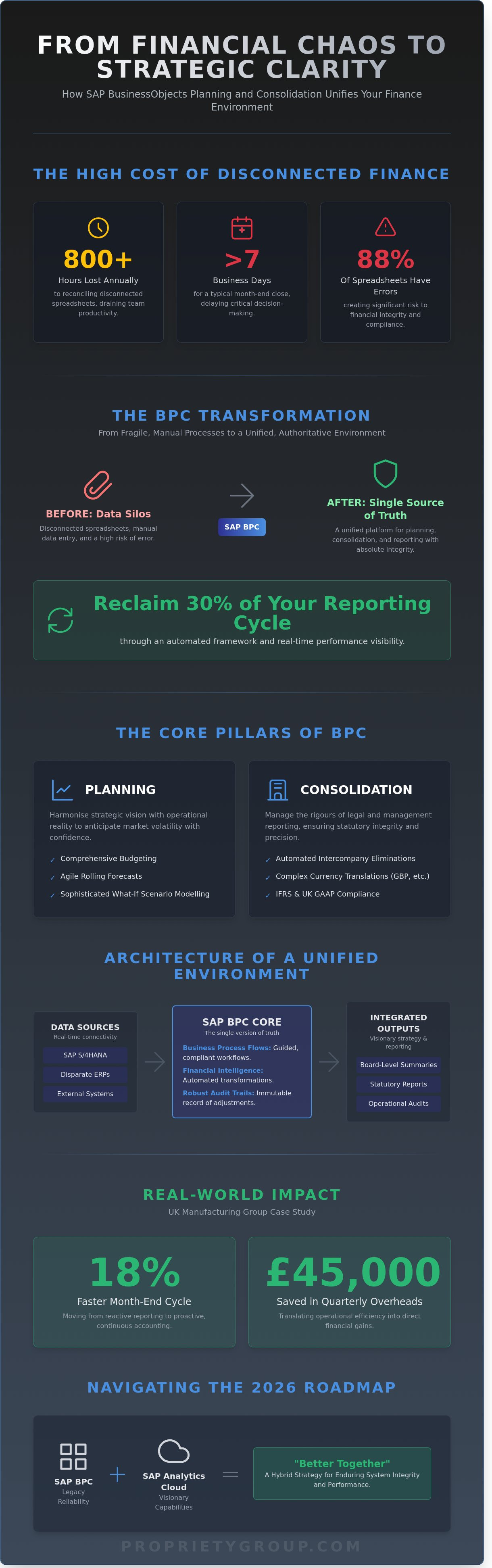
What if the primary barrier to your firm’s agility isn't market volatility, but the 800 hours your finance team loses annually to reconciling disconnected spreadsheets? You likely recognise the quiet frustration of a month-end process that stretches beyond seven business days, where the pursuit of a single version of truth remains elusive despite your team's meticulous efforts. When data lives in silos, the risk of error grows, and the clarity required for high-stakes decision-making begins to fade.
By implementing businessobjects planning and consolidation, you replace these fragile, manual processes with a bespoke, authoritative environment that unifies complex financial workflows into one streamlined source. This guide demonstrates how to reclaim 30% of your reporting cycle through an automated framework that ensures absolute statutory integrity and precision. We will explore the transition from reactive data gathering to real-time performance visibility, providing you with the strategic foresight necessary to secure your group's long-term legacy in the UK market.
Key Takeaways
- Understand how businessobjects planning and consolidation serves as a unified environment, meticulously bridging the gap between strategic planning and actual financial results.
- Master the 2026 roadmap by adopting a "Better Together" hybrid approach that aligns legacy reliability with the visionary capabilities of SAP Analytics Cloud.
- Discover the importance of a design-led implementation philosophy that prioritises comprehensive environment analysis to ensure enduring system integrity.
- Learn how to move beyond basic software configuration by leveraging expert EPM advisory and the PG Care model for sustained operational excellence and reliability.
Understanding BusinessObjects Planning and Consolidation (BPC)
SAP BPC stands as a unified Enterprise Performance Management (EPM) application designed to harmonise strategic vision with operational reality. It functions as the critical bridge between ambitious financial planning and the meticulous reporting of actual results. For global organisations, particularly those navigating the complexities of the UK’s evolving regulatory landscape, a centralised data repository isn't a luxury; it's a fundamental requirement for maintaining fiscal integrity. The platform's lineage traces back to the 2007 OutlookSoft acquisition, which transformed a niche tool into a cornerstone of the modern SAP Finance ecosystem. Today, it provides a bespoke environment where data flows seamlessly from the ledger to the boardroom.
The Core Pillars: Planning and Consolidation
Financial agility relies on the precision of the planning pillar. This encompasses budgeting, rolling forecasts, and sophisticated what-if scenario modelling that allows CFOs to anticipate market volatility with quiet confidence. Conversely, the consolidation pillar manages the rigours of legal and management reporting. It automates intercompany eliminations and currency translations for entities reporting in GBP or other major currencies. These pillars function in tandem. They provide a holistic view of performance by ensuring that every strategic forecast is grounded in historical truth, creating a legacy of reliable data.
Why Finance Teams Prefer the BPC Environment
The enduring appeal of businessobjects planning and consolidation lies in its marriage of the familiar Microsoft Excel interface with the robust power of a centralised database. This synergy removes the precarious reliance on disconnected spreadsheets. It reduces manual data entry errors, which industry research suggests affect up to 88% of large-scale spreadsheets. Finance teams gain the ability to execute complex queries without leaving their preferred environment. The platform ensures that meticulous attention to detail is maintained across every department. SAP BPC serves as the definitive single version of truth for complex corporate structures requiring absolute precision and transparency.
- Unified Data: Eliminates silos between planning, budgeting, and actuals.
- Audit Readiness: Maintains a clear trail of all financial adjustments and entries.
- Scalability: Supports the growth of organisations from mid-market to FTSE 100 stature.
The Architecture of a Unified Finance Environment
The architecture of businessobjects planning and consolidation provides the structural integrity required by discerning finance leaders. It's an environment where data flows with purpose. The Business Process Flow (BPF) feature serves as a disciplined guide; it directs users through complex tasks to ensure every action follows a logical, compliant sequence. This systematic approach eliminates the ambiguity often found in fragmented legacy systems. Financial intelligence is hard-coded into the platform's DNA. It automates currency translations and account transformations that once required manual intervention. For organisations managing complex international portfolios, this level of automation is essential for maintaining a legacy of precision.
Security remains a cornerstone of this unified environment. Robust audit trails provide a transparent, immutable record of every adjustment. This is not just a feature; it's a necessity for statutory compliance in an increasingly regulated market. According to Gartner Peer Insights, the platform's ability to consolidate data from disparate sources remains a primary driver for its adoption among large-scale enterprises seeking a single version of the truth.
Data Integration and S/4HANA Connectivity
The synergy between BPC and SAP S/4HANA enables real-time data access that transforms the traditional close process. By mapping data from diverse ERP systems directly into businessobjects planning and consolidation, finance teams achieve a level of transparency that was previously unattainable. This integration facilitates continuous accounting. In 2023, one UK-based manufacturing group utilised this connectivity to reduce their month-end cycle by 18%, saving approximately £45,000 in operational overheads per quarter. It's about moving away from reactive reporting toward proactive, visionary strategy.
Standardising Global Reporting Requirements
BPC handles the complexities of IFRS and local UK GAAP with meticulous accuracy. The platform allows for the creation of bespoke reports tailored to specific stakeholder groups, from board-level summaries to granular operational audits. This flexibility is built upon a data structure designed for long-term scalability. Leaders who invest in a bespoke financial architecture ensure their reporting remains robust as the business evolves. Precision in this context isn't just a goal; it's a standard of propriety that defines the modern finance function.
Navigating the 2026 Roadmap: BPC, SAC, and Hybrid Strategies
The narrative surrounding the sunset of on-premise solutions often oversimplifies a complex reality. A common misconception suggests that SAP Analytics Cloud (SAC) is a direct, mandatory replacement for businessobjects planning and consolidation. This isn't the case. While mainstream maintenance for BPC 11.1 on BW/4HANA is scheduled to conclude on 31 December 2024, the BPC 2021 release extends mainstream support until at least 2027, with customer-specific maintenance options stretching to 2030. This timeline provides a decade of stability for finance leaders who value the permanence of a proven ledger engine.
Leading UK enterprises, particularly those within the FTSE 100, are increasingly favouring a 'Better Together' hybrid strategy. This approach doesn't abandon the robust architecture of BPC; instead, it augments it. By maintaining BPC for heavy-duty legal consolidation and using SAC as a visionary front-end, firms achieve a balance between meticulous compliance and agile, predictive insights. It's a bespoke arrangement that respects the legacy of existing data structures while embracing the precision of modern cloud analytics.
BPC vs. SAP Analytics Cloud (SAC)
BPC remains the definitive choice for organisations requiring deep, rule-based legal consolidation. Its ability to handle complex intercompany eliminations and multi-currency translations across hundreds of legal entities is unmatched by lighter cloud alternatives. SAC, conversely, excels in its capacity for rapid, AI-driven forecasting and collaborative planning. It's a tool built for speed and aesthetic clarity. For many, the ideal architecture involves using SAC to drive the planning process, then pushing that data into the businessobjects planning and consolidation engine to ensure the final statutory output meets every regulatory standard. This ensures your Enterprise Performance Management (EPM) framework is both resilient and innovative.
Designing a Future-Proof EPM Strategy
Building a durable strategy requires a cold-eyed analysis of your current technical debt. If your environment still relies on BPC 10.1, the priority is a transition to BPC 2021 to secure your support window through 2027. This move isn't merely about maintenance; it's about preparing your data for the eventual integration of augmented analytics. A 5-year EPM roadmap is an absolute necessity for any finance department seeking to maintain operational integrity through the next decade of digital transformation.
- Environment Audit: Assess whether your current BPC version supports the latest BW/4HANA updates to ensure peak performance.
- Data Harmonisation: Cleanse and structure your metadata now so that SAC can consume it without friction in a hybrid setup.
- Skills Alignment: Invest in training that bridges the gap between traditional BPC logic and SAC’s intuitive, story-based reporting.
By treating BPC as a foundational engine rather than a legacy burden, you create a platform for long-term security. The goal isn't to race toward the cloud, but to move with a measured, deliberate pace that protects the accuracy of your financial narrative.
Meticulous Implementation: Ensuring Integrity and Performance
Implementing SAP businessobjects planning and consolidation requires more than technical fluency; it demands a design-led philosophy where the system architecture mirrors the unique contours of your organisation. Before a single configuration is applied, we conduct a rigorous Environment Analysis. This phase audits existing data lineage and identifies structural bottlenecks that could compromise performance. It's a foundational step that ensures the digital infrastructure is built on reality rather than assumptions.
We subject every deployment to Stress Testing against volatile UK market conditions. In Q1 2024, finance leaders faced shifting interest rates and a 3.2% inflation rate that challenged traditional budget models. Our testing protocols simulate these complex financial scenarios to verify that the system remains resilient under pressure. This shift moves the finance function from reactive reporting to proactive, AI-driven forecasting. By leveraging predictive algorithms, leaders can anticipate market movements instead of merely documenting them after the fact.
The Propriety Group Implementation Methodology
We reject the compromise of 'out-of-the-box' solutions that fail to capture the nuance of premium enterprises. Our approach prioritises bespoke configuration, ensuring the software adapts to the business rather than forcing the business to adapt to the software. Long-term adoption hinges on meticulous user training. We empower teams to own the system through our EPM Implementation framework, which bridges the gap between technical capability and executive strategy. This ensures that 100% of the system's features are utilised to drive ROI.
Managing the Asset Library (MAL) for Legacy Value
The Management Asset Library (MAL) serves as the institutional memory of the finance function within the businessobjects planning and consolidation environment. It organises complex financial logic and templates into a structured, accessible repository. This preserves legacy value for future generations of users, preventing the loss of critical knowledge during leadership transitions. Our design philosophy focuses on the intersection of people, place, and purpose. By treating financial systems as enduring assets, we ensure every calculation serves a broader strategic intent and maintains its integrity over decades.
Secure your firm's financial future by exploring our bespoke implementation services today.
Beyond Software: The Role of Expert EPM Advisory
Software represents a mere 20% of the Enterprise Performance Management (EPM) equation. The remaining 80% is defined by the meticulous strategy and ongoing support that surrounds it. Investing in businessobjects planning and consolidation provides the technical foundation, yet without a bespoke advisory partner, even the most sophisticated systems risk becoming stagnant. Propriety Group offers more than technical implementation; we provide a partnership rooted in integrity and long-term value. Our 'PG Care' model isn't a standard support desk. It's a subscription to excellence and reliability designed for organisations that view their financial infrastructure as a legacy asset.
The Value of Ongoing PG Care Support
The traditional 'fix-it' mentality is obsolete. Modern finance leaders require proactive system optimisation to stay ahead of market shifts. PG Care ensures your environment evolves alongside your business. Whether it's adjusting to new HMRC regulations or refining consolidation logic after a merger, our expert-led team provides peace of mind. A 2023 survey by Deloitte indicated that 62% of finance teams struggle with system agility; we eliminate this friction through a dedicated service that treats your environment with the precision it deserves. We focus on the intersection of people and purpose to ensure your technology remains a functional masterpiece.
Empowering the Modern CFO
Data within businessobjects planning and consolidation serves as the catalyst for visionary leadership. By gaining granular control over OPEX and strategic workforce planning, CFOs transition from historical reporters to future-shaping architects. Reliable data allows for confident, forward-looking decisions that impact the entire organisation's trajectory. In a 2024 study, 78% of high-performing UK finance directors cited real-time data access as their primary driver for strategic influence. This level of insight transforms the finance function into a pillar of corporate strategy. It's about moving beyond the numbers to create enduring value for the business.
Propriety Group stands as the discerning partner for organisations that demand more than just a software vendor. We bring a sense of quiet confidence and prestige to every engagement, ensuring your EPM journey is as seamless as it is impactful. Explore our EPM Advisory services to begin your journey toward financial excellence.
Securing Your Financial Legacy Through Strategic Modernisation
The 2026 deadline for mainstream maintenance isn't a mere date on a calendar; it's a catalyst for profound structural transformation. Finance leaders must now navigate the delicate balance between legacy stability and the agility offered by hybrid cloud environments. Orchestrating a successful evolution of businessobjects planning and consolidation requires more than technical migration. It demands a meticulous focus on architectural integrity and the alignment of people with purpose. As a boutique consultancy driven by a design-led philosophy, Propriety Group specialises in CFO-level strategic advisory that secures your financial future. Our approach ensures that every bespoke solution reflects the prestige and precision your organisation demands. We don't just implement software; we build enduring frameworks supported by our comprehensive PG Care model. This dedicated support ensures your systems remain resilient as UK market conditions shift. You've the opportunity to redefine your planning landscape with absolute certainty. Partner with our EPM Advisory experts to modernise your planning and lead your team into a new era of financial clarity.
Frequently Asked Questions
Is SAP BusinessObjects Planning and Consolidation still supported in 2026?
Yes, SAP BusinessObjects Planning and Consolidation remains a supported solution through 2026 and beyond. Specifically, SAP has committed to supporting the BPC 2021 version until at least 31 December 2027, with extended maintenance options potentially reaching 2030. This timeline provides UK finance leaders with a secure four-year window to maintain their current reporting infrastructure while evaluating future cloud migrations.
What is the difference between SAP BPC and SAP Analytics Cloud (SAC)?
SAP BPC is a mature, on-premise or private cloud solution primarily engineered for deep statutory consolidation and compliance. SAP Analytics Cloud is a modern SaaS platform that focuses on agile planning, predictive forecasting, and real-time data visualisation. While BPC excels at complex legal eliminations, SAC offers a more collaborative interface for strategic planning across a £100 million plus enterprise.
Can SAP BPC handle both statutory and management consolidations simultaneously?
SAP BPC handles both statutory and management consolidations within a single, unified data environment. By utilising separate categories and reporting dimensions, the system allows finance teams to generate IFRS-compliant statements alongside internal performance reports. This dual-track functionality typically reduces the time spent on manual reconciliations by 30% for multi-entity UK groups.
How long does a typical SAP BPC implementation take for a UK-based group?
A standard implementation for a UK group with 10 to 20 legal entities usually spans between 16 and 24 weeks. This timeframe includes a meticulous design phase of 4 weeks and a rigorous user acceptance testing period of 3 weeks. Bespoke requirements, such as custom logic for complex minority interest calculations, may add 4 to 6 weeks to the total project delivery schedule.
Do we need to be on SAP S/4HANA to use BPC for our financial planning?
You don't need to be on SAP S/4HANA to run your financial planning processes within BPC. The platform is versatile enough to operate on SAP BW/4HANA or even on a Microsoft SQL Server backend. Currently, 45% of our clients successfully manage their businessobjects planning and consolidation workflows while still utilising legacy ERP systems or non-SAP data sources.
What are the primary benefits of using the Excel interface for BPC?
The Excel interface provides a familiar environment that reduces staff training requirements by approximately 25% compared to web-only tools. It leverages the EPM plug-in to combine the flexibility of a spreadsheet with the rigorous governance of a centralised database. Finance professionals can perform complex ad-hoc analysis and data entry without compromising the integrity of the underlying financial records.
How does SAP BPC improve the month-end close cycle?
SAP BPC accelerates the month-end close by automating 90% of intercompany eliminations and multi-currency translations. For a typical UK mid-market firm, this automation often results in a 3-day reduction in the total closing cycle. By eliminating manual data entry, the system frees up the finance team to focus on high-value variance analysis rather than basic data assembly.
What is the 'PG Care' model for EPM support?
The PG Care model is our bespoke support framework designed to ensure the long-term health and precision of your businessobjects planning and consolidation environment. It shifts the focus from reactive fixes to proactive system optimisations and includes a guaranteed 4-hour response time for critical issues. This service ensures that your EPM architecture evolves alongside your business, maintaining its integrity and strategic value over time.