
CFO Challenges UK 2026: Navigating Structural Volatility and the AI Frontier

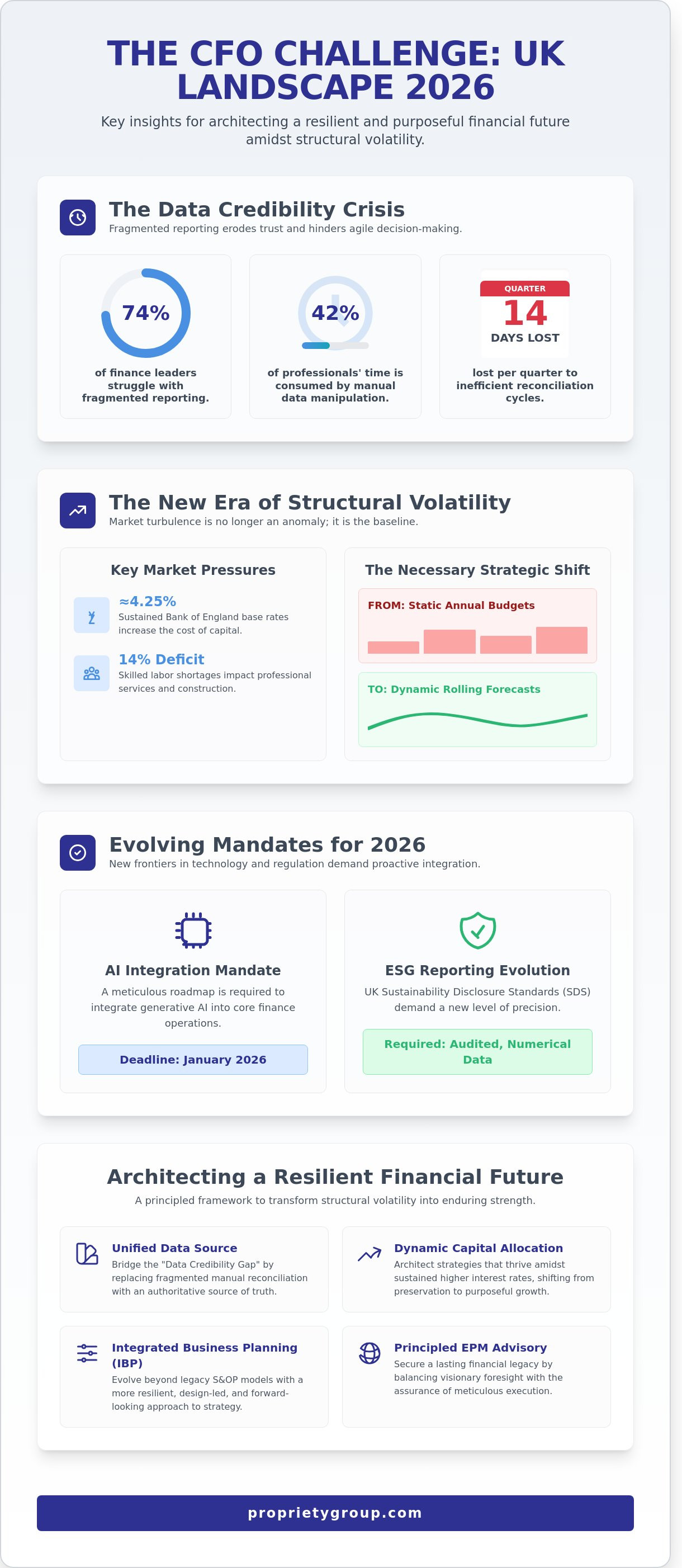
What if the greatest threat to your firm’s legacy in 2026 isn't market volatility, but the invisible decay of your data's integrity? As the fiscal horizon shifts, the primary cfo challenges uk 2026 center on a fundamental transition from reactive governance to a bespoke, visionary strategy. You've likely observed that 74% of finance leaders currently struggle with fragmented reporting, a friction that prevents the "one version of the truth" required for precise capital allocation. The mandate to integrate generative AI by January 2026, often without a meticulous roadmap, only adds to the complexity of maintaining institutional excellence.
We understand that the rising cost of capital and persistent margin squeeze demand a more sophisticated response than simple cost-cutting. This analysis provides a clear framework for your 2026 planning, offering the strategic insights needed to architect a resilient and purposeful financial future. We’ll explore how to align your workforce with evolving technological frontiers while ensuring every decision is grounded in data-driven certainty. By the end of this guide, you'll have the tools to transform structural volatility into a position of enduring strength and propriety.
Key Takeaways
- Master the transition from episodic to structural volatility by architecting capital allocation strategies that thrive amidst sustained higher interest rates.
- Bridge the "Data Credibility Gap" to solve the core cfo challenges uk 2026, replacing fragmented manual reconciliation with a unified, authoritative source of truth.
- Evolve AI from experimental pilot programs into a cornerstone of finance operations, ensuring transparency and integrity within every predictive forecast.
- Build a sophisticated framework for Integrated Business Planning (IBP) that replaces legacy S&OP models with a more resilient, design-led approach to strategy.
- Secure a lasting financial legacy by embracing a principled EPM advisory model that balances visionary foresight with meticulous execution.
The UK Macroeconomic and Regulatory Landscape in 2026
The UK market has entered an era where turbulence is no longer an anomaly; it is the foundation. By 2026, the distinction between temporary shocks and permanent shifts has dissolved into a state of structural volatility. Financial leaders now recognize that the evolving role of the CFO requires a transition from reactive cost-cutting to the curation of structural resilience. The growth-at-all-costs philosophy has been replaced by a mandate for meticulous capital preservation. With the Bank of England maintaining base rates near 4.25 percent to counter persistent inflationary pressures, the cost of capital remains a primary hurdle. This environment demands a sophisticated approach to capital allocation where every pound is measured against its long-term legacy and risk-adjusted return.
Structural Volatility and the New Baseline
Structural volatility now characterizes UK supply chains and labor markets. Skilled labor shortages in the professional services and construction sectors reached a 14 percent deficit by the start of 2026. This reality forces a shift from static annual budgets to dynamic rolling forecasts that adapt in real-time. CFOs utilize these tools to ensure liquidity remains robust during sudden shifts. Stress testing is no longer a quarterly exercise; it is a weekly discipline. These practices protect the integrity of the balance sheet against a backdrop of geopolitical and domestic flux. It's a bespoke strategy for a fragmented world.
Regulatory Evolution: ESG and Beyond
The 2026 regulatory environment demands more than narrative promises. The UK Sustainability Disclosure Standards (SDS) now require audited, numerical data that matches the precision of traditional financial reporting. This shift eliminates the risks of vague environmental claims. For the discerning firm, propriety in reporting serves as a competitive advantage. It attracts a higher caliber of investor who values transparency and ethical precision. Navigating these mandates is among the most complex cfo challenges uk 2026 faces, as it requires integrating ESG metrics into the core financial engine. Success here depends on:
- Data Integrity: Transitioning from qualitative stories to audited, quantitative ESG performance indicators.
- Strategic Alignment: Ensuring 2026 reporting requirements reflect the company’s broader purpose and place in the market.
- Risk Mitigation: Identifying climate-related financial risks before they impact the valuation of physical assets.
This rigorous approach to compliance ensures that firms don't just survive regulatory scrutiny but thrive through it. By treating transparency as a pillar of brand prestige, UK financial leaders are redefining what it means to lead with integrity. The cfo challenges uk 2026 landscape is demanding, yet it offers a clear path for those who value precision over speed.
The Data Credibility Crisis: Moving Beyond Fragmented Reporting
The "Data Credibility Gap" has emerged as one of the most pressing cfo challenges uk 2026 faces. It represents the chasm between the rapid pace of market volatility and the sluggish, often inaccurate nature of manual reporting. When board members question the validity of a forecast, the CFO’s authority diminishes. This crisis isn't merely technical; it’s a matter of institutional integrity. Today’s leaders are directly responsible for the precision of both financial and non-financial data, including ESG disclosures that now require the same meticulous audit trails as traditional tax filings.
The Cost of Fragmentation
Fragmented reporting is the primary barrier to 2026 agility, defined by the existence of disconnected datasets that require manual intervention to align. It creates a landscape where departments operate on conflicting versions of reality. Research from late 2024 indicated that finance professionals spend 42% of their time on manual data manipulation. By 2026, this inefficiency translates to a significant drain on corporate resources. Organizations lose an average of 14 days per quarter to reconciliation cycles that should be automated. This delay forces a reactive stance. As the UK economic outlook for 2026 warns of a two-speed economy, those burdened by "Excel chaos" will inevitably fall into the lower tier of growth and investment readiness.
Architecting a Single Source of Truth
Establishing a single source of truth requires a shift from legacy silos to a connected ecosystem. A sophisticated approach involves positioning Enterprise Performance Management (EPM) software as the intelligence layer residing above the ERP. This architecture ensures that data flows seamlessly and remains auditable at every touchpoint. It provides a level of clarity that manual systems cannot replicate.
- Data Lineage: Every metric must be traceable to its origin point to satisfy 2026 regulatory standards.
- Real-time Synchronization: Eliminating the 48-hour lag in reporting allows for immediate strategic pivots.
- Unified Governance: Centralizing non-financial data ensures it meets the high standards of corporate propriety.
Building this foundation is a visionary act. It transforms finance from a back-office function into a pillar of long-term security. Leaders who prioritize meticulous financial architecture create a legacy of transparency that attracts top-tier capital and talent alike. This technical evolution is the only way to ensure that "one version of the truth" isn't just a corporate aspiration, but a functional reality.
Harnessing AI and Predictive Analytics for Strategic Foresight
By 2026, the era of experimental AI pilots has concluded. Finance departments have transitioned these tools into the bedrock of core operations. Research indicates that AI is transforming finance by automating 65% of routine data reconciliation and entry tasks. This evolution allows the finance function to move beyond descriptive reporting. It creates space for a meticulous focus on long-term value creation. One of the central cfo challenges uk 2026 involves dismantling the 'Black Box' problem. CFOs must ensure transparency in AI-driven forecasts to maintain the integrity of their reporting. Without clear visibility into how an algorithm reached a specific conclusion, the risk of structural error increases. Leaders are now adopting explainable AI (XAI) frameworks to provide the audit trails necessary for regulatory compliance and board confidence.
Predictive analytics serves as a sophisticated early warning system. These tools identify margin erosion at a threshold as low as 0.5% before the impact hits the P&L. By analyzing real-time supply chain fluctuations and energy price volatility, finance teams can execute surgical adjustments to pricing strategies. This proactive stance ensures that the company's fiscal legacy remains protected against the sudden shocks of a volatile market.
AI with Purpose: Beyond the Hype
High-value use cases are now concentrated in FP&A and bespoke workforce planning. A 2025 study of UK mid-cap firms showed that predictive workforce modeling reduced hiring costs by 18% through better churn anticipation. To maintain financial integrity, CFOs are implementing rigorous protocols to mitigate bias in predictive models. Human-in-the-loop oversight remains a critical requirement. It ensures that AI-generated insights are tempered by professional judgment and ethical propriety. This balance preserves the human element in strategic decision-making.
Moving to Prescriptive Analytics
The shift to prescriptive analytics represents a fundamental change in leadership. Predictive tools allow finance teams to run complex 'what-if' scenarios in real-time; they simulate the impact of a 3% interest rate hike or a localized trade disruption in seconds. This capability has a profound impact on cash flow predictability. Working capital management is no longer a reactive exercise. It's a precise, data-led strategy that optimizes liquidity across global accounts. This level of control is essential for navigating the cfo challenges uk 2026. AI transforms the CFO into a visionary architect of the enterprise's enduring financial structure.
Building a Resilient Architecture for Integrated Business Planning (IBP)
Traditional Sales and Operations Planning (S&OP) often fails because it operates in isolation from the balance sheet. By 2026, the UK's economic landscape, characterized by a persistent 2.5% productivity gap and ongoing supply chain friction, demands more than just inventory management. One of the primary cfo challenges uk 2026 involves moving beyond reactive forecasting toward a proactive, unified model. A successful IBP framework rests on five pillars: strategic alignment, demand-supply synchronization, financial reconciliation, multi-variate scenario modeling, and rigorous executive governance. These pillars ensure every tactical decision reflects the overarching corporate legacy. When demand shifts by even 3%, the financial impact must ripple through the entire architecture instantly.
The Transition to xP&A (Extended Planning and Analysis)
Silos represent the greatest threat to corporate agility. xP&A dissolves these barriers by weaving financial targets into the operational fabric of HR, procurement, and sales. Selecting the right EPM or CRM stack requires a meticulous environment analysis to ensure data integrity across every touchpoint. Precision in selection prevents the accumulation of technical debt. You can explore our comprehensive guide on integrated business planning to understand these technical requirements and how they support a visionary growth strategy.
Workforce Planning as a Financial Lever
Labour costs in the UK rose by an average of 6% in 2024; a trend expected to persist through the 2026 fiscal year. CFOs must integrate headcount modelling directly into long-range financial plans to protect margins against high-skill demand pressures. It's not merely about recruitment. It's about the meticulous alignment of talent acquisition with projected revenue trajectories. Our workforce planning services provide the clarity needed to manage these human capital pressures with quiet confidence and precision.
Choosing an EPM solution that scales requires a focus on architectural flexibility rather than just current features. In a market where 40% of UK firms report data fragmentation as a primary barrier to growth, your software must mirror your organizational complexity. It's the difference between a tool that records history and a platform that shapes the future. This level of meticulous planning ensures that the business remains resilient, regardless of external volatility.
The Role of EPM Advisory in Securing a Financial Legacy
The final transition into 2026 requires a departure from the "install and ignore" mentality that has historically plagued digital transformations. Technical implementation represents only 20% of the total journey toward financial excellence. To master the cfo challenges uk 2026 presents, leaders must embrace an ongoing advisory partnership that extends far beyond the initial go-live date. Our Propriety approach rejects the notion of software as a silver bullet; instead, we advocate for a synthesis of meticulous execution and visionary strategy. This methodology ensures that Enterprise Performance Management (EPM) systems are woven into the organization's cultural fabric, turning a tool into a permanent competitive advantage.
The goal is a fundamental shift in the finance function’s identity. By moving away from reactive reporting, the CFO becomes a proactive architect of value. This evolution demands a commitment to integrity and precision. It creates a structure where data isn't just stored but is utilized to steer the enterprise through structural volatility. When a finance team functions as a strategic partner, they provide the steady hand required to navigate the complexities of the UK’s shifting economic landscape.
Meticulous Implementation and Beyond
Standardized solutions rarely accommodate the unique operational DNA of a sophisticated firm. By January 2026, bespoke configuration will be the hallmark of high-performing finance teams, as 72% of organizations now prioritize tailored workflows over generic software. We focus on upskilling the department to ensure they thrive in a digital-first environment. This meticulous attention to detail defines a CFO’s legacy. It builds a modernized function where 85% of routine manual tasks are eliminated, allowing the team to focus on high-impact strategic growth.
Partnering for Performance
Traditional consultancy models often create a vacuum once the project ends, leading to system decay. PG Care offers a subscription-based support model that ensures long-term system optimization and a 15% higher ROI on technology investments. A vital component of this is our Management Asset Library, which preserves institutional knowledge and prevents "brain drain" during personnel transitions. This continuous evolution allows finance leaders to maintain peak performance year after year. Discover how Propriety Group empowers UK CFOs to lead with confidence and address the cfo challenges uk 2026 with a principled, expert-led strategy.
Architecting a Future of Fiscal Precision
Navigating the landscape of 2026 requires a departure from fragmented data and a commitment to integrated business planning. The shift toward AI-driven predictive analytics isn't just a technological upgrade; it's a fundamental requirement for maintaining strategic foresight amidst structural volatility. By the arrival of 2026, the ability to synthesize macroeconomic shifts into actionable intelligence will define market leaders. Addressing the core cfo challenges uk 2026 demands a meticulous focus on data integrity and a resilient architecture that supports long-term growth.
Since 2019, Propriety Group's delivered bespoke EPM and CRM implementations that transform complex financial data into clear, strategic narratives. Our PG Care managed support model provides the expert-led guidance necessary to master predictive analytics while ensuring your reporting remains beyond reproach. We've spent years refining a philosophy where people, place, and purpose intersect to create enduring value. You've the opportunity to turn regulatory pressure into a competitive advantage by building a foundation of correctness and ethical transparency.
Secure your 2026 financial strategy with Propriety Group's EPM Advisory
The path ahead's complex, but with the right structural support, your organization's financial legacy's secure.
Frequently Asked Questions
What are the most significant CFO challenges in the UK for 2026?
The primary cfo challenges uk 2026 include managing 2.5% structural inflation and navigating the mandatory transition to UK Sustainability Reporting Standards. CFOs must also bridge a 15% projected talent gap in advanced data analytics. These hurdles require a shift from retrospective reporting to predictive agility. Success depends on maintaining integrity while adopting high-velocity decision-making frameworks that protect the firm's long-term legacy.
How can AI improve financial forecasting for UK businesses in 2026?
AI improves financial forecasting by reducing variance by up to 40% through the analysis of non-linear datasets that traditional models ignore. It processes thousands of external variables, such as real-time supply chain shifts, to provide a meticulous view of future cash flow. By 2026, 70% of UK finance leaders will use machine learning to automate baseline forecasts. This allows teams to focus on bespoke strategic advisory roles.
What is the difference between ERP and EPM for modern finance teams?
ERP systems focus on the granular recording of daily transactions, while EPM platforms orchestrate high-level strategic planning and performance management. An ERP functions as the system of record for 100% of data generated by business operations. EPM layers over this data to facilitate complex modeling and scenario planning. This distinction is vital for maintaining a legacy of precision; it’s the difference between looking backward and seeing ahead.
How should UK CFOs prepare for upcoming ESG reporting regulations in 2026?
UK CFOs should prepare for ESG regulations by integrating non-financial data into their core EPM systems before the January 2026 UK SRS deadlines. This involves establishing a 100% traceable audit trail for carbon emissions and social impact metrics. Meticulous data governance ensures that sustainability claims withstand rigorous third-party assurance. It’s no longer a voluntary disclosure; it’s a pillar of corporate propriety that defines a brand's standing.
Why is Integrated Business Planning (IBP) critical for financial resilience?
Integrated Business Planning is critical because it aligns sales, operations, and finance into a single strategy that can improve EBITDA margins by 20%. It replaces fragmented departmental silos with a unified vision of the company’s purpose. By 2026, the ability to pivot resources within 24 hours of a market shift will define resilient firms. IBP provides the structural framework for this necessary agility and ensures long-term security.
Can EPM software help manage rising labour costs and workforce planning?
EPM software manages rising labour costs by modeling the impact of the 2026 National Living Wage increases across different headcount scenarios. It allows finance teams to simulate a 10% rise in payroll and its subsequent effect on project profitability. This foresight enables leaders to optimize workforce distribution without compromising on service quality. It’s a bespoke approach to human capital management that balances the needs of people, place, and purpose.
What is the ROI of implementing an EPM solution in 2026?
The ROI of implementing an EPM solution in 2026 typically manifests as a 3x return on investment within the first 18 months of deployment. These gains stem from a 50% reduction in budgeting cycle times and the elimination of costly manual errors. The true value lies in the long-term security provided by accurate insights. It’s a strategic investment in the firm's enduring legacy and a response to the cfo challenges uk 2026.
How does Propriety Group's PG Care model differ from standard software support?
Propriety Group’s PG Care model differs from standard support by providing a bespoke, proactive partnership rather than a reactive helpdesk. While standard support solves 80% of technical bugs after they occur, PG Care focuses on continuous optimization and strategic alignment. This model ensures that your EPM architecture evolves alongside your business. It reflects our commitment to integrity and the intersection of people and purpose, ensuring your systems never stagnate.