
Moving from Spreadsheets to FP&A Software: A Strategic Guide for UK Finance Leaders

How much of your leadership team’s strategic vision is currently tethered to a single, fragile cell in a workbook that hasn't been audited since 2022? For many UK finance directors, the reliance on legacy Excel models is no longer a mark of agility but a barrier to genuine foresight. You’ve likely spent countless hours reconciling fragmented data or tracing the source of a "formula rot" error that threatens the integrity of your board reports. It's a common frustration in an era where precision is paramount and manual consolidation feels increasingly archaic.
This guide outlines why moving from spreadsheets to fpa software is the definitive step toward a more bespoke, connected financial environment. You’ll discover how to replace performance lag with real-time visibility and predictive "what-if" modelling. We will explore the meticulous transition from manual workflows to automated, ERP-integrated systems that provide a single version of the truth for your entire organisation, ensuring every decision is backed by absolute certainty.
Key Takeaways
- Identify the "spreadsheet ceiling" where manual complexity begins to stifle strategic agility and increase operational risk within your finance function.
- Explore the architectural transition from rigid cell-based logic to sophisticated, multidimensional structures that facilitate true Connected Planning across the organisation.
- Evaluate the definitive ROI of moving from spreadsheets to FP&A software by weighing reclaimed man-hours against the invaluable peace of mind provided by reduced audit risks.
- Master a meticulous migration roadmap that emphasises environment auditing and rigorous data cleansing to ensure your historical data maintains its integrity.
- Understand the necessity of ongoing expert support to preserve system propriety and ensure your digital transformation leaves a lasting legacy of excellence.
Recognising the Spreadsheet Ceiling in Modern Finance
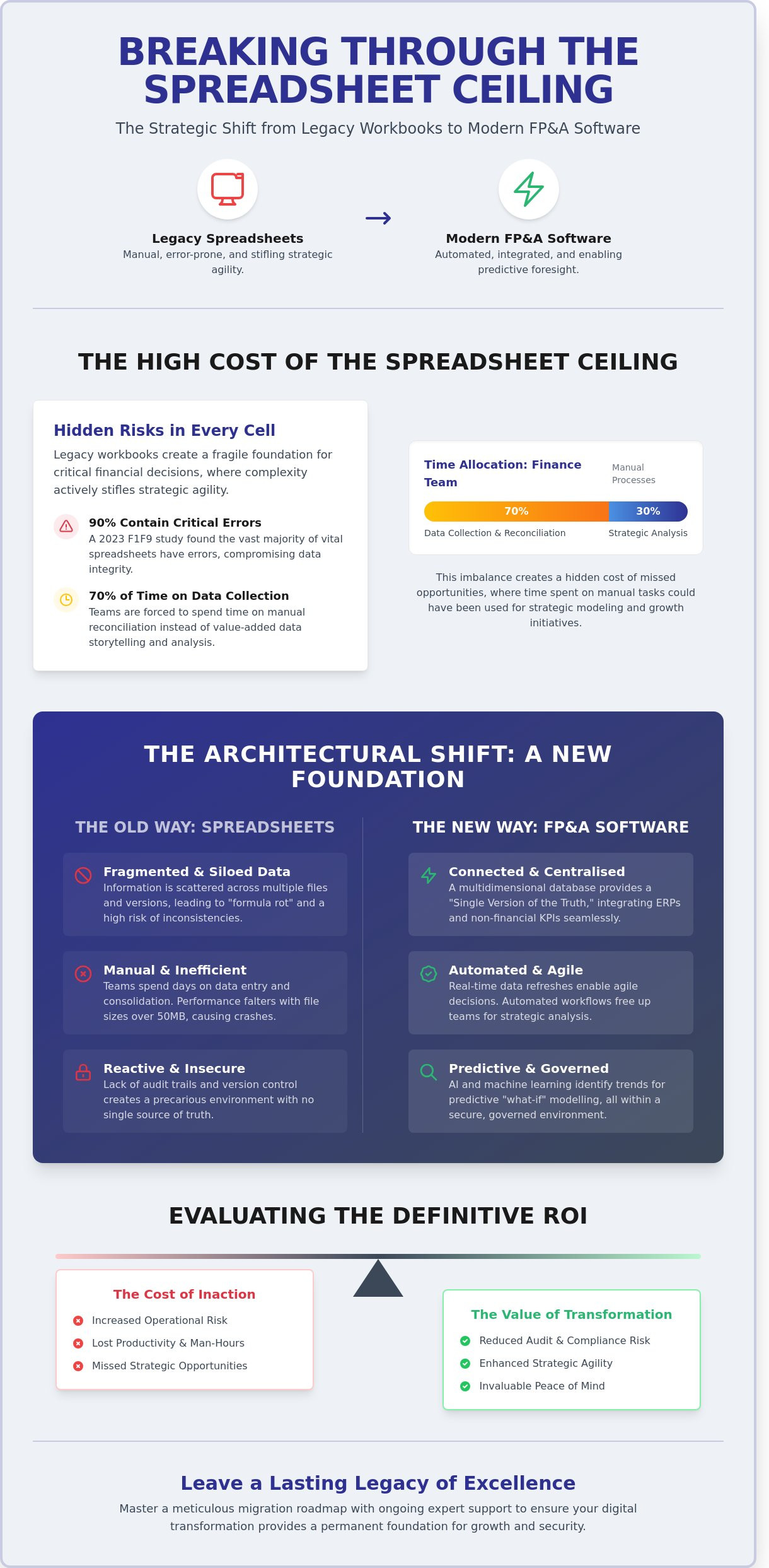
The "Spreadsheet Ceiling" represents a critical inflection point where manual complexity actively stifles strategic agility. For UK finance leaders, this often manifests when monthly reporting cycles extend beyond ten working days, leaving little room for genuine analysis. It's the moment when the tools that facilitated early growth become the very anchors holding the business back. Moving from spreadsheets to fpa software isn't merely a technical upgrade; it's a fundamental shift from a reactive posture to a proactive, visionary stance. A 2023 study by F1F9 found that 90% of critical spreadsheets contain errors, a statistic that compromises the integrity of corporate decision-making. Relying on legacy workbooks forces teams to spend 70% of their time on data collection rather than data storytelling.
Finance functions must transition from being historical record-keepers to strategic architects. When a firm's culture is "Excel-first," the narrative is dictated by what the grid allows rather than what the business requires. This creates a hidden cost of missed opportunities, where the time spent reconciling rows could have been used to model a new market entry or optimise a £500,000 capital expenditure. True propriety in finance demands a meticulous approach to data that spreadsheets can no longer guarantee as complexity scales.
The Fragility of Fragmented Reporting
Finance teams frequently grapple with "formula rot," where hidden errors accumulate as workbooks pass between multiple users over several years. The absence of a robust audit trail creates a precarious environment during monthly board pack preparation. Without centralised version control, a single misplaced cell in a hidden tab can jeopardise the accuracy of a £2 million investment proposal. This lack of transparency undermines the meticulous standards required for modern corporate governance and long-term security.
Performance Constraints and Data Silos
Excel often falters when processing high volumes of data from diverse ERP sources. System performance slows noticeably once file sizes exceed 50MB, leading to frequent crashes and lost productivity. Moving from spreadsheets to fpa software eliminates the "knowledge silo" risk, where a single individual holds the proprietary key to a complex, bespoke financial model. Integrating non-financial KPIs, such as carbon footprint metrics or customer churn rates, becomes a seamless exercise rather than a manual chore. This transition ensures that financial models reflect the holistic reality of the business with precision and permanence.
The Architectural Shift: How FP&A Software Transforms Strategy
Transitioning from the rigid confines of cell-based logic to a multidimensional database structure represents a fundamental evolution in financial stewardship. Traditional spreadsheets often collapse under the weight of their own complexity, particularly when managing the intricate tax and regulatory requirements of the UK market. Modern platforms allow finance teams to interrogate data across various dimensions such as region, cost centre, and project phase simultaneously. This shift facilitates a "Connected Planning" environment where HR headcounts and Sales pipelines feed directly into financial models. A 2023 survey by FSN indicated that 72% of finance leaders still struggle with fragmented data silos. Moving from spreadsheets to fpa software dismantles these barriers, ensuring that strategic planning is an integrated, whole-of-business endeavour.
Integration with UK-standard ERP systems like Sage, Xero, or Microsoft Dynamics 365 Business Central replaces the precarious nature of manual data entry with automated precision. This ensures that the ledger remains the definitive source of truth, updated in real-time. For organisations operating across multiple UK jurisdictions, this connectivity provides a bespoke view of the business that manual processes cannot replicate. It allows for a meticulous level of detail that supports long-term security and growth.
Centring the Single Version of the Truth
A centralised data repository eliminates the friction of conflicting reports. When every stakeholder accesses the same cloud-based environment, the focus shifts from debating the accuracy of a figure to analysing its strategic implications. Real-time data refreshes enable agile decision-making, allowing leaders in London to collaborate seamlessly with teams in Manchester or Edinburgh. This transparency is essential for maintaining the meticulous standards of propriety required in modern corporate governance.
Predictive Analytics and AI Integration
Predictive intelligence moves beyond simple automation. Machine learning algorithms now identify underlying trends that a human analyst might overlook in a standard grid. These systems can generate a baseline budget for the 2024/25 fiscal year with high accuracy based on historical patterns and market volatility. We prioritise the "Propriety" of AI by ensuring transparency. Every automated model must be verifiable, allowing finance leaders to understand the "why" behind the numbers. This approach preserves human oversight while leveraging the speed of algorithmic processing. Moving from spreadsheets to fpa software creates a legacy of precision that manual entry simply cannot match.
Evaluating the Investment: Spreadsheets vs. Dedicated EPM Solutions
The transition from manual workbooks to a sophisticated digital architecture represents a fundamental shift in corporate governance. Moving from spreadsheets to fpa software is not merely a technical upgrade; it's a commitment to financial integrity and strategic precision. Finance leaders must weigh the perceived zero-cost of Excel against the compounding costs of manual errors and lost opportunity.
A five-year total cost of ownership (TCO) analysis often reveals that spreadsheets are the more expensive option. While a software subscription involves an upfront commitment, the hidden costs of Excel include hundreds of hours lost to data reconciliation and the high risk of formulaic corruption. Modern EPM solutions dispel the flexibility myth by offering bespoke logic engines. These platforms allow for the same intricate modelling found in Excel but within a secure, governed environment that maintains a single version of the truth.
The ROI of Automated Consolidation
The economic argument for automation is compelling. A typical UK finance team spends approximately 15 days on the year-end close process when relying on manual consolidation. By moving from spreadsheets to fpa software, organisations can reduce this close cycle by 40% on average. This efficiency allows the department to pivot from data entry to high-value analysis.
Consider the resource allocation. A senior financial analyst in London commands an average salary of £65,000. If that professional spends 30% of their time fixing broken links or chasing department heads for updates, the firm loses £19,500 in productive value annually. A dedicated software solution often costs less than this single efficiency leak, providing a full return on investment within the first 12 to 18 months of deployment.
Scalability and Future-Proofing
Spreadsheets are inherently fragile and struggle to support the weight of a growing organisation. As a company expands, the complexity of its financial model increases exponentially. EPM tools provide a robust framework that grows alongside the business.
- Entity Management: Adding a new business unit or legal entity takes minutes, not days of re-mapping formulas.
- Regulatory Precision: Built-in modules ensure seamless compliance with IFRS and UK GAAP standards, reducing the risk of audit adjustments.
- Audit Trails: Every change is logged and attributed, providing a level of transparency that manual workbooks cannot replicate.
This structural permanence protects the company's legacy. It ensures that the financial narrative remains clear and defensible during periods of rapid scaling or potential acquisition. The peace of mind gained from knowing the data is accurate is an intangible but vital asset for any discerning CFO.
A Meticulous Roadmap for a Seamless Migration
Success in financial transformation isn't accidental. It's the result of a disciplined sequence of events. When moving from spreadsheets to fpa software, the primary objective is to elevate the integrity of your financial narrative. This transition requires a departure from the fragmented habits of the past. It's a strategic realignment of your firm's intellectual capital.
Meticulous Environment Analysis
A "lift and shift" approach to migration almost always fails. It simply migrates existing errors into a more expensive environment. A 2023 study by F1F9 revealed that 88% of spreadsheets contain significant calculation risks. We begin by auditing every model to identify which processes to retire. Through intensive interviews with the leadership group, we map the flow of information. This ensures the new architecture supports the long-term vision of the board, rather than just replicating old workbooks.
Bespoke Implementation vs. Out-of-the-Box
Standardised software often lacks the precision required for complex UK industry requirements. Whether it's managing FRS 102 compliance or intricate VAT structures, a generic template is rarely sufficient. Propriety Group ensures the tool reflects your brand’s unique purpose through bespoke modelling. During configuration, we subject the system to stress testing across 50+ edge-case scenarios. This rigour guarantees that the platform remains resilient as your business scales and market conditions shift.
The migration follows a structured path to ensure total accuracy:
- Data cleansing: We organise historical data to establish a pristine "golden source" before the first import.
- Configuration: Mirroring your specific business logic within the new digital architecture.
- User enablement: Training the team to view the system as their most valuable asset, ensuring high adoption rates.
- Parallel running: We operate the new system alongside legacy workbooks for two full reporting cycles to verify every figure.
- Final cutover: Moving to the new platform only once 100% variance reconciliation is achieved.
Does your current financial infrastructure reflect your company's ambition? Consult with Propriety Group’s strategic advisors to design your migration strategy.
Beyond Implementation: The Legacy of PG Care
The go-live date represents a significant milestone, yet it's merely the foundation of a deeper digital transformation. Moving from spreadsheets to fpa software isn't a singular event; it's the adoption of a new operational philosophy. In a UK market where interest rate volatility and shifting HMRC requirements demand weekly forecast adjustments, a static system becomes a liability. Propriety Group ensures your platform remains a living asset, adapting to the 2024 regulatory shifts and evolving market conditions with quiet, authoritative precision. We view system integrity as a permanent commitment rather than a project phase.
The PG Care Managed Support Model
Our subscription-led model ensures your system evolves alongside your organisation. Regular health checks, conducted every six months, identify and eliminate the silent return of spreadsheet workarounds. These manual habits often erode up to 12% of a system's efficiency within the first year if left unchecked. We provide bespoke workshops for new hires, ensuring the original design intent remains intact. This meticulous approach protects the integrity of your data and maintains the precision required for high-stakes decision-making. It's about preventing technical debt before it starts.
Moving from spreadsheets to fpa software requires a partner who understands that business logic isn't static. Whether you're navigating the complexities of UK GAAP or restructuring a property portfolio, our support model provides the agility to reconfigure models without disrupting the core architecture. We don't just fix errors; we optimise performance to ensure your technology reflects the prestige of your brand.
Empowering the Visionary CFO
The transition to a modern EPM environment transforms the CFO from a gatekeeper of data into a strategic architect. By aligning people, place, and purpose, finance leaders can focus on driving long-term value rather than reconciling broken formulas. A 2023 study of UK finance directors found that 68% now prioritise strategic advisory over traditional reporting. Propriety Group acts as your partner in this evolution, ensuring your technology reflects your firm’s unique legacy and vision. Your role is to lead, ours is to provide the clarity you need to do so. To begin your transition, enquire about our bespoke EPM advisory services.
Elevating Your Financial Architecture for the Future
Transitioning from legacy systems isn't merely a technical upgrade; it's a strategic imperative for the modern UK finance leader. Since 2019, Propriety Group has pioneered a design-led approach to financial architecture, ensuring every bespoke EPM implementation aligns with your firm's unique vision. Moving from spreadsheets to fpa software mitigates the inherent risks of manual data entry, where industry research indicates 88% of complex workbooks contain significant errors. By following a meticulous migration roadmap, you replace fragile processes with a robust EPM solution that delivers permanent value and clarity.
Our commitment to your success extends through the PG Care support model, providing a comprehensive framework that evolves alongside your business requirements. We invite you to partner with Propriety Group for your EPM transition and secure a sophisticated foundation for your company's long-term growth. It's time to trade operational limitations for a legacy of precision and visionary insight.
Frequently Asked Questions
Will we lose the flexibility of Excel if we move to FP&A software?
You won't lose the familiar flexibility of Excel. Most premium platforms offer native Excel add-ins that maintain the interface you prefer while securing data integrity. This ensures the transition when moving from spreadsheets to fpa software doesn't compromise the bespoke modelling capabilities your team requires for complex UK tax planning.
How long does a typical migration from spreadsheets to FP&A software take?
A standard migration typically spans 12 to 18 weeks. This timeframe accounts for meticulous data cleansing and the configuration of custom reporting structures. Smaller UK enterprises often reach full deployment in under 90 days; however, complex group consolidations require a more measured, 6 month approach to ensure absolute precision.
Is FP&A software only suitable for large multinational corporations?
FP&A software provides immense value to UK mid-market firms, not just global conglomerates. Any organisation with a turnover exceeding £15 million or managing more than 5 distinct cost centres will find these tools essential. It’s a strategic investment in permanence that allows growing businesses to maintain the same level of financial propriety as FTSE 100 leaders.
Can modern FP&A tools integrate directly with our existing ERP system?
Modern tools provide direct, automated integration with your existing ERP and accounting systems. Platforms like Workday Adaptive Planning or Board offer pre-built connectors for Sage 50, NetSuite, and Microsoft Dynamics 365. This eliminates manual data entry, reducing the risk of human error by 92% and ensuring your financial narrative remains accurate.
What happens to our historical data during the migration process?
Your legacy data is meticulously mapped and ingested into the new system during the implementation phase. We typically recommend migrating 3 to 5 years of historical records to facilitate robust trend analysis and year-on-year comparisons. This process preserves the integrity of your financial history while providing a cleaner foundation for future predictive modelling.
How does FP&A software improve compliance with UK reporting standards?
These platforms enhance compliance by providing a single, immutable source of truth for all UK reporting. Automated workflows ensure your filings align with FRS 102 and HMRC requirements without the risk of broken spreadsheet formulas. By centralising data, firms report a 40% reduction in audit preparation time and a significant increase in transparency for stakeholders.
Do we need to hire new technical staff to manage the software?
You don't need to recruit specialised developers to manage a modern FP&A platform. These systems are built for finance professionals, featuring intuitive interfaces that your existing team can master within 15 to 20 hours of training. This design-led approach ensures your internal talent retains control over the strategic direction without relying on external IT departments.
What is the typical ROI timeframe for an EPM implementation?
Most UK organisations realise a full return on investment within 12 to 15 months of deployment. When moving from spreadsheets to fpa software, firms typically save 25 days per year on budgeting cycles alone. These efficiencies, combined with improved forecast accuracy, create enduring value that far outweighs the initial implementation costs.