
Rolling Forecasts: A Guide for Agile Finance Teams in 2026

The traditional annual budget has become a relic of a slower era, often failing to reflect the fluid reality of the modern UK market. Recent industry data indicates that 64% of annual budgets are rendered obsolete within the first four months of the fiscal year. By the time the final figures are signed off, the world has often moved on. Adopting rolling forecasts allows your organisation to maintain a standard of excellence that keeps pace with change, ensuring your financial strategy remains as meticulous as your operational execution.
It's understandable if you feel trapped by the cycle of reactive decision-making and the weight of spreadsheet-heavy processes that lead to team fatigue. You deserve a system that reflects the integrity of your long-term vision rather than one that merely tracks outdated figures. This guide will show you how to transition from rigid structures to a dynamic model that ensures your organisation remains agile and forward-looking. We'll provide a clear roadmap for continuous planning that improves accuracy and aligns your financial goals with your daily operational reality through the lens of purpose and precision.
Key Takeaways
- Move beyond the limitations of static annual budgets to embrace a dynamic model that preserves its relevance and precision throughout the entire financial year.
- Master the strategic implementation of rolling forecasts to ensure your organisation maintains a meticulous and constant view of future performance.
- Align your financial processes with bespoke strategic objectives that prioritise the specific business drivers responsible for long-term growth and integrity.
- Discover how a continuous planning mindset redistributes effort across the year, effectively removing the burden of the traditional year-end crunch.
- Transition your finance team from a reactive stance to a visionary one, focusing on purpose-led planning that adapts to the evolving UK market.
The Shift from Static to Dynamic: Defining the Rolling Forecast
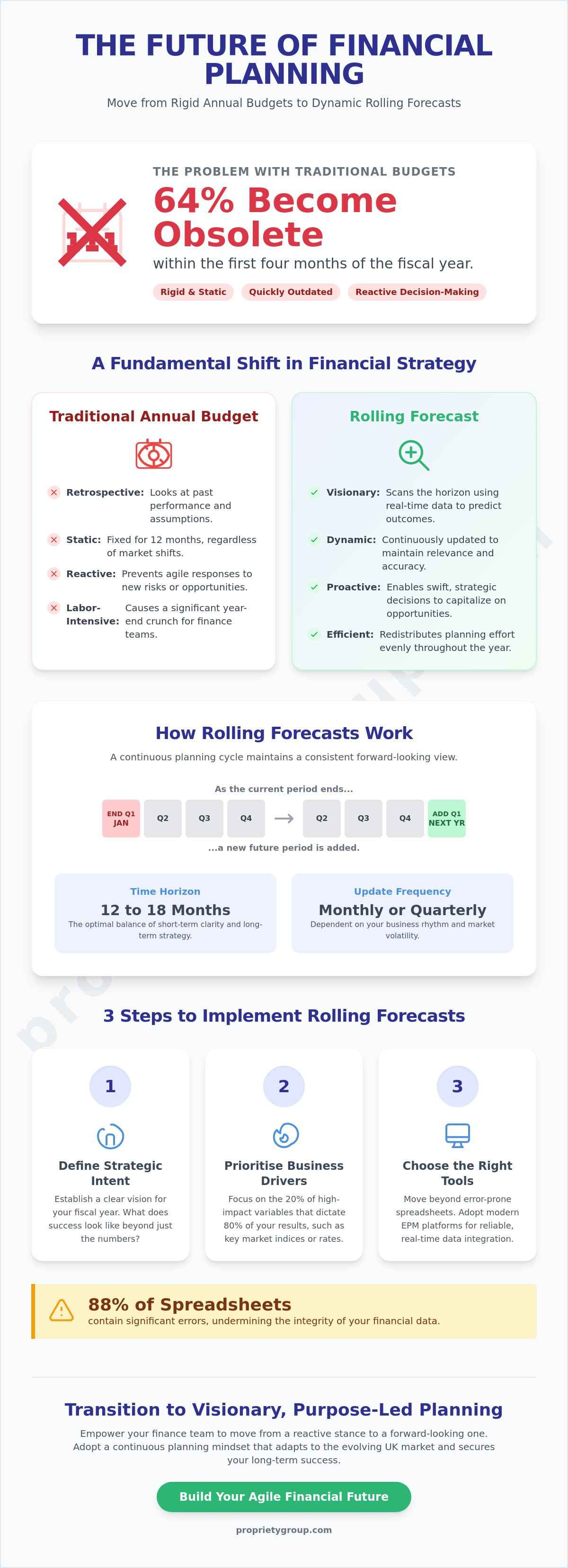
Rolling forecasts represent a fundamental departure from the rigid constraints of traditional fiscal planning. Instead of a fixed annual target, this approach uses a continuous cycle where a new period is added as the current one expires. This "drop and add" mechanism ensures that the finance team always maintains a clear view of the future. By adopting this method, organisations move away from the static nature of annual budgets that often lose their relevance by the second quarter of the fiscal year.
Within a strategic EPM advisory framework, this transition is essential for maintaining precision and integrity in decision-making. Forecasting moves from a retrospective analysis of what happened to a visionary tool that predicts what is likely to occur based on real-time data. It's a shift from looking in the rear-view mirror to scanning the horizon with clarity.
To better understand this concept, watch this helpful video:
Why Traditional Annual Budgets Fail in a Volatile Market
Traditional budgets often become obsolete by April or May. They rely on assumptions made months before the fiscal year begins. In the volatile UK market, where interest rates and consumer confidence can shift rapidly, a static plan becomes a liability. Rigid budgets prevent businesses from reacting to new risks or investing in sudden growth opportunities. When data is stale, the ability to lead with confidence disappears.
The Core Components of a Successful Rolling Model
A successful model requires two main pillars to ensure long-term security and performance:
- The Time Horizon: Most UK finance leaders find that a 12 to 18 month window provides the best balance between immediate clarity and long-term strategy.
- The Frequency: Whether you update your figures monthly or quarterly depends on your business rhythm. High-growth sectors often require monthly updates to capture rapid shifts in demand.
Implementing rolling forecasts allows a business to remain agile. It ensures that capital is allocated where it can create the most value today, rather than where it was needed six months ago. This meticulous approach to planning fosters a culture of transparency and accountability across the entire organisation.
A Step-by-Step Guide to Implementing Rolling Forecasts
Transitioning to a rolling model begins with a clear vision of your strategic intent. You aren't just updating numbers; you're creating a meticulous framework for decision-making that anticipates the shifts of 2026. Before altering any technical process, define what success looks like for your fiscal year. To understand the fundamental shift in perspective, one must first grasp What is a Rolling Forecast? and how it departs from the rigid, static annual budget that often fails to account for market volatility.
Identifying and Prioritising Your Business Drivers
Traditional budgeting often gets bogged down in granular line items that offer little strategic value. A driver is a measurable factor that directly influences financial outcomes. By focusing on these high-impact variables, finance teams can respond to market shifts with greater precision and integrity. This shift toward driver-based budgeting ensures your team spends time on the 20% of activities that dictate 80% of your results. In the UK market, this might involve tracking specific energy price indices or the latest base rate adjustments from the Bank of England to maintain a competitive edge.
Choosing the Right Tools for Continuous Planning
Reliable data is the bedrock of any enduring financial legacy. Moving away from manual spreadsheets is essential, as industry research suggests nearly 88% of complex spreadsheets contain significant errors. Modern EPM platforms offer the real-time integration required for a bespoke planning process. Automation reduces the administrative burden, allowing your team to focus on analysis rather than data entry. Once the technology is in place, establish a monthly review cadence with senior leadership to ensure the forecast remains a living document. For those seeking to refine their internal processes, exploring a bespoke financial strategy can provide the necessary clarity for long-term security and growth. This steady rhythm of review transforms rolling forecasts from a simple report into a visionary tool for steering the business forward.
Ensuring Long-Term Success with a Continuous Planning Mindset
The most common objection to adopting rolling forecasts is the perceived burden of constant budgeting. Many finance professionals worry they don't have time to budget every month. However, this perspective views the process through an outdated lens. Instead of a monthly recreation of the entire budget, agile teams treat this as a light-touch recalibration of existing data. By spreading the effort across 12 months, the traditional, high-stress "year-end crunch" that often consumes 60 to 80 hours of a finance professional's time in December is effectively dismantled. This steady rhythm creates a more sustainable workload and ensures that financial strategy remains a living, breathing part of the business.
Transparency acts as the foundation of this mindset. When finance teams collaborate closely with operational departments, the forecast stops being a control mechanism and becomes a tool for empowerment. It provides department heads with the clarity they need to make informed decisions based on current UK market conditions rather than figures set 14 months ago. This collaborative approach fosters a sense of shared responsibility and long-term security across the entire organisation.
Overcoming Internal Resistance and Budgeting Fatigue
Internal resistance often stems from a fear of increased workload or a loss of fixed targets. Leaders can overcome this by framing the shift as a move toward precision and agility. When departments understand that their targets reflect current realities, engagement increases. This method pairs perfectly with zero-based budgeting, ensuring that every pound allocated serves a specific strategic purpose. Reviewing rolling forecast pros, cons, and best practices helps teams identify where friction might occur during the transition and how to address it through clear communication.
The Role of AI and Predictive Intelligence
By 2026, the manual entry of historical data will be largely obsolete. Implementing AI in finance allows for the automation of baseline rolling forecasts, allowing the team to focus on high-level strategic analysis. This shifts the focus to "management by exception," where human expertise is only required when AI alerts signal a significant deviation from the trend. It transforms the finance department into a visionary partner, prioritising meticulous accuracy and enduring value over repetitive manual tasks.
Mastering the Future of Financial Agility
The transition toward dynamic financial management represents a fundamental change for UK finance teams. By moving away from rigid annual budgets and embracing rolling forecasts, organisations gain the agility to respond to market shifts in real time. Success requires a blend of sophisticated technology and a continuous planning mindset. This approach ensures that every strategic decision is backed by accurate, predictive data rather than outdated assumptions from the previous quarter.
Propriety Group stands as a specialist in EPM and CRM implementation. Our team brings deep expertise in AI and predictive financial analytics to help your business navigate the complexities of 2026. We provide a bespoke PG Care support model that ensures your systems evolve alongside your long-term ambitions. Precision in planning isn't just a tactical advantage; it creates a legacy of stability and trust. We're here to guide you through every meticulous detail of your digital transformation.
Discover how Propriety Group can transform your planning with bespoke EPM Advisory
Building a resilient financial framework is the most reliable way to secure your business's future in an ever-changing landscape.
Frequently Asked Questions
How do rolling forecasts differ from traditional budgets?
Rolling forecasts differ from traditional budgets by providing a continuous view of a company's financial future rather than a static snapshot. While a standard UK budget remains fixed for the financial year, a rolling model adds a new month or quarter as the previous one concludes.
This ensures a clear 12 to 18 month horizon. It allows businesses to adjust to shifts, like the 3.8% inflation rate seen in early 2024, without waiting for the next annual cycle.
How often should an organisation update its rolling forecast?
Approximately 72% of organisations update their rolling forecasts monthly or quarterly to maintain accuracy. A 2023 survey of UK finance directors indicated that 65% of agile firms prefer a monthly cadence to capture rapid changes in consumer demand.
Frequent updates transform the forecast into a living document. It's a meticulous process that ensures strategic goals align with the current economic climate. This consistency builds a legacy of precision and allows for better capital allocation.
What are the biggest challenges when transitioning to a rolling model?
The most prominent challenges involve shifting the internal culture and ensuring data integrity across the business. Moving away from a fixed annual target requires a 100% commitment from leadership to embrace constant change.
Internal audits show that 70% of finance teams find manual data entry consumes too much time, with some departments spending 20 hours a week on spreadsheets. Overcoming these hurdles requires a bespoke approach that prioritises clarity and long-term security.
Does a rolling forecast replace the annual budget entirely?
This model doesn't necessarily replace the annual budget, as 58% of UK companies use both to balance long-term targets with short-term agility. The annual budget often serves as a fixed benchmark, while the forecast provides the day-to-day flexibility needed for growth.
In a 2024 study, 42% of high-growth firms used a hybrid model. This approach maintains professional propriety by ensuring that immediate tactical decisions don't compromise the firm’s enduring strategic vision.