

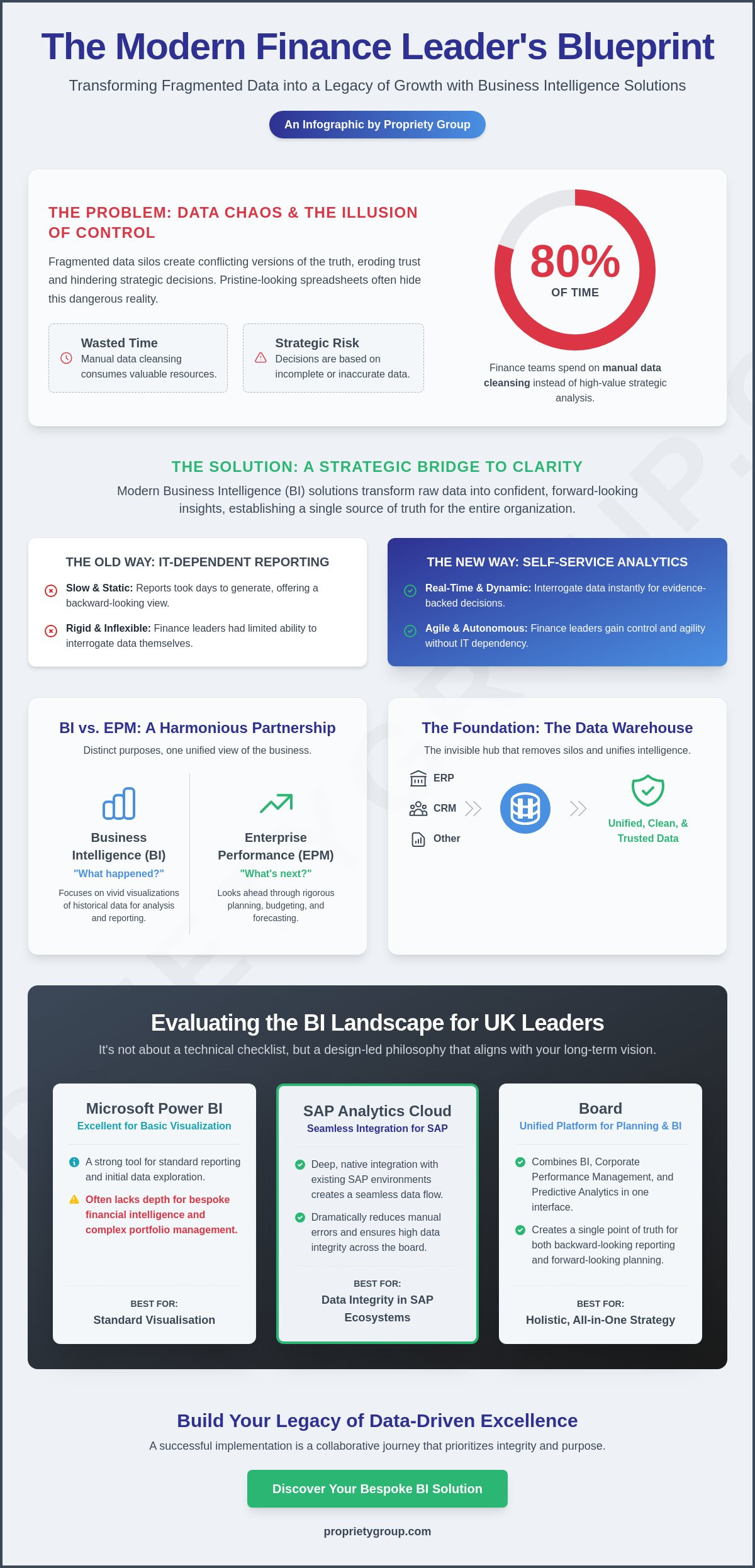
A pristine spreadsheet is often the most dangerous illusion in a modern UK boardroom. You've likely felt the quiet tension when different departments present conflicting versions of the truth during a single executive meeting. This friction usually stems from fragmented data silos that force finance teams to spend 80 percent of their time on manual data cleansing rather than high-level strategic analysis. To secure a firm's long-term legacy, discerning leaders must look past basic reporting and invest in sophisticated business intelligence solutions that offer a singular, meticulous view of organisational performance.
We understand that your goal isn't just to see what happened yesterday, but to predict with certainty what will happen tomorrow. This article provides a strategic roadmap to help you move away from the fragility of manual forecasting toward a more resilient digital infrastructure. We'll explore how bespoke systems provide the clarity needed for real-time scenario modelling, ensuring your financial projections remain accurate as market conditions shift. You'll gain the insights necessary to select a scalable platform that aligns with your specific vision for growth, precision, and operational integrity.
Key Takeaways
- Understand how bespoke business intelligence solutions serve as a strategic bridge, transforming raw data into the confident, forward-looking insights necessary for long-term corporate value.
- Navigate the transition from traditional, IT-dependent reporting to modern self-service analytics that offer finance leaders greater agility and autonomy.
- Compare the strategic advantages of leading platforms, such as SAP Analytics Cloud and Microsoft Power BI, specifically tailored to the requirements of UK organisations.
- Recognise the importance of a meticulous environment analysis to ensure your chosen framework integrates seamlessly with existing finance systems and predictive needs.
- Discover why a successful implementation is a collaborative journey that prioritises integrity and purpose to create a lasting legacy of data-driven excellence.
Defining Modern Business Intelligence Solutions for the Finance Leader
True leadership in finance requires more than just access to numbers; it demands the ability to see the narrative within the data. Modern Business Intelligence (BI) acts as a strategic bridge. It converts raw, disjointed figures into confident, forward-looking decisions. Historically, finance teams relied on IT departments to generate static reports, a process that often took days. Today, the shift toward self-service analytics allows leaders to interrogate data in real-time, ensuring that every strategic move is backed by evidence rather than intuition.
To better understand these concepts, watch this helpful video:
Establishing a single source of truth is the cornerstone of corporate integrity. Without it, performance metrics become subjective and trust erodes. A robust BI solution ensures that whether you're looking at a balance sheet or a departmental budget, the data remains consistent across the entire organisation. A comprehensive BI Solution is the meticulous integration of software, strategy, and ongoing advisory.
The Crucial Difference: BI Solutions vs. EPM
While they often share the same stage, business intelligence solutions and Enterprise Performance Management (EPM) serve distinct purposes. BI focuses on "what happened" by providing vivid visualisations of historical data. In contrast, EPM looks ahead to determine "what's next" through rigorous planning and forecasting. These systems shouldn't compete; they must work in harmony to provide a full-spectrum view of the business. Our EPM Advisory pillar shows how professional consultancy bridges the gap between looking back and moving forward.
The Role of the Data Warehouse in Unified Intelligence
Every sophisticated BI platform relies on an invisible foundation: the data warehouse. This central hub consolidates fragmented data from your ERP and CRM systems, cleaning it for use. It removes the silos that prevent a holistic view of the company's health. For a deeper look at this technical bedrock, explore our Data Warehouse pillar. By unifying these disparate streams, business intelligence solutions provide the clarity needed to protect your legacy and drive future growth.
Evaluating the Landscape: A Comparison of Leading BI Frameworks
UK finance leaders often choose between three primary frameworks: SAP Analytics Cloud (SAC), Board, and Microsoft Power BI. Selecting the right platform requires a shift in perspective. It's not about ticking boxes on a technical checklist. Instead, the focus must be on a design-led philosophy that aligns with your long-term strategy. True business intelligence solutions should feel like a natural extension of your firm's DNA, offering scalability that matches your growth and meticulous integration with existing finance systems.
Many teams ask if Power BI is sufficient for their needs. While it's an excellent tool for basic data visualisation, it often lacks the depth required for bespoke financial intelligence. It's the difference between a standard report and a tailored strategic asset. For organisations managing complex UK portfolios, reliance on basic tools can lead to fragmented insights. You need a platform that supports a visionary approach rather than just displaying historical figures.
SAP Analytics Cloud (SAC) vs. Board EPM
SAC excels through its deep integration with existing SAP environments. It creates a seamless data flow that reduces manual errors and ensures integrity across the board. Conversely, Board offers a unified approach by combining BI, Corporate Performance Management, and Predictive Analytics into one interface. This creates a single point of truth for both reporting and planning. You can explore a more granular software breakdown in this EPM Platform guide.
The Shift Toward AI and Predictive Analytics
Modern business intelligence solutions are evolving. We're moving away from descriptive data that simply explains what happened. The new standard is predictive insight. Financial AI now automates mundane tasks, allowing your team to focus on high-level strategy and legacy-building. This transition is detailed further in our AI in Finance guide. Ensuring your chosen platform supports this visionary approach is essential for maintaining a competitive edge in the UK market. If you're looking to refine your data strategy, consider how a bespoke consultation might clarify your path forward.
Selecting and Implementing a Legacy-Grade BI Solution
Choosing the right business intelligence solutions marks the beginning of a transformative period for any finance department. It's not a simple transaction, but a commitment to clarity. Before any software is purchased, a meticulous environment analysis is required. This stage identifies where data gaps exist and defines the organisational purpose. Without this foundation, even the most expensive software fails to deliver value. Success depends on a deep understanding of your firm’s unique structure and the UK market conditions that influence it.
The Implementation Roadmap: Strategy Over Software
Implementation is a collaborative journey between your leadership team and our advisory partners. We don't just install software; we integrate a new way of seeing your business. The process follows three deliberate steps:
- Environment Analysis. We identify where data is siloed and define what success looks like for your specific operations.
- Bespoke Configuration. We build a system that mirrors the unique rhythm of your business, ensuring every report feels intuitive and relevant.
- User Training. We ensure your team embraces the technology through hands-on guidance, turning new tools into permanent habits.
Sustainable Success with Managed Support
The "PG Care" model moves away from the frustration of ad-hoc technical fixes. Instead, it offers a subscription-based approach that prioritises system health and data integrity. This model ensures your business intelligence solutions evolve alongside the shifting UK regulatory landscape and your firm's growth. Ongoing optimisation prevents the system from becoming obsolete, maintaining a high standard of correctness.
Our approach creates a lasting legacy of financial excellence. When your data is precise and your systems are reliable, your leadership group can make decisions with quiet confidence. This sense of security allows you to focus on high-level strategy, knowing the technical foundation is secure and your vision is supported by facts.
Defining Your Path to Financial Clarity
Selecting the right business intelligence solutions isn't just a technical upgrade; it's a commitment to the long-term integrity of your financial data. Modern frameworks provide the precision required for UK finance teams to navigate complex market conditions with quiet confidence. By moving beyond outdated legacy systems, leaders gain the ability to turn granular details into high-level strategic concepts that drive value. Success lies in the meticulous alignment of your chosen platform with your team's specific purpose and goals.
At Propriety Group, we provide expert-led advisory services specifically for UK finance teams seeking a more refined approach to data. We specialize in SAP Analytics Cloud and Board EPM, ensuring your infrastructure is built for permanence and excellence. Our subscription-based PG Care support model offers a steady, reliable partnership that evolves with your business needs. We view technology as a means of creating enduring value through a holistic focus on people and purpose.
Explore our bespoke Advisory for EPM and BI solutions to see how we can help you build a more resilient future. Your journey toward a more sophisticated and transparent financial landscape starts today.
Frequently Asked Questions
What is the difference between a BI tool and a BI solution?
A BI tool is a specific software application used for data analysis, while a BI solution represents a comprehensive ecosystem designed to transform raw data into strategic assets. A tool might provide a single dashboard or report. In contrast, a complete business intelligence solution encompasses the data architecture, governance protocols, and bespoke reporting structures required for long term success. Gartner research indicates that 70% of successful data initiatives prioritise this holistic solution framework over simple software acquisition.
How long does a typical business intelligence implementation take for a mid-market UK firm?
A standard implementation for a mid-market UK firm typically spans 4 to 9 months from inception to completion. This timeline allows for a meticulous audit of existing data, the cleansing of records, and the phased deployment of business intelligence solutions across key departments. While a pilot project can often produce results within 12 weeks, a full scale rollout ensures that 100% of your data remains accurate and reliable. This measured pace protects the integrity of your strategic reporting.
Do we need to replace our existing ERP to implement a new BI solution?
You don't need to replace your existing ERP system to adopt a modern BI solution. Most contemporary platforms are designed to integrate with your current infrastructure, extracting value from legacy systems without requiring a costly overhaul. Data from the UK's Office for National Statistics shows that 65% of established firms maintain their core ERP for over 10 years. We focus on building a bridge between your historical data and new analytical capabilities to preserve your previous investments.
Can business intelligence solutions integrate with our current CRM and HR software?
Modern business intelligence solutions integrate seamlessly with a wide array of CRM and HR platforms through secure, automated connectors. Whether your firm utilises global platforms like Salesforce or specific UK payroll software, these systems can feed into a single, unified repository. This creates a precise view of the intersection between your people and your profit. By connecting these disparate data points, finance leaders can move from fragmented oversight to a position of quiet confidence and clarity.