

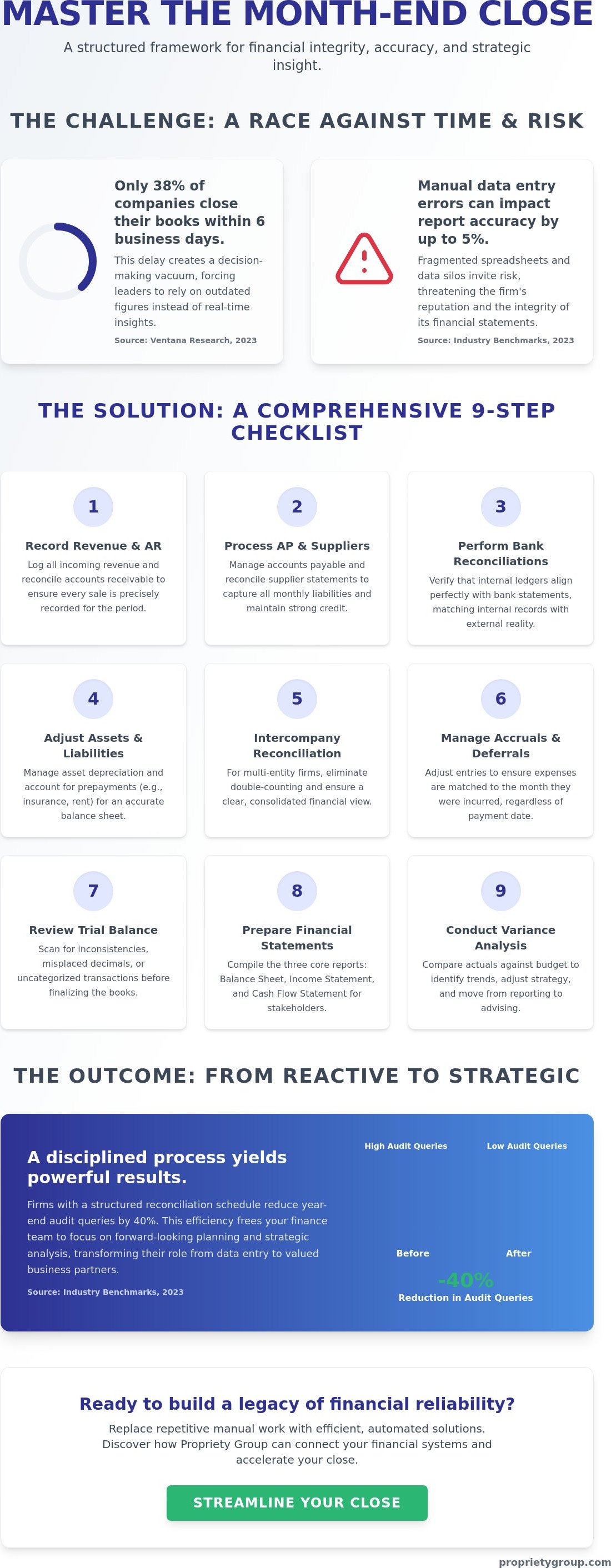
The true measure of a firm’s integrity isn't found in its revenue alone, but in the meticulous precision of its reporting. For many UK finance directors, the final week of the month remains a frantic race against manual errors and fragmented data silos. While it's common to view this period as an unavoidable burden, a 2023 study by Ventana Research found that only 38% of organisations manage to close their books within six business days. This delay creates a vacuum where strategic decisions are often made on outdated figures rather than real-time insights.
We believe that financial excellence requires a more bespoke and principled approach. You likely recognise the frustration of chasing figures across departments while leadership demands faster, more accurate results. By implementing a structured month-end close checklist, you can move away from reactive troubleshooting and toward a legacy of reliability. This guide provides a repeatable framework designed to streamline your reconciliations and instil absolute confidence in your final numbers. We'll explore how to bridge the gap between disparate data points and establish a rhythmic, efficient path to a faster close.
Key Takeaways
- Understand how a structured financial process serves as a foundation for business integrity and provides a clear view of your company’s performance.
- Implement a comprehensive month-end close checklist to ensure every pound of revenue and liability is accurately recorded and reconciled.
- Discover how modern technology connects your financial systems to replace repetitive manual work with efficient, automated solutions.
- Learn how to shorten the time it takes to close your books, allowing your team to focus more on strategic planning and less on data entry.
- Gain the insights needed to produce reliable financial reports that build trust with your partners and support long-term growth.
The Strategic Importance of a Structured Month-End Close
The month-end close is a meticulous cycle where finance teams verify and adjust account balances to ensure every financial statement is precise. It functions as the bedrock of organisational integrity. This process isn't merely a compliance task; it's a commitment to transparency that builds long-term trust with stakeholders. By establishing a definitive financial close process, companies move beyond simple record-keeping towards a standard of visionary leadership.
Transitioning from reactive accounting to strategic foresight requires a disciplined framework. A clean close provides the reliable data needed for forward-looking planning. This level of precision enables a modern financial close process that empowers leaders to make decisions based on facts rather than intuition. Using a structured month-end close checklist ensures that no detail is overlooked in the pursuit of financial excellence.
To better understand how to refine these operations, watch this helpful guide on optimising your closing activities:
Common Friction Points in the Closing Cycle
Efficiency often stalls during the "data chase." Finance professionals frequently lose hours waiting for department heads to submit invoices or expense claims. Relying on fragmented spreadsheets creates silos that invite risk. According to industry benchmarks from 2023, manual data entry errors can impact the accuracy of consolidated reports by as much as 5%. These delays prevent the timely delivery of insights to the board.
A unified system replaces the chaos of disconnected files with a single source of truth. Without this, the risk of manual error remains high, threatening the reputation of the firm. A robust month-end close checklist acts as a safeguard, ensuring that consolidated reports are both accurate and reflective of the company's true value. This structured approach allows the finance team to focus on growth rather than correcting past mistakes.
The Comprehensive Month-End Close Checklist
A meticulous month-end close checklist serves as the backbone of financial integrity. It begins with recording all incoming revenue and reconciling accounts receivable. This step ensures that no sales are overlooked, providing a precise view of the firm's income for the period. Finance teams then process accounts payable and reconcile supplier statements. This captures every monthly liability, ensuring the business accounts for every pound owed to external partners and maintains strong credit relationships.
Accuracy depends on matching internal records with external reality. You'll perform bank reconciliations to verify that your ledger aligns perfectly with bank statements. Following this, you must review and adjust assets and liabilities. This includes managing depreciation for physical assets and accounting for prepayments, such as insurance or rent paid in advance. According to 2023 industry benchmarks, firms that maintain a disciplined reconciliation schedule reduce year-end audit queries by 40%.
Ensuring Data Integrity and Accuracy
For businesses operating multiple entities, intercompany reconciliation is a vital step to prevent double-counting and ensure a clear consolidated view. You must also manage accruals and deferrals. These adjustments ensure that expenses match the specific month they were incurred, regardless of when the invoice was settled. Before finalising the books, review the trial balance for glaring inconsistencies. Spotting a misplaced decimal or an uncategorised transaction now prevents significant errors in your statutory filings.
The Final Review and Reporting Phase
The closing sequence concludes with the preparation of three essential documents: the Balance Sheet, Income Statement, and Cash Flow statement. Adopting a modern month-end close process allows your team to move beyond simple data entry into strategic analysis. Use variance analysis to compare your actual spending against the set budget. This identifies hidden trends and helps you adjust your strategy for the following quarter. Holding a short post-close meeting allows the team to refine their methods, ensuring each cycle is more efficient than the last. Developing a bespoke financial framework ensures these standards remain consistent as your legacy grows.
Accelerating the Close with Modern Finance Technology
The evolution of the month-end close checklist is no longer just about ticking boxes. It's about the seamless integration of technology. Connected finance represents the pinnacle of this evolution, where Enterprise Resource Planning (ERP) and Enterprise Performance Management (EPM) systems operate in a unified ecosystem. This harmony allows for the automation of repetitive reconciliation tasks. These tasks often consume 60% of a finance team's capacity during the first week of the month. By removing manual intervention, organisations can reduce their close cycle by an average of four business days.
Managing complex, multi-entity structures requires a level of precision that spreadsheets cannot provide. Utilising financial consolidation software ensures that intercompany eliminations and currency conversions are handled with meticulous accuracy. This transition builds a single source of truth for finance. It effectively dismantles data silos that lead to conflicting reports across different departments, ensuring every stakeholder looks at the same figures.
The Shift Toward Continuous Accounting
Waiting until the 31st to address discrepancies creates unnecessary friction. Continuous accounting encourages teams to perform reconciliations and data validation daily. This rhythmic approach transforms the month-end close checklist from a high-pressure event into a quiet confirmation of data that's already been verified. Modern AI tools now flag up to 92% of potential errors before the month even concludes. This allows for immediate correction rather than a frantic search for answers during the final hours of the reporting cycle.
Future-Proofing Your Finance Function
A streamlined close is a hallmark of corporate integrity. It bolsters investor confidence and ensures strict adherence to UK regulatory standards. The Financial Reporting Council often highlights the importance of timely and accurate disclosures for maintaining market trust. Beyond the technical execution, visionary leaders often seek bespoke advisory services to refine their internal processes. This strategic foresight secures a lasting legacy of financial excellence and operational transparency. It's an investment in the long-term stability and prestige of the business.
Mastering the Path to Financial Precision
A meticulous approach to reporting does more than just balance the books; it establishes a foundation of integrity for the entire organisation. By implementing a structured month-end close checklist, finance leaders eliminate the friction of manual reconciliations and reduce the risk of errors that can delay vital UK statutory filings. Transitioning from traditional methods to automated systems allows your team to move beyond simple data entry into the realm of strategic insight.
Recent industry data suggests that top-tier finance departments now finalise their reporting cycles within five working days. Achieving this level of efficiency requires a blend of sophisticated technology and expert guidance. As expert EPM implementation partners, Propriety Group provides the high-level strategic advisory that modern CFOs require. Our bespoke PG Care support model ensures your systems don't falter, turning routine cycles into a source of long-term value and clarity.
Explore how Propriety Group can optimise your financial close process
It's time to transform your reporting into a source of certainty and lead your team toward a more resilient financial future.
Frequently Asked Questions
How long should a typical month-end close process take?
A typical month-end close process should take between five and ten business days to complete with precision. While some agile UK firms achieve a "fast close" within 72 hours, a Deloitte survey of 1,500 finance leaders indicates that 40% of organisations require at least six days. It's vital that your month-end close checklist covers every meticulous detail without sacrificing the integrity of the financial data.
What is the difference between a month-end close and a year-end close?
The month-end close focuses on internal performance and monthly reporting, whereas the year-end close involves a comprehensive statutory audit and final tax calculations. While monthly cycles ensure ongoing accuracy, the year-end process requires filing accounts with Companies House within nine months of the financial year end. This annual ritual demands a higher level of scrutiny to ensure the firm's legacy and financial standing remain beyond reproach.
Who should be responsible for the month-end close checklist?
The Financial Controller maintains ultimate responsibility for the month-end close checklist, ensuring every task aligns with the firm's standards of excellence. However, the wider finance team executes specific duties, from accounts payable to bank reconciliations. In a 2023 study by Gartner, 70% of high-performing teams assigned specific owners to every checklist item to ensure total accountability. This bespoke approach ensures that no detail is overlooked during the final review.
Can a month-end close be fully automated?
A month-end close can't be fully automated because it requires the discerning eye of a finance professional to interpret complex data. While 60% of manual tasks like data entry can be handled by software, the final validation remains a human endeavour. Modern teams use technology to handle the granular details, allowing leaders to focus on the purpose and strategy behind the numbers. This balance of technology and human expertise protects the integrity of the financial narrative.