
The Definitive Rolling Forecast Implementation Guide for Finance Leaders

What if the traditional annual budget, once the pillar of corporate stability, is now the primary obstacle to your organization's agility? It's a frustrating reality for many finance leaders that static plans often become obsolete within months of their creation. Research shows that 42% of companies have adopted a rolling forecast to manage this volatility, yet the path to successful execution remains elusive. This rolling forecast implementation guide offers a sophisticated roadmap for moving beyond rigid constraints toward a model of continuous, visionary planning.
You likely recognize that your team's expertise is wasted on manual data consolidation and the exhausting cycle of low-value entry. You require a system that provides real-time visibility. It should foster a seamless alignment between operations and finance. This article outlines how to transition your team into an agile framework that prioritizes strategic stewardship over administrative burden. We'll explore the precise steps needed to move from periodic budgeting to a model of continuous, intentional planning through driver-based automation.
Key Takeaways
- Transition from rigid annual cycles to a continuous planning model that maintains visibility far beyond the traditional fiscal year-end.
- Follow our rolling forecast implementation guide to pinpoint the essential business drivers that simplify your planning and eliminate unnecessary complexity.
- Establish a forecasting frequency that balances market responsiveness with your team’s internal capacity to ensure sustainable, high-value output.
- Harness the power of EPM software and financial AI solutions to automate data gathering and remove human bias from your projections.
- Reclaim time for strategic decision-making by replacing manual data entry with a structured framework for long-term organizational security.
Understanding the Strategic Shift: Why Static Budgets Fade
Static budgets often act as anchors. They tie an organization to assumptions that may no longer be valid just months after they're signed. A rolling forecast serves as a continuous planning mechanism. It ensures your strategic vision extends beyond the artificial boundary of the fiscal year-end. This shift transforms the finance department into a proactive leader rather than a historian of past performance.
Embracing an agile horizon gives leadership the power to pivot with confidence. Effective Forecasting maintains a consistent 12 to 18-month window of visibility. As each month passes, a new month is added to the horizon. This provides a permanent, clear view of the future. The rolling forecast is a dynamic management tool that updates future projections based on actual performance and current market variables.
To better understand how these dynamic models are structured, watch this helpful video:
This evolution is a central pillar of any modern rolling forecast implementation guide. It moves the organization away from the "fixed point" mentality that limits growth. Instead of a once-a-year scramble, the process becomes a rhythmic, deliberate exercise in precision. It allows for a holistic approach to long-term security.
The Distinction Between Budgeting and Forecasting
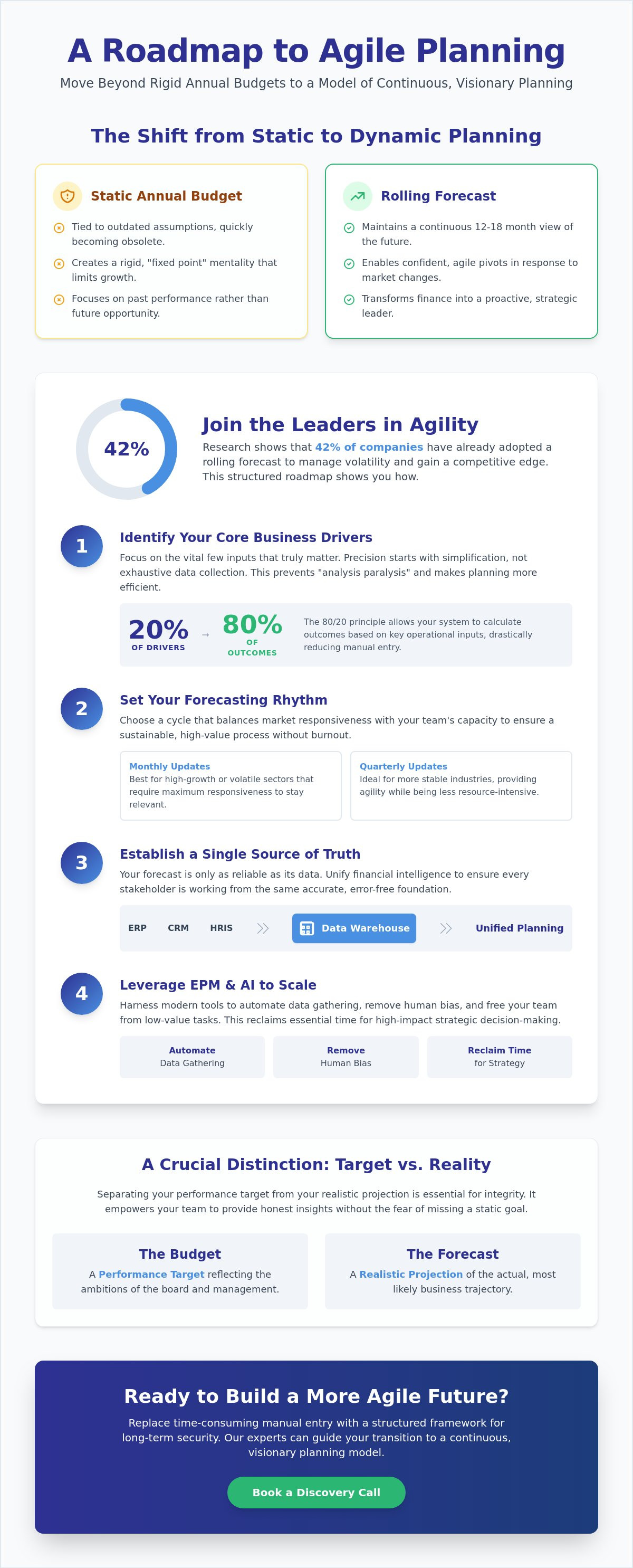
Many leaders confuse targets with reality. A budget is a performance target; it reflects the ambitions of the board and the commitments of the management team. Conversely, the forecast is a realistic projection of the actual trajectory. Separating these two is crucial for integrity. It allows for clear accountability against the budget without sacrificing the accuracy needed for the forecast. When you keep these distinct, you empower your team to provide honest insights without the fear of missing a static goal.
A Step-by-Step Rolling Forecast Implementation Roadmap
Successful implementation requires a shift from exhaustive data collection to focused strategic analysis. This rolling forecast implementation guide emphasizes that agility is born from structure, not just speed. By designing a process that prioritizes high-impact variables, you can create a sustainable rhythm that your team can maintain without burnout. This structured rolling forecast implementation guide provides the clarity needed to move from reactive reporting to proactive stewardship.
Identifying and Prioritising Your Business Drivers
Precision starts with simplification. Most organizations find that roughly 20% of their operational drivers influence 80% of their financial outcomes. Focusing on these vital few prevents the "analysis paralysis" that often stalls new initiatives. Driver-based planning reduces the need for manual entry because it allows the system to calculate outcomes based on key operational inputs. To explore the specific methodology behind this approach, you can review our driver-based budgeting guide.
Choosing between a monthly or quarterly cycle depends on your industry's specific volatility and your team's internal capacity. High-growth sectors often require monthly updates to stay relevant. Regardless of frequency, you must design a feedback loop where actual results are compared to previous forecasts. This comparison isn't about finding fault; it's about refining predictive accuracy over time. Reviewing Rolling Forecast? Pros, Cons, and Best Practices can provide additional perspective on balancing these cycles.
Data Governance and the Single Source of Truth
A rolling process is only as reliable as the data that fuels it. Automated integration between your ERP and planning environment is essential to eliminate the risk of human error. Establishing a "Single Source of Truth" ensures that every stakeholder is working from the same foundation of unified financial intelligence. Utilizing a Data Warehouse allows for the seamless unification of disparate data streams. If you're looking to refine this infrastructure, consider exploring our Advisory for EPM services to ensure your foundation is built for scale.
Leveraging EPM and AI to Scale Your Forecasting Capability
Modern enterprise performance management (EPM) platforms serve as the engine for sustainable agility. These systems automate the consolidation of actual results, which effectively liberates your finance team from the drudgery of manual data reconciliation. By shifting the focus from data assembly to strategic analysis, leaders can spend more time on high-value decision-making. This transition is a critical component of any effective rolling forecast implementation guide, as it ensures the process remains a source of insight rather than a burden.
Predictive analytics introduces a level of precision that traditional methods cannot match. By utilizing historical data to establish a neutral baseline, these tools remove the inherent human bias that often clouds financial projections. Integrating Financial AI Solutions allows organizations to identify subtle trends and market shifts that manual spreadsheets frequently overlook. Gartner predicts that by the end of 2026, 40% of business software will include AI capable of completing end-to-end tasks independently. Adopting these technologies now positions your firm at the forefront of this shift toward automated intelligence.
Transitioning from Manual Spreadsheets to Connected EPM
Relying on Excel for continuous planning often leads to "spreadsheet rot," where broken links and version control issues compromise the integrity of your data. A connected EPM environment provides a more secure and scalable foundation for your rolling forecast implementation guide. Professional EPM advisory ensures that your software configuration aligns perfectly with your business’s unique intentionality and operational standards. This alignment creates enduring value by providing a reliable framework for growth.
The Future of Forecasting: AI-Driven Predictive Intelligence
The next evolution of financial planning involves using AI to run thousands of distinct scenarios in seconds. This capability allows leaders to perform rigorous stress testing on their rolling forecasts, preparing the organization for a variety of potential market conditions. Following rolling forecast best practices suggests a measured approach to this technology. Start by applying AI to high-impact areas like cash flow or demand sensing before expanding its reach across the enterprise. Propriety Group acts as the principled visionary in this journey, bridging the gap between high-level strategic concepts and the granular details of technical execution.
To ensure your planning framework is built with the precision and permanence your organization deserves, we invite you to take the next step. Our team is ready to help you align your financial goals with a sophisticated, AI-driven infrastructure. Book a call with our experts today to begin your transition toward an agile, visionary future.
Securing Your Organization's Strategic Future
Transitioning to a continuous planning model is more than a technical upgrade; it's a commitment to organizational agility and long-term security. By following this rolling forecast implementation guide, you've seen how to shift from static annual constraints to a dynamic 18-month horizon. You've also explored how driver-based planning and modern EPM platforms remove the administrative burden from your finance team. This allows your experts to focus on the high-level strategic concepts that create enduring value for the business.
Since 2019, our team has served as specialists in EPM and CRM implementation with a focus on precision and excellence. We bring deep expertise in SAP Analytics Cloud, Board, and AI-driven FP&A solutions to every engagement. Through our PG Care model, we provide subscription-based support that ensures your systems maintain their standards of correctness over time. Book a call with our advisory team to discuss your forecasting transition and align your financial infrastructure with intentional, data-led growth. We look forward to helping you build a more resilient and visionary organization.
Frequently Asked Questions
What is the primary difference between a rolling forecast and an annual budget?
An annual budget acts as a static performance target, whereas a rolling forecast serves as a dynamic projection that continuously updates based on real-world performance. This rolling forecast implementation guide highlights that while budgets provide a fixed point for accountability, forecasts offer the agility needed for navigating market volatility. Keeping these two processes separate ensures you don't sacrifice accuracy for the sake of meeting a pre-set commitment.
How many months ahead should a rolling forecast look?
Leading organizations typically project 12 to 18 months into the future to maintain visibility beyond the current fiscal period. This timeframe allows leadership to identify trends and adjust strategies long before they impact financial outcomes. The specific length of your rolling window should reflect your business cycle and the time required to see the results of major strategic shifts or capital investments.
Will implementing a rolling forecast increase the workload of my finance team?
Implementing a rolling forecast shouldn't lead to team burnout if you prioritize automation and focus on the business drivers that truly matter. While the initial transition requires a deliberate shift in process, it ultimately replaces tedious manual data entry with streamlined, driver-based planning. This approach frees your finance team to act as strategic advisors, moving them away from low-value administrative tasks toward high-impact decision support.
What software is required to implement a successful rolling forecast?
A successful transition requires modern FP&A software solutions that can automate data consolidation and provide a unified view of your operations. Sophisticated platforms like SAP Analytics Cloud or Board are ideal for managing the complexity of a rolling horizon without the risks of spreadsheet errors. Integrating these tools with your ERP ensures that your rolling forecast implementation guide is supported by a secure and scalable technical foundation.