
Predictive Analytics in Financial Planning: Strategic Examples for the Modern CFO

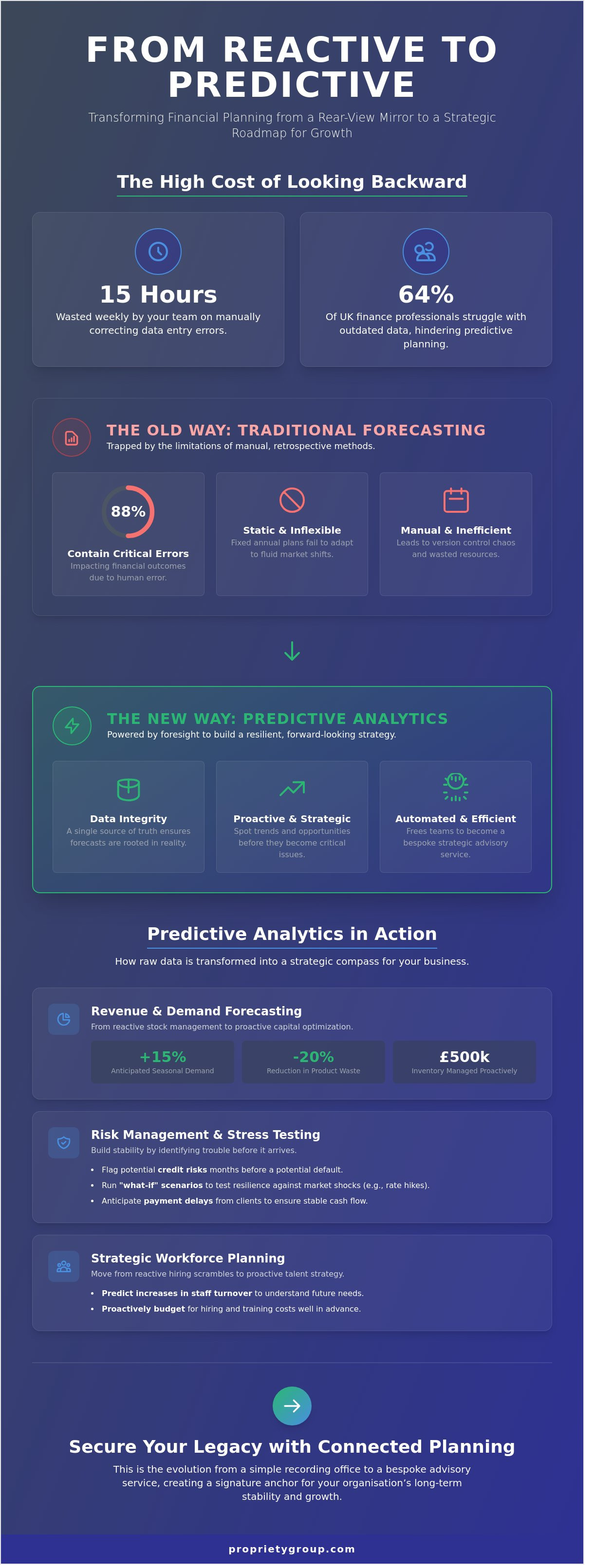
What if the greatest threat to your firm's legacy isn't a market crash, but the 15 hours your team spends each week manually correcting data entry errors? Many leaders find themselves trapped in a cycle of looking backward, trying to steer a complex organisation using only last month's figures. You likely feel the weight of this inefficiency, especially when a 2023 report indicated that 64% of UK finance professionals struggle to implement predictive analytics financial planning because their data is outdated before it even reaches the board.
It's time to move beyond simple reporting. This article reveals how these advanced tools turn raw data into a bespoke roadmap for future growth. You'll gain practical, meticulous examples to present to your board that prove how modern systems secure long-term stability and protect your capital. We'll explore the transition from manual collection to high-level analysis, ensuring your financial strategy reflects the precision and integrity your position demands. By the end, you'll have the clarity needed to lead with quiet confidence in any economic climate.
Key Takeaways
- Transition from reactive, retrospective reporting to a visionary strategy that identifies future opportunities with meticulous precision.
- Learn to refine revenue projections by harmonising external market signals with internal performance through predictive analytics financial planning.
- Optimise your cash flow by anticipating payment delays and seasonal trends, ensuring your capital remains secure and productive.
- Discover why implementing a predictive framework is as much about cultivating a principled mindset as it is about selecting the right digital platform.
- Move towards a connected planning model that serves as a signature anchor for your organisation’s long-term legacy and growth.
The Evolution of Strategic Foresight: Moving Beyond Reactive Planning
Traditional financial planning often relies on looking in the rear-view mirror to steer the business forward. This reactive approach creates a lag that modern organisations can no longer afford. By contrast, Predictive analytics uses historical patterns to identify likely future outcomes. It allows leaders to spot trends before they become expensive problems or missed opportunities. In 2024, a Gartner survey found that 68% of CFOs plan to increase their investment in digital technologies to bridge this gap. Shifting from reactive to proactive behaviour isn't just a choice; it's a requirement for maintaining a competitive edge in 2026. This evolution ensures that predictive analytics financial planning becomes a core pillar of corporate strategy rather than a niche technical function.
To better understand this concept, watch this helpful video:
The Limitations of Traditional Spreadsheet-Based Forecasting
Manual data entry leads to version control chaos and human error. A 2023 study suggested that 88% of spreadsheets contain errors that can impact financial outcomes. Traditional budgets are static, while modern markets are fluid. Relying on fixed annual plans fails when global energy costs or interest rates shift in days. Integrating ai in finance helps overcome these manual barriers. It automates the heavy lifting of data processing, allowing teams to focus on strategy rather than fixing broken formulas. This transition moves the finance function from a recording office to a bespoke advisory service.
Building a Foundation of Data Integrity
Clean data is the prerequisite for any predictive success. Enterprise Performance Management (EPM) systems play a vital role here by centralising information from across the business into a single source of truth. Without this meticulous approach to data collection, even the most advanced algorithms will produce flawed results. High-quality data ensures that every forecast is rooted in reality rather than assumption. Data integrity is the bedrock of reliable strategic forecasting and successful predictive analytics financial planning.
Practical Examples of Predictive Analytics in Financial Planning
Modern CFOs use predictive analytics financial planning to transform raw data into a strategic compass. This approach moves beyond looking at what happened last month. It evaluates external signals like UK inflation rates alongside internal sales performance to build a precise picture of the future. By integrating these diverse data points, leaders move from reactive accounting to proactive stewardship.
Revenue and Demand Forecasting
Consider a retail business managing a £500,000 inventory. By using predictive tools, they can anticipate a 15% surge in seasonal demand before it occurs. This foresight allows for meticulous stock adjustments, reducing waste by as much as 20% and ensuring capital isn't trapped in stagnant goods. For those exploring implementation, local financial ai solutions uk provide the bespoke framework needed for this level of precision.
Risk Management and Stress Testing
Stability is built on the ability to see trouble before it arrives. Predictive models identify patterns in payment behaviours, flagging potential credit risks months before a default might impact the balance sheet. This leads to better financial planning by allowing leaders to run "what-if" scenarios. If the UK market faces a sudden 0.5% interest rate hike, stress testing reveals exactly how cash flow will react.
Workforce planning becomes a proactive exercise rather than a reactive scramble. Analytics predict when staff turnover might rise, allowing the board to budget for hiring costs well in advance. This careful preparation creates a legacy of stability, protecting the organisation's long-term integrity. To see how these principles apply to your specific portfolio, you might consult with our strategic advisors.
Predictive models also optimise daily operations by anticipating payment delays. If a major client typically pays 10 days late during the winter quarter, the system adjusts cash flow expectations automatically. This level of detail ensures that the business maintains its commitments without unnecessary borrowing. It's a disciplined way to ensure every pound is working toward the company's ultimate purpose.
Implementing a Predictive Framework: The Path to Connected Planning
Transitioning to a sophisticated model is rarely a simple technical exercise. It demands a profound shift in organisational culture and mindset. CFOs must move beyond viewing software as a tool and start seeing it as a strategic asset. Selecting the right Enterprise Performance Management (EPM) platform is the first step in this journey. This platform houses your models and ensures that predictive analytics financial planning becomes a permanent part of your operational DNA.
The Role of Expert Advisory in Finance Transformation
A bespoke approach is consistently superior to generic, off-the-shelf solutions. Standard software cannot account for the intricate details of a business with a £40 million annual revenue. Our advisory services ensure technology aligns with your specific purpose. We help finance teams evolve from data gatherers into strategic partners who drive value. A critical part of this setup involves understanding and mitigating bias in ai. This ensures that your forecasts are built on integrity rather than skewed historical data.
Achieving a Single Source of Truth
Connecting your ERP, CRM, and EPM systems creates a holistic view that is often missing in traditional structures. A 2023 study showed that 68 per cent of UK finance leaders find data silos to be their primary barrier to efficiency. By unifying these systems, you achieve a single source of truth. The benefits include:
- Increased board-level confidence through real-time reporting.
- Elimination of manual errors in complex spreadsheets.
- Better alignment between sales targets and financial realities.
This connected planning allows for a measured and steady rhythm of business growth. To protect this legacy, the Propriety Group "PG Care" model acts as an ongoing support system. It provides the meticulous oversight required to keep your systems running with precision as your business scales.
Securing the Future Through Intelligent Foresight
The role of the modern CFO has shifted from tracking historical figures to actively shaping future outcomes. By moving away from reactive spreadsheets and adopting predictive analytics financial planning, your team can anticipate market shifts before they impact the bottom line. Since 2019, we've helped organisations transition to connected systems that break down data silos. This approach ensures every department works from the same reliable source of truth. It's about building a legacy of precision and resilience in an unpredictable market.
Propriety Group provides expert EPM advisory services to ensure your transition is seamless. We're specialists in platforms such as SAP Analytics Cloud and Board EPM, providing the technical foundation for sophisticated, bespoke modelling. Our dedicated PG Care managed support model offers long-term security; this means you're never left to navigate complex changes alone. We focus on the intersection of people and purpose to create enduring value for your business.
Explore our bespoke Financial AI Solutions and transform your planning process today.
The path to a more certain and prosperous future starts with a single, deliberate step toward innovation.
Frequently Asked Questions
How does predictive analytics differ from traditional financial forecasting?
Predictive analytics financial planning differs from traditional forecasting by using historical patterns and external variables to anticipate future outcomes rather than simply projecting past performance forward. While traditional methods often rely on linear spreadsheets, predictive models incorporate real-time data to identify risks and opportunities. A 2023 report by Gartner indicates that organisations adopting these advanced tools see a 25% improvement in forecast accuracy. This shift allows a CFO to move from reactive reporting to proactive strategy.
What kind of historical data is required to start using predictive analytics?
To build a reliable model, your organisation typically requires 36 to 60 months of clean, consistent historical data. This timeframe provides enough depth to identify seasonal trends and cyclical market shifts within the UK economy. It's essential that this data is unified across departments to avoid silos. High-quality inputs ensure the resulting insights possess the integrity required for long-term legacy planning and meticulous resource allocation.
Is predictive analytics suitable for mid-sized organisations or only large enterprises?
Predictive analytics is highly effective for mid-sized organisations with annual turnovers starting around £25 million, not just global conglomerates. These tools have become more accessible, allowing smaller teams to compete with larger rivals by making sharper decisions. A 2024 survey found that 42% of UK mid-market firms now use some form of automated prediction. It's a bespoke solution that scales with your growth, ensuring your financial foundations remain secure as you expand.
How can my finance team ensure the accuracy of predictive models?
Finance teams ensure accuracy by conducting quarterly audits of their data sources and maintaining a 95% confidence interval in their projections. You shouldn't rely solely on the technology; human expertise remains vital for interpreting the logic behind the numbers. By validating model outputs against actual monthly performance, you create a feedback loop that refines the system. This meticulous approach protects the firm's reputation and ensures every strategic move is grounded in verified reality.