
Zero-Based Budgeting: A Strategic Guide to Resetting Your Financial Vision

Does your current financial plan actually reflect your future, or is it merely a slightly more expensive version of your past? A 2023 study found that 40% of UK finance leaders believe their current planning methods are too rigid to support real innovation, often leading to "lazy" spending habits within bloated departments. It’s common to feel trapped by historical data that fails to show where capital is truly creating value. You deserve a financial framework that prioritises integrity and precision over simple convenience.
By adopting zero-based budgeting, you can strip away the clutter and ensure every pound serves a specific, strategic purpose. This approach isn't about cutting costs for the sake of it; it's about building a bespoke roadmap that aligns your resources with your firm's long-term legacy. This guide will clarify the differences between this method and traditional planning. We'll also provide a straightforward framework to help you decide if this shift is right for your organisation and explain how to use modern technology to keep the process efficient.
Key Takeaways
- Shift from simply adjusting last year's figures to a purposeful method where every pound spent must support your current business goals.
- Understand how a more detailed approach to planning can eliminate waste and ensure your capital is always working towards your most important objectives.
- Follow a clear five-step process to implement zero-based budgeting, turning a repetitive chore into a strategic advantage for your organisation.
- Learn how to move away from complicated manual tracking towards a more intelligent way of seeing how your financial decisions impact your overall performance.
- Discover how to prioritise the activities that build long-term value, helping you maintain a position of strength and prestige in the market.
Understanding Zero-Based Budgeting: A Strategic Reset for Finance
Financial clarity is the cornerstone of any enduring organisation. Zero-based budgeting is a rigorous method where every expense must be justified from a base of zero for each new period. It's a departure from the traditional approach of simply adding a small percentage to last year's spend. This strategic reset ensures that every pound supports the current year's goals rather than just funding historical habits. In a UK market where the Office for National Statistics reported a 6.7% inflation rate in late 2023, relying on old data is a risk few can afford. This method aligns resources with today's reality.
The Core Philosophy: Starting from a Clean Slate
This approach changes how leadership views capital. It forces managers to think like business owners who are investing their own money. Every line item requires meticulous justification, regardless of whether it was approved in the past. It's about purpose. By stripping away the assumptions of previous years, a company ensures its spending reflects its current vision. This creates a culture of integrity and precision. Decisions are based on what'll create value today, not what was convenient yesterday.
Moving Beyond the Trap of Automatic Increases
Traditional budgeting often leads to "budget padding," where departments inflate requests to protect their future funding. This hides inefficiencies and wastes resources that could be used for growth. A 2022 survey of UK finance directors found that 38% of budgets contained unnecessary carry-over costs. The incrementalism trap acts as a structural barrier that prevents leaders from making agile decisions or redirecting funds to high-priority projects. By breaking this cycle, firms can reclaim their financial agility and focus on building a lasting legacy. It's a shift that prioritises people and purpose over simple accounting convenience.
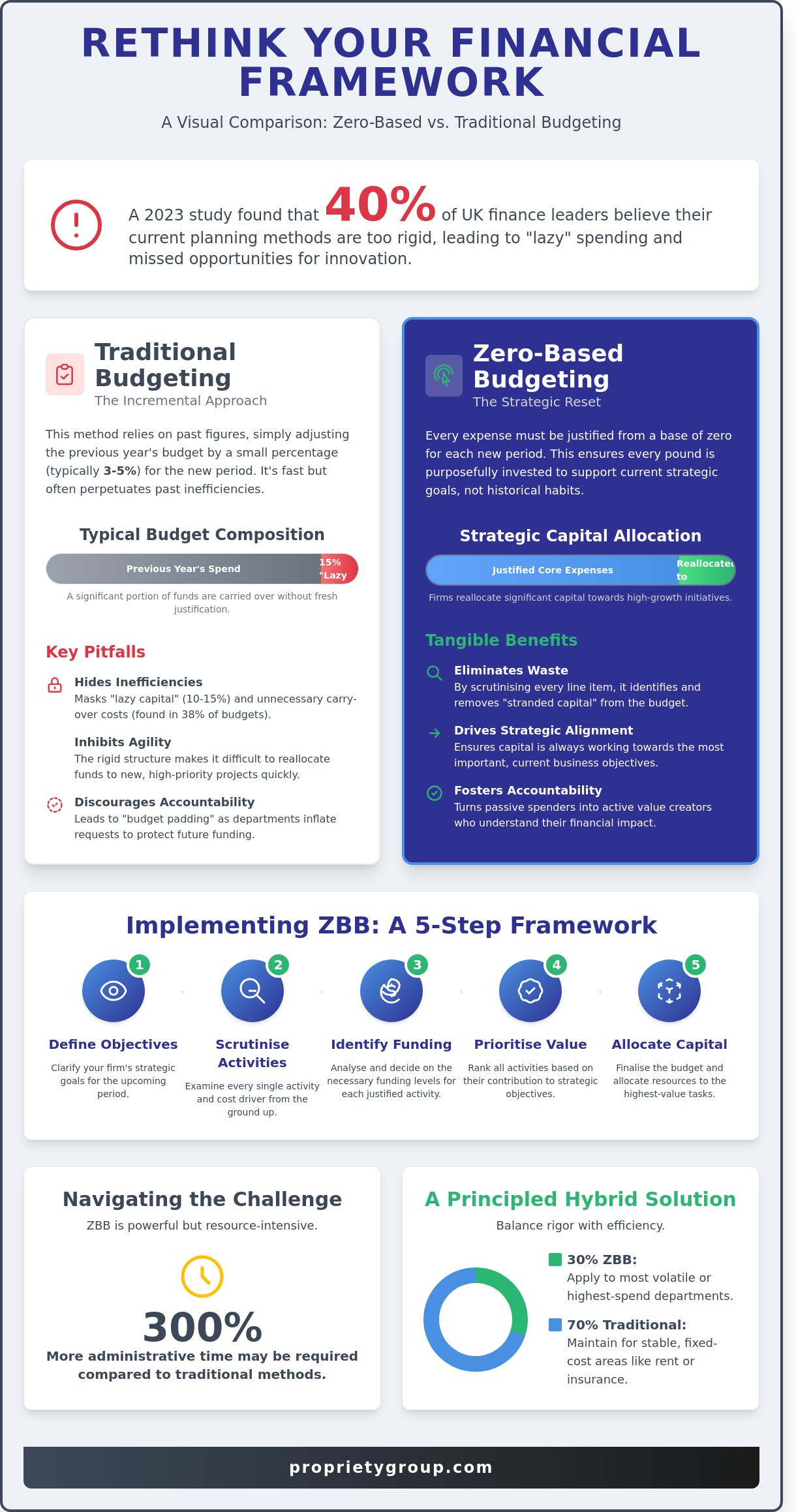
Zero-Based vs Traditional Budgeting: A Comprehensive Comparison
Traditional budgeting typically relies on incrementalism. Managers take the previous year's figures and add a small percentage, often between 3% and 5%, to account for inflation or growth. While this is time-efficient, it frequently hides 10% to 15% of "lazy capital" that no longer serves a strategic purpose. By contrast, zero-based budgeting requires every pound to be justified from scratch. It doesn't assume that because a cost existed yesterday, it deserves a place in tomorrow's vision. This method ensures that capital isn't simply spent; it's invested with intent.
This shift in perspective fosters a deep culture of accountability. When department heads must defend every line item, they move from being passive spenders to active value creators. It creates a level of transparency that traditional methods often obscure. Everyone in the organisation begins to understand the direct link between their specific costs and the company's overarching legacy. It's a meticulous process that aligns financial resources with current strategic priorities rather than historical habits.
The Tangible Benefits of the Zero-Base Approach
One of the most vital outcomes is the discovery of "stranded capital." A 2023 analysis of UK mid-market firms found that those using this approach reallocated up to 18% of their annual spend toward high-growth innovation. Beyond the balance sheet, the psychological impact is profound. It gives every department a voice. By justifying their requirements, teams demonstrate their unique contribution to the firm's purpose, turning a dry fiscal exercise into a shared mission of excellence.
Navigating the Challenges: Complexity and Resource Demand
The primary objection to this method is the sheer volume of work. Implementing a full-scale reset can require 300% more administrative time than a traditional roll-over. This can lead to "budget fatigue" if the process isn't managed with precision. For organisations seeking a middle ground, a hybrid approach is often the most principled choice. You might apply zero-based budgeting to 30% of your most volatile departments while maintaining traditional oversight for fixed costs like rent or insurance. Our team at Propriety Group applies this level of bespoke detail to ensure every investment delivers enduring value.
Implementing ZBB: From Manual Complexity to Connected Intelligence
Implementing zero-based budgeting is a deliberate journey that transforms how a firm views its resources. It starts with five clear steps: defining strategic objectives, scrutinising every activity, identifying funding sources, prioritising high-value tasks, and finally allocating capital. This meticulous approach ensures that every £1 spent is a conscious choice rather than a historical habit. By stripping away the assumptions of previous years, leaders can redirect funds toward projects that truly drive growth.
Many organisations find this shift daunting due to the level of detail required. This is where EPM advisory plays a vital role. Expert advisors help bridge the gap between high-level strategy and granular execution, ensuring the framework is robust enough to handle complex UK market conditions. They provide the roadmap needed to move from fragmented data to a unified financial vision.
Modern software has replaced the era of static, disconnected spreadsheets. These digital environments allow teams to collaborate in real time, making the justification process transparent and accessible. AI now assists in this effort by predicting future performance outcomes based on vast datasets. For instance, a firm might use predictive tools to justify a £100,000 investment by showing a direct correlation to a forecasted 15% increase in operational efficiency.
The Role of EPM Software in Streamlining the Process
A "single source of truth" is the foundation of successful zero-based budgeting. It allows for faster data collection and ensures every justification is based on accurate, live figures. By integrating AI in finance, businesses gain predictive intelligence that makes the ZBB cycle more proactive. This transparency can reduce the time spent on manual data entry by up to 40%, allowing finance teams to focus on high-level analysis instead of administrative tasks.
Building a Culture of Integrity and Justification
Success depends on more than just technology. It requires a cultural shift led by the executive team. When leadership treats every budget line as a fresh opportunity to create value, it instils a sense of pride and responsibility across the organisation. This commitment to integrity ensures that ZBB isn't a one-off exercise but a permanent legacy of financial discipline. It creates a future where every resource is used with purpose, securing long-term stability and growth.
Mastering the Shift to Strategic Financial Clarity
Adopting a fresh perspective on your organisation's finances isn't just about cutting costs; it's about ensuring every pound spent serves a specific purpose. Transitioning from traditional methods to zero-based budgeting allows you to justify every expense from the ground up. This shift replaces outdated assumptions with clear, data-driven decisions that align with your long-term goals. It turns a static spreadsheet into a dynamic roadmap for growth.
Since 2019, Propriety Group has operated as a specialist in implementing Enterprise Performance Management and CRM software. Our team of finance transformation consultants provides the expert advisory needed to move beyond manual complexity. We ensure your strategy remains resilient through our bespoke PG Care model, which offers continuous technical and strategic support tailored to your unique requirements. Partner with Propriety Group to evolve your planning and budgeting strategy. Taking control of your financial destiny starts with a single, deliberate step toward clarity.
Frequently Asked Questions
Is zero-based budgeting only for companies in financial trouble?
Zero-based budgeting is a proactive tool for healthy organisations, not just those facing financial hardship. While it helps during a downturn, a 2022 report found that 42% of high-performing UK firms used this method to redirect capital toward new growth projects. It ensures every pound spent aligns with your current vision rather than past habits. This meticulous approach builds a foundation of long-term security and prestige.
How often should an organisation perform a zero-based budget reset?
Most UK enterprises find that a full reset every 3 to 5 years provides the necessary balance between strategic clarity and operational stability. Performing this deep dive too often can disrupt your team's focus. Instead, firms often choose to review specific departments on a rolling basis. This ensures the entire framework remains relevant to the market without losing its sense of propriety or its focus on purpose.
What is the biggest difference between ZBB and incremental budgeting?
The fundamental distinction lies in your starting point. Incremental budgeting typically adds a small percentage, such as 2% or 3%, to last year's figures. This often carries over old inefficiencies. In contrast, zero-based budgeting requires you to justify every single cost from scratch. This bespoke approach ensures your financial legacy is built on intentional choices rather than historical assumptions, providing a clearer path toward your future goals.
Can zero-based budgeting be automated with EPM software?
You can certainly automate these processes using modern Enterprise Performance Management software. Data from 2023 indicates that 70% of finance leaders now use digital tools to handle the heavy lifting of data collection. This technology allows your team to focus on high-level strategy and integrity while the software manages the granular calculations. It's a reliable way to maintain precision and transparency across the entire organisation without manual errors.