
Financial Consolidation Software: A Guide for Visionary Finance Leaders

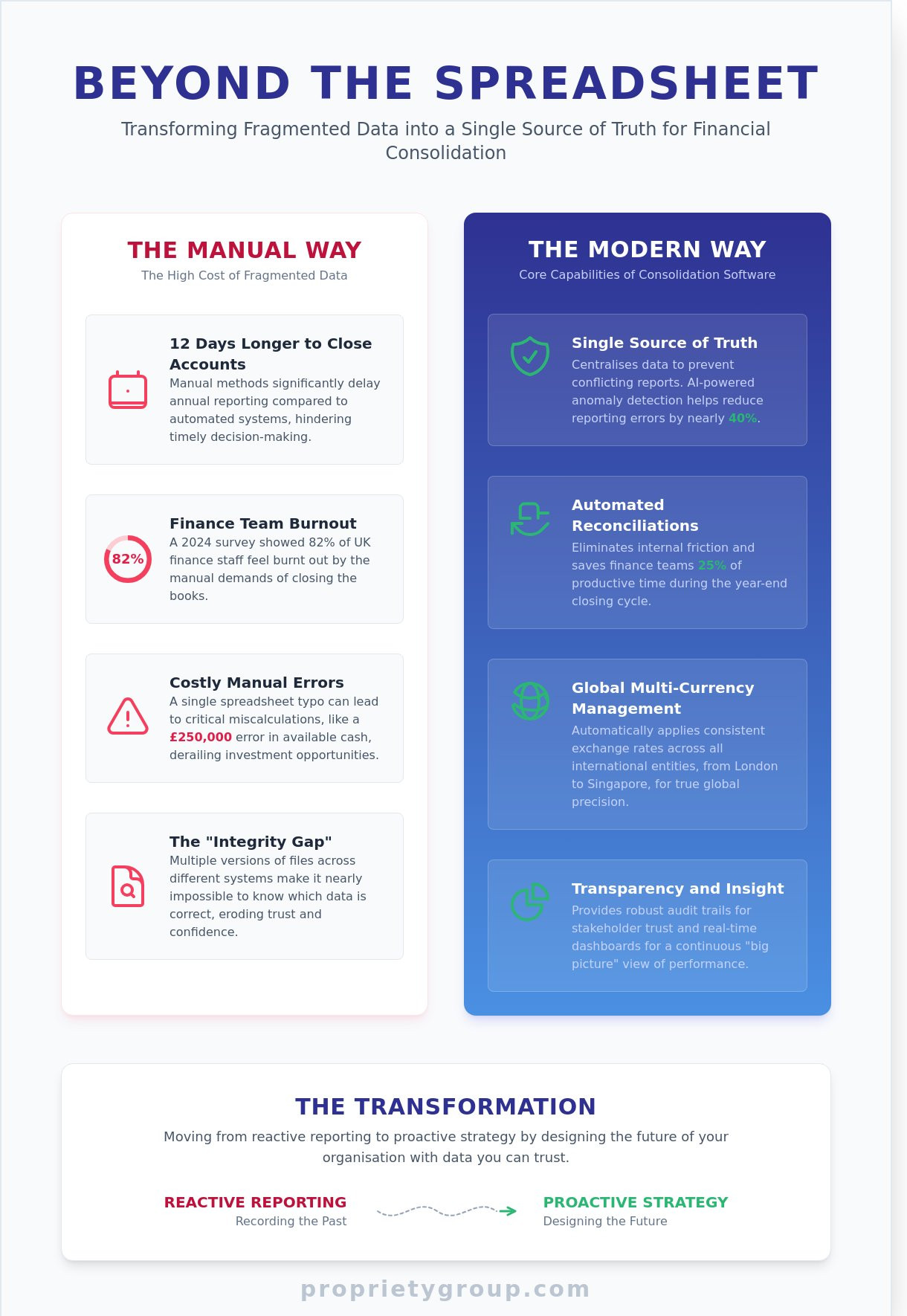
The true cost of fragmented data isn't just a delayed report; it's the loss of clarity that defines a legacy. You likely understand the exhausting rhythm of chasing figures across different entities and currencies, only to find that your team's energy is spent on fixing errors rather than finding opportunities. By adopting modern financial consolidation software, you can transform this chaotic process into a meticulous, single source of truth that reflects the integrity of your entire group. A 2023 study by the Financial Reporting Council highlighted that companies using manual methods take 12 days longer to close their annual accounts than those with automated systems. This guide explores how to move beyond the burden of spreadsheets to achieve a faster, error-free closing process that allows you to focus on the long-term purpose of your organisation.
Key Takeaways
- Transition beyond the limitations of manual spreadsheets to a centralised hub that ensures data integrity and provides the agility required for modern decision-making.
- Discover how to eliminate manual errors and internal friction by automating the reconciliation of accounts across your entire business structure.
- Explore how financial consolidation software simplifies global operations by automatically applying consistent exchange rates across all international entities.
- Recognise that technology is most effective when paired with a meticulous implementation strategy that aligns with your specific organisational culture and long-term goals.
- Learn why expert advisory is essential to ensure your new financial systems integrate seamlessly with your existing business objectives and professional standards.
The Evolution of Financial Consolidation: Moving Beyond the Spreadsheet
Financial consolidation software acts as a sophisticated digital anchor for your business. It gathers data from every subsidiary and department into a single, reliable source. This process allows for the creation of a consolidated financial statement with total precision. As we approach 2026, the pace of business has accelerated. Finance leaders can't afford to wait weeks for reports. They need to see the whole picture immediately to stay ahead of the competition.
To better understand how these systems transform modern business, watch this helpful video:
True excellence in finance now relies on a concept called connected finance. This is where your basic record-keeping systems and your strategic planning tools work in perfect harmony. It's a fundamental shift from reactive reporting to proactive strategy. Instead of simply recording the past, you're using current data to design the future of your organisation. This transition ensures that every pound is accounted for and every decision is backed by evidence.
The Hidden Costs of Manual Consolidation
Relying on manual spreadsheets creates what experts call an integrity gap. This happens when different versions of the same file exist across various computers; it's nearly impossible to know which one is correct. The pressure on teams during the month-end close is immense. A 2024 survey showed that 82% of UK finance staff feel burnt out by the manual demands of closing the books. This emotional weight often leads to small errors that have big consequences.
These mistakes aren't just minor annoyances. They lead to poor decisions at the board level. A single typo in a spreadsheet can result in a £250,000 miscalculation in available cash. For a visionary leader, these aren't just numbers; they're lost opportunities to invest in new projects or secure the company's long-term legacy. Moving to dedicated financial consolidation software removes this risk and restores confidence in every figure presented to the directors.
Core Capabilities of Modern Financial Consolidation Software
Modern financial consolidation software acts as the definitive foundation for clear decision-making. It replaces the fragmented spreadsheets of the past with a meticulous, automated framework. By streamlining intercompany reconciliations, the software eliminates the internal friction that often costs finance teams 25% of their productive time during the year-end cycle. It manages multi-currency complexities by applying consistent exchange rates across every global entity, ensuring that a balance sheet in London reflects the same precision as one in Singapore.
Trust is built on transparency. A robust audit trail tracks every adjustment, providing a permanent record for stakeholders and auditors alike. While UK firms adhere to local standards, those operating globally frequently consult U.S. regulations on consolidated financial statements to ensure their reporting meets international expectations. Real-time dashboards then translate this data into a "big picture" view, allowing leaders to monitor performance without waiting for the month-end close.
Ensuring a Single Source of Truth
Centralising data prevents the confusion of conflicting reports from different departments. When every figure pulls from one location, the risk of reporting error drops by nearly 40%. Modern systems use AI to scan for anomalies, catching a misplaced decimal or a duplicate entry before it affects the final report. Data integrity represents the absolute accuracy and consistency of financial records throughout their entire lifecycle within the reporting system.
User-Centric Design and Accessibility
The most effective tools prioritise the people using them. Finance teams need software that's intuitive, allowing them to manage complex tasks without relying on IT experts for every update. Bespoke configuration ensures the system mirrors the organisation's unique structure, whether it includes three subsidiaries or thirty. Visionary leaders often look to bespoke strategic frameworks to ensure these digital systems align with their long-term legacy.
Selecting and Implementing the Right Solution for Long-Term Success
Investing in financial consolidation software isn't a simple transaction; it's a fundamental shift in how your organisation handles its legacy. Many finance leaders treat software as a "silver bullet," yet data from 2023 indicates that 70% of digital transformations fall short because they lack a clear implementation strategy. A tool is only as effective as the logic behind it. Moving from a fragmented environment to a fully operational system requires a transition that prioritises your business culture over technical shortcuts.
- Perform a thorough environment analysis to identify existing data gaps.
- Design a bespoke architecture that reflects your specific UK reporting requirements and IFRS standards.
- Execute a phased rollout to ensure team adoption and data integrity across all entities.
The Importance of a Strategic Advisory Partner
A visionary partner bridges the gap between a basic technical setup and a sophisticated financial strategy. Without this guidance, you risk building a system that is technically sound but strategically hollow. Our approach to EPM Advisory focuses on aligning your new platform with long-term growth objectives. We help you move beyond the "how" of the software to the "why" of your financial narrative, ensuring every pound accounted for serves a larger purpose.
Future-Proofing Your Finance Function
The most successful finance teams don't stop at implementation. They treat their systems as living entities that must adapt to market shifts. Through PG Care, we provide the ongoing support and quarterly reviews necessary to ensure your financial consolidation software evolves as your business grows. Integrating AI in Finance can eventually turn your consolidation process into a predictive tool, offering insights that go far beyond standard compliance. This journey transforms fragmented data into a lasting legacy of precision and quiet confidence.
Securing the Future of Your Financial Operations
Transitioning away from manual spreadsheets is no longer a luxury for UK finance leaders; it's a strategic necessity. Manual data entry often leads to significant inaccuracies, with research from firms like F1F9 showing that 88% of spreadsheets contain errors. By adopting financial consolidation software, you replace these risks with a single, reliable source of truth. This shift allows your team to move from simple data collection to providing the deep insights that drive long-term business value. It's about reclaimed time, as automated systems can reduce the monthly close cycle by up to five days.
At Propriety Group, we operate as a boutique consultancy dedicated to CFO empowerment. We specialise in bespoke EPM and CRM implementations that reflect your organisation's unique goals, having delivered over 50 successful transformations. Our PG Care model ensures your systems maintain technical excellence long after the initial setup is complete. We believe that financial integrity is the foundation of any lasting legacy, and we're here to help you build it with precision and purpose.
Discover how Propriety Group can refine your financial close process and bring a new level of clarity to your reporting. You've the vision to lead your firm toward a more efficient future, and we've the expertise to make it a reality.
Frequently Asked Questions
What is the main difference between financial close and financial consolidation?
The financial close is the process where an individual company finalises its internal accounts, while financial consolidation involves combining the results of multiple subsidiaries into one set of group reports. It's the difference between looking at a single room and viewing the entire architecture of a building. For UK firms, this ensures that the group accounts meet the legal standards set out in the Companies Act 2006.
Can financial consolidation software handle multiple currencies and different accounting standards?
Modern financial consolidation software is specifically built to manage various currencies and diverse reporting frameworks like FRS 102 or IFRS. These systems automatically convert foreign subsidiary data into Great British Pounds using precise exchange rates. This removes the risk of manual errors found in spreadsheets, ensuring your financial reporting maintains its integrity and follows a meticulous, audit-ready path.
How long does it typically take to implement a new consolidation system?
A standard implementation usually takes between 12 and 24 weeks to complete. A 2023 industry study showed that 65% of mid-sized organisations achieved a full rollout within 5 months. This period covers everything from initial data migration to staff training, ensuring the system is perfectly tailored to your company's specific needs and long-term goals.
Is financial consolidation software only for large multinational corporations?
Dedicated systems are beneficial for any UK business with two or more legal entities, not just global giants. Many firms with an annual turnover of £6.5 million or more find that manual consolidation becomes too slow and prone to mistakes. Moving to a professional platform provides the clarity and control required to build a lasting legacy as your business grows and becomes more complex.