
Navigating the Strategic Challenges with Disparate Financial Systems

System fragmentation is not merely a technical inconvenience; it's a strategic anchor that prevents your most ambitious goals from taking flight. When your leadership team relies on a patchwork of software, the resulting friction often leads to the common challenges with disparate financial systems that stall growth and obscure clarity. You've likely spent far too many hours reconciling manual data only to find that reports vary between departments, leaving you without a clear direction or the ability to perform real-time forecasting. It's difficult to lead with confidence when your infrastructure feels like a collection of isolated islands rather than a cohesive map.
It's frustrating to manage a business when you can't trust the numbers in front of you. We understand that you need a single source of truth to move from reactive accounting to proactive, visionary leadership. This article shows you how to dissolve these data silos and transition toward a unified financial environment where predictive analytics and AI become your standard tools. We will explore the path toward faster month-end closing cycles and the precision that comes with a truly integrated digital architecture, ensuring your organization remains agile as global regulations and market shifts demand higher standards of correctness.
Key Takeaways
- Understand how software tools that operate in isolation create administrative friction and hidden costs as your organization expands.
- Address the core challenges with disparate financial systems that lead to reporting inconsistencies and prevent a real-time view of your cash flow.
- Recognize the impact of data silos on your financial close process and how they obscure critical insights into operating expenses and headcount.
- Learn how to bridge the gap between fragmented data sources to establish a single, reliable source of truth for your entire leadership team.
- Discover the steps necessary to transition toward predictive analytics and AI, allowing your finance department to focus on long-term strategic value.
Understanding the Burden of Disparate Financial Systems
Disparate financial systems are a collection of software tools that cannot communicate or share data automatically. They often emerge as a byproduct of success. Rapid growth, mergers, or department-specific software choices create a patchwork of technology over time. While these systems might have served a purpose yesterday, they eventually become a barrier to organizational agility. You'll find that Understanding Information Silos is essential to seeing why these disconnected tools hinder progress. Relying on "good enough" legacy infrastructure prevents the establishment of a single source of truth in finance.
To better understand how these disconnected environments impact leadership, watch this helpful video:
The Invisible Friction of Manual Reconciliation
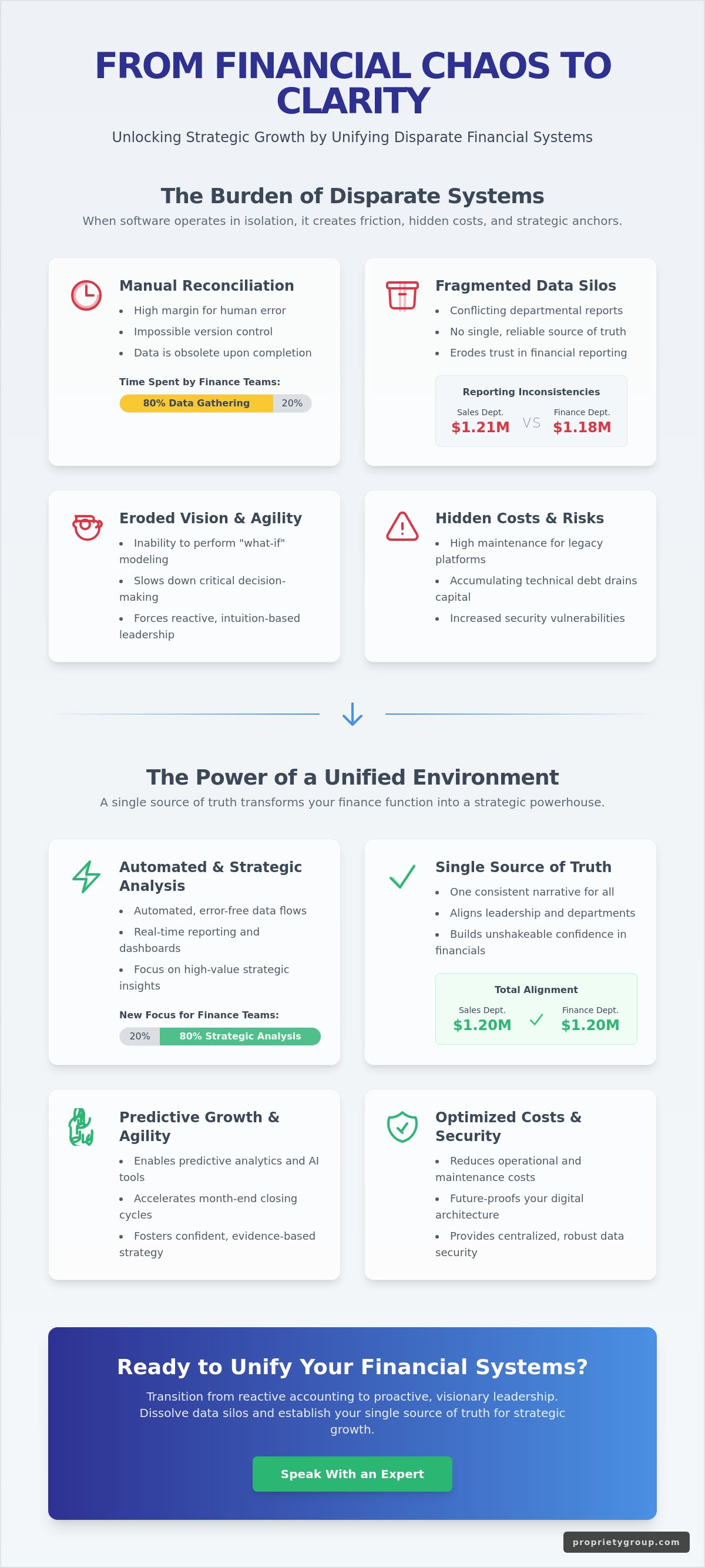
There's a significant human cost when finance teams spend 80% of their time gathering data rather than analyzing it. This administrative burden drains the energy of your most talented people. Manual data entry introduces a margin for error that compromises the integrity of every board report. Without a unified system, version control becomes impossible as multiple spreadsheets circulate across the office. These challenges with disparate financial systems ensure that by the time a report is finished, the data is already obsolete.
The Erosion of Financial Vision and Agility
Fragmented data prevents the high-level scenario modeling required for modern business. You can't perform "what-if" adjustments if you're constantly waiting for departments to align their conflicting numbers. It's deeply frustrating for leadership when the sales team and the finance team present different figures for the same period. This lack of alignment erodes trust and slows down critical decision-making. When you can't see the full picture in real-time, you're forced to lead by intuition rather than evidence, which limits your ability to navigate the challenges with disparate financial systems effectively.
The Strategic Impact of Fragmented Data Silos
Fragmented data silos do more than slow down the office. They fundamentally compromise the integrity of the modern financial close process by creating barriers that prevent a clear, real-time view of organizational health. When information is trapped in separate software, leadership loses sight of headcount, operating expenses, and cash flow. The complexities of these environments are well-documented, with a GAO report on financial systems consolidation emphasizing that failure to modernize leads to persistent coordination issues and higher operational risks. Relying on stale data from the previous month makes high-stakes decisions feel like a gamble. It's impossible to adopt predictive growth strategies when your vision is obscured by the challenges with disparate financial systems.
Operational Costs and Security Risks
Maintaining multiple legacy platforms carries hidden costs that drain your capital. It isn't just about software fees; it's about the technical debt and human energy required to keep outdated tools running. Moving data manually between unlinked systems also creates security vulnerabilities. Every time a file is exported to a spreadsheet and emailed, the risk of a breach increases. This lack of intentionality in your digital space threatens the permanence and precision that modern enterprises require.
The Trust Gap in Financial Reporting
Inconsistent data undermines a CFO's authority during strategic planning sessions. If the board sees conflicting numbers from different departments, their confidence in the financial narrative wavers. This shift turns visionary leaders into reactive firefighters who spend their days resolving discrepancies instead of guiding the company's future. To avoid this erosion of trust, you might speak with an expert about aligning your systems to ensure every decision is backed by a single source of truth.
Transitioning to Unified Financial Intelligence
Transitioning toward a unified intelligence environment requires a deliberate shift in perspective. While basic centralization is a step forward, a Brookings analysis of fragmented financial data highlights that silos create broader systemic risks that can't be solved by simple software patches. Instead, visionary leaders look to Enterprise Performance Management (EPM) as the strategic bridge that connects your accounting and customer data. This integration is the essential foundation for adopting AI for FP&A and predictive analytics. By overcoming the challenges with disparate financial systems, you move toward a unified data warehouse that offers both permanence and precision.
A Roadmap for System Integration
A holistic approach begins with a professional advisory phase to map your current environment before selecting new tools. This ensures the solution fits your specific human and operational needs while maintaining a high level of expertise.
- Environment analysis: Identify exactly where data bottlenecks and manual hand-offs are slowing your progress.
- Connected architecture: Design a system that supports driver-based budgeting, ensuring every financial input has a clear purpose and situational framing.
- Scalable implementation: Deploy an EPM platform that evolves alongside your organization, maintaining standards of correctness at every stage of growth.
Empowering the Visionary Finance Team
The future state of your department is one where your team isn't just reporting on the past but actively predicting the future. With a unified system, you provide real-time, predictive insights that allow the board to adjust to market changes with quiet confidence. This clarity transforms the finance function into a true partner for business growth, moving beyond the challenges with disparate financial systems to create enduring value. To begin your journey from fragmentation to unified intelligence, book a call with our advisory team.
Realising a Unified Financial Vision
The journey from a fragmented digital landscape to a unified environment is more than an IT upgrade; it's a commitment to strategic clarity. By addressing the challenges with disparate financial systems, you reclaim the time needed for high-level analysis and visionary planning. We've explored how moving beyond data silos allows your team to provide the real-time insights that modern boards demand. It's about creating a foundation of permanence where every figure is precise and every decision is informed.
Propriety Group specializes in guiding UK-based finance teams through this transformation. We provide bespoke environment analysis and expert implementation of EPM and CRM software, ensuring your tools align perfectly with your business objectives. With ongoing technical assistance through our PG Care model, your systems will remain as reliable as the day they were installed. The path toward financial excellence is clear when you have the right partner. To begin your transition toward a single source of truth, book a call with Propriety Group to discuss your finance transformation. You have the potential to turn your data into a powerful asset for growth.
Frequently Asked Questions
What are the most common signs that our financial systems are too disparate?
Common indicators include your team spending more time in spreadsheets than in strategy sessions. If different departments present conflicting figures during the same board meeting, you're experiencing the challenges with disparate financial systems. You might also notice that your month-end closing cycle takes weeks rather than days; this delay prevents you from reacting quickly to market shifts or new opportunities.
Can we integrate disparate systems without replacing our existing ERP software?
You can absolutely integrate your data without the disruption of replacing your core accounting software. An Enterprise Performance Management solution acts as a sophisticated layer that sits above your existing tools, pulling data into a central hub. This approach allows you to maintain your current records while gaining the visionary insights and predictive power of a unified environment without a total system overhaul.
How much time can a finance team save by moving to a unified EPM solution?
Finance teams often see a dramatic reduction in the time spent on manual data entry and reconciliation, often shifting from spending 80% of their time gathering data to spending that same time on analysis. This efficiency doesn't just save hours; it improves the quality of your human experience. By removing administrative friction, your team can focus on high-value work that contributes to the long-term security and growth of the organization.
What is the difference between a simple data link and a fully integrated EPM environment?
A simple data link merely moves information from one place to another, but a fully integrated environment provides a cohesive digital architecture. It includes built-in logic, automated workflows, and version control that ensures every department works from the same set of facts. This holistic approach allows for advanced stress testing and the use of predictive tools to model future growth with absolute precision. To begin your own transformation, book a call with our advisory team.