
Building a Single Source of Truth for Finance: A Strategic Guide

A single source of truth isn't a software product you buy; it's a meticulous commitment to data integrity that transforms your finance department into a visionary engine for growth. Most leadership teams spend more time debating which spreadsheet is correct than they do discussing high-level strategy. It's frustrating to watch your month-end close crawl along while manual errors in Excel undermine your confidence in the numbers. This struggle makes building a single source of truth for finance a necessity rather than a luxury, especially when the average cost of a data breach in the United States has reached a record $10.22 million.
You deserve to feel certain about your reports and the legacy you're building. This guide explores how to unify your data to eliminate inconsistencies and empower your leadership with real-time insights. We'll show you how to move from reactive planning to predictive growth, creating a foundation for the agentic AI tools that 95% of private equity firms are already implementing in 2026. We'll outline the path toward automated data flows and the precision required to meet the continuous data verification standards now demanded for regulatory compliance.
Key Takeaways
- Define the unified data environment as the essential foundation for maintaining financial integrity and correctness in 2026.
- Master the strategic blueprint for building a single source of truth for finance by analyzing your current landscape before investing in new tools.
- Learn the importance of meticulous data cleaning to ensure your migration results in a reliable and permanent record of truth.
- Explore how a consolidated data source enables the use of financial AI for advanced stress testing and scenario modeling.
- Transition your leadership focus from manual data reconciliation to proactive, visionary planning that secures your company's legacy.
The Foundation of Modern Finance: Defining the Single Source of Truth
Excellence in finance begins with a standard of correctness. Building a single source of truth for finance is not merely a technical upgrade; it's a commitment to a unified data environment where every figure is beyond reproach. This concept, often referred to as a single source of truth, ensures that your entire organization operates from one verified origin. It represents a shift from isolated silos toward a holistic view of performance, serving as the intersection of people, place, and purpose.
In 2026, financial integrity is no longer optional. With the effective federal funds rate at 3.63% and regulatory demands for continuous data verification, guess-work is a significant liability. A meticulous approach to data ensures that your reporting reflects the true health of the business, instilling a sense of trust and long-term security in your partners. This foundation is what allows a company to move beyond simple record-keeping toward a visionary strategy.
To better understand how this foundation supports your organization, watch this helpful video:
From Fragmented Spreadsheets to Strategic Intelligence
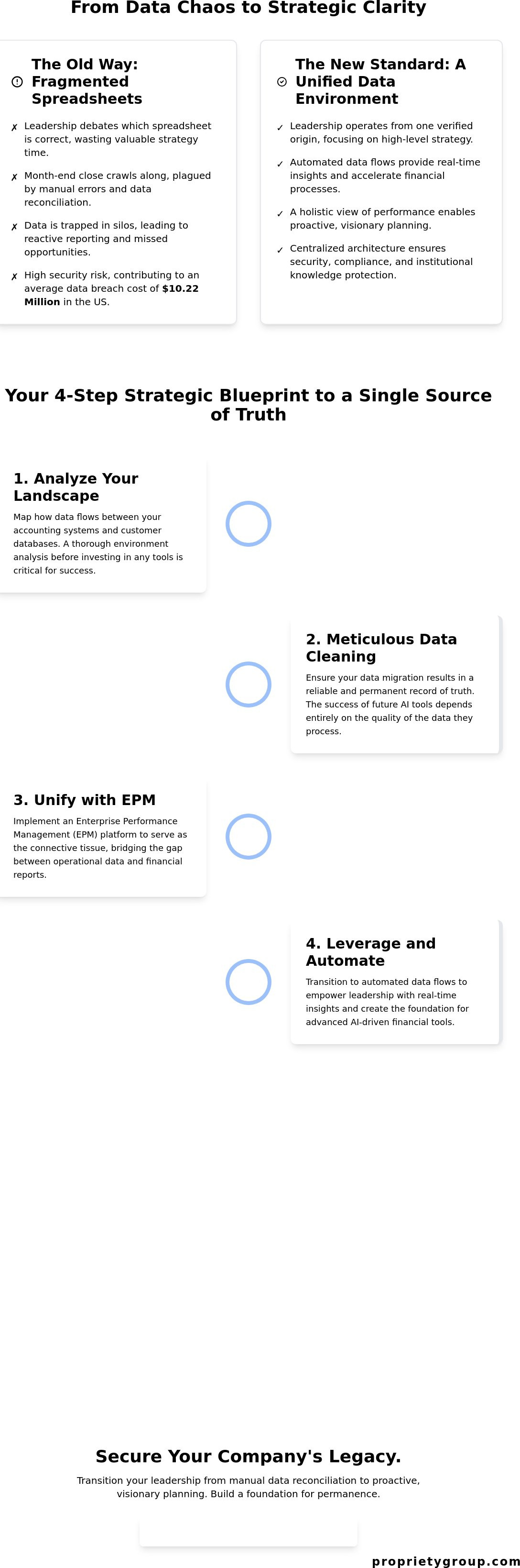
Relying on manual spreadsheets creates a precarious single point of failure. When data is trapped in separate files, your team remains stuck in reactive reporting, often discovering errors only after they've impacted the bottom line. True strategic intelligence requires unified financial intelligence to reduce manual errors and allow for forward-looking decisions. While 56% of finance professionals now use AI in 2026, the success of these tools depends entirely on the meticulous cleaning of the data they process. Shifting to an automated flow transforms your finance department into an engine for predictive growth.
The Hidden Risks of Scattered Financial Data
Scattered data carries hidden costs that erode a company's legacy. Your team loses countless hours searching for and synchronizing disparate systems; this inefficiency directly undermines the confidence of the leadership group. Beyond productivity, there's the critical matter of security. In 2025, the average total cost of a data breach in the United States reached a record $10.22 million. A centralized data architecture provides the security and compliance required to protect your firm. By building a single source of truth for finance, you create a bespoke environment that ensures both the accuracy of your reports and the safety of your institutional knowledge.
A Strategic Blueprint: How to Build Your Single Source of Truth
Success in building a single source of truth for finance depends on a thorough environment analysis before a single line of code is written or a software license is purchased. It's a bespoke process that respects the unique legacy of your business. You must map how data flows between your accounting systems and customer databases. This meticulous preparation ensures that when you migrate your data, it remains accurate and untainted. Only after understanding your current landscape can you select the tools that will create enduring value.
Enterprise Performance Management (EPM) serves as the connective tissue in this architecture. It bridges the gap between your operational data and your financial reports. Without this bridge, information remains fragmented. By aligning your systems, you create a standard of propriety that ensures every department speaks the same language. For organizations seeking a refined path forward, engaging in strategic advisory ensures your foundation is built for permanence.
Aligning Technology with Business Purpose
Software should never be a mere utility. It's a means of creating enduring value. The right EPM platform acts as the engine for your transformation, but its power is only realized through proper training and support. Your team needs to embrace the new system as a partner in their work, not a burden. This alignment ensures that your technology serves your people and your purpose, rather than forcing your people to serve the technology.
Streamlining the Month-End Close through Automation
A unified data source radically accelerates the financial close process. Automation handles the heavy lifting of intercompany reconciliation and data validation, which previously consumed weeks of manual effort. Your finance team transitions from the tedious task of gathering data to the high-value work of analyzing insights. This shift empowers leadership to make decisions with quiet confidence, backed by numbers that are both current and correct.
Predictive Growth: Leveraging AI once the Foundation is Set
Artificial intelligence and predictive analytics cannot function effectively without a single source of truth. If the underlying data is fragmented or inconsistent, the intelligence produced will be inherently flawed. While 56% of finance professionals report using AI in 2026, only 17% are successfully applying it to core workflows. This gap exists because many organizations attempt to layer advanced tools over messy data. Building a single source of truth for finance ensures that your AI models are fueled by high-quality, verified information, allowing for projections that carry a sense of quiet confidence.
Clean data allows for sophisticated stress testing and scenario modeling. By utilizing a structured library of management actions, you can project certainty even when market conditions shift. This transition transforms the CFO into a visionary leader who doesn't just report on the past but actively designs the future. It creates an environment of connected planning; every department works from the same facts, ensuring the entire organization moves with purpose and precision.
The Future of Financial Forecasting
The adoption of AI in finance enables more accurate cash flow and revenue projections by identifying patterns that traditional spreadsheets often miss. We're seeing a decisive shift toward driver-based budgeting and rolling forecasts that adapt as quickly as the market does. To remain accurate in 2026, AI models require a unified data warehouse that serves as the definitive record for all financial metrics. This central hub ensures that your predictive models are grounded in reality rather than speculation.
Ongoing Excellence: The PG Care Model
A single source of truth requires continuous meticulous care and optimization to maintain its integrity over time. It's not a one-time project but a living system that must reflect your business’s evolving legacy. Having an expert-led advisory partner ensures your long-term system health and provides the thoroughness required for lasting success. Ongoing support ensures the system matures alongside your company, protecting your institutional knowledge and maintaining the high standard of propriety your partners expect.
Designing the Future of Your Financial Architecture
A single source of truth is more than a technical milestone; it's a standard of propriety that defines your organization's commitment to excellence. By unifying your data, you move beyond the limitations of manual errors and reactive planning. This transformation allows your leadership team to act with quiet confidence, knowing every projection is grounded in a meticulous foundation. Building a single source of truth for finance is the essential bridge between your current operations and a future of predictive, AI-driven growth.
Propriety Group brings a design-led philosophy to financial architecture, ensuring your systems are as functional as they are visionary. As specialists in EPM and CRM software implementation, we provide the expert-led narrative your business needs to secure its legacy. Our PG Care model offers ongoing technical assistance to ensure your systems remain accurate and resilient as your business evolves.
Success requires a partner who values integrity and precision as much as you do. Explore our bespoke EPM implementation services to discover how we can help you unify your data and empower your leadership. It's time to create a financial foundation that reflects the true purpose and potential of your business.
Frequently Asked Questions
What is the first step in building a single source of truth for finance?
The first step is a meticulous analysis of your current data environment and organizational purpose. Before selecting software, you must map how information moves between departments and identify where silos exist. This assessment ensures that your technical foundation respects your business’s legacy and provides a clear path for integration. It’s about understanding the intersection of people and place before introducing new tools.
How long does it take to implement a unified financial data system?
A standard implementation typically spans between three and nine months. The duration depends on the complexity of your existing systems and the volume of data requiring migration. Taking a steady, measured approach ensures that data cleaning is thorough and that the final system achieves a high standard of correctness. This timeframe allows for the proper training required to ensure your team feels confident in the new environment.
Can we build a single source of truth while keeping our existing ERP?
Yes, building a single source of truth for finance is often achieved by integrating an Enterprise Performance Management system with your current accounting software. This layer acts as a bridge, connecting fragmented data from your ERP and CRM into one unified view. It allows you to maintain your established workflows while gaining the benefits of a centralized data architecture. This approach protects your existing investment while enhancing your strategic intelligence.
What are the main benefits of moving away from spreadsheets for planning?
Moving away from manual spreadsheets eliminates the risk of human error and the frustration of reconciling inconsistent reports. It accelerates your month-end close and provides the transparency needed for regulatory compliance. By building a single source of truth for finance, your team shifts from the tedious task of gathering data to analyzing strategic insights. This transition fosters a more visionary leadership culture where decisions are backed by reliable, real-time facts.