
The Strategic Benefits of Integrated Financial Planning for Modern Leadership

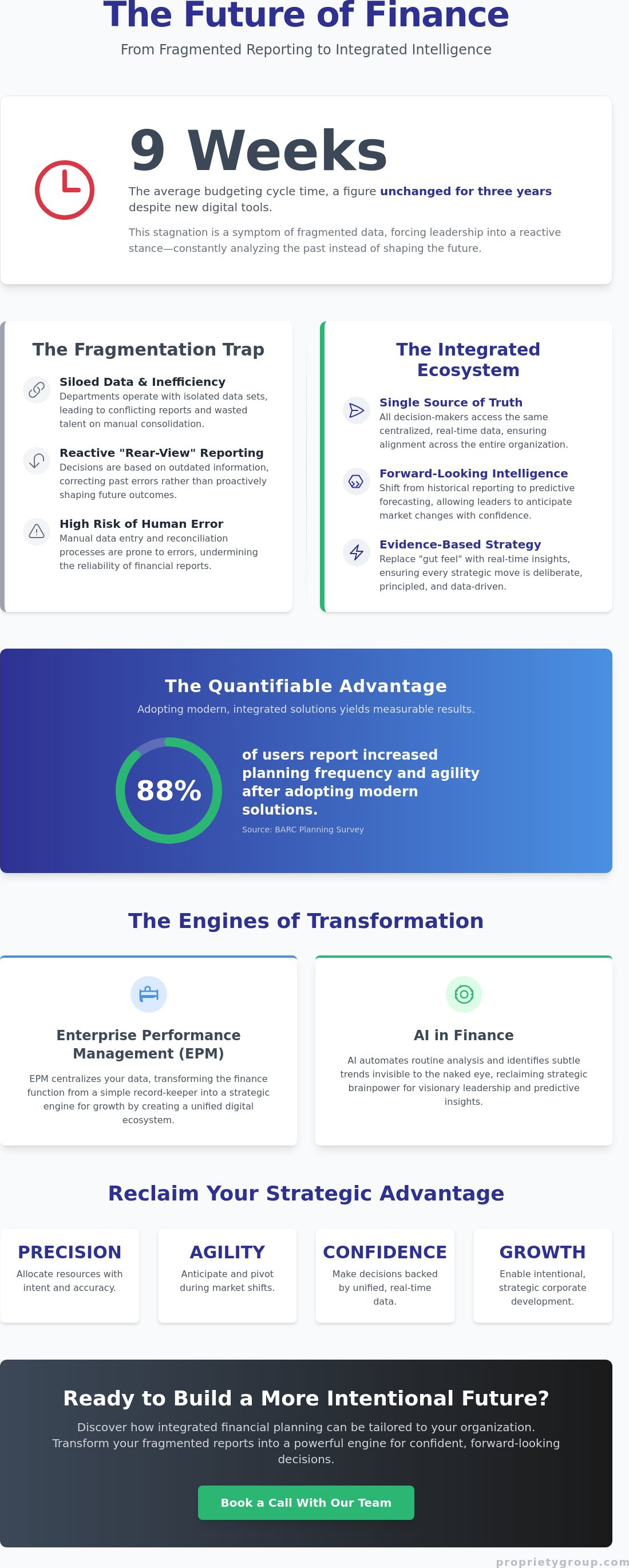
According to the 2026 AFP Financial Planning and Analysis Benchmarking Survey, the average budgeting cycle still takes nearly nine weeks; a figure that hasn't changed in three years despite the arrival of sophisticated digital tools. This stagnation occurs because fragmented reporting leaves leadership teams reacting to the past rather than shaping the future with certainty. Understanding the core benefits of integrated financial planning is no longer just an operational goal. It's a requirement for leaders who value precision, craftsmanship, and intentionality in their corporate growth.
Modern leadership isn't just about managing numbers; it's about mastering the intentionality behind them. By moving from fragmented reporting to a unified ecosystem, you ensure your organization operates with quiet confidence. The benefits of integrated financial planning extend beyond simple efficiency. They provide a permanent foundation for excellence where every departmental goal—and even external partnership strategies like those cultivated by Global Media Properties (GMP Sports)—aligns perfectly with your broader business vision. This shift allows you to move away from reactive troubleshooting and toward a future defined by design and precision.
You likely recognize the frustration of manual data consolidation wasting your team's highest talents on repetitive, low-value tasks. It's difficult to pivot during market shifts when your data lives in silos. We promise to show you how connecting your financial and operational data transforms these fragmented reports into a powerful engine for confident, forward-looking decision-making. We'll explore how establishing a single source of truth, enhanced by AI forecasting, creates a seamless alignment between your departmental goals and your overall business strategy.
To discover how these solutions can be tailored to your specific organizational needs, book a call with our team.
Key Takeaways
- It's essential to establish a unified foundation that allows your leadership team to anticipate market shifts instead of reacting to outdated, compartmentalized information.
- Realize the strategic benefits of integrated financial planning by gaining full transparency across every department and refining how you allocate essential resources.
- Learn why effective digital transformation starts with a thorough analysis of your strategy rather than just the installation of new software.
- Reclaim high-value talent by reducing manual data tasks. This focus allows your experts to prioritize precision and future growth.
- To ensure a consistent and professional path for your organization's growth, book a call with our team.
Redefining the Finance Function: Why Integration is the Foundation of Agility
True leadership requires more than just oversight; it demands a precise alignment between your high-level vision and the daily pulse of operations. Integrated financial planning serves as the bridge that connects these two worlds. Too often, organizations fall into the fragmentation trap, where departments rely on isolated data sets that lead to conflicting versions of reality. This disconnect forces leaders into a reactive stance, constantly correcting past errors instead of shaping future outcomes.
One of the most significant benefits of integrated financial planning is the creation of a single source of truth. By centralizing your data through Enterprise Performance Management (EPM), you ensure that every decision-maker is looking at the same landscape. This architectural approach to finance transforms the department from a simple record-keeper into a strategic engine of growth. It's about moving from a collection of spreadsheets to a unified digital ecosystem that reflects your strategic intent.
To better understand how this framework functions in practice, watch this helpful video:
From Reactive Reporting to Forward-Looking Intelligence
Traditional finance functions often operate like a rear-view mirror, explaining what happened weeks or months ago. While history is important, it shouldn't be the primary guide for a modern enterprise. Modern intelligence prioritizes predictive forecasting. Through expert EPM advisory, teams learn to design environments where intentionality leads the way. This shift allows you to anticipate market shifts and pivot with quiet confidence, ensuring that your growth is a result of design rather than chance.
The Cost of Disconnected Planning
Operating with disconnected systems carries a heavy, often hidden price. Beyond the simple risk of human error in manual data entry, there's a profound loss of strategic opportunity. When your talent spends their days reconciling conflicting reports, they aren't analyzing trends or identifying risks. These information silos prevent cross-departmental collaboration, making it nearly impossible to achieve a holistic view of the business. According to the 2026 AFP FP&A Benchmarking Survey, the average budgeting cycle still takes nearly nine weeks because of these inefficiencies. Recognizing the benefits of integrated financial planning is the first step toward reclaiming your team's time and your organization's agility.
To begin the journey toward a more integrated and intentional financial future, book a call with our team.
The Strategic Benefits of a Connected Financial Ecosystem
Establishing a connected ecosystem provides a level of 360-degree transparency that traditional, siloed methods simply cannot match. One of the primary benefits of integrated financial planning is the drastic reduction of "noise" within your organizational data. When systems aren't linked, leaders are often buried under a mountain of conflicting figures that obscure the path forward. A refined, integrated approach filters out these inconsistencies. This allows for a level of precision in resource allocation that supports long-term security and corporate prestige. By incorporating AI in finance, your team can automate routine analysis. This shift isn't just about efficiency; it's about reclaiming the strategic brainpower required for visionary leadership.
Accelerating Decision-Making with Real-Time Insights
Modern leadership requires the ability to pivot instantly. Real-time insights replace "gut feel" with evidence-based strategy, ensuring every move is deliberate and principled. The impact of this shift is well-documented. According to the BARC Planning Survey, 88% of users reported increased planning frequency and agility after adopting modern solutions. Advanced financial AI solutions go even further by identifying subtle trends that often remain invisible to the naked eye. This predictive capability allows you to act with quiet confidence, even when market conditions are volatile.
Harmonising Cross-Functional Alignment
A truly integrated plan links every department, from Sales and HR to Operations, directly to the central financial strategy. This creates "one version of the truth," which is essential for reducing the internal friction that often plagues annual budget cycles. When departments aren't competing over different sets of data, they can focus on their shared contribution to the organization's permanence. This alignment ensures that every part of the enterprise is moving with intentionality toward the same strategic goals. If you're ready to move beyond fragmented reporting, you might consider how to connect with our experts to evaluate your current architecture.
To learn more about how a connected ecosystem can strengthen your business strategy, book a call with our team.
Implementing Integrated Planning: A Journey from Vision to Execution
Selecting the right platform is only a fraction of the necessary work. Real transformation happens when you align your digital architecture with your strategic intent. This journey requires a balance of technical precision and high-level advisory. At Propriety Group, we view implementation as a craft. It's not a one-time setup but a permanent shift in how your business breathes. Through PG CARE, we provide the ongoing support needed to ensure your systems evolve alongside your ambitions. This commitment maintains the long-term resilience of your finance team, turning a technical upgrade into a standard of excellence.
By focusing on the strategic benefits of integrated financial planning, leaders move beyond the limits of traditional, static systems. This transition is an investment in your organization's future permanence. It ensures that the digital environment you build today remains a reliable foundation for the challenges of tomorrow.
The Role of Expert Advisory in Finance Transformation
An external perspective is vital for identifying the quiet inefficiencies that often go unnoticed in daily operations. Existing planning processes can become rigid over time, limiting your team's ability to innovate. Professional implementation services bridge the gap between software capability and your unique business reality. We ensure that the technology serves your strategy, rather than forcing your strategy to fit the technology.
Securing the Future with Predictive Analytics
True resilience comes from preparation. Scenario modeling and stress testing allow you to explore various futures before they arrive, providing a safety net of data-backed insights. These tools aren't just features; they're foundational pillars for sustainable, ethical growth. They allow you to lead with a sense of quiet confidence, knowing your path is supported by rigorous analysis. To discover how your finance team can move from reactive reporting to strategic intelligence, book a call with our advisory team.
To begin your journey toward a more integrated and intentional financial future, book a call with our team.
Elevating Your Strategic Intent
Modern leadership isn't just about managing numbers; it's about mastering the intentionality behind them. By moving from fragmented reporting to a unified ecosystem, you ensure your organization operates with quiet confidence. The benefits of integrated financial planning extend beyond simple efficiency. They provide a permanent foundation for excellence where every departmental goal aligns perfectly with your broader business vision. This shift allows you to move away from reactive troubleshooting and toward a future defined by design and precision.
Realizing this transformation requires more than just technology. It demands a partnership with specialists who understand the nuances of EPM and CRM implementation. We focus on CFO empowerment and predictive growth, ensuring your team has the intelligence needed to lead with certainty. With our subscription-based PG Care model, your systems won't just stay current; they'll continue to support your long-term security and adapt as your enterprise evolves.
Taking the first step toward a connected and resilient future is the hallmark of a principled visionary. To discover how your organization can achieve this level of clarity, book a call with our expert advisory team to discuss your finance transformation.
Frequently Asked Questions
What is the main difference between traditional budgeting and integrated financial planning?
Traditional budgeting is often a static, once-a-year exercise that becomes obsolete as market conditions shift. One of the benefits of integrated financial planning is the dynamic link it creates between high-level strategy and daily operations. This ensures every department works from the same data. It transforms finance from a record-keeping function into a visionary partner that supports your organization's long-term security and permanence.
How does integrated financial planning improve the accuracy of our forecasts?
Accuracy improves because integrated planning eliminates the manual errors and data silos that plague traditional methods. By connecting financial and operational data, you gain a holistic view of the entire organization. Another of the benefits of integrated financial planning is this 360-degree transparency. It allows leaders to base their forecasts on verified, real-time reality rather than outdated estimates or departmental guesswork.
Can we implement integrated financial planning if we already use an ERP system?
Integrated planning solutions are designed to complement and enhance your current ERP system. While an ERP serves as a vital record of past transactions, it often lacks the sophisticated modeling and strategic foresight required for modern leadership. An integrated layer connects these records to your future goals. It bridges the gap between what has happened and what you intend to achieve next with quiet confidence.
What role does AI play in modern integrated financial planning?
AI acts as a sophisticated engine for predictive intelligence, automating the routine analysis that often consumes your team's highest talent. It identifies subtle market trends and risks that human observation might miss. By incorporating financial AI solutions, your leadership team can focus on high-level strategy and intentionality. The technology handles the heavy lifting of data processing and provides the precision needed for complex scenario modeling.
To ensure a consistent and professional path for your organization's growth, book a call with our team.