
Mastering OPEX Planning for professional services organisations

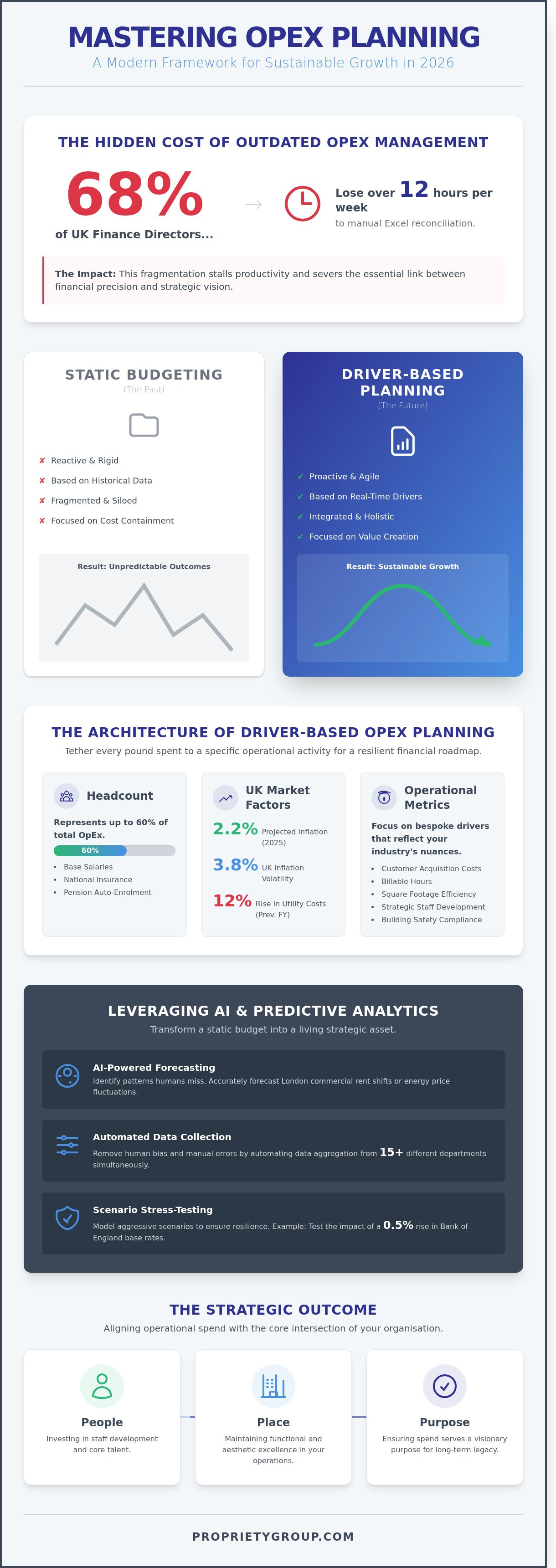
What if your operational expenditure was no longer a series of isolated line items, but a meticulously crafted narrative of your firm’s future legacy? You likely recognise the frustration of reactive cost management, especially when recent data suggests that 68% of UK finance directors still lose over twelve hours each week to manual Excel reconciliation. This fragmentation doesn't just stall productivity; it severs the essential link between your financial precision and your strategic vision. You deserve a system that reflects the integrity of your leadership rather than one that obscures it.
Mastering opex planning requires a shift from fragmented oversight to a sophisticated, driver-based framework that fuels sustainable growth. This article outlines how to replace reactive habits with a bespoke methodology that offers real-time visibility and absolute confidence in your 2026 forecasts. We'll explore a strategic approach to aligning people, place, and purpose, ensuring your operational spend serves as a precise instrument for long-term value creation and organisational prestige.
Key Takeaways
- Transition from static, historical budgeting to a sophisticated, driver-based narrative that transforms opex planning into a catalyst for sustainable growth.
- Understand how the "OpEx-ification" of technology investments necessitates a more agile approach to harmonising short-term liquidity with long-term legacy.
- Master a meticulous, phased roadmap for implementing automated frameworks that ensure financial precision amidst the volatile UK economic landscape of 2026.
- Discover the strategic advantage of aligning operational spend with the core intersection of people, place, and purpose to deliver lasting organisational integrity.
- Identify the specific business drivers that dictate your expenditure, moving beyond mere accounting treatment to achieve true operational excellence.
Defining OpEx Planning in the Modern Enterprise
Operating expenditure represents the lifeblood of daily business integrity. It's the continuous pulse that sustains an organisation's vital functions, from the energy powering a Mayfair office to the bespoke software driving client engagement. While the foundational concept of Operating Expense (OpEx) distinguishes recurring costs from long-term capital investments, modern opex planning has evolved into a disciplined art form. It's no longer a mere exercise in cost containment. Instead, it's the strategic orchestration of resources to ensure every pound spent serves a visionary purpose.
Static budgeting models have become relics. In a 2026 economic landscape defined by a 3.8% volatility in UK inflation rates and shifting energy levies, rigid annual forecasts fail to protect margins. Professional enterprises now view opex planning as a dynamic component of the wider Enterprise Performance Management (EPM) ecosystem. This integration ensures that operational liquidity remains aligned with long-term legacy goals, allowing leaders to pivot without compromising their principled standards of service.
The Core Components of Operational Expenditure
In the UK business context, distinguishing between fixed and variable costs requires meticulous precision. Fixed costs often include long-term commercial leases in London’s primary districts and core payroll obligations, including National Insurance contributions. Variable costs have become more complex, often tied to consumption-based cloud computing or seasonal utility fluctuations that saw a 12% rise in the previous fiscal year. Distinguishing between essential maintenance, such as building safety compliance, and strategic operational investment, such as staff development programmes, allows a firm to maintain its aesthetic and functional excellence without wasteful overreach.
Why Sophisticated Planning is a Competitive Advantage
Proactive resource allocation separates market leaders from their reactive counterparts. When a firm anticipates market shifts, it captures opportunities that others miss. Meticulous precision in financial forecasting signals a level of propriety that resonates with stakeholders. This transparency builds a foundation of trust. It proves that the leadership team values permanence over temporary gains. OpEx planning is the rhythmic alignment of spend and strategy.
The Architecture of Driver-Based OpEx Planning
Reliable opex planning requires a departure from the static mirrors of the past. Relying solely on last year's ledger creates a temporal lag that London’s volatile market won't forgive. A driver-based model replaces guesswork with mathematical logic. It tethers every pound spent to a specific operational activity, ensuring your financial roadmap remains resilient. This meticulous approach builds a foundation where data integrity acts as the single source of truth for the entire C-suite. By prioritising precision over historical habit, firms protect their margins against unforeseen shifts.
Identifying and Organising Your Key Business Drivers
Drivers are the variables that dictate your spend. In the UK, headcount often represents 60% of total operational costs. Beyond base salaries, your model must account for National Insurance contributions and pension auto-enrolment obligations. Customer acquisition costs and the 2.2% inflation rate projected for 2025 also demand granular precision. Avoid vanity metrics like social media reach that fails to convert. Focus on bespoke drivers that reflect your industry's nuances, such as billable hours or square footage efficiency. Adopting a strategic framework for OpEx planning provides the structure needed to align these variables with long-term corporate goals.
The Role of Predictive Analytics and AI
Financial AI solutions now identify patterns that human analysts frequently miss. These tools process thousands of data points to forecast London’s commercial rent shifts or energy price fluctuations with startling accuracy. AI agents can automate the collection of granular data from 15 different departments simultaneously. This removes human bias and manual entry errors. Use these insights to stress test your opex planning against aggressive scenarios, such as a 0.5% rise in Bank of England base rates. Such foresight transforms a static budget into a living strategic asset. If you require a more refined approach to financial strategy, integrating these predictive technologies is a non-negotiable step toward permanence. It allows leadership to pivot based on evidence rather than intuition.
OpEx vs. CapEx: Harmonising Short-Term Agility with Long-Term Legacy
Distinguishing between Operating Expenditure (OpEx) and Capital Expenditure (CapEx) is no longer a mere accounting exercise; it's a strategic imperative for the modern London enterprise. While CapEx builds the tangible legacy of a firm through property and infrastructure, OpEx provides the vital oxygen for daily agility. A meticulous approach to opex planning ensures that a business remains responsive to market shifts without over-leveraging its future. By the start of 2025, approximately 73% of UK mid-market firms had transitioned at least one core legacy system to a subscription model. This shift demands a sophisticated understanding of how recurring costs impact liquidity. CFOs must choose between the permanence of owned assets and the flexibility of leased services. This choice defines the firm's resilience.
The Strategic Pivot to Subscription-Based Models
The transition to cloud-based Enterprise Performance Management (EPM) has fundamentally altered the corporate balance sheet. Rather than a singular £500,000 upfront investment in hardware, firms now manage predictable monthly outlays that scale with demand. Our PG Care programme exemplifies this shift, providing bespoke system support as a steady operational cost rather than an unpredictable capital drain. This model simplifies annual operating budget planning by removing the volatility of emergency repairs or outdated software licences. However, leaders must remain vigilant. Fragmented subscriptions often lead to "SaaS sprawl," where redundant services erode intended savings by as much as 18% annually if left unmonitored.
Tax and Regulatory Implications in the UK
UK GAAP requirements dictate a precise separation of these expenditures to maintain the integrity of financial reporting. OpEx directly reduces net profit in the period incurred, while CapEx is depreciated over time, significantly influencing EBITDA figures. For a London business seeking investment or acquisition, these margins are critical. Meticulous opex planning also facilitates compliance with emerging ESG standards. By 2026, UK firms with over 250 employees must report on sustainability with greater transparency. Shifting to OpEx-based green energy providers or cloud services helps align operational spending with these rigorous carbon-reduction targets, ensuring the brand's legacy remains untarnished by inefficiency.
A Meticulous Roadmap for Implementing Automated OpEx Planning
Transitioning to automated opex planning requires more than a simple software licence. It demands a structured, five-stage methodology to ensure your digital architecture aligns with your commercial legacy. A haphazard rollout often leads to data fragmentation. We follow a precise sequence to guarantee system integrity.
- Phase 1: Environment Analysis. We conduct a forensic audit of your current state. 74% of London firms still rely on disconnected spreadsheets, which creates significant version-control risks.
- Phase 2: Bespoke Framework Design. We define a driver-based model tailored to your specific sector. This ensures costs correlate directly with business activity, such as headcount or office square footage.
- Phase 3: Software Configuration. Selecting the right FP&A solution is critical. We configure the platform to mirror your unique organisational hierarchy and reporting requirements.
- Phase 4: System Integration. We manage the seamless migration of data from existing ERP and CRM systems. This ensures every £1 of expenditure is tracked with total precision.
- Phase 5: Cultural Transition. The final step involves rigorous user training. We move your team away from static annual budgets toward a culture of continuous, rolling forecasts.
Overcoming the Hurdles of Change Management
Departmental heads often resist the increased spend transparency that modern opex planning provides. This friction can stall 40% of digital transformations if left unaddressed. Success requires visionary leadership to frame transparency as a tool for empowerment rather than oversight. We facilitate bespoke workshops that align team behaviour with these new processes. This collaborative approach turns potential sceptics into system advocates.
Ensuring Long-Term System Health with PG Care
Implementation is merely the start of your digital journey. System performance can degrade by 15% annually if the underlying logic isn't refined as the business scales. PG Care provides the recurring support needed to maintain peak efficiency. We establish a Management Asset Library (MAL) to preserve your institutional knowledge. This ensures your planning remains resilient, regardless of personnel changes or market shifts. You can optimise your operational expenditure by securing a partnership that values long-term stability over short-term fixes.
Propriety Group: Elevating Operational Planning through Bespoke Advisory
The philosophy at Propriety Group is rooted in the belief that financial precision thrives only where people, place, and purpose intersect. We don't treat opex planning as a routine administrative task. Instead, we view it as a sophisticated instrument of strategic integrity. While many firms rely solely on software to solve complex problems, we prioritise a partner-led advisory that values human insight and design-led thinking. Our London-based experts provide the quiet confidence CFOs need to lead their organisations through 2024 and beyond. We focus on creating a connected, forward-looking environment where every pound spent is an investment in your company's permanence.
Advisory for EPM: A Partner-Led Approach
We meticulously tailor EPM implementations to align with your specific commercial objectives. Our consultants understand that fragmented reporting is more than a nuisance; it's a drain on resources that cost UK enterprises an average of £185,000 in 2023 due to data silos. We replace this confusion with a bespoke framework that offers total clarity. You can explore our Advisory for EPM services to see how we transform disparate data points into a unified narrative. This partner-led approach ensures your technology stack isn't just functional but also reflects the prestige of your brand. Our methodology bridges the gap between high-level concepts and the granular details of execution.
Securing Your Financial Future
Integrity and legacy sit at the heart of our work. We believe that property and operational development should create enduring value. The peace of mind we offer stems from our subscription-based support model, which ensures you aren't left behind after the initial implementation. This model allows for a measured, steady flow of strategic updates that keep your opex planning resilient against market shifts. We provide the security required to make bold, principled decisions in a fluctuating economy. Our commitment is to your long-term success and the standard of correctness your business represents. This measured rhythm of support creates a sense of thoroughness and transparency that transactional consultancies cannot match. Enquire about our bespoke OpEx planning advisory today.
Securing Financial Resiliency for the 2026 Fiscal Landscape
The 2026 fiscal landscape demands a definitive transition from static budgeting to a dynamic, driver-based model. By integrating automated workflows within platforms like CCH Tagetik, SAP BPC, or IBM Planning Analytics, UK finance leaders bridge the gap between immediate operational agility and enduring capital legacy. Since 2019, Propriety Group has refined this intersection of people, place, and purpose within the premium real estate and corporate sectors. Our meticulous approach ensures that opex planning isn't merely a cost-management exercise; it's a strategic engine for sustained growth and architectural integrity.
Through our specialised PG Care managed support model, we provide the technical precision required to navigate complex market fluctuations with absolute certainty. Precision in execution defines the modern enterprise. We invite you to elevate your operational strategy through our expert-led narrative and technical mastery. Your organisation's future depends on the integrity of your current financial architecture. Request a Bespoke Environment Analysis to begin your transformation. We look forward to building your legacy together.
Frequently Asked Questions
What is the primary difference between OpEx and CapEx planning?
OpEx planning focuses on the recurring costs of daily business operations, such as London office rent and utilities, while CapEx involves long term investments in physical assets. In the UK commercial sector, OpEx typically accounts for 70% of a firm's total annual cash outflow. Unlike capital expenditures, operational expenses are fully tax-deductible within the same financial year they're incurred.
How can AI improve the accuracy of my OpEx forecasting in 2026?
AI enhances opex planning by utilizing predictive algorithms to identify cost saving opportunities that manual reviews often overlook. By 2026, these systems will likely automate 45% of variance analysis for London based firms. This transition reduces the margin of error in budget allocations, allowing leadership to deploy capital with meticulous precision and quiet confidence.
Is it possible to integrate OpEx planning with my existing ERP system?
Modern EPM solutions integrate seamlessly with established ERP systems like SAP or Oracle through secure API connectors. This synchronisation ensures that 100% of your transactional data flows into the planning environment in real time. It eliminates the 20 hour monthly manual data entry burden that many UK finance teams currently face, protecting the integrity of your financial reporting.
What are the most common mistakes UK firms make in operational budgeting?
The most frequent error is failing to account for the 4.2% average annual increase in London commercial service charges. Many firms also rely on static annual budgets rather than rolling 12 month forecasts. This rigidity often results in a 15% discrepancy between projected and actual spend by the close of the third fiscal quarter.
How long does a typical EPM implementation for OpEx planning take?
A standard EPM implementation for opex planning spans 12 to 16 weeks from the initial discovery phase to the final go-live date. This timeline includes a bespoke 4 week configuration period designed to align the software with your specific organisational hierarchy. We ensure every milestone reflects our commitment to excellence and long term functional value.
Can driver-based planning help my business manage UK inflation volatility?
Driver-based planning manages volatility by linking financial outcomes to specific operational variables, such as the 3.8% CPI inflation rate. By adjusting these drivers, London businesses can model the impact of fluctuating energy costs on their bottom line within minutes. This approach provides a 25% increase in forecast reliability during periods of significant economic shifts.
What happens if we continue to use Excel for our OpEx planning?
Relying on Excel exposes your firm to a 90% risk of formula errors, which can lead to substantial financial misstatements. Manual spreadsheet management consumes 30% more time than automated platforms, which diverts your team from high level strategic analysis. It's a method that lacks the robust security protocols required to safeguard a modern corporate legacy.
How does Propriety Group ensure the security of our financial data during implementation?
Propriety Group maintains data security through AES 256-bit encryption and strict adherence to UK GDPR standards. We perform quarterly security audits to ensure 100% compliance with ISO 27001 certifications. Our principled approach treats your financial data with the same meticulous care we apply to every aspect of our bespoke consultancy services.