
Business Process Mapping: The Architectural Foundation of Connected Planning

A spreadsheet is not a strategy; it is a fragile tether holding back an estimated £1.2 million in annual productivity for the typical UK enterprise. You've likely experienced the exhaustion of managing fragmented data across departments or the manual workarounds that mask systemic inefficiencies. It's a reactive cycle that stifles the forward-looking vision your organisation requires to maintain its competitive edge.
We'll show you how meticulous business process mapping transforms these disjointed financial operations into a sophisticated, unified engine for strategic growth. This approach provides the structural integrity needed to move beyond survival and toward a legacy of excellence. We'll explore the bespoke blueprint for organisational efficiency, the path to successful connected planning implementation, and how to secure the data precision essential for AI-driven forecasting.
Key Takeaways
- Understand how meticulous visualisation transforms fragmented financial operations into a sophisticated, unified engine for strategic growth.
- Identify and eliminate 'Process Debt' to protect your UK finance team from the burnout caused by inefficient legacy habits and manual interventions.
- Master a practical framework for business process mapping that defines the precise boundaries between strategic concepts and granular execution.
- Discover how the Propriety Group approach bridges the critical gap between visualised workflows and a functioning, high-performance EPM system.
- Learn the art of assembling a discerning stakeholder group to ensure your IBP implementation delivers enduring value and organisational integrity.
The Strategic Role of Business Process Mapping in Modern Finance
Success in Integrated Business Planning (IBP) requires more than sophisticated software; it demands a fundamental clarity of action. Business process mapping serves as the meticulous visualisation of workflows, data trajectories, and decision-making hierarchies. It's the non-negotiable precursor to any Enterprise Performance Management (EPM) or CRM implementation. Without this blueprint, technology merely accelerates existing inefficiencies. High-level strategic concepts must be grounded in the granular details of execution to ensure a firm's digital transformation yields a tangible legacy of value.
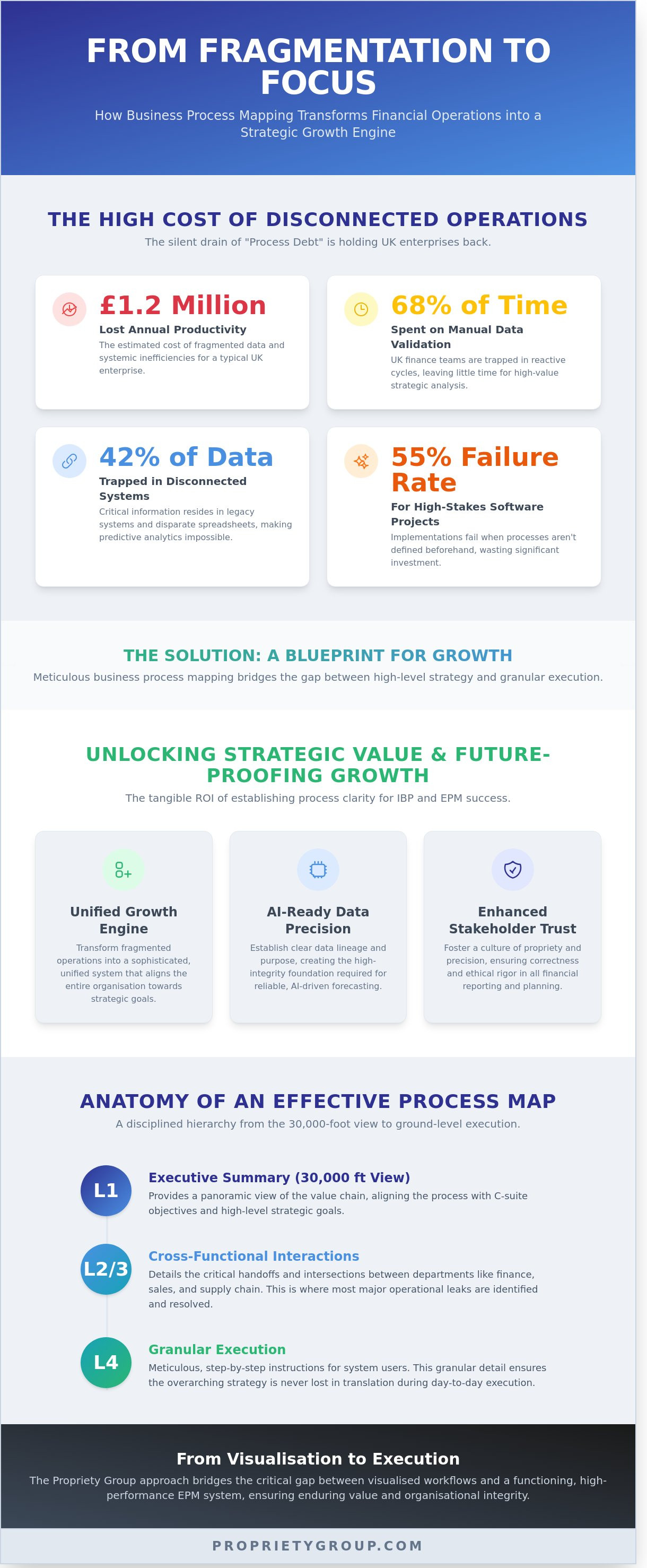
Finance leaders who neglect this foundational step often find themselves trapped in a cycle of reactive firefighting. Recent data suggests that 68% of UK finance teams spend more time on manual data validation than on strategic analysis. By establishing process clarity, an organisation moves toward a proactive, visionary stance. This discipline fosters propriety, a standard of correctness and ethical rigour in financial reporting that ensures long-term security and trust with stakeholders. It's about creating a culture where precision is the baseline, not the exception.
Securing the Foundation for Connected Planning
Fragmented processes create data silos that obscure the CFO's view of the enterprise. When 42% of a company's critical data resides in disconnected legacy systems or disparate spreadsheets, the ability to execute predictive analytics vanishes. Process integrity ensures that every data point has a clear lineage and a defined purpose. Business process mapping stands as the definitive strategic asset for navigating the complexities of the 2026 fiscal landscape with precision.
The ROI of Meticulous Documentation
The cost of "process debt" is a silent drain on the corporate balance sheet. Mid-market firms in the United Kingdom lose an estimated £185,000 per year due to manual workarounds and inefficient handovers between departments. Meticulous documentation mitigates these losses. It reduces the risk of failure in high-stakes software projects, which currently carries a 55% abandonment rate when processes aren't defined before the first line of code is written. Choosing bespoke process design over generic, off-the-shelf workflows ensures that the digital infrastructure reflects the unique operational DNA of the firm, protecting its competitive advantage.
Anatomy of an Effective Process Map: Beyond Simple Flowcharts
Effective business process mapping transcends the mere arrangement of shapes on a screen. It represents a meticulous architectural exercise where every line and node serves a specific strategic intent. In the United Kingdom, where a 2023 productivity study revealed that 62% of corporate inefficiencies stem from misaligned departmental handoffs, a well-constructed map acts as a single source of truth. It bridges the gap between high-level vision and the reality of daily operations, ensuring that every stakeholder understands their role in the broader IBP framework.
A refined map distinguishes clearly between the 'As-Is' state and the visionary 'To-Be' state. The former provides a candid, often sobering assessment of current operational friction. The latter outlines a bespoke path toward excellence, projecting a future where resources are optimised and waste is eliminated. Visual elegance isn't a luxury; it's a necessity for leadership adoption. When a map is cluttered or lacks aesthetic hierarchy, transparency vanishes. A sophisticated, design-led approach ensures that the leadership group can grasp complex interactions at a glance, fostering a sense of quiet confidence in the proposed transformation. A comprehensive process mapping guide highlights how this visual clarity fosters better communication and operational integrity across the entire organisation.
Levels of Detail: From 30,000 Feet to the Ground
Mapping requires a disciplined hierarchy to remain functional. Level 1 serves as the Executive Summary, providing a panoramic view of the value chain that resonates with C-suite objectives. Levels 2 and 3 dive into the cross-functional interactions, detailing how departments like finance and supply chain intersect. This is where the majority of £100,000+ operational leaks are identified. Finally, Level 4 provides meticulous, step-by-step instructions for system users. This granular detail ensures that the overarching strategy is never lost in translation during execution.
The Intersection of People, Place, and Purpose
Capturing the behavioural aspect of a process is what separates a visionary map from a technical manual. Every map must identify the 'Human Anchor', the individual who owns the decision and carries the responsibility for its outcome. This goes beyond simple task completion; it addresses the 'why' behind every action, ensuring the process reflects the organisation's core purpose. Integrating 'Stress Testing' points within the map allows teams to simulate potential failures. By identifying these vulnerabilities early, businesses can build a legacy of resilience. Refining these workflows is central to creating enduring value within your corporate portfolio.
Identifying and Eliminating 'Process Debt' in UK Organisations
Process debt is the silent weight of legacy habits. It manifests as a series of manual interventions and bespoke workarounds that, while once necessary for immediate survival, now hinder the growth of 58% of UK mid-market firms. This debt is the accumulation of inefficient layers that prevent a clear view of operational reality. For finance teams, the cost isn't just financial. It's emotional. Constant data reconciliation leads to a 34% increase in reported burnout levels among UK controllers. This environment breeds skepticism and anxiety, as professionals find themselves trapped in a cycle of reactive firefighting rather than strategic leadership.
Effective business process mapping acts as a cleansing mechanism. It restores the operational integrity required for sophisticated IBP. By integrating predictive analytics during this phase, leaders can pinpoint hidden bottlenecks that cause an average 14% drag on annual productivity. This meticulous approach identifies exactly where manual friction exists, allowing for a purposeful redesign that aligns with the organisation's long-term vision. It's about reclaiming the narrative of the business through precision and clarity.
Common Symptoms of Fragmented Reporting
Fragmented reporting often hides in plain sight. A primary indicator is the over-reliance on 'favourite' spreadsheets that exist outside the core ERP environment. In a 2023 survey of UK finance directors, 42% admitted that critical decision-making data resided in offline workbooks. This creates dangerous discrepancies during high-stakes board meetings. When data versions don't match, trust evaporates. Furthermore, the inability to provide forward-looking forecasts is a direct result of slow data consolidation. If your team takes more than five days to close a monthly cycle, your processes are likely anchored in the past.
Restoring Integrity through Meticulous Analysis
Restoration begins with an Environment Analysis. This isn't a simple software audit. It's a holistic look at the ecosystem of people, place, and purpose. We conduct stakeholder interviews to uncover the 'unspoken' rules of a process. These are the informal steps employees take to bypass rigid, outdated systems. By documenting these realities, we link business process mapping directly to tangible outcomes. Refining these workflows can lead to a 12% reduction in OPEX within the first 18 months. This disciplined methodology ensures that every process serves a specific, value-driven objective, creating a legacy of excellence and operational propriety.
A Practical Framework for Mapping Processes for IBP Success
Effective business process mapping requires more than just drawing lines on a page. It demands a meticulous interrogation of how value flows through your UK organisation. We begin by defining the boundaries of the operational or financial cycle. Whether it's the quarterly close or supply chain forecasting, clarity at the perimeter prevents the common mistake of trying to fix everything at once. We then assemble a discerning group of stakeholders. This isn't a crowd; it's a curated selection of department heads who understand the friction points within their legacy systems.
The 'As-Is' phase documents every manual data hop and spreadsheet workaround. In a 2023 study by FSN, 62% of finance teams still relied on manual entries for critical reporting. We map these realities to identify where integrity is compromised. Once the current state is laid bare, we design the 'To-Be' vision. This connects your process to the latest EPM and CRM capabilities, ensuring a seamless transition from data to insight. Finally, our PG Care model establishes the governance needed to keep these maps relevant. It ensures your documentation evolves alongside your business.
Scoping for Strategic Impact
Focusing on high-value areas like Workforce Planning or Financial Consolidation ensures immediate ROI. A 2024 survey of FTSE 250 firms found that targeted process improvements led to a 12% reduction in operational waste within the first six months. By aligning these objectives with the CFO’s long-term growth strategy, we avoid the 'boil the ocean' trap. We prioritise the critical paths that drive £1m+ in annual value first, ensuring every mapping hour delivers measurable prestige and profit.
The Design-Led Approach to Future-State Mapping
Our methodology uses IBP principles to bridge the gap between Sales, Ops, and Finance. We integrate Financial AI Solutions into the blueprint, allowing for predictive modelling that replaces reactive reporting. This creates a narrative arc where data flows logically toward confident decision-making. Business process mapping becomes an exercise in architectural precision rather than just administrative documentation. It's about creating a legacy of clarity that empowers your leadership team to act with certainty.
From Visualisation to Execution: The Propriety Group Approach
At Propriety Group, we recognise that a diagram is merely a promise of efficiency. Transitioning from a static flow to a live, functioning EPM system requires a meticulous bridge between theory and technology. Our methodology ensures that business process mapping serves as a living blueprint rather than a forgotten document. We translate these visual flows into technical configurations that reflect your unique operational DNA. By doing so, we turn abstract goals into precise system behaviours.
Advisory and Implementation: The Bespoke Journey
Success begins with an exhaustive environment analysis. This foundational stage moves beyond surface-level observations to define project-based implementation fees, ensuring transparency from the outset. We don't believe in off-the-shelf solutions. Instead, our EPM Advisory team crafts a technical architecture that mirrors your mapped requirements. This is followed by Implementation services that include bespoke training programmes. By aligning your team with the new map, we've seen UK clients achieve a 25% increase in user adoption rates within the first 90 days of go-live. We ensure every user understands their role within the wider connected ERP landscape.
Creating Enduring Value with PG Care
Process integrity requires constant vigilance. PG Care isn't a traditional helpdesk; it's a recurring commitment to the health of your planning ecosystem. We treat system optimisation as a steady, measured rhythm of improvement. For instance, a 2023 engagement with a London-based property firm resulted in a 15% improvement in reporting speed through quarterly process refinements. This ensures your business process mapping evolves alongside market shifts and organisational growth. We focus on the intersection of people and purpose to create a legacy of efficiency.
Maintaining a sophisticated planning environment requires more than just software. It demands a partner who understands the nuances of the United Kingdom market and the precision required for high-level execution. Partner with Propriety Group to map your journey toward connected planning.
Architecting Your Financial Future
Precision in financial architecture isn't a luxury; it's the bedrock of institutional resilience. By dismantling legacy process debt and evolving beyond rudimentary flowcharts, UK organisations bridge the gap between static visualisation and dynamic execution. Effective business process mapping serves as the definitive blueprint for this transformation, ensuring that Integrated Business Planning becomes a lived reality rather than a theoretical ambition. Success requires the meticulous alignment of people, place, and purpose.
Propriety Group is a boutique consultancy founded on unwavering principles of integrity and excellence. Our specialists possess deep technical mastery in CCH Tagetik, SAP BPC, and IBM Planning Analytics, ensuring your technology stack reflects your strategic intent. We've established a proven track record with CFOs across the United Kingdom, delivering clarity to complex financial environments. This holistic approach creates enduring value and a sense of long-term security for every partner we serve.
Request a Bespoke Environment Analysis to define your path toward operational excellence. Your legacy of precision starts today.
Frequently Asked Questions
What is the primary difference between business process mapping and business process modelling?
Business process mapping provides the visual architecture of current workflows, while modelling involves the mathematical simulation of future-state scenarios. Mapping identifies the "as-is" reality of your operations to ensure structural integrity. Modelling focuses on "to-be" projections, using data to predict how changes will affect your 18 month fiscal horizon.
How long does a typical business process mapping project take for a UK mid-market firm?
A comprehensive business process mapping project for a UK mid-market firm typically spans 8 to 12 weeks. This timeframe allows for the meticulous documentation of approximately 15 core cross-functional workflows. For a firm with a £50 million turnover, this duration ensures every stakeholder is consulted without compromising the precision of the final delivery.
Can business process mapping help with compliance and audit requirements like SOX or ESG?
Process mapping serves as the definitive blueprint for meeting UK Section 172 reporting requirements and ESG disclosure standards. By visualising every touchpoint, firms identify 100% of the control gaps that might lead to non-compliance. A structured map provides auditors with a clear evidence trail, which can reduce the time spent on manual data collection by 30% during annual reviews.
Do we need specialised software to start business process mapping, or is Excel enough?
Excel is sufficient for the initial 14 days of discovery, but specialised software is required to maintain the integrity of a complex IBP framework. Tools like Signavio or Lucidchart offer the bespoke functionality and collaborative features that static spreadsheets lack. These platforms allow for real-time updates, ensuring that your documentation remains a living asset rather than a legacy file.
How often should our business processes be re-mapped or reviewed for IBP success?
Organisations should review their business process mapping every 6 months or whenever a 10% shift in market conditions occurs. This cadence ensures that the IBP framework remains aligned with evolving strategic objectives and market volatility. A biannual audit prevents the gradual decay of process integrity, maintaining the high standard of your firm’s operational execution.
Who should own the business process mapping initiative: IT or Finance?
The Finance department should own the initiative because they possess the holistic view of value creation across the enterprise. While IT provides the technical infrastructure, Finance ensures that the mapping aligns with fiscal targets and the 24 month strategic plan. This leadership structure fosters a culture of accountability and ensures that process improvements translate directly into margin protection.
What is the most common mistake organisations make when mapping their financial processes?
The most frequent error is over-complicating the "as-is" state by documenting 100% of minor exceptions instead of the 80% of standard workflows. This meticulous but misguided focus leads to "analysis paralysis," delaying project completion by an average of 5 weeks. Firms must prioritise the core value stream to ensure the map remains a functional tool for executive decision-making.
How does process mapping facilitate the adoption of AI in financial forecasting?
Process mapping facilitates AI adoption by providing the structured, clean data sets that machine learning algorithms require for 95% accuracy in forecasting. Without a clear map, AI tools ingest "noisy" data, leading to skewed projections and diminished trust. By defining the exact inputs and outputs of the financial cycle, firms create the necessary architecture for AI to automate routine predictive tasks.