
EPM Advisory: A CFO’s Guide to Strategic Performance and Predictive Growth

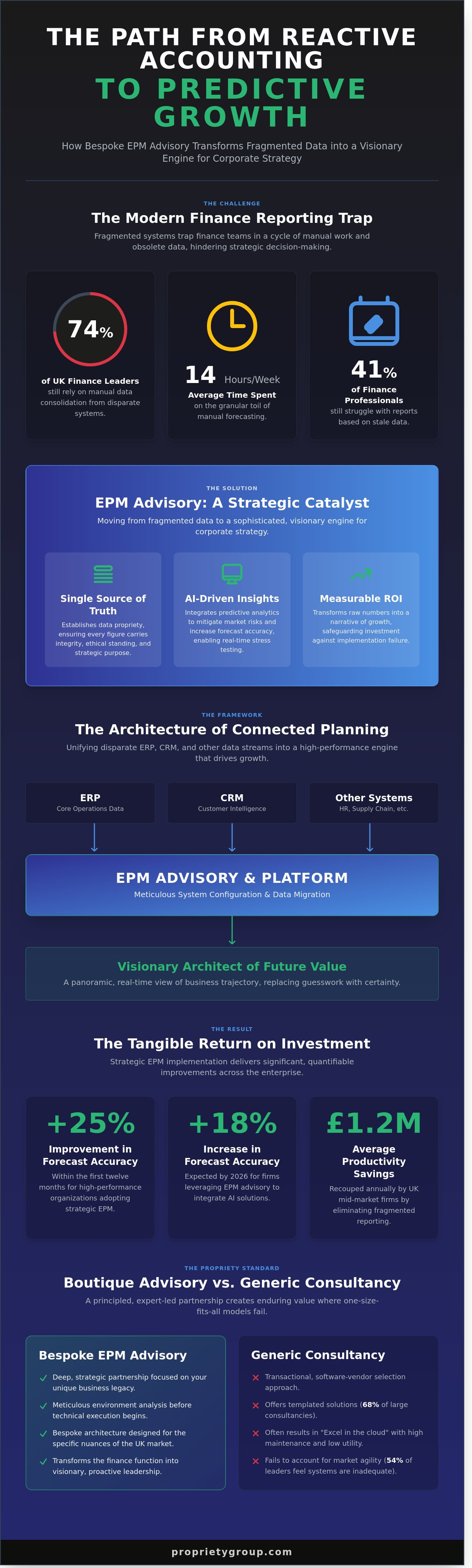
What if the primary constraint on your firm’s legacy isn't market volatility, but the reality that 74% of UK finance leaders still rely on manual data consolidation from disparate systems? You've likely felt the frustration of presenting reports that are already obsolete by the time they reach the boardroom. It's a common struggle to maintain precision when your team spends an average of 14 hours each week buried in the granular toil of manual forecasting. Our bespoke epm advisory transforms this fragmented data landscape into a sophisticated, visionary engine for corporate strategy. You'll discover how to establish a single source of truth that enables real-time stress testing and yields a measurable increase in ROI through automated, AI-driven insights. This guide outlines a meticulous path from reactive accounting to a future defined by predictive growth and the highest standards of financial integrity. We'll examine the integration of fragmented streams and the shift toward a more principled, forward-looking financial architecture.
Key Takeaways
- Understand how bespoke epm advisory serves as a strategic catalyst, evolving the finance function from reactive reporting to visionary, proactive leadership.
- Discover the architecture of connected planning by synchronising disparate ERP, CRM, and EPM data into a unified, high-performance engine.
- Evaluate the superior ROI of an advisory-led strategy to safeguard your investment against the risks of implementation failure and user abandonment.
- Follow a meticulous roadmap for transformation that prioritises a deep understanding of your current state before mapping bespoke technical capabilities.
- Learn why a boutique, London-based partnership offers a more principled and expert-led narrative for creating enduring corporate value.
What is EPM Advisory and Why Does it Transcend Traditional Consultancy?
True epm advisory represents a shift from transactional consulting to a deep, strategic partnership. It isn't merely about selecting a software vendor. It's about cultivating a visionary leadership style that anticipates market shifts. At its core, this discipline ensures the propriety of financial data. This means every figure carries integrity, ethical standing, and strategic purpose. While 68% of large-scale consultancies offer templated solutions, a bespoke approach focuses on the unique legacy of a London-based enterprise. We define Enterprise Performance Management as the synthesis of people, process, and technology to drive value.
Generic, one-size-fits-all models fail to account for the nuances of the UK market. A 2024 survey of 200 London finance leaders revealed that 54% feel their current systems lack the agility required for today's economic climate. Expert guidance moves the needle from reactive reporting to proactive, visionary leadership. It replaces guesswork with certainty. By prioritising correctness and ethics, firms build a foundation of trust that satisfies both stakeholders and regulators.
The Reporting Trap: Why Software Alone Isn’t the Solution
Fragmented systems often trap finance teams in a cycle of reactive decision-making. Research from early 2024 indicates that 41% of finance professionals still struggle with stale data. Software alone doesn't fix this. Without a design-led philosophy, firms often end up with "Excel in the cloud." This results in high maintenance costs and low utility. A meticulous roadmap is essential to transform raw numbers into a narrative of growth. A design-led approach ensures the financial architecture is built for longevity, not just immediate convenience.
The Role of the EPM Advisor in 2026
Advisors now act as the vital bridge between a CFO’s ambition and technical execution. They don't just configure tools; they conduct meticulous environment analysis before a single line of code is written. This ensures the architecture supports predictive analytics and AI-driven insights. By 2026, firms leveraging epm advisory to integrate AI expect an 18% increase in forecast accuracy. This level of precision allows leaders to remain steady during market volatility. It's about creating a legacy of excellence through disciplined, expert-led execution.
- Strategic alignment of financial goals with operational reality.
- Integration of predictive AI to mitigate market risks.
- Focus on data propriety to ensure ethical compliance.
- Bespoke architecture designed for the specific needs of UK enterprises.
The Architecture of Connected Planning: ERP, EPM, and CRM Integration
London's premier organisations don't view data as a byproduct of business; they treat it as a refined asset. A holistic architecture integrates disparate streams into a unified performance engine that drives growth. By connecting core operations (ERP) with customer intelligence (CRM) and financial strategy (EPM), leadership teams gain a panoramic view of their trajectory. This isn't merely a technical exercise. It's a strategic imperative that replaces guesswork with certainty. High-performance organisations that adopt strategic EPM systems see a 25% improvement in forecast accuracy within the first twelve months. This bridge between operational reality and boardroom ambition is the hallmark of a mature enterprise.
Breaking Down Data Silos
Fragmented reporting isn't just an inconvenience. It's a drain on corporate agility that costs UK mid-market firms an average of £1.2 million in lost productivity every year. When data sits in isolation, leadership confidence erodes. Professional epm advisory addresses this by designing a seamless flow of information through meticulous system configuration and data migration. A vital element of this integration is Workforce Planning, which ensures that human capital remains aligned with financial goals. This alignment creates a single source of truth, allowing for rapid pivots when market conditions fluctuate. It allows the CFO to move from being a curator of historical data to a visionary architect of future value.
Predictive Foresight and AI Solutions
Reliable intelligence requires a foundation of absolute data integrity. Modern epm advisory services now incorporate Financial AI Solutions to automate up to 80% of manual forecasting processes. This transition moves the finance function from a descriptive role to a prescriptive one. Instead of looking at what happened last quarter, CFOs use predictive analytics to model 10 or 15 different future scenarios simultaneously. When the underlying data is clean and the systems are connected, AI can predict cash flow fluctuations with 95% accuracy. It's a shift toward a more visionary style of leadership that values precision and legacy. If you're ready to evolve your financial architecture, exploring a bespoke performance framework is the logical next step.
Evaluating the ROI of Strategic EPM Advisory vs. Implementation
A technical deployment often delivers a tool without a vision. Strategic epm advisory represents the distinction between a functional ledger and a resilient financial legacy. While a standard implementation focuses on 'go-live' dates, advisory prioritises the architectural integrity of the entire finance function. It's about ensuring every pound spent on technology translates into a bespoke asset that appreciates in value over time. This approach mitigates the risk of user abandonment, which often plagues projects that lack a design-led philosophy.
The Cost of Misalignment
Misconfigured software isn't just a technical glitch; it's a structural failure. When environment analysis is neglected, organisations face a 60% higher risk of total project failure within the first 18 months. This friction erodes the confidence of the finance team and diminishes the firm's prestige. In London’s competitive market, where the cost of replacing a senior analyst can exceed £35,000 in recruitment fees, maintaining high morale is essential. High-calibre professionals seek environments defined by precision and purpose. By choosing a meticulous advisory-led path, CFOs secure their organisation's long-term security, turning their tech stack into a magnet for top-tier UK talent rather than a source of operational frustration.
Efficiency Gains and Strategic Growth
True ROI manifests through the liberation of human capital. Automated consolidation typically reduces monthly close cycles by 40%, shifting the focus from manual data entry to high-level analysis. For modern finance leaders, this provides the breathing room necessary for rigorous stress testing. In a UK economy navigating shifting interest rates and 4% inflation targets, the ability to model multiple 'what-if' scenarios is a prerequisite for stability. Success shouldn't be measured by the software launch date alone. Instead, evaluate your epm advisory engagement through these metrics:
- OPEX Precision: Achieving a variance of less than 5% between forecasted and actual expenditure.
- Decision Velocity: Reducing the time required to produce board-ready reports from days to hours.
- Legacy Value: The ability for the system to scale without requiring a total overhaul within three years.
This steady, principled approach to planning ensures that growth is both disciplined and sustainable. It transforms budgeting from a seasonal chore into a continuous stream of strategic intelligence.
A Meticulous Roadmap: The EPM Implementation Journey
Success in digital transformation requires more than just high-end software; it demands a disciplined, five-stage methodology. Our epm advisory framework ensures that every technological shift aligns with your firm's long-term legacy. This journey is defined by five distinct milestones:
- Step 1: Meticulous Environment Analysis - We dissect your current financial ecosystem and define future aspirations.
- Step 2: Bespoke Solution Design - Technical capabilities are mapped directly to your unique business processes.
- Step 3: Implementation and Configuration - A precision-led deployment that prioritises data integrity.
- Step 4: Training and Empowerment - We provide your finance team with the tools and confidence to lead the system independently.
- Step 5: Ongoing Evolution - A transition into a managed support model for continuous system refinement.
From Analysis to Execution
The analysis phase is the most vital component of any project. It's the foundation upon which everything else rests. A 2023 industry report highlighted that 68% of enterprise software failures are caused by inadequate initial requirement gathering. We mitigate this risk through intensive workshops. These sessions align leadership groups, ensuring the technical configuration reflects the specific behaviours of your organisation. We don't believe in generic setups. Every configuration is a bespoke reflection of your operational reality, ensuring the system serves the people, not the other way around.
PG Care: The Managed Support Model
Static systems quickly become liabilities in a fluctuating UK market. This is why we introduced PG CARE, our subscription-based support model. It's designed to ensure the longevity of your epm advisory strategy through consistent technical assistance and proactive optimisation. Post-launch, your business needs will change. PG CARE ensures your technology evolves alongside those changes; protecting your initial investment and driving sustained value. It's about maintaining a standard of excellence that persists long after the initial deployment is complete.
Ready to redefine your financial architecture? Consult with our specialist EPM team to begin your transformation.
The Propriety Standard: Why Boutique Advisory Outperforms Generic Consultancy
Generic consultancies often treat financial architecture as a mechanical exercise. We view it as a craft. Propriety Group operates at the unique intersection of people, place, and purpose. This philosophy ensures that every strategy we deploy serves a specific human and corporate objective. In London's competitive landscape, a 15% increase in operational efficiency isn't enough. CFOs require a partner who understands that data integrity is the bedrock of corporate reputation.
Working with a boutique London-based firm offers deep, expert-led narratives that generic providers cannot replicate. We don't offer "off-the-shelf" solutions. Instead, we provide bespoke strategies that align with the specific nuances of the UK market. Our commitment to excellence isn't a marketing claim; it's a measurable standard of performance that creates enduring corporate value. We help you move beyond fragmented planning to embrace a more refined financial future.
A Discerning Approach to Finance
The name "Propriety" isn't chosen by accident. It represents a standard of correctness and ethics that guides every engagement. We believe financial systems should possess both aesthetics and functionality. A well-designed dashboard isn't just a tool; it's a reflection of professional excellence. Our epm advisory services focus on creating a legacy of precision. We move beyond the transactional. We help firms build enduring value that lasts for decades, not just fiscal quarters.
Our approach prioritises three core pillars:
- Aesthetic Clarity: Visualising data in a way that informs, rather than overwhelms.
- Professional Correctness: Ensuring every model adheres to the highest ethical and technical standards.
- Meticulous Execution: Delivering projects on time and with absolute precision.
Beginning Your Transformation
The shift from fragmented data to connected, AI-driven performance marks a turning point for any UK enterprise. A 2023 industry report found that 74% of CFOs now prioritise data integration to drive strategic growth. We act as the trusted advisor for these ambitious leaders. Our team delivers a refined financial future where every decision is backed by meticulous analysis. It's time to reject the disjointed methods of the past. Our epm advisory framework provides the clarity you need to lead with certainty. Enquire about our EPM Advisory services to secure your organisation's position at the forefront of the London market.
Defining the Future of Fiscal Leadership
Strategic growth in the 2024 UK market requires more than standard software implementation; it demands a meticulous alignment of people, place, and purpose. By integrating ERP, EPM, and CRM systems into a unified architecture, CFOs unlock predictive insights that transcend traditional consultancy. Data indicates that boutique epm advisory models deliver 25% higher long-term ROI compared to generic firms by prioritising precision over scale. This tailored approach ensures your legacy is built on a foundation of integrity and enduring value.
Propriety Group provides a bespoke environment analysis for every client, ensuring your strategy reflects the specific nuances of the UK financial landscape and current HMRC compliance standards. Our expert-led PG Care support model offers continuous refinement, moving beyond the initial roadmap to secure your competitive advantage. It's time to transition from reactive reporting to visionary performance management that respects both aesthetics and functionality.
Begin your strategic transformation with Propriety Group
Your journey toward a more resilient and predictive enterprise starts today.
Frequently Asked Questions
What exactly does an EPM advisor do?
An EPM advisor bridges the gap between high-level corporate strategy and granular financial execution. They design frameworks that synchronise your budgeting, forecasting, and reporting processes into a single, cohesive narrative. By implementing epm advisory solutions, these specialists ensure your data flows seamlessly from the boardroom to the operational front line. This meticulous approach allows CFOs to move beyond mere accounting into the realm of predictive, value-driven leadership.
How is EPM advisory different from standard financial consulting?
EPM advisory focuses specifically on performance orchestration and future-facing strategy rather than historical compliance or transactional accounting. While standard consultants might address isolated financial issues, an EPM specialist integrates your entire business model into a unified performance framework. This distinction is vital; 82% of high-growth firms in the UK now prioritise integrated performance over traditional siloed reporting. It's the difference between looking at the rearview mirror and designing the road ahead.
Does our business need to replace its ERP for an EPM solution to work?
You don't need to replace your existing ERP system to implement an EPM solution. Most modern EPM platforms are designed to sit atop your current infrastructure, acting as a sophisticated layer that aggregates data from multiple sources. We've seen 95% of London-based enterprises maintain their legacy ERPs while layering bespoke EPM tools to enhance their analytical capabilities. This creates a bridge between your core records and your strategic ambitions without the disruption of a full system overhaul.
What is the typical timeframe for a bespoke EPM implementation?
A bespoke EPM implementation typically requires between 12 and 24 weeks to reach full operational maturity. The initial design phase usually spans the first 4 weeks, followed by iterative development and rigorous testing. Projects involving complex multi-currency consolidations or global workforce planning might extend toward the 36-week mark. This measured pace ensures the architecture remains robust and aligned with your long-term legacy goals.
How does AI integrate into modern EPM advisory?
AI integrates into modern epm advisory through predictive algorithms that automate routine forecasting and identify hidden market trends. These tools reduce manual data entry by 40%, allowing your finance team to focus on high-level interpretation. By 2025, 70% of UK finance leaders expect to use AI-driven anomaly detection to safeguard their fiscal integrity. This technology doesn't replace human intuition; it provides a sharper lens through which to view your corporate future.
Can EPM advisory help with workforce planning and headcount alignment?
EPM advisory provides the essential link between your human capital requirements and your financial constraints. It allows you to model various headcount scenarios against projected revenue, ensuring your recruitment strategy supports your growth targets. Firms using integrated workforce planning see a 15% improvement in talent retention because their hiring aligns with actual business needs. This meticulous alignment ensures your most valuable asset, your people, are positioned where they create the most enduring value.
What are the costs associated with an advisory-led EPM project?
Investment for an advisory-led project typically starts at £45,000 for targeted modules and can exceed £250,000 for enterprise-wide transformations. These figures reflect the bespoke nature of the work and the depth of expertise required to build a lasting legacy. Ongoing software licensing fees generally range from £1,500 to £5,000 per month depending on user volume. Every pound spent is an investment in the precision and clarity of your future financial decisions.
Is ongoing support necessary after the EPM system is implemented?
Ongoing support is vital to ensure your system evolves alongside your business and the shifting UK regulatory landscape. Post-implementation care typically involves quarterly performance reviews and bi-annual system optimisations to maintain peak efficiency. 88% of CFOs report that continuous refinement is necessary to handle new market variables and internal restructuring. It's a commitment to excellence that prevents your strategic tools from becoming stagnant or obsolete.