

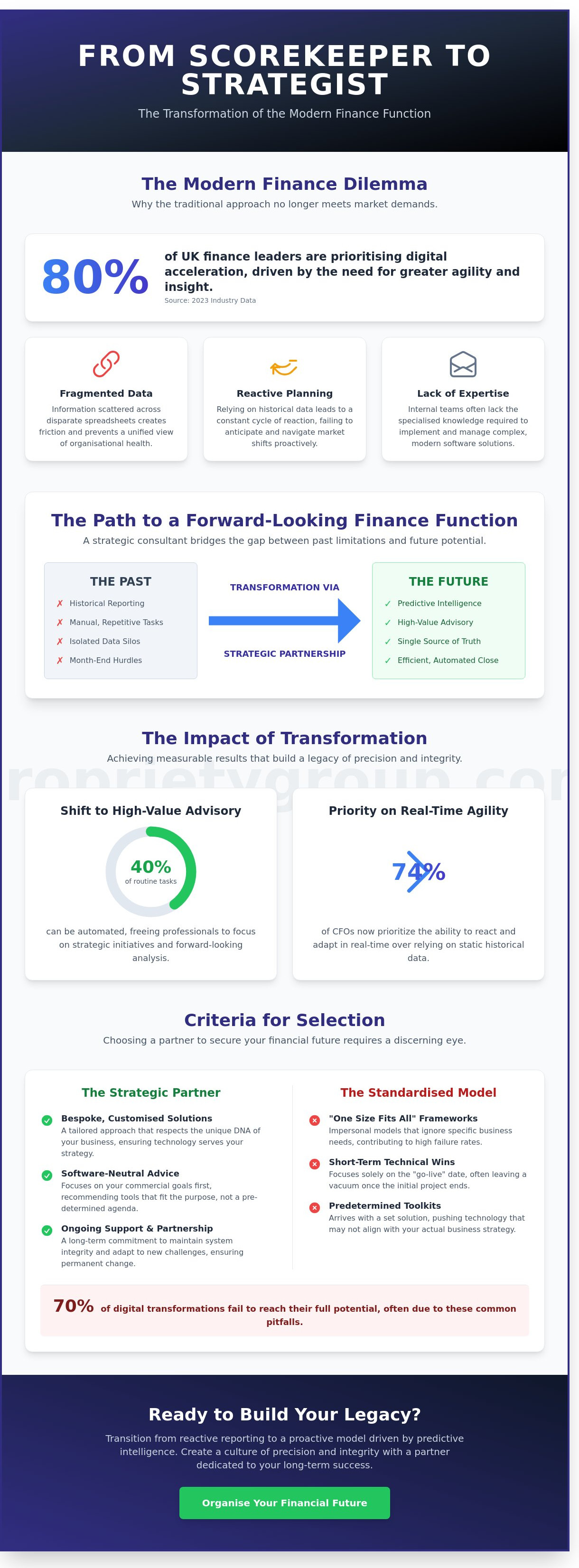
What if the traditional month-end close became a relic of the past rather than a monthly hurdle? In a market where 80% of UK finance leaders are prioritising digital acceleration according to 2023 industry data, the role of a finance transformation consultant has moved from a luxury to a strategic necessity. You likely feel the strain of fragmented data scattered across disparate spreadsheets and the frustration of reactive planning that fails to anticipate sudden market shifts. It's a common challenge that often stems from a lack of internal expertise to implement complex software solutions.
Propriety Group facilitates this transition through bespoke EPM and CRM implementation, tailored to the specific demands of the UK market. As you refine your CRM strategy, you may also wish to learn more about Customer Service Support to ensure your front-line teams are as integrated and professional as your back-office systems. We ensure your infrastructure remains robust through our PG Care model, which provides ongoing technical excellence and support. Our approach combines meticulous detail with a visionary outlook, creating a financial ecosystem that stands the test of time. It's an investment in certainty and professional integrity.
We understand that true financial integrity requires more than just balancing the books; it demands a bespoke approach to data that offers total clarity. This guide explores how you can move beyond simple reporting to embrace visionary, AI-driven decision-making. You'll discover how to establish a single source of truth for your financial data and automate your processes to ensure a meticulous, efficient close. We'll outline the precise steps to transition your department into a pillar of strategic value, providing the confidence needed to manage the complexities of 2026.
Key Takeaways
- Understand how a finance transformation consultant serves as a strategic partner to align your technological infrastructure with your long-term business purpose and legacy.
- Learn to identify the meticulous traits of a successful partner, prioritising software-neutral advice and bespoke solutions over rigid, standardised consultancy models.
- Discover the journey from reactive, historical reporting to a proactive model driven by predictive intelligence and visionary decision-making.
- Explore how integrating AI into your financial functions can automate complex forecasts, ensuring your data remains a reliable foundation for growth.
- Gain insight into creating a culture of precision and integrity by shifting from traditional accounting to a forward-looking, strategic evolution.
The Strategic Value of a Finance Transformation Consultant in 2026
A finance transformation consultant acts as a discerning partner, aligning sophisticated technology with a clear business purpose. Traditional accounting no longer sustains competitive growth in a UK market where 74% of CFOs now prioritise real-time agility over historical data. Static spreadsheets and isolated reporting cycles create friction, preventing leaders from seeing the full picture of their organisation's health. In 2026, the role isn't just about digitising old records; it's about reimagining how value is created and measured.
To better understand the complexities of this evolution, watch this analysis of common pitfalls in large-scale changes:
Bridging the gap between isolated data points and a unified vision requires more than just software. It demands a bespoke strategy. Consultants apply Business Process Re-engineering Principles to strip away outdated habits, replacing them with streamlined workflows. This meticulous focus on epm advisory transforms the finance function into a predictive engine. A design-led philosophy ensures that the resulting systems are intuitive, encouraging teams to engage with data rather than avoiding it. When technology is built with people in mind, it fosters a culture of excellence and transparency.
Beyond Process Improvement: The Shift to Advisory
The true impact of a finance transformation consultant is felt when a team stops reacting to the past and starts shaping the future. By automating approximately 40% of routine tasks, professionals can dedicate their time to high-value advisory roles. This shift allows the CFO to lead with quiet confidence, grounding every strategic move in verified, real-time data. It builds a legacy of precision and integrity, ensuring the organisation remains resilient against market shifts while maintaining its commitment to long-term security. Moving from a scorekeeper to a strategic navigator provides the clarity needed to lead with certainty.
Criteria for Selection: Finding a Consultant to Organise Your Financial Future
Selecting a partner to lead your strategic evolution requires a discerning eye for detail and a commitment to long-term value. A successful finance transformation consultant prioritises your legacy over short-term technical wins. This individual must possess a rare blend of meticulous precision and software neutrality. They shouldn't arrive with a predetermined toolkit; instead, they should evaluate your specific needs with a fresh perspective. While large consultancies often rely on standardised, impersonal models, boutique firms offer a bespoke approach that respects the unique DNA of your business. Research from 2023 indicates that 70% of digital transformations fail to reach their full potential, often because they rely on these "one size fits all" frameworks.
True success isn't defined by a software "go-live" date. It's defined by the depth of the implementation and the permanence of the change. A consultant who focuses solely on the technical launch often leaves a vacuum once the initial project ends. To ensure your systems remain robust, you need a model that includes ongoing support. Propriety Group addresses this through PG Care, a dedicated support framework designed to maintain system integrity and adapt to new challenges as they arise. You might consider how a bespoke partnership can provide this level of security and foresight.
Balancing Software Expertise with Business Strategy
A consultant's primary duty is to understand your commercial goals before recommending any specific tool, whether it's an Enterprise Performance Management (EPM) system or a new CRM. Technology must always serve the strategy, never the other way around. By focusing on connected planning, a consultant helps your finance, sales, and operations teams share data in real-time. This approach ensures that every £1 spent on technology creates a ripple effect of efficiency across the entire organisation. It's about creating a unified vision where people, place, and purpose align to drive sustainable growth.
Transitioning to a Forward-Looking Finance Function
The journey from reactive reporting to predictive intelligence marks the final stage of a successful evolution. Traditionally, finance departments spent 80% of their time on historical data entry and manual reconciliation. A finance transformation consultant shifts this balance entirely. By implementing sophisticated systems, teams can focus on what lies ahead rather than merely documenting what has already happened. This shift ensures that the finance function becomes a visionary partner in the organisation's growth.
Establishing a "single source of truth" is the cornerstone of this process. When leadership asks what is a data warehouse, they're essentially seeking a unified view of their financial health. This centralised repository eliminates conflicting data sets. It ensures every department operates from the same figures, creating a foundation of integrity for the firm. The transition provides several key advantages:
- Reduced operational risk through automated validation.
- Improved agility when responding to UK market volatility.
- Enhanced transparency for stakeholders and investors.
- A meticulous approach to long-term legacy planning.
The Impact of Predictive Analytics on Decision-Making
Architecting a Resilient Financial Legacy
Preparing for the economic landscape of 2026 requires a departure from traditional, reactive accounting. A specialist finance transformation consultant acts as the architect of this evolution, replacing fragmented processes with a cohesive strategy that prioritises clarity and precision. By focusing on a design-led philosophy, your organisation can implement sophisticated systems that don't just record data but actually illuminate the path toward long-term growth. This shift ensures your finance function becomes a centre of strategic value rather than a back-office necessity.
Propriety Group facilitates this transition through bespoke EPM and CRM implementation, tailored to the specific demands of the UK market. We ensure your infrastructure remains robust through our PG Care model, which provides ongoing technical excellence and support. Our approach combines meticulous detail with a visionary outlook, creating a financial ecosystem that stands the test of time. It's an investment in certainty and professional integrity.
Partner with Propriety Group to redefine your financial performance
We look forward to helping you build a more transparent and prosperous future for your business.
Frequently Asked Questions
What does a finance transformation consultant actually do on a daily basis?
A finance transformation consultant operates as the architect of your firm's fiscal future, balancing high-level strategy with meticulous execution. On a typical day, they might oversee the migration of legacy data to cloud-based systems or facilitate workshops to align department heads with new regulatory standards. Their work ensures that every process reflects the principles of integrity and precision required for long-term growth.
According to 2024 industry research, 90% of finance leaders are now prioritising AI integration. The consultant manages these complex transitions, ensuring that technological shifts serve the people and purposes of the organisation. They spend time refining bespoke reporting frameworks that turn raw figures into actionable intelligence for the board.
How long does a typical finance transformation programme take to complete?
Most comprehensive programmes require between 12 and 24 months to reach full maturity. This timeline allows for a measured approach, moving through discovery, design, and implementation without compromising the quality of the result. Smaller, targeted interventions might conclude within 6 months, while global structural shifts often extend beyond the two-year mark to ensure a lasting legacy.
Data from recent UK corporate projects suggests that 18 months is the standard duration for a complete ERP system transition. This period includes the vital stabilisation phase, where the consultant monitors the new systems to guarantee they meet the organisation's high standards of correctness. Rushing this process often leads to technical debt, so a steady, rhythmic pace is essential for success.
What are the clear signs that my organisation needs external consultancy?
Your organisation likely needs expert intervention if your month-end closing process consistently exceeds 10 business days. This delay often indicates deep-seated inefficiencies or fragmented data silos that hinder clear decision-making. When manual workarounds become the standard rather than the exception, it's a signal that your existing architecture no longer supports your strategic aspirations.
A 2023 report found that 70% of UK finance teams struggle with disconnected data sources. If your staff spend more time gathering information than analysing it, the need for a finance transformation consultant becomes undeniable. External experts provide the objective perspective required to dismantle these barriers and restore a sense of professional order to your operations.
How do we measure the return on investment for a transformation project?
We measure success through a combination of tangible cost reductions and enhanced operational agility. A primary metric is the reduction in transaction processing costs, where many firms target a 20% improvement within the first year of implementation. You'll also see a marked decrease in reporting errors, which protects the firm's reputation and ensures regulatory compliance.
Beyond the balance sheet, ROI manifests in the reclaimed time of your senior leadership. When automated systems handle routine tasks, your team can focus on bespoke strategy and high-value partnerships. This shift creates enduring value, ensuring the project isn't just a temporary fix but a cornerstone of the company's future security.