
Managing Multi-Currency Financial Reporting: A Strategic Guide for Modern Finance Leaders

Did you know that global foreign exchange markets reached a staggering daily turnover of £7.6 trillion in April 2025? For a UK finance leader, this figure represents more than just market volume; it's a reminder of the constant volatility that can quietly erode your profit margins. You've likely felt the pressure of managing multi-currency financial reporting when manual translations and inconsistent exchange rates delay your month-end close. It's a common struggle to maintain a clear view of performance when your data is scattered across different jurisdictions and denominations.
We believe that international consolidation shouldn't be a technical hurdle, but rather a meticulous design for global clarity. In this guide, you'll learn how to master these complexities and transform fragmented currency data into a unified, strategic asset. We'll examine how the new IFRS 18 standards, effective for periods beginning on 1 January 2027, will reshape your income statements to improve comparability. By moving toward a bespoke, automated approach, you can establish a single source of truth that provides the certainty and integrity your legacy deserves, ensuring your reporting maintains the highest standard of financial propriety.
Key Takeaways
- Learn to distinguish between the money used for daily tasks and the currency required for group presentation to ensure the meticulous integrity of your global records.
- Discover how a structured framework for managing multi-currency financial reporting eliminates errors and provides a single, reliable source of truth for your business.
- Master a clear, step-by-step consolidation process that explains how to apply different exchange rates without getting lost in technical complexity.
- Explore how bespoke EPM technology and financial AI can turn current data into predictive insights for managing cash flows across international borders.
Establishing a Robust Framework for Multi-Currency Financial Reporting
Managing multi-currency financial reporting demands more than just a technical fix; it requires a bespoke architectural foundation that prioritises clarity. This foundation begins with a meticulous understanding of how value is recorded across different borders. When your data is fragmented, you lose the quiet confidence required to lead a global finance function. Every figure must be handled with precision to ensure the final report reflects the true health of the organisation.
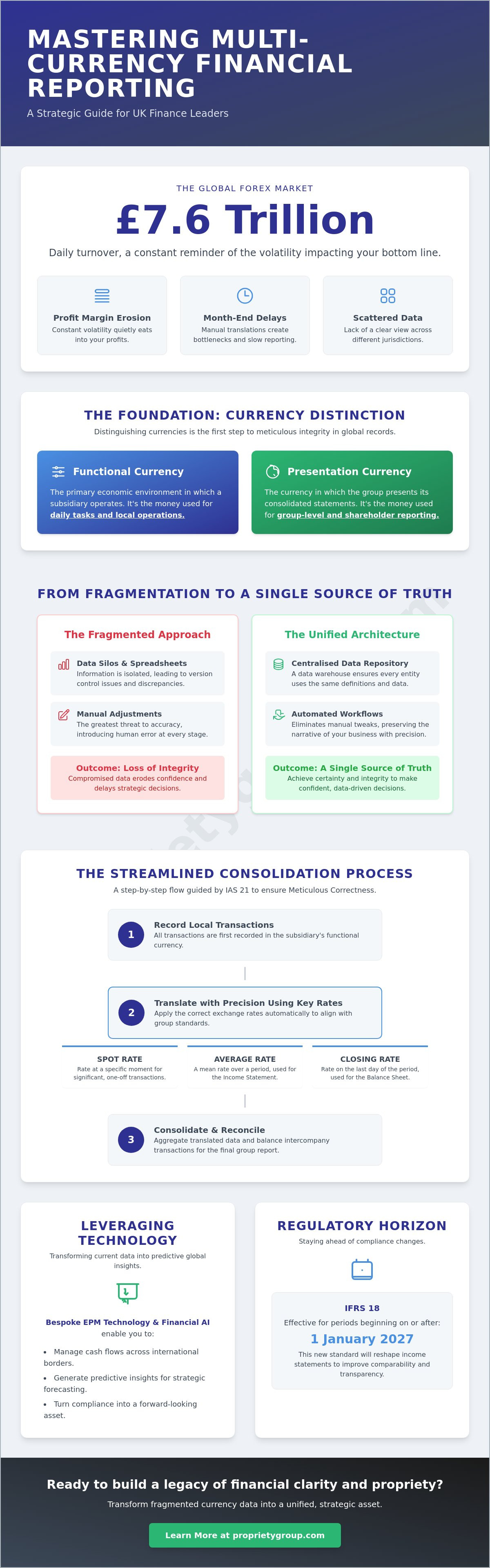
Functional currency is the primary economic environment in which a subsidiary operates. While this is the currency used for daily tasks, the reporting currency is what the group uses to present its final legacy to shareholders. Gaining a deep understanding of this concept through this Functional Currency Explained resource is vital for maintaining the integrity of your books. Without this distinction, your consolidated statements may fail to provide an accurate picture of performance.
To better understand this concept, watch this helpful video:
A fragmented approach to data leads to a "loss of integrity" in global financial statements. When information sits in isolated silos, the risk of error increases, often resulting in reporting delays that can span several days. A unified data architecture serves as the foundation for all international reporting, ensuring that every figure reflects the true state of the business. This approach isn't just about compliance; it's about creating enduring value through transparent communication.
The Architecture of a Single Source of Truth
Manual spreadsheets often create version control issues that compromise your month-end close. A centralised data repository eliminates these discrepancies by ensuring that every entity uses the same data definitions. To understand how this works at a technical level, you can explore our guide on What is a Data Warehouse? to see how unified intelligence supports global growth. This structure provides the certainty needed to make strategic decisions without second-guessing the numbers.
Aligning People, Place, and Purpose in Global Finance
We view financial reporting as a means of connecting global teams through a shared language of value. It's about more than just numbers. It's about ensuring that standards like IFRS 18 are applied with precision across the entire organisation. This alignment creates a sense of trust and long-term security, allowing your team to focus on strategic insights rather than manual adjustments. When purpose and reporting align, the result is a resilient and principled financial legacy.
Streamlining the Translation and Consolidation Process
The path from a local subsidiary’s ledger to a polished group report is a journey that requires absolute precision. Managing multi-currency financial reporting isn't merely about converting numbers; it's about preserving the narrative of your business across different markets. This process follows a logical flow. First, local transactions are recorded in the currency of daily operations. Next, they are translated using specific rates to ensure they align with the group's standards. We look to the International Accounting Standard 21 to maintain this meticulous level of correctness and ethical propriety.
To keep things clear, we use three primary exchange rates. The "spot rate" is the price of a currency at a specific moment. The "average rate" provides a middle ground for income and expenses over a period, such as a month. Finally, the "closing rate" is the value on the last day of the reporting period, typically used for balance sheet items. When these rates aren't applied automatically, teams often resort to manual adjustments. These manual tweaks are the greatest threat to reporting accuracy. They introduce human error and erode the quiet confidence a CFO needs when presenting a legacy of financial health to the board.
Intercompany reconciliation is another vital step in this consolidation. When entities within your group trade with each other, those transactions must balance perfectly. Mismatches in these internal trades create a loss of integrity that can distort your final global statements. Ensuring every internal trade is meticulously balanced is essential for a true reflection of value.
Automating the Translation Mechanism
Modern EPM solutions remove the burden of manual entry by automatically fetching daily exchange rates. This ensures real-time accuracy and maintains balance sheet integrity by automating complex adjustments. You can see how this fits into the broader month-end cycle in our guide to The Modern Financial Close Process. This automation provides the certainty required for high-level strategic concepts.
Managing Foreign Exchange Volatility
Currency volatility is a constant. Rather than just reacting to past events, finance leaders now use scenario modelling to understand how future shifts might impact profitability. This moves the organisation from a reactive state to a proactive management of risk. If you're looking to enhance your global clarity, our bespoke EPM advisory can help you design a more resilient framework for the future.
Leveraging EPM Technology for Predictive Global Insights
The true value of managing multi-currency financial reporting lies in its transition from a retrospective task to a forward-looking strategy. With global foreign exchange markets seeing a daily turnover of £7.6 trillion in April 2025, the scale of data can feel overwhelming without a bespoke architecture. Enterprise Performance Management (EPM) software acts as the bridge, converting raw data into a strategic asset that informs every boardroom decision. By centralising information from various jurisdictions, these platforms provide the clarity needed to navigate global economic uncertainty with quiet confidence. This shift allows the modern CFO to step into the role of a visionary leader, using connected planning to align the organisation’s financial goals with its long-term legacy.
The Role of AI in Multi-Currency Forecasting
Artificial Intelligence enhances this process by identifying subtle patterns in currency fluctuations that human analysis might miss. These insights significantly improve budget accuracy, especially in markets where volatility is the norm. Predictive intelligence allows finance teams to simulate "what-if" scenarios for global market entries, providing a clear view of potential risks before capital is committed. It's a method that replaces guesswork with meticulous data. For those seeking a deeper understanding of these technologies, our guide on AI in Finance explores how intelligent automation creates strategic growth.
Choosing the Right Path for Implementation
Achieving this level of precision requires more than a simple software purchase. A bespoke implementation ensures the technology matches the unique goals and legacy of your organisation. We believe in an advisory-led approach that prioritises long-term system integrity over quick fixes. Our PG Care model offers the ongoing support necessary to adapt as global reporting requirements evolve. This ensures that your reporting standards remain ethical and principled as your business expands. Selecting the right foundation is a critical decision, and our framework for Choosing the Right EPM Platform can help you evaluate your options with meticulous care.
- Strategic Alignment: Ensure your technology reflects your specific business purpose.
- Predictive Power: Use AI to forecast cash flows across multiple jurisdictions.
- Ongoing Integrity: Maintain system accuracy through expert-led support models like PG Care.
Architecting a Resilient Global Legacy
Mastering the art of managing multi-currency financial reporting is a transition from technical complexity to strategic clarity. We've explored how a robust framework and automated translation processes protect the integrity of your global data. By leveraging EPM technology, you move beyond simple historical accounting to achieve predictive insights that secure your organisation's long-term value. This approach ensures your reporting is both compliant and visionary, providing the certainty required to lead with quiet confidence.
At Propriety Group, we specialise in solving these complex CFO-level challenges through expert-led advisory and meticulous implementation. As specialists in SAP Analytics Cloud and Board EPM, we ensure your systems match your unique goals and legacy. Our PG Care model provides the ongoing support needed to maintain this standard of excellence as global regulations and market conditions shift. Discover how Propriety Group transforms global reporting through bespoke EPM Advisory. You have the tools to turn fragmented data into a source of enduring strength and global prosperity.
Frequently Asked Questions
What is the difference between functional and reporting currency?
Functional currency is the money used in the primary economic environment where a subsidiary operates daily. Reporting currency is the specific denomination used to present the final consolidated financial statements to shareholders and regulators. Maintaining this distinction is vital for the integrity of your books. For instance, a UK subsidiary might handle its daily operations in British Pounds while its parent group requires reports in another currency for global presentation.
How often should exchange rates be updated in a multi-currency reporting system?
Exchange rates should be updated daily through an automated feed to ensure the highest level of precision in your data. While some organisations still use monthly averages, the volatility in global markets makes real-time updates essential for managing multi-currency financial reporting accurately. This practice provides the quiet confidence needed to make strategic decisions based on the most current and meticulous financial information available.
What are the main challenges of consolidating financial statements with different currencies?
The primary hurdles include navigating fluctuating exchange rates and the high risk of human error during manual translation tasks. Fragmented data often results in a slow month-end close and a lack of visibility into how currency shifts impact the bottom line. Overcoming these challenges requires a move toward automated systems that can transform disparate figures into a single, unified source of truth for the entire organisation.
Can EPM software automate intercompany eliminations in multiple currencies?
Modern EPM software is specifically designed to automate intercompany eliminations across various currencies with meticulous accuracy. These systems ensure that internal trades between subsidiaries balance perfectly by applying the correct rates at the moment of consolidation. This automation removes the burden of manual adjustments from your finance team. It secures the long-term integrity of your financial legacy and ensures every internal transaction is handled with propriety.