
Intercompany Reconciliation Best Practices: A Strategic Guide for 2026

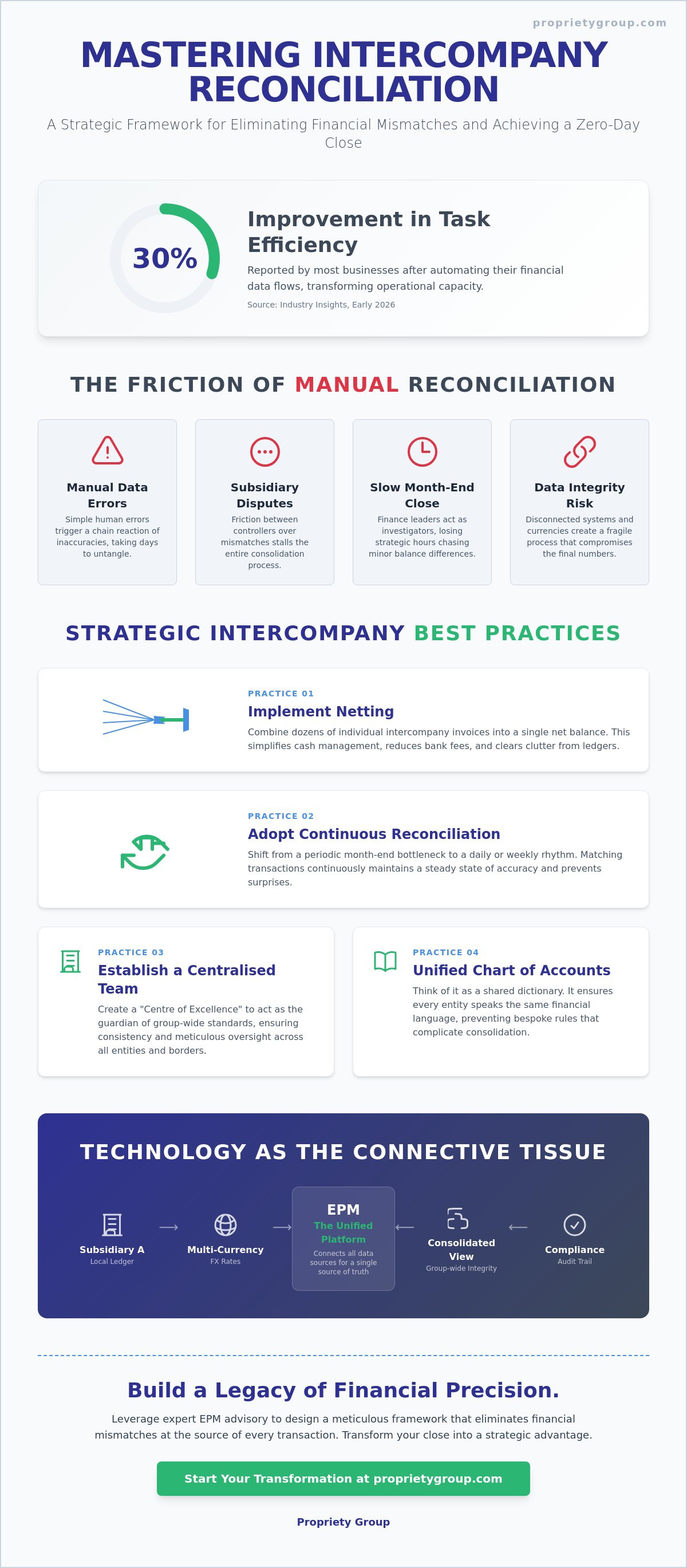
Most businesses report a 30% improvement in task efficiency after automating their financial data flows, according to industry insights from early 2026. This shift is essential because the traditional approach to managing internal transactions often feels like a race against time. You likely recognize the frustration of manual data entry errors or the friction of disputes between subsidiary controllers that stretch into the early hours of the morning. These challenges don't just slow down your month-end close; they compromise the integrity of your group-wide financial story. Achieving a zero-day close requires more than just effort. It demands a meticulous framework that treats data as a pillar of long-term security.
In this guide, you'll master the intercompany reconciliation best practices needed to eliminate financial mismatches and build a legacy of precision across every legal entity. We'll explore how a unified approach to Enterprise Performance Management creates a sense of propriety in your reporting, ensuring that multi-currency transactions are handled with quiet confidence. You'll gain a clear roadmap for establishing standardized policies and centralized oversight that transform your financial close from a recurring burden into a streamlined, strategic advantage.
Key Takeaways
- Identify the root causes of friction between subsidiary entities to prevent reporting delays and ensure total data integrity.
- Implement intercompany reconciliation best practices like netting to combine several invoices into one payment for a simpler internal cash flow.
- Utilize EPM technology as the essential connective tissue that aligns information across all your separate accounting platforms.
- Leverage expert EPM advisory to design a meticulous framework that eliminates financial mismatches at the source of every transaction.
The Structural Challenges of Intercompany Reconciliation in Multi-Entity Groups
Managing transactions between entities under one parent company often creates friction because each unit operates as its own world. When these entities exchange goods or services, they record the details in their own ledgers. To understand the foundation of these internal movements, one might ask, What is Intercompany Accounting? and how it serves as the basis for group-wide reporting. Without a unified vision, these individual records rarely align perfectly on the first try. This friction isn't just a minor annoyance; it's a structural barrier to financial clarity.
This misalignment creates the "mismatch" problem. If Subsidiary A records a sale at one value while Subsidiary B records the purchase at another, the entire consolidation process stalls. These discrepancies often stem from disconnected accounting systems that don't share the same data language. Within the modern financial close process, these gaps represent a risk to the integrity of the final balance sheet. To better understand how these entries impact your books, watch this helpful video:
The Hidden Costs of Manual Data Handling
Relying on spreadsheets makes your financial operations fragile. Simple human errors in data entry can trigger a chain reaction of inaccuracies that take days to untangle. Senior finance leaders often find themselves acting as investigators rather than strategists. They lose hours chasing minor balance differences across rows of static data. This manual effort is a significant drain on resources, especially when intercompany reconciliation best practices suggest that automation could recover much of this lost time.
Multi-Currency and Regulatory Complexities
Cross-border transactions add layers of difficulty through fluctuating exchange rates. A value recorded on Monday might shift by Friday, making a perfect match a moving target. Maintaining a meticulous audit trail is essential for satisfying international tax standards and local regulations. Without a clear record, your firm faces increased audit risks and potential compliance failures. Adopting intercompany reconciliation best practices ensures that every transaction remains transparent, regardless of the currency or jurisdiction involved.
Strategic Intercompany Reconciliation Best Practices for Finance Leaders
Standardisation serves as the cornerstone for any multi-entity group aiming for financial integrity. Without a common foundation, the group close becomes a chaotic scramble rather than a deliberate process. One highly effective strategy is "netting." Instead of settling dozens of individual invoices between Subsidiary A and Subsidiary B, you consolidate them into a single net balance. This reduces bank fees and simplifies cash management across the entire group. It's a simple way to clear the clutter from your ledgers.
Shifting from periodic to continuous reconciliation prevents the common month-end bottleneck. By matching transactions daily or weekly, teams maintain a steady rhythm of accuracy. Establishing a centralised team ensures that group-wide standards are upheld with meticulous care. This "Centre of Excellence" acts as the guardian of your financial legacy, ensuring consistency across every border. You can find deeper insights into these frameworks in the Intercompany Accounting Best Practices outlined by industry leaders. Adopting these intercompany reconciliation best practices creates a culture of transparency and accountability.
Implementing a Unified Chart of Accounts
Think of a unified chart of accounts as a shared dictionary. It ensures that every entity uses the same codes for the same types of transactions. This prevents subsidiaries from creating their own "bespoke" accounting rules that confuse the parent company and complicate consolidation. When everyone speaks the same financial language, the data flows with much higher precision. This alignment is vital for those seeking a sophisticated approach to group reporting.
Establishing a Clear Dispute Resolution Framework
When balances don't match, a clear path forward is vital. Most successful finance teams follow a simple three-step guide to maintain momentum:
- Identify: Pinpoint the exact transaction causing the gap through automated matching.
- Escalate: Notify the relevant controllers if the difference exceeds a set limit.
- Resolve: Correct the entry in the source system immediately to prevent future errors.
Setting "materiality thresholds" is equally important. For example, ignoring discrepancies under $500 can save hours of investigative work. This focus on what truly matters helps maintain the speed of your intercompany reconciliation best practices without sacrificing the quality of your reports.
Leveraging EPM Technology to Optimise Intercompany Workflows
Enterprise Performance Management (EPM) acts as the essential connective tissue sitting above your various accounting systems. While individual ledgers record local activity, EPM looks across the entire group to ensure harmony. Through EPM advisory, organisations can design frameworks that eliminate discrepancies before they even enter the ledger. This proactive stance moves your team away from simply fixing errors toward a state of constant, quiet confidence in your data.
Establishing a "Single Source of Truth" ensures that every stakeholder sees the same data in real-time. This visibility is central to modern Intercompany Accounting Best Practices, as it removes the silos that often lead to internal disputes. When data is unified, finance teams are no longer burdened by repetitive manual tasks. They're empowered to focus on strategic growth and the long-term security of the business. Transitioning to automated software isn't just about speed; it's about elevating the role of the finance professional.
The Role of AI and Predictive Analytics in Anomaly Detection
Modern software doesn't wait for the month-end close to find an error. It uses AI to flag a mismatch the second it occurs. These systems learn from your historical data to suggest the correct categorisation for even the most complex transactions. This level of intelligence ensures that intercompany reconciliation best practices are followed automatically. It maintains the integrity of your group-wide financial story without requiring constant human intervention.
Creating Enduring Value Through System Integration
Connecting your EPM platform to existing ERP systems creates a seamless flow of information. It bridges the gap between local execution and group-wide strategy. The Propriety Group approach focuses on the intersection of meticulous design and technical precision. By integrating these systems, you build a legacy of reliability that supports every decision your leadership makes. This integrated approach ensures that your intercompany reconciliation best practices remain robust as your business scales, creating a foundation of permanence and trust.
Achieving a Vision of Financial Integrity
The journey toward a zero-day close is more than a technical hurdle; it's an opportunity to instill a standard of correctness across your entire organisation. By moving from manual investigation to continuous, automated matching, you protect your group's financial integrity. You've seen how standardisation and EPM technology serve as the pillars of this transformation. Implementing these intercompany reconciliation best practices ensures that your month-end reporting is no longer a source of friction but a testament to your meticulous oversight.
Propriety Group provides authoritative advisory for CFOs and finance leaders, specialising in the implementation of bespoke EPM and CRM software. Our PG Care model offers managed support to ensure your systems provide long-term security and precision. This approach balances technical excellence with a visionary philosophy, allowing you to create enduring value through every transaction. Explore how Propriety Group's EPM advisory can transform your financial close and lead your team toward a future of quiet confidence and strategic clarity.
Frequently Asked Questions
What is intercompany reconciliation in simple terms?
It's the meticulous process of confirming that transactions between two entities within the same group align perfectly. For instance, if a London branch records a £1,000 transfer while the Paris branch only notes £900, reconciliation identifies that £100 gap. This practice ensures that when accounts are combined, the total financial picture remains accurate and trustworthy. It provides a foundation of propriety for the entire group's reporting.
Why do intercompany balances often fail to match?
Mismatches typically arise from timing differences, data entry errors, or shifting exchange rates. A subsidiary might record a sale on December 31st, but the purchasing entity doesn't log it until January 2nd. Without a shared framework, these small timing gaps can stall the entire group close and create unnecessary friction during audits. These errors are often the result of using disconnected systems that don't share a common data language.
How does automation improve the reconciliation process?
Automation replaces fragile manual spreadsheets with intelligent software that identifies errors the moment they occur. Instead of staff spending hours checking thousands of lines of data, the system automatically pairs corresponding buy and sell orders. This shift allows finance teams to move away from tedious data correction and focus on strategic actions that create long-term value. It's a key step in modernising your financial close and ensuring data integrity.
What is intercompany netting and why is it a best practice?
Netting is a core element of intercompany reconciliation best practices that combines multiple internal transactions into a single settlement. Rather than subsidiaries sending ten separate payments back and forth, they calculate the net difference and settle it once. This reduces bank transaction fees and significantly simplifies the group's internal cash flow management. It creates a clearer, more transparent view of the financial relationships within your organisation.