
Reducing Manual Work for Finance Teams with EPM in 2026

What if the hours your team spends reconciling spreadsheets each month are actually the greatest hidden cost to your firm's enduring legacy? For many UK finance leaders, the "spreadsheet chase" during month-end close isn't just a nuisance; it's a barrier to the high-level strategic thinking that defines industry pioneers. You likely recognise the frustration of fragmented reporting across different entities and the struggle to provide leadership with the real-time data they require. Reducing manual work for finance teams with epm is the architectural solution to this problem, bridging the gap between simple data storage and meticulous execution.
In this guide, we'll demonstrate how Enterprise Performance Management transforms manual tasks into strategic assets through intelligent automation. With Oracle Cloud EPM Standard starting at approximately £200 per user as of May 2026, the path to a single source of truth is more accessible than ever. We'll explore how automated consolidation and new generative AI features, active in production environments since 15 May 2026, allow your team to focus on bespoke forecasting rather than repetitive entry. You'll discover how to navigate the latest accounting standards while building a finance function that values precision, integrity, and purpose.
Key Takeaways
- Identify the hidden costs of manual data cleaning and the specific reasons why standard accounting software often leaves teams trapped in repetitive cycles.
- Discover the architectural power of reducing manual work for finance teams with epm by replacing tedious spreadsheet exports with seamless, automated data flows.
- Learn how to transform your finance function from a data entry hub into a strategic partner by unifying disparate reporting systems into one reliable source of truth.
- Understand the importance of a bespoke implementation journey that aligns your digital tools with the meticulous standards and long-term legacy of your organisation.
The Strategic Burden of Manual Finance Processes
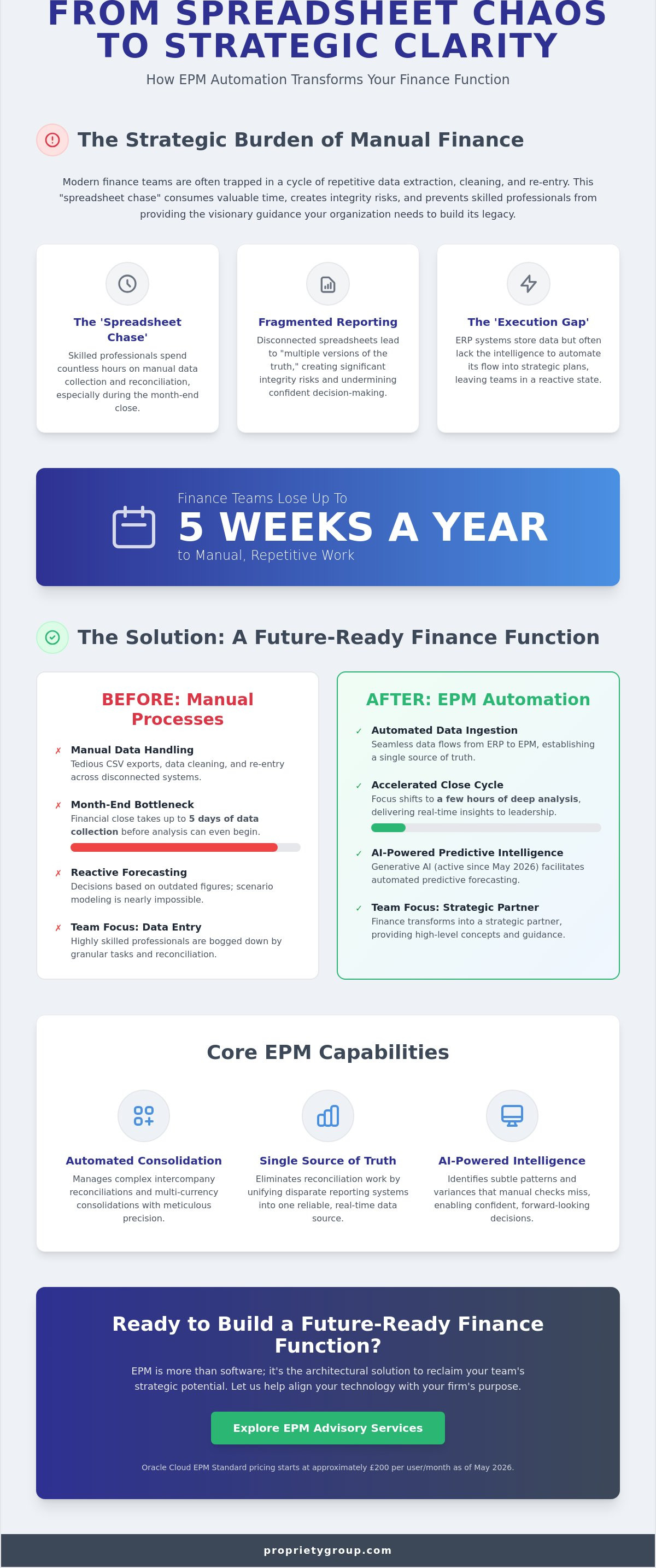
In modern finance, manual work isn't just about physical effort; it's a meticulous drain on your team's talent. We define this work as the repetitive extraction, cleaning, and re-entry of data across disconnected systems. While many UK firms have invested in sophisticated ERP systems, they often encounter an "Execution Gap." This gap exists because an ERP acts as a repository for data but lacks the architectural intelligence to automate the flow of that information into a strategic plan.
When expert minds are wasted on data entry, the organisation's legacy is at risk. Finance leaders find themselves trapped in reactive planning rather than providing the visionary guidance the board expects. Reducing manual work for finance teams with epm isn't just a software upgrade; it's a commitment to business integrity. It allows your professionals to move away from the granular details of execution and toward high-level strategic concepts.
To better understand how these manual burdens impact your team's efficiency, watch this helpful video:
Why Spreadsheets Create Fragmented Reporting and Risk
Relying on disconnected spreadsheets inevitably leads to "multiple versions of the truth" across different departments. This fragmentation creates significant integrity risks, as a single error in manual data handling can cascade through the entire reporting cycle. Without a unified system, performing accurate scenario modelling for opex becomes nearly impossible. Decisions are then based on outdated or conflicting figures, undermining the sense of security and permanence that a prestigious firm requires for its long-term growth.
The Hidden Cost of the 'Spreadsheet Chase'
The month-end close often descends into a "spreadsheet chase," taking a heavy operational toll on your most skilled professionals. This siloed approach prevents finance teams from becoming true strategic partners to the CEO. When teams are bogged down by manual bottlenecks, they can't execute rolling forecasts effectively. By reducing manual work for finance teams with epm, you reclaim the time needed for the thoughtful analysis that drives long-term value and purpose. This shift ensures that your finance function operates with the precision and quiet confidence necessary to lead in 2026.
Transforming Finance Operations with EPM Automation
EPM serves as the visionary layer that unites your ERP data with future-focused strategic planning. By reducing manual work for finance teams with epm, you replace tedious CSV exports with automated data ingestion. This ensures that information flows directly into your models without human intervention. Establishing a single source of truth for finance eliminates the reconciliation work that often plagues month-end; it creates a system where automated workflows replace disjointed email chains for budget approvals. If you're ready to evolve your operations, our EPM advisory services can help align your technology with your firm's purpose.
Automating Financial Consolidation and Close Cycles
Modern EPM software manages complex intercompany reconciliations and multi-currency consolidations with meticulous precision. This automation shifts the focus from spending five days on data collection to spending just a few hours on deep, impactful analysis. It's a fundamental part of the modern financial close process, where speed never compromises the integrity of the final report. By centralising these tasks, your team can provide leadership with real-time data that reflects the true state of the business.
Leveraging AI for Predictive Intelligence
Integrating AI in finance allows your team to identify subtle patterns and variances that manual checks often overlook. Since May 2026, generative AI features have been enabled across key Oracle EPM realms, facilitating a transition from manual tracking to automated predictive forecasting. This shift is the ultimate goal of reducing manual work for finance teams with epm, empowering leadership to make confident, forward-looking decisions that secure the company's legacy in a competitive market.
Building a Future-Ready Finance Function
The journey toward a future-ready function begins with a thorough environment analysis that respects your firm's existing strengths. It's not about simply installing a tool; it's about a design-led strategy that aligns your technology with your unique business goals. Software alone is never a silver bullet. Without a deliberate approach, the legacy of manual work remains, often hiding within the very systems designed to eliminate it. Reducing manual work for finance teams with epm requires a partnership that understands the intersection of people, place, and purpose. Engaging in EPM advisory ensures that your digital transformation is as refined as your organisation's reputation.
The Necessity of Bespoke Implementation
Off-the-shelf configurations rarely address the nuances of a high-performing UK finance team. They often fail to eliminate manual work entirely because they don't account for specific organisational structures or complex reporting requirements. Our process involves a meticulous migration of data and system configuration tailored to your specific needs. We prioritise comprehensive user training to ensure your team feels confident embracing automation. When people trust the integrity of the system, they naturally move away from legacy spreadsheets. This transition is essential for establishing a single source of truth that stands the test of time and supports your long-term growth.
Ensuring Long-Term Success with PG CARE
True excellence requires constant refinement and steady oversight. Even the most sophisticated systems can experience drift, where teams slowly return to manual workarounds as business conditions change or new regulations emerge. We provide PG CARE to keep your EPM solution optimised and aligned with your evolving strategy. This support model maintains system integrity and ensures user confidence remains high through every reporting cycle. By securing ongoing technical assistance, you protect your organisation's legacy and ensure that reducing manual work for finance teams with epm remains a permanent achievement rather than a temporary fix. This commitment to excellence provides the quiet confidence needed to lead your industry into the future.
Securing Your Strategic Legacy Through Precision
The transition from repetitive data cleaning to visionary leadership defines the most successful UK finance functions in 2026. We've explored how reducing manual work for finance teams with epm replaces fragmented reporting with a single, reliable source of truth. This shift empowers your professionals to focus on the intersection of people and purpose rather than the granular details of data entry. By automating the 2026 reporting cycle, your team can finally provide the real-time insights that leadership requires to navigate a complex market with certainty.
Achieving this level of excellence requires more than just software. It demands a meticulous implementation strategy and expert-led advisory for finance leaders who value precision and long-term security. At Propriety Group, we specialise in bespoke EPM solutions and provide continuous system optimisation through PG Care to ensure your digital architecture remains resilient. Discover how Propriety Group can automate your finance operations through bespoke EPM advisory. You have the opportunity to transform your finance department into a strategic asset that secures your firm's legacy for years to come.
Frequently Asked Questions
What are the most common manual tasks that EPM software can automate?
EPM software automates the repetitive extraction and cleaning of data from multiple sources across your organisation. It handles complex intercompany reconciliations and multi-currency consolidations that typically consume 70% of a finance team's time during the month-end close. By centralising these processes, you eliminate the need for manual CSV exports and the disjointed email chains often used for budget approvals. This shift is a primary step in reducing manual work for finance teams with epm.
How long does it take to see a reduction in manual work after implementing EPM?
Most organisations experience a noticeable decrease in manual effort within the first 30 days of going live. Once the initial data migration and system configuration are complete, the automated data flows begin to function immediately. While the full strategic transition may take 3 to 6 months as the team adapts to new workflows, the time spent on data entry drops significantly after the first successful month-end close using the new architecture.
Can EPM software completely replace the need for spreadsheets in the finance team?
EPM software replaces spreadsheets as the central repository and single source of truth for all financial data. While your team might still use spreadsheets for bespoke, one-off calculations, they'll no longer rely on them for core reporting or consolidation. This transition ensures data integrity and prevents the version control errors that occur when approximately 45% of complex spreadsheets contain significant mistakes, according to industry research.
How does EPM automation improve the accuracy of financial forecasts?
Automation improves accuracy by removing human error and utilising real-time data directly from your ERP. Reducing manual work for finance teams with epm allows for the integration of AI-driven predictive intelligence, which identifies subtle variances that manual checks often miss. With generative AI features active in production environments since 15 May 2026, forecasts are now based on meticulous patterns and live data rather than static, outdated figures.