
Financial Consolidation for Multiple Entities: A Strategic Guide for Growing Groups

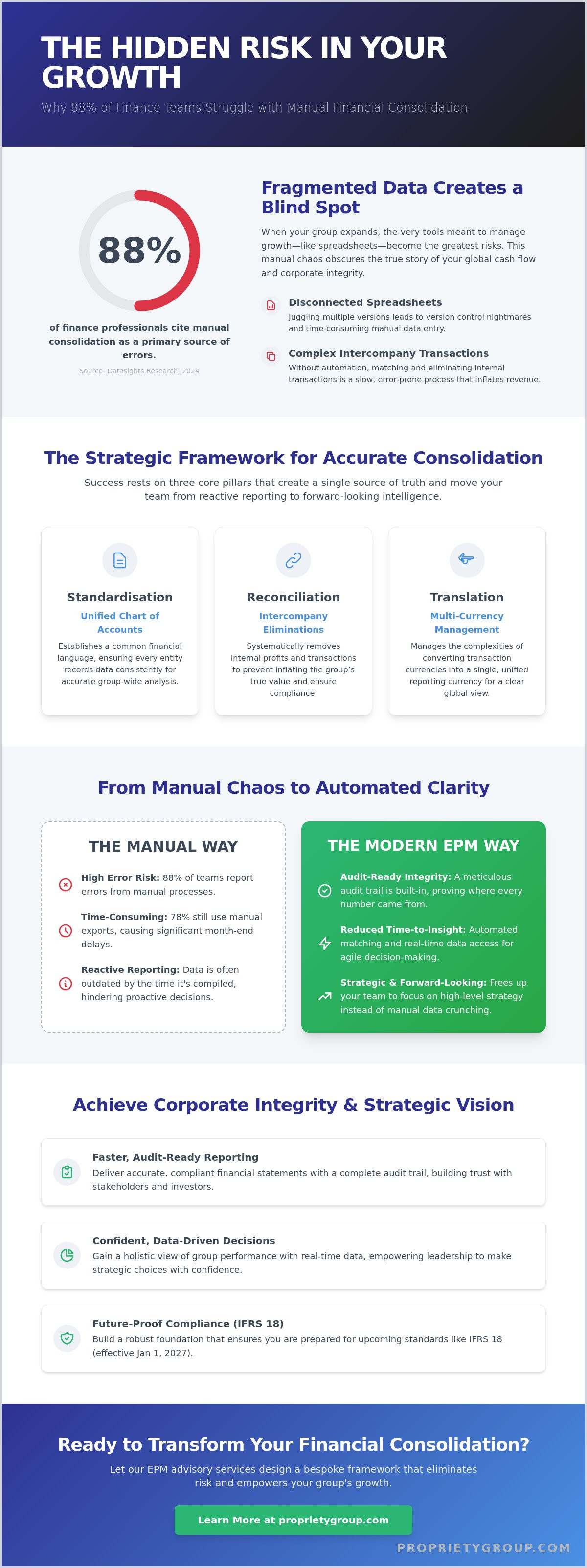
Did you know that 88% of finance professionals find manual consolidation processes to be a significant source of errors? According to 2024 research by Datasights, the very tools meant to organize our growth often become the greatest risks to our corporate integrity. It's a common frustration for expanding groups. You've likely felt the weight of the month-end close as you juggle disconnected spreadsheets and complex intercompany transactions. When your data is fragmented, it's nearly impossible to see the true story of your global cash flow.
Effective financial consolidation for multiple entities shouldn't feel like a monthly crisis; it should be a meticulous exercise in clarity and purpose. We promise to show you how to transform that fragmented data into a single, unified source of truth for your entire group. This guide explores how modern EPM solutions and strategic automation can deliver faster, audit-ready reporting. We'll also help you prepare for upcoming standards like IFRS 18, ensuring your financial narrative remains both precise and visionary.
Key Takeaways
- Understand why true consolidation requires more than just adding numbers, focusing instead on meticulous intercompany eliminations and uniform policies.
- Discover how a unified "Chart of Accounts" serves as a foundational tool to ensure every entity in your group communicates with clarity and precision.
- Master the core pillars of standardization and reconciliation to simplify financial consolidation for multiple entities across diverse markets.
- Transition from manual spreadsheets to a sophisticated model of connected planning that empowers your team to focus on high-level strategy.
- Learn to navigate the advisory path when selecting EPM platforms to ensure your technology supports your long-term vision and corporate integrity.
Understanding Financial Consolidation for Multiple Entities: Beyond Simple Summation
Financial consolidation for multiple entities is far more than a simple mathematical sum. It's a meticulous process that combines the financial performance of a parent company and its various subsidiaries into a single, holistic report. Think of it as a clear window into the health of your entire business. While it might seem easy to just add up the numbers from different branches, this approach fails to account for the internal movements that happen within a group. A true consolidated financial statement requires the removal of intercompany transactions to prevent double counting. If one subsidiary sells a product to another, that internal revenue shouldn't appear as a profit for the group as a whole. You also need uniform accounting policies so every office measures success the same way.
To better understand this concept, watch this helpful video:
This level of precision builds a single source of truth in finance. It ensures that every stakeholder, from board members to investors, sees the same reality. It moves your team away from reactive reporting, where you're always looking at what happened last month. Instead, it provides the forward-looking intelligence that high-growth groups need to make confident decisions about the future. With new standards like IFRS 18 arriving on January 1, 2027, having this foundation is no longer optional; it's a requirement for corporate integrity.
The Complexity of Group Reporting
As you add new entities, the administrative weight grows exponentially. In the UK market, where regulatory standards are high, managing this manually is a significant risk. Research by Datasights revealed that 88% of finance professionals find manual consolidation processes to be a primary source of errors. A meticulous audit trail is essential. It isn't just about compliance; it's about building a legacy of trust. When you can prove exactly where every number came from, you protect the reputation of your group and ensure transparency for future investors.
The Strategic Framework for Accurate Multi-Entity Reporting
Success in financial consolidation for multiple entities rests on three core pillars: standardisation, reconciliation, and translation. It begins with a unified "Chart of Accounts." This acts as a common language, ensuring every entity, regardless of its location or specific function, records data in the same way. Without this baseline, the group's financial story becomes a collection of disparate dialects that are impossible to interpret accurately. This meticulous alignment is what allows leadership to move from simply viewing data to understanding the true performance of the group.
A critical step in this framework is the process of intercompany eliminations. This refers to the removal of internal profits or transactions between sister companies to prevent inflating the group’s true value. By following authoritative standards like FASB's Consolidation Guidance (Topic 810), firms ensure their reports reflect only external economic reality. Implementing modern financial close processes reduces the "time-to-insight" for leadership. Instead of waiting weeks for a report, executives receive real-time data that drives agile decision-making and long-term security.
Managing Intercompany Transactions and Reconciliations
Matching transactions between sister companies is often where the most time is lost. A 2026 report from LiveFlow found that 78% of finance leaders still rely on manual spreadsheet exports for this task, which frequently leads to delays. Automation replaces this manual searching with a system that matches entries instantly. This ensures that integrity is a built-in feature of your workflow rather than a manual check at the end of the month. If you're looking to refine these processes, our EPM advisory services can help design a bespoke framework tailored to your group's growth.
Navigating Multi-Currency Challenges
Global groups must distinguish between transaction currency and reporting currency. The transaction currency is the money used for a specific deal, while the reporting currency is what you use for the final group statement. Inconsistent exchange rates can lead to misleading variances that cloud your financial narrative. Applying a meticulous, group-wide rate ensures your reports remain accurate across all borders, providing a clear view of your global cash flow without the noise of currency fluctuations.
Transitioning to Modern Performance Management: The Advisory Path
Moving away from manual spreadsheets is more than a simple upgrade; it's a journey toward connected planning. For growing groups, financial consolidation for multiple entities often represents the first step in a broader digital transformation. This shift isn't about buying a product. It's about choosing the right EPM platform that aligns with your group's unique legacy and future purpose. When technology is properly integrated, your finance team moves from being data entry clerks to becoming strategic architects of the business.
Expert advisory ensures that your chosen solutions respect the complexity of your operations. This is particularly vital for international groups navigating different regulatory tiers. Citing the IMF technical note on financial statement consolidation reminds us that high-level reporting requires a meticulous approach to data integrity across all levels of an organization. Once you master the basics of financial consolidation for multiple entities, you can embrace the next frontier: AI and predictive intelligence. These tools allow you to move beyond what happened yesterday and start modeling what might happen tomorrow.
The Role of Expert Implementation
Success begins with a thorough environment analysis. We don't just install software; we study your current workflows to identify where friction exists. This bespoke approach ensures that the implementation matches your specific needs from day one. To maintain this standard of excellence, our PG Care model provides ongoing support. It's designed to ensure long-term system health and give your team the confidence to manage complex group data with total propriety. This continuous partnership protects your investment and ensures your financial narrative remains clear and authoritative as you grow.
Building a Legacy of Financial Clarity
Masterful financial consolidation for multiple entities is the cornerstone of any group's long-term security. We've explored how moving beyond simple summation allows you to eliminate internal noise and establish a single source of truth for all stakeholders. By adopting a unified "Chart of Accounts" and embracing the principles of connected planning, you transform the finance function from a reporting center into a strategic engine. This journey ensures your organization remains audit-ready and prepared for the 2027 regulatory shifts that will redefine corporate transparency.
Achieving this level of precision requires more than just new software; it demands a partner who understands the intersection of people, place, and purpose. As specialists in EPM implementation, Propriety Group provides bespoke advisory that focuses on CFO empowerment and strategic clarity. Our commitment doesn't end at the go-live date. Through the PG Care model, we offer the meticulous, ongoing support needed to maintain system health and team confidence as your business evolves.
Empower your finance team with bespoke EPM advisory from Propriety Group to ensure your group's financial narrative remains accurate and visionary. Your future growth deserves a foundation built on integrity and steady, professional guidance.
Frequently Asked Questions
What is the difference between multi-entity reporting and financial consolidation?
Multi-entity reporting allows you to view the performance of individual subsidiaries as separate, standalone units. In contrast, financial consolidation for multiple entities combines these individual results to present a single, unified view of the entire group's health. While reporting focuses on the performance of the parts, consolidation focuses on the integrity of the whole. This meticulous process ensures that the group's total value isn't distorted by transactions between internal branches.
Why are intercompany eliminations necessary for multiple entities?
Intercompany eliminations are necessary to prevent the artificial inflation of a group's revenue and assets. If one subsidiary sells services to another, these internal flows don't represent actual growth from external markets. Removing these entries ensures your final statements reflect only the economic reality of your interactions with the outside world. This practice maintains the propriety of your reports and builds a legacy of trust with your investors and regulators.
How does multi-currency consolidation affect financial accuracy?
Multi-currency consolidation impacts accuracy by introducing the risk of exchange rate variances. When a group operates across different regions, small fluctuations in currency values can lead to significant differences in the final reporting currency. Using a consistent, group-wide exchange rate for all translations is essential to avoid misleading data. This approach ensures that your global cash flow remains clear and that your true performance isn't obscured by the volatility of international markets.
Can financial consolidation be fully automated for complex groups?
Modern EPM software can automate approximately 90% of the manual tasks involved in financial consolidation for multiple entities. While a human expert is still required for final strategic oversight and complex decision-making, automation handles the heavy lifting of data collection, currency translation, and intercompany matching. This shift allows your finance team to spend less time on data entry and more time on high-level analysis. It's a journey toward connected planning that preserves your group's integrity through technical precision.