
Integrating Operational Data with Financial Plans: A Guide for Forward-Looking Leadership

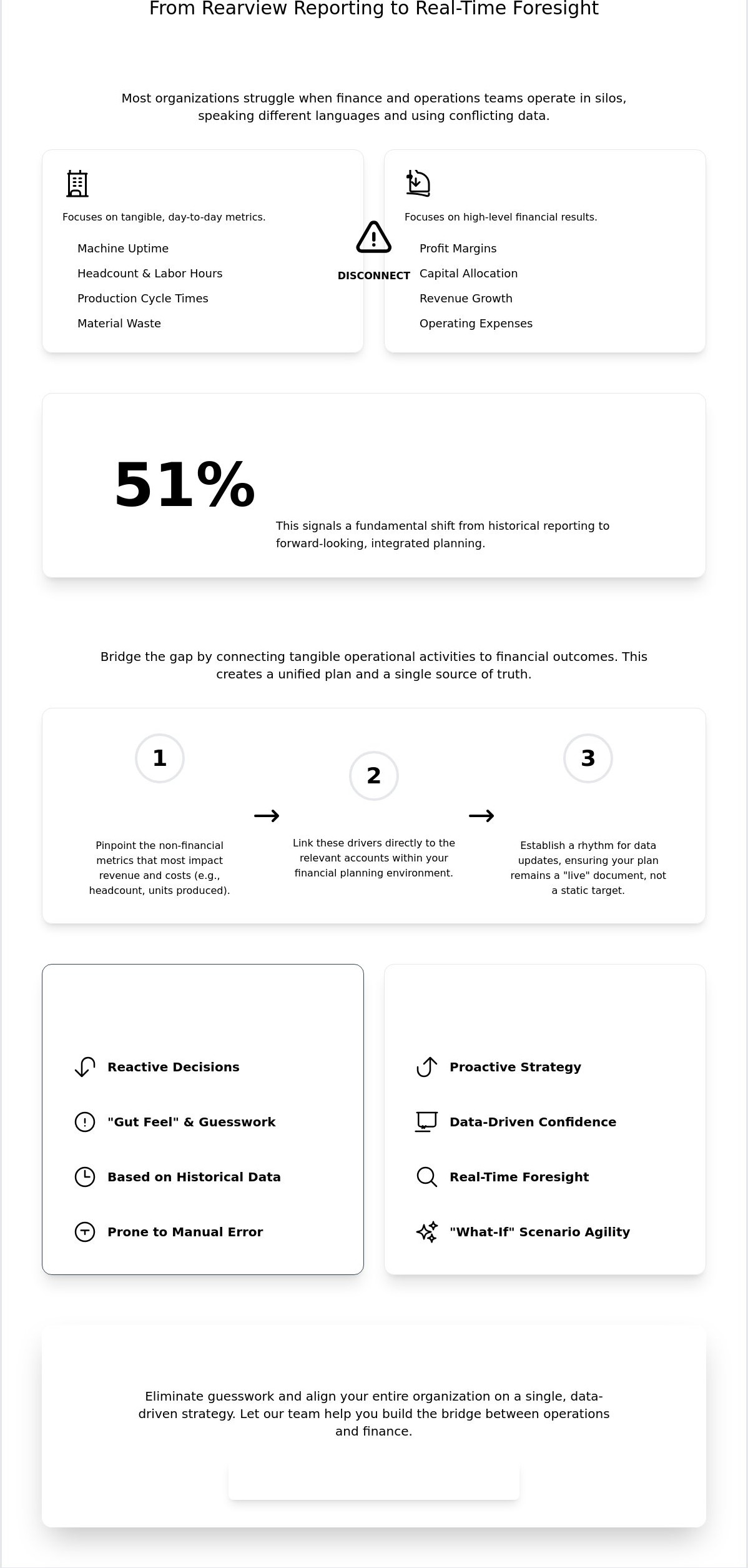
What if your financial forecast wasn't a reflection of last month's history, but a live pulse of this morning's production line? Many leaders find themselves managing through a rearview mirror, relying on fragmented reporting and manual data consolidation that often introduces human error. The challenge of integrating operational data with financial plans is a common hurdle for organizations striving for precision; it's the difference between reactive survival and intentional growth. You've likely felt the friction when finance and operations teams operate in silos, yet research shows that 51 percent of CFOs now rely on non-financial data to drive their most critical decisions.
This guide will show you how to bridge the gap between daily tasks and long-term strategy to drive more accurate forecasts and confident decision-making. We'll explore how establishing a single source of truth allows your leadership team to run real-time "what-if" scenarios with quiet confidence. By the end of this article, you'll understand how to align human intentionality with granular execution, fostering a culture of trust that transforms data into enduring value and institutional strength.
Key Takeaways
- Discover how to reconcile the disconnect between department-specific metrics and high-level financial reporting to create a unified organizational vision.
- Understand the methodology of driver-based planning, shifting your focus from historical results to the specific activities that influence future outcomes.
- Learn the strategic benefits of integrating operational data with financial plans to eliminate manual errors and increase the precision of your forecasts.
- Establish a single source of truth that allows your finance team to move beyond data entry and become a proactive partner in shaping company strategy.
The Strategic Value of Connecting Operations and Finance
True integrated planning is more than a technical handshake between software systems. It's the intentional alignment of daily front-line activities with the broader balance sheet. When leadership succeeds in integrating operational data with financial plans, they create a narrative where every hour worked or unit produced translates directly into future value. This methodology ensures that the strategic vision isn't just a document, but a living reality reflected in the numbers.
Most organizations struggle with a "Great Divide" in communication. Finance teams traditionally speak the language of currency and Corporate Finance Principles, focusing on margins and capital allocation. Meanwhile, operations teams focus on tangible metrics like machine uptime, headcount, and cycle times. This linguistic gap often leads to fragmented reporting, where leaders make reactive decisions based on outdated monthly figures rather than real-time insights.
To better understand how these two worlds can converge, watch this helpful video:
Breaking Down Functional Silos
When departments rely on disparate systems, they inevitably produce conflicting versions of the truth. These silos stall decision-making and erode the trust between the CFO and operational managers. A unified narrative is essential for any leadership team that values precision. By integrating operational data with financial plans, you move from historical reporting to forward-looking financial intelligence, allowing for a proactive stance in a volatile market.
The Move Toward Connected Planning
Modern leadership requires a bridge between day-to-day activity and high-level strategy. This is where Enterprise Performance Management (EPM) becomes vital. It acts as the connective tissue that turns raw activity into strategic foresight. For a deeper look at how this fits into a broader growth strategy, explore our EPM Advisory pillar article. This shift ensures that every tactical move supports the long-term security of the enterprise.
Turning Operational Drivers into Financial Foresight
To move beyond passive reporting, leadership must embrace driver-based planning. This methodology links tangible activities to financial outcomes, ensuring that every number on a spreadsheet has a clear operational origin. While traditional accounting focuses on "what" happened at the end of the month, driver-based planning investigates "why" those results occurred. By integrating operational data with financial plans, you move from a reactive posture to one of strategic foresight.
This approach replaces "gut feel" with empirical evidence. When your forecast is built on real-time data from the warehouse or the sales floor, you don't have to guess about future performance. It also encourages a culture of precision. When an operational manager understands how their specific metrics, such as labor hours or material waste, impact the bottom line, they take true ownership of the financial results.
Identifying Your Core Business Drivers
Transitioning to this model requires a structured approach to your data architecture:
- Step 1: Identify the non-financial metrics that most impact your revenue, such as headcount, production units, or customer acquisition costs.
- Step 2: Map these drivers directly to the relevant financial accounts within your EPM environment.
- Step 3: Establish a steady rhythm for data updates, ensuring your plan remains a "live" document rather than a static annual target.
Scenario Modelling and Stress Testing
The true power of integrating operational data with financial plans is revealed during periods of volatility. Integrated data allows leadership to run rapid "what-if" scenarios. For instance, if supply chain costs rise by 10 percent, you can immediately see the ripple effect across your entire organization. This level of agility leads to more resilient scenario modelling for OPEX, allowing you to pivot before a crisis occurs. If you're ready to refine your approach to performance management, our team can help you design a more integrated future.
Building a Unified Foundation for Growth
Establishing a reliable data foundation is the final step in the journey toward forward-looking leadership. A resilient organization requires a Single Source of Truth. This foundation ensures that every stakeholder, from the shop floor to the boardroom, relies on the same set of verified facts. By utilizing a modern data warehouse, companies can seamlessly blend CRM and ERP data, removing the friction that traditionally plagues manual reporting. This structural integrity is the essential prerequisite for implementing Financial AI Solutions. Without a clean, integrated data set, even the most advanced algorithms will fail to provide meaningful value.
The Role of AI and Predictive Analytics
Artificial intelligence acts as a sophisticated lens, identifying subtle patterns in operational data that might escape human observation. When integrating operational data with financial plans, predictive intelligence turns historical patterns into accurate future-looking forecasts. This shift allows the finance team to move from describing the past to actively shaping the future. By uncovering the hidden correlations between daily activities and financial health, AI helps leadership maintain a position of quiet confidence in even the most volatile markets.
Choosing a Visionary Implementation Partner
Technology is a powerful tool, but expert advisory is what ensures that tool aligns with your specific business goals. Successful integration begins with a thorough environment analysis to understand the unique nuances of your existing systems. It's not just about the "plumbing" of data pipelines; it's about the intentionality behind the architecture. Integrating operational data with financial plans requires a partner who understands both the granular details of execution and the high-level strategic concepts of the CFO. Furthermore, ongoing support through PG CARE - EPM Solution Support ensures your systems remain optimized and secure as your enterprise matures. This long-term commitment to excellence ensures that your data infrastructure continues to create enduring value for years to come.
Cultivating a Culture of Precision and Strategic Resilience
The transition from reactive reporting to proactive foresight is the hallmark of modern leadership. By moving beyond isolated spreadsheets and embracing a unified data foundation, you ensure that every tactical decision supports your long-term vision. We've explored how driver-based planning turns daily activities into financial intelligence, creating a reliable roadmap for sustainable growth. This alignment doesn't just improve numbers; it builds the trust necessary for a high-performing organization.
Achieving this level of clarity requires more than just software; it demands a principled approach to integrating operational data with financial plans. As specialists in EPM and CRM integration, we provide expert-led advisory for CFOs who value craftsmanship and accuracy in their financial architecture. Our commitment to your success continues beyond implementation, as we offer ongoing technical assistance via PG CARE to keep your systems optimized as your business evolves. To see how your organisation can unify its data for better decision-making, book a call with our advisory team today. The path to enduring value begins with the intentional alignment of today's actions with tomorrow's aspirations.
Frequently Asked Questions
What is the difference between financial data and operational data?
Financial data captures the monetary impact of your business activities, recording results like revenue, expenses, and profit margins. Operational data tracks the underlying physical and temporal activities that create those results, such as machine uptime, labor hours, or production units. While financial figures tell you what happened during a period, operational metrics provide the context to understand why it happened.
How long does it typically take to integrate these two data sets?
A foundational project for integrating operational data with financial plans typically spans three to six months. This timeframe allows for a meticulous environment analysis and the intentional design of a data architecture that aligns with your specific strategic goals. By following a structured, phased approach, your leadership team can begin realizing tangible value while the system continues to scale and mature.
Do we need to replace our existing ERP to achieve integration?
You don't need to replace your current ERP system to achieve a unified view of your organization. Modern Enterprise Performance Management (EPM) solutions are designed to act as a sophisticated bridge, pulling information from your existing ERP and CRM into a single source of truth. This method preserves your previous technology investments while providing the precision and visibility required for advanced financial intelligence.
How does integrating operational data improve the accuracy of our rolling forecasts?
Accuracy improves when you replace historical guesswork with real-time business drivers. By integrating operational data with financial plans, your forecasts are built on the actual pulse of the company, such as current production capacity or sales pipeline velocity. This level of detail allows you to run more resilient "what-if" scenarios and make confident adjustments before market shifts impact your bottom line.