
Continuous Forecasting vs Traditional Budgeting: A Strategic Framework for Finance Leaders

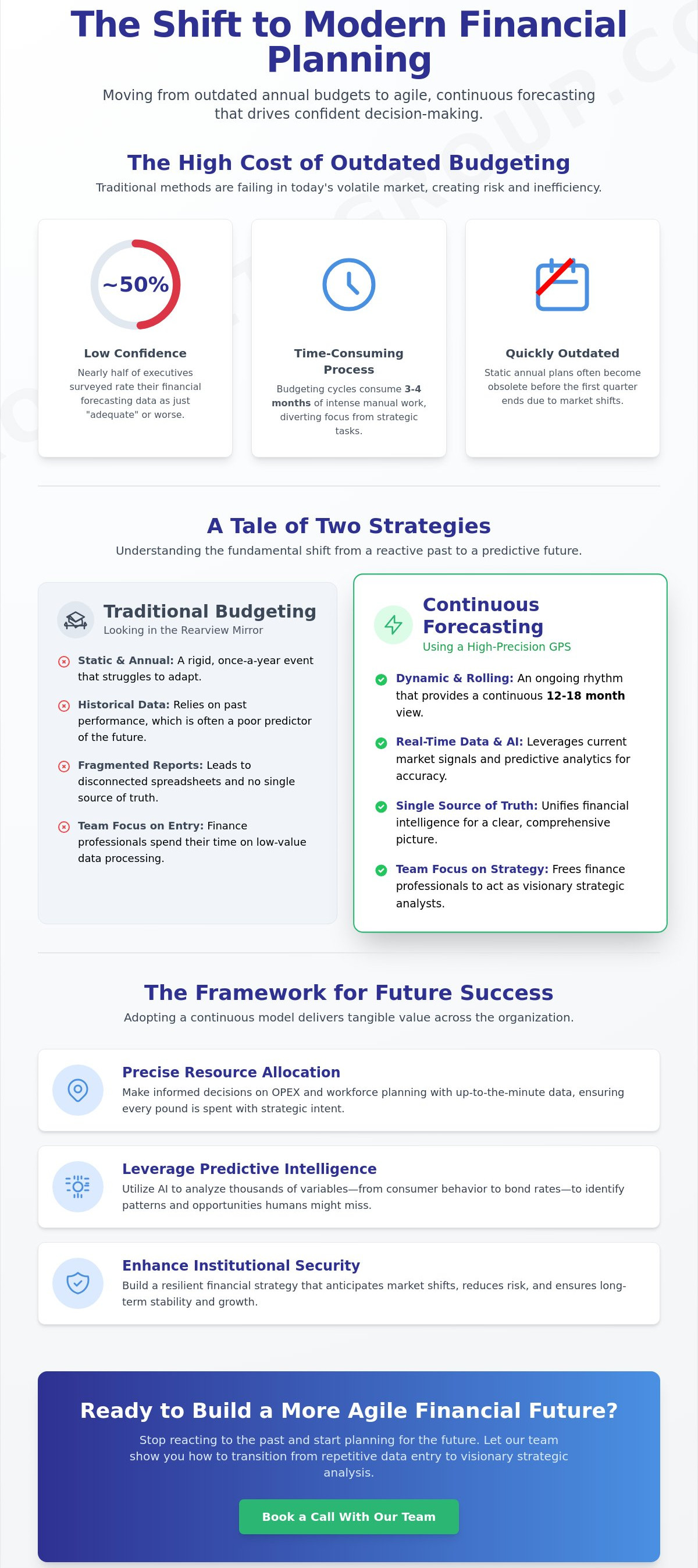
Nearly half of over 540 executives surveyed by KPMG recently rated their financial forecasting data as just adequate or worse. In an environment where annual inflation reached 4.2 percent in May 2026, relying on stagnant figures poses a significant risk to institutional security. You likely recognize the exhaustion of a budgeting cycle that consumes four months of your team's time, only to become obsolete before the first quarter concludes. This disconnect often prevents the speed required to meet sudden market shifts.
The choice between continuous forecasting vs traditional budgeting represents a fundamental shift from looking in the rearview mirror to using a high precision GPS. It's about moving toward a model that values craftsmanship and accuracy over manual repetition. You'll discover how to transition from rigid annual cycles to an agile, forward-looking financial strategy that empowers confident decision-making. This article outlines a strategic framework to reduce low value data entry, achieve a single source of truth, and leverage predictive analytics for enduring institutional value.
Key Takeaways
- Understand why static, annual budgets often fail to account for modern market volatility and how relying solely on historical data can lead to missed opportunities.
- Analyze the fundamental shift of continuous forecasting vs traditional budgeting to move your finance team from a rigid annual event to a rhythmic, data-driven strategy.
- Discover how integrating real-time data updates allows for more precise resource allocation and helps maintain a single source of truth for financial intelligence.
- Learn how to manage the cultural and technological transition by identifying data gaps and aligning departmental spending with high-level strategic intentions.
- Gain the tools to replace low-value manual entry with a visionary framework that prioritizes agility and long-term institutional security.
The Limitations of Traditional Budgeting in a Modern Economy
Traditional budgeting is a legacy of a slower era. It relies on a static, annual cycle where finance leaders look at historical data to guess the next twelve months. In 2026, this approach is failing. With year-ahead inflation expectations at 4.6 percent and mandatory amendments to IFRS 9 and IAS 21 now in effect, last year's figures provide little guidance for next month's reality. When we examine What is forecasting?, we see it's about predicting the future based on current signals, not just repeating the past.
The debate of continuous forecasting vs traditional budgeting often highlights the "time-sink" trap. Many budgets require three to four months of intense manual data entry. By the time the board approves the final figures, the market has already shifted. This creates a disconnect where departments are forced to follow a map that no longer matches the terrain. It's a process that values completion over correctness.
To better understand the core differences in these approaches, watch this helpful video:
The Cost of Rigidity
Fixed budgets act as a set of handcuffs for ambitious organizations. When an unexpected opportunity appears in the market, a rigid budget often says "no" because the funds weren't allocated six months ago. This rigidity doesn't just hurt the bottom line; it creates a psychological burden on your team. Finance professionals spend budget season in a state of high stress, knowing their hard work might be obsolete by the time Q1 concludes. A visionary leader understands that prestige comes from agility, not just adherence to a plan.
Fragmented Reporting vs. Unified Truth
Reactive planning usually stems from disconnected spreadsheets. When every department maintains its own version of the truth, leadership loses the ability to see the big picture. Relying on these fragmented reports makes it impossible to achieve a single source of truth finance. Moving away from traditional models toward continuous forecasting vs traditional budgeting helps align human experience with financial intentionality. It ensures that every pound spent is a reflection of current strategic goals rather than past assumptions.
Continuous Forecasting vs Traditional Budgeting: A Strategic Comparison
The core distinction in the debate of continuous forecasting vs traditional budgeting lies in the frequency and purpose of the data. While traditional budgeting treats financial planning as a rigid annual event, continuous forecasting introduces an ongoing rhythm. This dynamic process updates projections based on real-time market signals. It ensures your strategy remains relevant even when investment grade corporate bond yields fluctuate, as seen with the 5.23 percent rate recorded in June 2026. Instead of a static document, you gain a living tool that evolves with your business.
Adopting this model provides a "rolling" view of the next 12 to 18 months. It eliminates the blind spots that occur when a traditional budget reaches its final months. By constantly extending the horizon, finance leaders maintain a persistent state of readiness. This approach relies heavily on predictive analytics in financial planning to enhance accuracy. It allows you to move beyond simple historical averages and toward a more sophisticated understanding of future performance.
Leveraging AI and Predictive Intelligence
Many view artificial intelligence as a mysterious "magic box," yet its true value lies in its ability to identify patterns that manual processes often miss. Our financial AI solutions integrate directly with your existing planning cycles. They analyze thousands of variables, from shifting consumer behavior to the 7.07 percent high-yield corporate bond rates of June 2026. This shift liberates your team from the drudgery of manual data entry. Finance professionals can then focus on strategic analysis, acting as discerning visionaries rather than mere data processors.
Agile Resource Allocation
A continuous model transforms how you manage your most significant costs. It supports dynamic OPEX and workforce planning, allowing you to reallocate resources as needs change. If a new market opportunity arises or a department requires additional support, the framework provides the clarity needed to act. This speed of decision-making creates enduring value and institutional security. To explore how these frameworks can be tailored to your specific organizational needs, you might connect with our team for a detailed discussion.
Transitioning to a Continuous Planning Model
Transitioning from a static past to a dynamic future requires a shift in both technology and culture. It isn't a simple swap of tools; it's an evolution in how your team perceives value and reacts to change. You should begin with a thorough environment analysis to identify where your data gaps exist. This clarity ensures that when you select an EPM platform, it aligns perfectly with your specific operational needs. The choice of continuous forecasting vs traditional budgeting is ultimately a choice to prioritize agility over habit.
Many organizations struggle because they view implementation as a purely technical task. Expert EPM advisory serves to de-risk this transition by bridging the gap between strategic vision and technical execution. This guidance ensures that your new framework isn't just functional but also elegant and reliable. With 53 percent of finance chiefs currently prioritizing digital transformation through data analytics and AI, moving toward a more responsive model is now a standard for modern excellence.
Step-by-Step Implementation Roadmap
- Assess current data maturity and infrastructure readiness to ensure a solid foundation for predictive tools.
- Define key business drivers that impact financial outcomes rather than just tracking isolated line items.
- Implement a pilot rolling forecast alongside the traditional budget to build confidence and demonstrate tangible results without disrupting existing operations.
Ongoing Support and Optimization
Implementation isn't a "one-and-done" event. Your business is a living entity that will grow and change. Managed support ensures that your financial intelligence evolves alongside your strategic goals. This commitment to permanence and precision provides the long-term security your leadership team requires. A principled visionary knows that the value of a system is found in its enduring accuracy and its ability to align human experience with intentionality.
To begin your transition toward a more agile financial future, book a call with our team to discuss your strategic goals and explore our implementation frameworks.
Embracing a Visionary Approach to Financial Agility
The shift from rigid annual cycles to a dynamic rhythm is no longer a luxury for the few. It's a necessity for leaders who value precision and long term institutional security. By moving beyond the limitations of static data, you empower your team to act with quiet confidence in the face of market shifts. The journey of continuous forecasting vs traditional budgeting is about more than just software; it's about aligning your financial strategy with your organization's highest strategic intentionality.
As a boutique consultancy dedicated to CFO empowerment, we're specialists in EPM and CRM software implementation that create enduring value. Our expertise in AI-driven predictive analytics ensures your framework is built with a commitment to excellence and craftsmanship. Ready to evolve your financial planning? Book a call with our specialist advisory team today. We're here to help you build a forward-looking strategy that instills trust and reliability throughout your entire organization.
Frequently Asked Questions
Is continuous forecasting more work for the finance team than an annual budget?
While it requires an initial process shift, continuous forecasting reduces the total annual workload by eliminating the intense four-month budget season. Spreading the effort across the year creates a steady, manageable rhythm. By automating manual data entry, your finance team moves away from being mere data processors. This allows them to focus on high-value strategic analysis, which provides more enduring value to the organization than a one-time annual event.
Can we implement continuous forecasting if our data is currently fragmented?
Yes, fragmented data is a common starting point that a structured transition helps resolve. The implementation process begins with a thorough environment analysis to identify data gaps and silos. By consolidating these disconnected sources into a single source of truth, you create a foundation for reliable intelligence. This evolution from fragmented spreadsheets to a unified framework is essential for achieving the precision and transparency required in modern financial leadership.
What is the difference between a rolling forecast and continuous forecasting?
A rolling forecast is a specific tactical tool, whereas continuous forecasting is the broader strategic philosophy. A rolling forecast adds a new month or quarter to the projection as each period expires, maintaining a constant 12 to 18 month view. Continuous forecasting encompasses this method but also includes the cultural shift toward real-time updates. In the debate of continuous forecasting vs traditional budgeting, the focus remains on maintaining a dynamic GPS for the future.
How does AI improve the accuracy of continuous forecasts in 2026?
AI improves accuracy by identifying complex patterns and external market signals that manual analysis often misses. In 2026, these solutions can process diverse data points, such as the 4.2 percent annual inflation rate, to predict their impact on your specific business drivers. This move toward predictive intelligence ensures your continuous forecasting vs traditional budgeting transition is rooted in data-driven certainty. It allows for a higher level of craftsmanship in your financial strategy.