
Integrated Financial and Operational Planning Strategy: A UK Leader's Guide for 2026

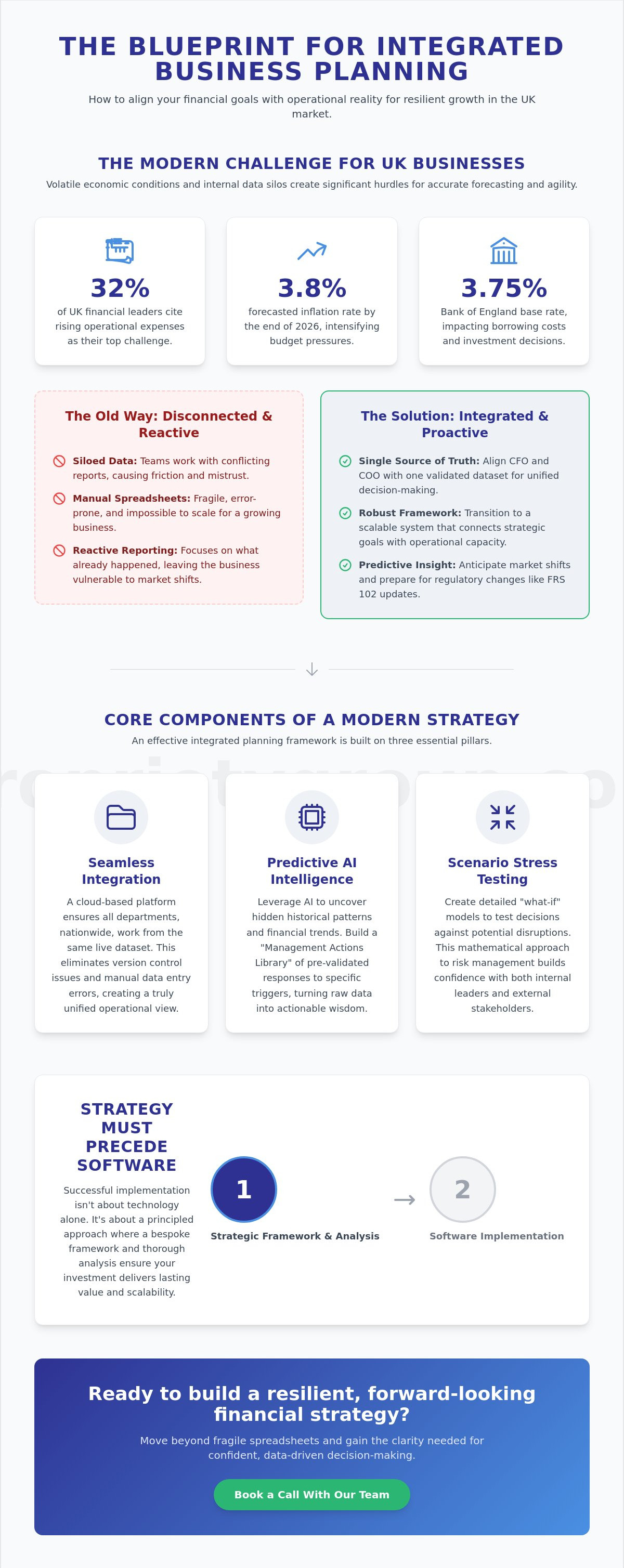
A recent survey of UK financial leaders revealed that 32% consider rising operational expenses to be their most significant professional hurdle. This pressure is intensified by a volatile economy where inflation is forecasted to reach 3.8% by the end of 2026. You likely recognise the frustration of managing siloed data and conflicting reports that make accurate forecasting feel like an impossible task. Relying on fragile, manual spreadsheets often leaves your organisation vulnerable just when it needs to be most agile.
Adopting a sophisticated integrated financial and operational planning strategy is the definitive way to bridge the gap between your boardroom ambitions and the daily reality of your business. This guide promises to show you how to align your growth goals with a connected, AI-driven planning framework designed specifically for the UK market. We will outline how to move beyond fragmented systems to create a single source of truth. This approach ensures your infrastructure is ready for national expansion and remains resilient against shifting regulations, such as the upcoming changes to UK GAAP and FRS 102 standards. You will gain the clarity needed for confident, forward-looking decision-making in an increasingly complex landscape.
Key Takeaways
- Unify high-level strategic objectives with your actual operational capacity to ensure every growth target is supported by practical reality.
- Transition from fragile, manual spreadsheets to a robust integrated financial and operational planning strategy that provides a single source of truth for all departments.
- Leverage AI-driven insights to detect hidden financial patterns and maintain high forecast accuracy despite the complexities of the UK economy.
- Prioritise a bespoke strategic framework and thorough environment analysis to ensure your software implementation delivers enduring value and scalability.
The Strategic Importance of Integrated Planning for UK Organisations
True strategic growth requires more than just ambitious sales targets. It demands a precise alignment between what a business intends to achieve and what its infrastructure can actually support. An integrated financial and operational planning strategy acts as the vital bridge between high-level financial goals and operational reality. In a volatile UK economy, where the Bank of England base rate sits at 3.75% and inflation is forecasted to reach 3.8% by the end of 2026, this connection is no longer a luxury. It's a requirement for long-term stability.
Many organisations are moving away from fragmented, manual spreadsheets that are prone to error and difficult to scale. Instead, they are adopting unified EPM advisory frameworks. This shift isn't merely about installing new software; it's about embracing a principled approach to performance that ensures every department moves in the same direction with absolute clarity.
To better understand how these two worlds collide and collaborate, watch this helpful video:
From Reactive Silos to Proactive Performance
Traditional reporting methods often look backward, providing a snapshot of what has already happened. This reactive stance is dangerous in a market facing major regulatory shifts, such as the 2026 updates to FRS 102 which bring leases onto the balance sheet. Modern planning allows leaders to anticipate market shifts before they impact the bottom line. Real-time visibility transforms data into a predictive tool, allowing for adjustments in workforce planning or supply chain management before a crisis occurs. It moves the conversation from "what went wrong" to "how we will succeed."
Aligning the CFO and COO: A Single Source of Truth
When the CFO and COO work from identical, validated data sets, the entire organisation gains a single source of truth. This alignment eliminates the friction of conflicting reports and builds a foundation for ethical, sustainable growth. It ensures that every management action is based on correctness and intentionality. By connecting financial targets with physical capacity, leaders can make decisions that protect the human experience and the long-term health of the business.
Core Components of a Modern Integrated Planning Strategy
A successful integrated financial and operational planning strategy for 2026 relies on a platform that prioritises seamless data integration and intuitive user accessibility. It isn't enough for systems to simply exist; they must communicate. For UK organisations with national footprints, cloud-based accessibility is essential. It ensures that teams operating nationwide are collaborating on the same live dataset, removing the friction of version control and manual data entry.
Predictive Intelligence and AI Integration
Traditional analysis often misses subtle, historical trends that emerge over years of operation. By incorporating financial AI solutions, businesses can identify these hidden patterns with surgical precision. This intelligence powers a Management Actions Library, which acts as a curated repository of proven responses to specific market triggers. Instead of starting from scratch when a market shift occurs, leaders can draw upon pre-validated strategies to maintain momentum. It's about moving from raw data to actionable wisdom without the usual delays.
Scenario Modelling and Stress Testing
Certainty is a rare commodity in business, yet scenario modelling provides the next best thing: preparation. Leaders can create detailed "what-if" scenarios to stress-test their decisions against potential supply chain disruptions or sudden economic shifts. This process goes beyond simple guesswork. It provides a mathematical foundation for risk management that instils confidence in both the internal leadership group and external stakeholders. When you can demonstrate exactly how a 5% rise in operational costs affects your five-year plan, you gain a level of control that manual systems simply cannot provide.
If you are looking to refine these capabilities within your own organisation, you might consider how an expert-led review of your current planning architecture could reveal new efficiencies and growth opportunities.
Successful Implementation: Why Strategy Must Precede Software
Software is often mistaken for the solution itself. A successful integrated financial and operational planning strategy begins long before any digital tools are deployed. It starts with a deep understanding of your organisation's unique intentionality. An expert-led approach ensures that the chosen system reflects your specific business logic rather than forcing your teams to adapt to rigid, pre-built templates.
Conducting a thorough environment analysis is the critical first step in any EPM implementation journey. This process identifies existing data gaps and cultural barriers that could otherwise undermine your investment. By mapping out how information flows through your business today, you create a blueprint for a more resilient and transparent future.
The Role of Advisory in Finance Transformation
Specialist consultants act as the essential bridge between technical features and your overarching strategic goals. They don't just install software; they transform how your finance team operates. This includes delivering bespoke training programmes that ensure high user adoption rates across the organisation. When your team understands the logic and "why" behind the new system, they are far more likely to use it to its full potential, turning a technical tool into a strategic asset.
Maintaining Excellence with Ongoing Support
Excellence is not a one-time event but a continuous standard of correctness. A managed support model, such as PG CARE - EPM Solution Support, ensures your planning system evolves alongside your business. As you expand nationally or face new UK regulations, your infrastructure must remain agile. Dedicated technical assistance and regular health checks provide the peace of mind that your data remains accurate and your processes stay efficient, regardless of external market volatility.
Ultimately, software is a tool for creating enduring value. It enables a more principled way of working where your integrated financial and operational planning strategy serves the human experience and supports ethical, sustainable growth. By prioritising strategy and expert advisory, you ensure your organisation is built on a foundation of precision and long-term security.
To align your financial goals with operational reality through a bespoke, expert-led framework, book a call with our team today.
Securing Your Organisation's Future Through Precision
Transitioning to a unified model is about more than operational efficiency. It's about creating a legacy of clarity and resilience. You've explored how a robust integrated financial and operational planning strategy bridges the gap between high-level ambition and ground-level capacity. By prioritising expert-led environment analysis and bespoke strategy, you ensure your technology serves your business's unique intentionality rather than the other way around.
We provide specialist implementation of EPM and CRM software designed to withstand the complexities of the UK market. Our commitment to your success extends beyond deployment through our PG Care managed model; this offers ongoing technical assistance and regular system health checks to keep your data accurate. This holistic approach guarantees that your infrastructure remains as agile as the market demands. To ensure your planning systems are built for precision and long-term growth, book a call with our advisory team today. We're ready to help you build a more certain future.
Frequently Asked Questions
What is the primary difference between S&OP and Integrated Business Planning (IBP)?
S&OP traditionally focuses on balancing supply and demand at a tactical level. Integrated Business Planning serves as the strategic evolution of this process, ensuring that financial targets and product portfolios are fully aligned with operational realities. This transition is a core part of an integrated financial and operational planning strategy, as it brings the executive team into the planning cycle. It shifts the focus from simple volumes to overall business value and long-term sustainability.
How does integrated planning software connect with our existing ERP systems?
Modern planning platforms connect to existing ERP systems through automated data connectors that pull live information into a unified environment. This integration ensures that your strategic plans are always informed by the most recent transactional data without the need for manual intervention. The software doesn't replace your ERP; it enhances it by providing a sophisticated layer for modelling and analysis. This creates a seamless flow of information that supports more precise, data-driven decision-making across the business.
What is the typical timeframe for implementing a new integrated planning system in the UK?
A typical timeframe for implementing a new planning system in the UK ranges from three to six months for the initial phase. This period allows for a comprehensive environment analysis, system configuration, and bespoke staff training to ensure high adoption rates. While complex organisations may require longer for a full national rollout, a phased approach provides immediate value. This steady pace ensures every detail is correct and that the infrastructure is scalable for future expansion.
Can AI truly improve the accuracy of our operational and financial forecasts?
AI improves forecast accuracy by detecting complex patterns and correlations within your data that manual methods often miss. Industry research indicates that organisations using these advanced tools can see a 5% to 15% improvement in forecast precision. By automating the identification of trends, your team can focus on strategic management actions. This creates a more reliable foundation for an integrated financial and operational planning strategy in a volatile economy.