
Aligning Sales Forecasts with Financial Targets: A Strategic Framework for 2026

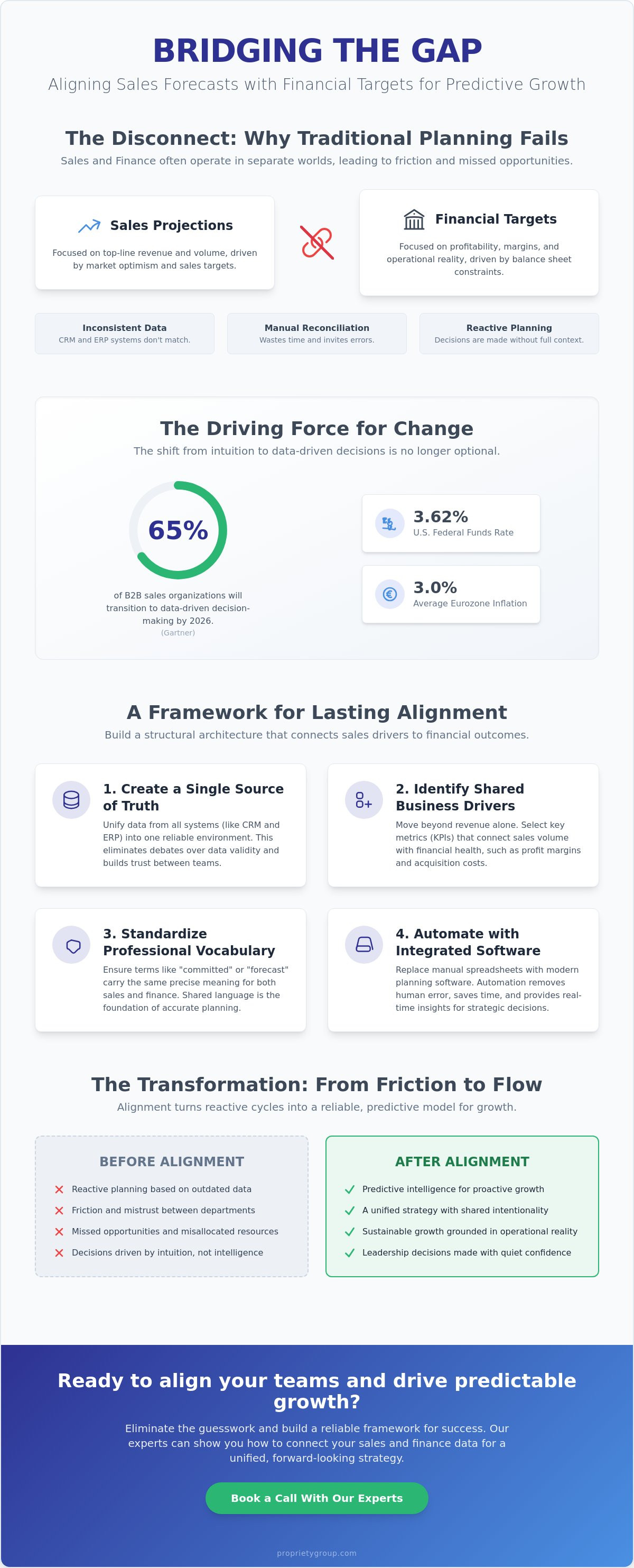
By 2026, 65% of B2B sales organizations are expected to shift from intuition-based to data-driven decision-making by integrating workflows and analytics, according to Gartner. This evolution is no longer optional in an environment where the U.S. Federal Reserve maintains an effective funds rate of 3.62% and eurozone inflation averages 3.0%. You likely recognize the tension that arises when sales projections exist in a vacuum, separate from the rigorous constraints of the balance sheet. This lack of cohesion often stems from inconsistent data between CRM and ERP systems, forcing teams into manual reconciliation processes that waste time and invite error.
Achieving true precision requires aligning sales forecasts with financial targets through a deliberate, structural architecture. We'll show you how to bridge the gap between optimistic projections and concrete financial goals to create a unified strategy. By moving toward a more sophisticated model, you can replace reactive planning with a reliable, predictive framework. This approach provides the clarity needed for forward-looking decisions and reduces the friction between your sales and finance departments, ensuring every department moves with intentionality toward shared growth.
Key Takeaways
- Recognize how a unified reporting structure eliminates the reactive planning that often stems from disconnected data sets.
- Learn to identify the shared business drivers that bridge the gap between sales volume and your overall financial margins.
- Discover the necessity of a standardized professional vocabulary to ensure both sales and finance teams operate with absolute precision.
- Explore how aligning sales forecasts with financial targets through modern software creates a reliable and predictive model for growth.
- Understand the transition from manual reconciliation to predictive intelligence, allowing your leadership to make decisions with quiet confidence.
The Strategic Necessity of Synchronising Sales and Finance
True alignment is more than a shared spreadsheet; it's a structural architecture where sales drivers and financial outcomes are mathematically and strategically linked. This represents the seamless integration of top-down financial goals with bottom-up sales projections. When organizations fail at aligning sales forecasts with financial targets, they often find themselves trapped in a cycle of reactive leadership. Misalignment creates gaps where opportunities are missed and resources are misallocated, particularly in a year where the U.S. federal funds rate sits at 3.62% and eurozone inflation averages 3.0%.
This integration is often formalized through Sales and Operations Planning (S&OP), a process that ensures every department operates with the same intentionality. Moving beyond traditional silos is no longer just a preference; it's a strategic necessity for creating enduring value. Establishing a visionary perspective allows a business to move with quiet confidence, ensuring that tactical execution always serves a higher strategic purpose.
To better understand how these plans connect in a modern business environment, watch this helpful video:
The Architecture of a Single Source of Truth
Precision in planning requires a foundation of unified data. Fragmented reporting leads to errors that erode trust between departments and introduce unnecessary risk. This is where EPM advisory provides the necessary framework to replace isolated facts with actionable intelligence. By creating a reliable data environment, leaders can focus on the broader significance of their figures. Context-driven data ensures that every stakeholder understands the "why" behind the numbers, transforming raw information into a tool for proactive growth.
Balancing Optimism with Operational Reality
There's an inherent tension between the ambition of a sales team and the prudence of a finance department. This tension shouldn't be eliminated; it should be harnessed. Utilizing rigorous financial close processes allows an organization to validate sales assumptions against actual performance. This discipline ensures that growth remains sustainable and grounded in operational reality. It's through this balance that a business maintains its commitment to excellence while pursuing its most aspirational targets.
A Framework for Aligning Forecasts with Financial Targets
In a market defined by rapid shifts, permanence in planning comes from a repeatable, architectural framework. Aligning sales forecasts with financial targets requires more than just meeting in a boardroom; it demands a fundamental shift in how data flows through your organization. This process begins by identifying shared drivers. While sales teams focus on volume, finance must prioritize margins. Success lies in finding the metrics that influence both. Standardizing the vocabulary between these departments is a prerequisite for forecast accuracy. When "committed" carries the same weight for a sales lead as it does for a controller, precision becomes inevitable.
Automation serves as the next pillar of this alignment. By implementing integrated planning software, you remove the friction of manual data entry and the errors that follow. This technological foundation allows for a steady rhythm of cross-functional reviews. These sessions shouldn't be spent debating the validity of the data. Instead, they should focus on making strategic adjustments based on a single, verified version of the truth. This disciplined approach transforms forecasting from a chore into a visionary tool for growth.
Identifying Key Drivers and KPIs
Looking beyond top-line revenue is essential to understanding the true cost of acquisition. Metrics must reflect both the energy of the sales floor and the stability of the balance sheet. You need to select indicators that highlight financial health alongside performance. Precision in defining what constitutes a "forecasted" deal ensures that your projections aren't just optimistic guesses. They become grounded in data-driven probability, providing the quiet confidence needed for high-stakes decision-making.
Implementing Rolling Forecasts for Agility
Static annual budgets often become obsolete within months of their creation, especially in the volatile economy of 2026. Rolling forecasts offer a more resilient alternative. They allow for continuous adjustment as real-time sales data flows into the system. By utilizing specialised EPM services, organizations can maintain a measured and steady communication rhythm. This ensures every strategic pivot is intentional rather than reactive. If you're ready to refine your planning architecture, consult with our advisory team to discuss a tailored approach for your firm.
Leveraging EPM and AI for Predictive Precision
The evolution of aligning sales forecasts with financial targets reaches its pinnacle with the integration of artificial intelligence. While manual methods often struggle with human bias, AI-native platforms are now achieving 90-98% accuracy. This shift represents a move toward AI in finance, where technology identifies complex patterns that traditional analysis might overlook. By leveraging these insights, leadership can transition from reactive reporting to predictive intelligence. This allows for rigorous stress-testing of sales projections against diverse economic conditions, ensuring the organization remains resilient and prepared for any market shift.
Propriety Group approaches this transformation by combining sophisticated technology with principled advisory. We believe that software alone isn't a solution; it's the craftsmanship behind the implementation that creates permanence. By linking sales drivers to financial outcomes through a unified mathematical model, we help you build a strategy that's both aspirational and grounded in reality. This creates a sense of long-term security for every stakeholder involved.
Enhancing Decision-Making with Predictive Analytics
Modern financial AI solutions transform historical data into forward-looking strategies. These tools allow for more sophisticated financial forecasting methods that go beyond simple linear projections. By applying predictive models, businesses can set sales quotas and financial targets that are both ambitious and attainable. This data-driven approach significantly reduces the inherent bias in forecasting, fostering an ethical and reliable business culture grounded in precision and transparency.
The Path to a Forward-Looking Organisation
The journey from fragmented data to unified intelligence is a transformation of organizational character. It requires a move from isolated spreadsheets to a cohesive system where every department operates with absolute clarity. This commitment to excellence doesn't end with implementation; it's sustained through ongoing optimization and support models like PG CARE. Ultimately, aligning sales forecasts with financial targets isn't a one-time project. It's a continuous pursuit of intentionality and enduring value that defines the most successful firms of 2026.
To begin your journey toward strategic alignment and predictive growth, we invite you to book a call with our team today.
Building a Legacy of Strategic Precision
Creating a business that thrives in the coming years requires more than just meeting numbers. It's about building an architecture where every projection is grounded in operational reality. You've seen how a unified data environment and a standardized vocabulary eliminate the friction between departments. By aligning sales forecasts with financial targets, you move from reactive planning to a state of predictive intelligence. This evolution ensures that your growth is not just expected but engineered with intentionality and quiet confidence.
Propriety Group brings a visionary approach to AI-driven financial intelligence. As specialists in EPM and CRM implementation, we help you bridge the gap between sales ambition and financial health. Our commitment to your long-term security is reflected in our PG Care managed support model, ensuring your systems remain optimized as the market shifts. To ensure your sales and financial strategies are perfectly synchronised for the year ahead, book a call with our expert advisory team today. We look forward to helping you create enduring value through strategic alignment.
Frequently Asked Questions
What is the main difference between a sales forecast and a financial budget?
A sales forecast is a bottom-up projection of expected revenue based on current pipeline and market conditions, whereas a financial budget is a top-down plan that outlines spending limits and strategic goals. While the forecast reflects what the sales team believes will happen, the budget defines what the organization permits to happen. Reconciling these two perspectives ensures that operational ambitions remain grounded in financial reality, preventing the fragmented reporting that leads to reactive planning.
How often should sales and finance teams meet to align their targets?
Most organizations find that a monthly cadence is the most effective rhythm for aligning sales forecasts with financial targets. This frequency allows teams to review actual performance against previous projections and adjust for market shifts without becoming overwhelmed by administrative tasks. In periods of high volatility, such as the economic climate of 2026, brief bi-weekly check-ins can provide the agility needed to pivot strategies before a minor deviation becomes a structural gap.
Can EPM software replace the need for regular communication between departments?
EPM software acts as the architectural foundation for data consolidation, yet it remains a complement to, not a replacement for, human intentionality. The software provides a single source of truth that removes debates over data validity, allowing meetings to focus on high-level decision-making. Technology streamlines the flow of information and automates reconciliation, but the nuanced interpretation of market shifts still requires collaborative dialogue between sales and finance leaders to create enduring organizational value.
How does AI improve the accuracy of sales and financial alignment?
AI improves accuracy by identifying non-linear patterns in historical data that traditional human analysis often overlooks. By 2026, AI-native platforms are achieving accuracy rates between 90% and 98% by analyzing thousands of variables simultaneously. These systems reduce the optimism bias inherent in manual projections, providing a more objective foundation for aligning sales forecasts with financial targets. This results in a reliable, predictive model that allows leadership to stress-test various scenarios with absolute precision and quiet confidence.
To build a more resilient and unified planning architecture for your organization, book a call with our advisory team today.